VEHICLE DYNAMICS
CHAPTER 2 : ROAD LOADS
2.1 VEHICLE AERODYNAMICS
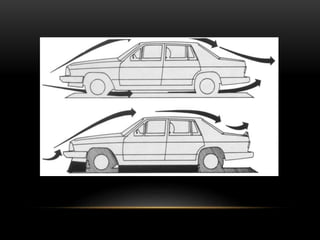
 The study of the aerodynamics of road vehicles.
 Its main goals are reducing drag and wind noise,
minimizing noise emission, and preventing undesired lift
forces.
 Its also important to produce down-force to improve
traction and thus cornering abilities.
 An aerodynamic automobile will integrate the wheel arcs
and lights into the overall shape to reduce drag.
2.2 MECHANICS OF AIR FLOW AROUND A
VEHICLE
 In fluid mechanical terms, road vehicles are bluff bodies
in very close proximity to the ground.
 Internal and recessed cavities which communicate freely
with the external flow and rotating wheels add to their
geometrical and fluid mechanical complexity.
 The objectives of improvement of flow past vehicle bodies
are to reduce of fuel consumption and improve the driving
characteristics.
 Vehicle aerodynamics includes three interacting flow
fields which are:
a. flow past vehicle body
b. flow past vehicle components (wheels, heat
exchanger, brakes or windshield)
c. flow in passenger compartment.
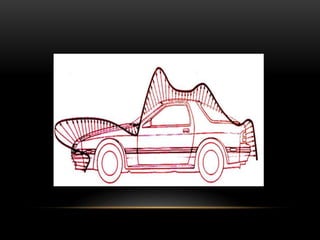
2.3 PRESSURE DISTRIBUTION ON A VEHICLE
 The pressure distribution over the body surface exerts
normal forces which, summed and projected into the free-
stream direction.
 Combination of shock wave effects, vortex system
generation effects and wake viscous mechanisms
 When the viscosity effect over the pressure distribution is
considered separately, the remaining drag force is called
pressure (or form) drag.
 In the absence of viscosity, the pressure forces on the
vehicle cancel each other and, hence, the drag is zero.
2.4 AERODYNAMIC FORCES
 The force exerted on a body whenever there is a relative
velocity between the body and the air.
 There are only two basic sources of aerodynamic force:
a. the pressure distribution
b. the frictional shear stress distribution exerted by the
airflow on the body surface.
 The distribution of pressure and shear stress represent a
distributed load over the surface.
2.5 DRAG COMPONENTS
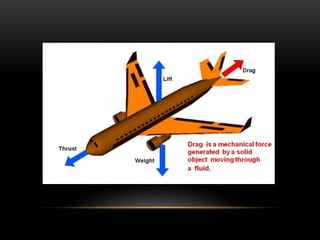
 Drag refers to forces acting opposite to the relative motion
of any substance moving in a fluid.
 Lift acts perpendicular to the motion.
 Drag sources - the skin friction between the molecules of
the air and the solid surface of the aircraft.
 The skin friction is an interaction between a solid and a
gas, so the magnitude of the skin friction depends on
properties of both solid and gas.
 The additional drag components caused by the generation
of lift is induced drag.
 Occurs because the flow near the wing tips is distorted
span wise as a result of the pressure difference from the
top to the bottom of the wing.
 Called induced drag because it has been "induced" by the
action of the tip vortices.
 It is also called "drag due to lift" because it only occurs on
finite, lifting wings.
2.6 AERODYNAMICS AIDS
2.6.1 BUMPER SPOILER
 A motor vehicle bumper which comprises a shield and a
spoiler hinged between two positions of stable equilibrium
 Namely a high position in which at least a part of the
spoiler projects from the shield and,
 a low position in which the spoiler extends the shield
downwards.
 The spoiler is suitable for adopting a third position of
stable equilibrium, in which it is completely retracted
behind the shield.
2.6.2 AIR DAMS
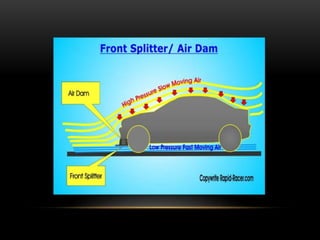
 A front spoiler (air dam) is positioned under or integrated
with the front bumper.
 In racing, this spoiler is used to control the dynamics of
handling related to the air in front of the vehicle.
 To improve the drag coefficient of the body of the vehicle
at speed, or to generate down-force.
 In passenger vehicles, the focus shifts more to directing
the airflow into the engine bay for cooling purposes.
 Air dam will keep the nose steady and pointed at the
ground in high speed driving.
2.6.3 DECK LID SPOILERS
 The trunk lid or boot lid is the cover allows access to the
main storage or luggage compartment.
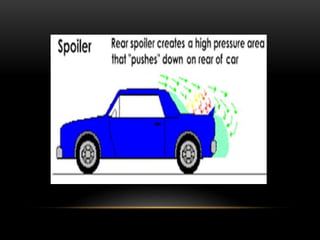
 A spoiler’s function is to 'spoil' unfavorable air movement
across a body of a vehicle in motion.
 Spoilers are used primarily on sedan-type race cars.
 They act like barriers to air flow, in order to build up
higher air pressure in front of the spoiler.
2.6.4 WINDOW AND PILLAR TREATMENTS
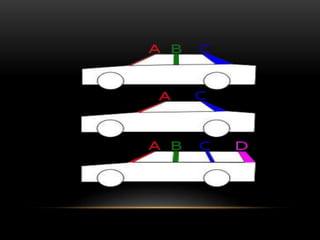
 Pillars are the vertical or near vertical supports of an
automobile's window area or greenhouse-designated.
 Which is A, B, C or D-pillar moving in profile view from
the front to rear.
 Pillars are implied, whether they exist or not; where a
design's greenhouse features a break between windows or
doors without vertical support at that position
 The non-existent pillar is "skipped" when naming the
other pillars.
2.6.5 OPTIMIZATION
 A mass reduction enable fuel economy improvement.
 Various global optimization methods use to solve drag
reduction problems in the automotive industry.
 The genetic algorithms (GA) has the major advantage to
seek for a global minimum.
 But this method is very time consuming because of the
large number of cost function evaluations that are needed.
 All the hybrid optimization methods have greatly reducing
the time cost by coupling a GA.
2.7 DETERMINE AND ESTIMATE DRAG
COMPONENTS
2.7.1 AIR DENSITY
 In simple terms, density is the mass of anything -
including air - divided by the volume it occupies.
 Lift and drag vary directly with the density of the air-as air
density increases, lift and drag increase.
 As air density decreases, lift and drag decrease.
 Air density is affected by pressure, temperature and
humidity.
2.7.2 DRAG COEFFICIENT
 A common measure in automotive design as it pertains to
aerodynamics.
 The drag coefficient of an automobile impact the way the
automobile passes through the surrounding air.
 Aerodynamic drag increases with the square of speed;
therefore it becomes critically important at higher speeds.
 Reduce drag coefficient to improves the performance of
the vehicle as it pertains to speed and fuel efficiency.
2.8 SIDE FORCE
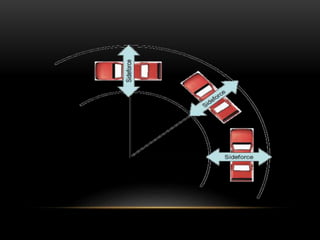
 Cornering force is the lateral force produced by a vehicle
tire during cornering.
 Its generated by tire slip and is proportional to slip angle
at low slip angles.
 Slip angle describes the deformation of the tire contact
patch.
 This deflection of the contact patch deforms the tire in a
fashion akin to a spring.
 The deformation of the tire contact patch generates a
reaction force in the tire; the cornering force.
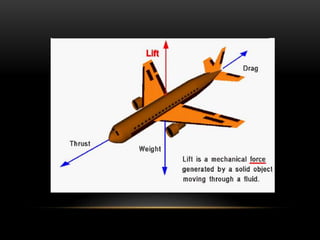
2.9 LIFT FORCE
 A fluid flowing past the surface of a body exerts a force
on it. Lift is the component of this force.
 Lift is the force generated by propellers and wings to
propel aircraft and keep them in the air.
 Lift can be in any direction since it is defined to the
direction of flow rather than to the direction of gravity.
 When an aircraft is climbing, descending, or banking in a
turn the lift is tilted with respect to the vertical.
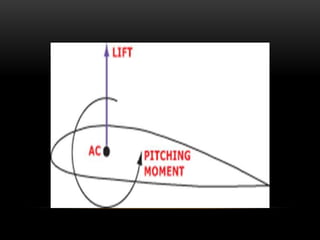
2.10 PITCHING MOMENT
 The moment (or torque) produced by the aerodynamic
force on the airfoil.
 The pitching moment on the wing of an airplane is part of
the total moment that must be balanced.
 The lift on an airfoil is a distributed force that can be said
to act at a point called the center of pressure.
 If the moment is divided by the dynamic pressure, to
compute a pitching moment coefficient, this coefficient
changes only a little.
2.11 YAWING MOMENT
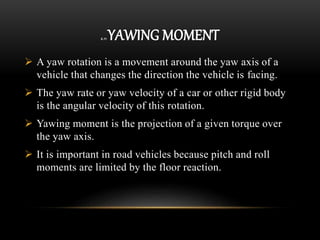
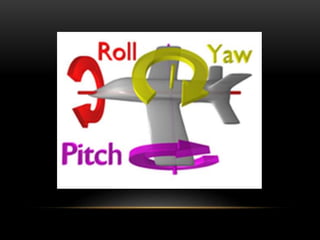
 A yaw rotation is a movement around the yaw axis of a
vehicle that changes the direction the vehicle is facing.
 The yaw rate or yaw velocity of a car or other rigid body
is the angular velocity of this rotation.
 Yawing moment is the projection of a given torque over
the yaw axis.
 It is important in road vehicles because pitch and roll
moments are limited by the floor reaction.
2.12 ROLLING MOMENT
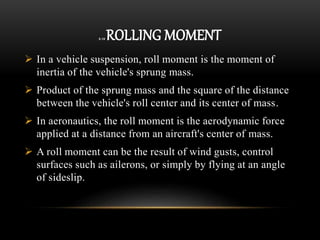
 In a vehicle suspension, roll moment is the moment of
inertia of the vehicle's sprung mass.
 Product of the sprung mass and the square of the distance
between the vehicle's roll center and its center of mass.
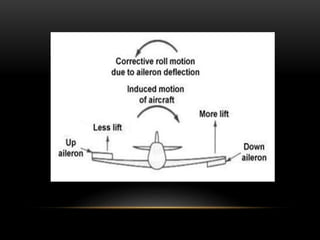
 In aeronautics, the roll moment is the aerodynamic force
applied at a distance from an aircraft's center of mass.
 A roll moment can be the result of wind gusts, control
surfaces such as ailerons, or simply by flying at an angle
of sideslip.
2.13 CROSSWIND SENSITIVITY
 The disturbances such as crosswinds should be minimized.
 The increasing of this disturbances will make the driver
have difficulties in compensating it.
 The sensitivity of a vehicle to cross-wind depends on
many factors involving the design of the suspensions and
the aerodynamics of the body.
 Streamlined bodies with smooth transitions and paralleled
underbodies lead to low drag coefficients.
 However, these measures cause the flow velocity around
the vehicle to increase.
 This also increases the sensitivity of the vehicle’s on-
centre handling under non-idealized flow conditions.
 A method for estimating the aerodynamic loads on vehicle
due to crosswind on a road section is also presented.
 The aim to find a relationship between steering feel and
crosswind sensitivity.
 Aerodynamic loads under real conditions were estimated
and the data were thereafter used in a study.
2.14 ROLLING RESISTANCE
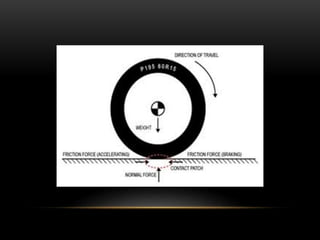
 A term used to describe the energy generated by the
friction of a tyre rolling over a road surface
 Tyre inflation pressure, tread compound, tread design and
temperature can affect the rolling resistance
 The tyres are usually manufactured with a higher degree
of silica built into the compound
 Silica allows the tyres grip performance to remain high,
especially in wet conditions, whilst rolling resistance is
improved.
2.14.1 CALCULATING THE FACTORS AFFECTING
ROLLING RESISTANCE
A. TYRE TEMPERATURE
 The temperature grades representing the tire's resistance to
heat generation and its ability to dissipate heat.
 Tested under controlled conditions on a specified indoor
laboratory test wheel.
 Sustained high temperature can cause the material of the
tire to degenerate and reduce tire life
 While excessive temperature can lead to sudden tire
failure
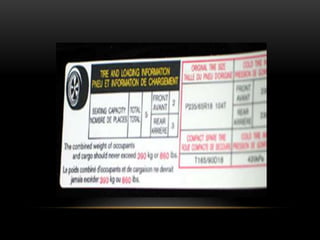
B. TYRE INFLATION PRESSURE/LOAD
 The level of air in the tire that provides it with load-
carrying capacity.
 Affects the overall performance of the vehicle.
 A number that indicates the amount of air pressure -
measured in pounds per square inch (psi).
 Manufacturers of passenger vehicles and light trucks
determine this number based on the vehicle's design load
limit.
C. VELOCITY
 Rolling without slipping is a combination of translation
and rotation where the point of contact is instantaneously
at rest
 When an object experiences pure translational motion, all
of its points move with the same velocity as the center of
mass
 The object will also move in a straight line in the absence
of a net external force.
D. TYRE MATERIAL AND DESIGN
 Tires provide a gripping surface for traction and serve as a
cushion for the wheels of a moving vehicle
 Rubber is the main raw material used in manufacturing
tires, and both natural and synthetic rubber is used.
 The other primary ingredient in tire rubber is carbon
black.
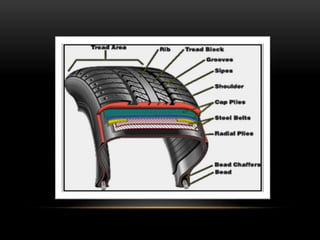
 In the tire design, the main features of a passenger car tire
are the tread, the body with sidewalls, and the beads.
E. TYRE SLIP
 Slip is the relative motion between a tire and the road
surface it is moving on.
 Can be generated either by the tire's rotational speed or by
the tire's plane of rotation being at an angle to its direction
of motion.
 In rail vehicle dynamics, this overall slip of the wheel
relative to the rail is called creepage.
 Its distinguished from the local sliding velocity of surface
particles of wheel and rail, which is called micro-slip.
2.14.2 TYPICAL COEFFICIENTS
 Tire Rolling Resistance Coefficient is calculated by
dividing the measured rolling resistance force
 Comparing Rolling Resistance Coefficients only allows
comparing tires within a single size.
 Larger tires generate higher Rolling Resistance Forces
than smaller tires.
 Larger tires will often have a lower Rolling Resistance
Coefficient than smaller tires.
2.15 CALCULATING THE TOTAL ROAD
LOADS
2.15.1 FUEL ECONOMY EFFECTS
 Vehicle weight, aerodynamic drag, driving style and
rolling resistance can effect the amount of fuel.
 Tyres can affect up to 1/3 of the vehicle's total fuel
consumption. Each tyre creates drag.
 A vehicle's aerodynamics and its travelling speed have an
extremely large effect on how much fuel is consumed.
 An environmental factors are impossible to control but
have a direct effect on fuel consumption.
THANK YOU !

Vehicle dynamics - Chapter 2 (Road Loads)

  • 1.
  • 2.
    2.1 VEHICLE AERODYNAMICS The study of the aerodynamics of road vehicles.  Its main goals are reducing drag and wind noise, minimizing noise emission, and preventing undesired lift forces.  Its also important to produce down-force to improve traction and thus cornering abilities.  An aerodynamic automobile will integrate the wheel arcs and lights into the overall shape to reduce drag.
  • 4.
    2.2 MECHANICS OFAIR FLOW AROUND A VEHICLE  In fluid mechanical terms, road vehicles are bluff bodies in very close proximity to the ground.  Internal and recessed cavities which communicate freely with the external flow and rotating wheels add to their geometrical and fluid mechanical complexity.  The objectives of improvement of flow past vehicle bodies are to reduce of fuel consumption and improve the driving characteristics.
  • 5.
     Vehicle aerodynamicsincludes three interacting flow fields which are: a. flow past vehicle body b. flow past vehicle components (wheels, heat exchanger, brakes or windshield) c. flow in passenger compartment.
  • 6.
    2.3 PRESSURE DISTRIBUTIONON A VEHICLE  The pressure distribution over the body surface exerts normal forces which, summed and projected into the free- stream direction.  Combination of shock wave effects, vortex system generation effects and wake viscous mechanisms  When the viscosity effect over the pressure distribution is considered separately, the remaining drag force is called pressure (or form) drag.  In the absence of viscosity, the pressure forces on the vehicle cancel each other and, hence, the drag is zero.
  • 8.
    2.4 AERODYNAMIC FORCES The force exerted on a body whenever there is a relative velocity between the body and the air.  There are only two basic sources of aerodynamic force: a. the pressure distribution b. the frictional shear stress distribution exerted by the airflow on the body surface.  The distribution of pressure and shear stress represent a distributed load over the surface.
  • 9.
    2.5 DRAG COMPONENTS Drag refers to forces acting opposite to the relative motion of any substance moving in a fluid.  Lift acts perpendicular to the motion.  Drag sources - the skin friction between the molecules of the air and the solid surface of the aircraft.  The skin friction is an interaction between a solid and a gas, so the magnitude of the skin friction depends on properties of both solid and gas.
  • 10.
     The additionaldrag components caused by the generation of lift is induced drag.  Occurs because the flow near the wing tips is distorted span wise as a result of the pressure difference from the top to the bottom of the wing.  Called induced drag because it has been "induced" by the action of the tip vortices.  It is also called "drag due to lift" because it only occurs on finite, lifting wings.
  • 12.
  • 13.
    2.6.1 BUMPER SPOILER A motor vehicle bumper which comprises a shield and a spoiler hinged between two positions of stable equilibrium  Namely a high position in which at least a part of the spoiler projects from the shield and,  a low position in which the spoiler extends the shield downwards.  The spoiler is suitable for adopting a third position of stable equilibrium, in which it is completely retracted behind the shield.
  • 15.
    2.6.2 AIR DAMS A front spoiler (air dam) is positioned under or integrated with the front bumper.  In racing, this spoiler is used to control the dynamics of handling related to the air in front of the vehicle.  To improve the drag coefficient of the body of the vehicle at speed, or to generate down-force.  In passenger vehicles, the focus shifts more to directing the airflow into the engine bay for cooling purposes.  Air dam will keep the nose steady and pointed at the ground in high speed driving.
  • 17.
    2.6.3 DECK LIDSPOILERS  The trunk lid or boot lid is the cover allows access to the main storage or luggage compartment.  A spoiler’s function is to 'spoil' unfavorable air movement across a body of a vehicle in motion.  Spoilers are used primarily on sedan-type race cars.  They act like barriers to air flow, in order to build up higher air pressure in front of the spoiler.
  • 19.
    2.6.4 WINDOW ANDPILLAR TREATMENTS  Pillars are the vertical or near vertical supports of an automobile's window area or greenhouse-designated.  Which is A, B, C or D-pillar moving in profile view from the front to rear.  Pillars are implied, whether they exist or not; where a design's greenhouse features a break between windows or doors without vertical support at that position  The non-existent pillar is "skipped" when naming the other pillars.
  • 21.
    2.6.5 OPTIMIZATION  Amass reduction enable fuel economy improvement.  Various global optimization methods use to solve drag reduction problems in the automotive industry.  The genetic algorithms (GA) has the major advantage to seek for a global minimum.  But this method is very time consuming because of the large number of cost function evaluations that are needed.  All the hybrid optimization methods have greatly reducing the time cost by coupling a GA.
  • 22.
    2.7 DETERMINE ANDESTIMATE DRAG COMPONENTS
  • 23.
    2.7.1 AIR DENSITY In simple terms, density is the mass of anything - including air - divided by the volume it occupies.  Lift and drag vary directly with the density of the air-as air density increases, lift and drag increase.  As air density decreases, lift and drag decrease.  Air density is affected by pressure, temperature and humidity.
  • 24.
    2.7.2 DRAG COEFFICIENT A common measure in automotive design as it pertains to aerodynamics.  The drag coefficient of an automobile impact the way the automobile passes through the surrounding air.  Aerodynamic drag increases with the square of speed; therefore it becomes critically important at higher speeds.  Reduce drag coefficient to improves the performance of the vehicle as it pertains to speed and fuel efficiency.
  • 25.
    2.8 SIDE FORCE Cornering force is the lateral force produced by a vehicle tire during cornering.  Its generated by tire slip and is proportional to slip angle at low slip angles.  Slip angle describes the deformation of the tire contact patch.  This deflection of the contact patch deforms the tire in a fashion akin to a spring.  The deformation of the tire contact patch generates a reaction force in the tire; the cornering force.
  • 27.
    2.9 LIFT FORCE A fluid flowing past the surface of a body exerts a force on it. Lift is the component of this force.  Lift is the force generated by propellers and wings to propel aircraft and keep them in the air.  Lift can be in any direction since it is defined to the direction of flow rather than to the direction of gravity.  When an aircraft is climbing, descending, or banking in a turn the lift is tilted with respect to the vertical.
  • 29.
    2.10 PITCHING MOMENT The moment (or torque) produced by the aerodynamic force on the airfoil.  The pitching moment on the wing of an airplane is part of the total moment that must be balanced.  The lift on an airfoil is a distributed force that can be said to act at a point called the center of pressure.  If the moment is divided by the dynamic pressure, to compute a pitching moment coefficient, this coefficient changes only a little.
  • 31.
    2.11 YAWING MOMENT A yaw rotation is a movement around the yaw axis of a vehicle that changes the direction the vehicle is facing.  The yaw rate or yaw velocity of a car or other rigid body is the angular velocity of this rotation.  Yawing moment is the projection of a given torque over the yaw axis.  It is important in road vehicles because pitch and roll moments are limited by the floor reaction.
  • 33.
    2.12 ROLLING MOMENT In a vehicle suspension, roll moment is the moment of inertia of the vehicle's sprung mass.  Product of the sprung mass and the square of the distance between the vehicle's roll center and its center of mass.  In aeronautics, the roll moment is the aerodynamic force applied at a distance from an aircraft's center of mass.  A roll moment can be the result of wind gusts, control surfaces such as ailerons, or simply by flying at an angle of sideslip.
  • 35.
    2.13 CROSSWIND SENSITIVITY The disturbances such as crosswinds should be minimized.  The increasing of this disturbances will make the driver have difficulties in compensating it.  The sensitivity of a vehicle to cross-wind depends on many factors involving the design of the suspensions and the aerodynamics of the body.  Streamlined bodies with smooth transitions and paralleled underbodies lead to low drag coefficients.
  • 36.
     However, thesemeasures cause the flow velocity around the vehicle to increase.  This also increases the sensitivity of the vehicle’s on- centre handling under non-idealized flow conditions.  A method for estimating the aerodynamic loads on vehicle due to crosswind on a road section is also presented.  The aim to find a relationship between steering feel and crosswind sensitivity.  Aerodynamic loads under real conditions were estimated and the data were thereafter used in a study.
  • 37.
    2.14 ROLLING RESISTANCE A term used to describe the energy generated by the friction of a tyre rolling over a road surface  Tyre inflation pressure, tread compound, tread design and temperature can affect the rolling resistance  The tyres are usually manufactured with a higher degree of silica built into the compound  Silica allows the tyres grip performance to remain high, especially in wet conditions, whilst rolling resistance is improved.
  • 39.
    2.14.1 CALCULATING THEFACTORS AFFECTING ROLLING RESISTANCE
  • 40.
    A. TYRE TEMPERATURE The temperature grades representing the tire's resistance to heat generation and its ability to dissipate heat.  Tested under controlled conditions on a specified indoor laboratory test wheel.  Sustained high temperature can cause the material of the tire to degenerate and reduce tire life  While excessive temperature can lead to sudden tire failure
  • 41.
    B. TYRE INFLATIONPRESSURE/LOAD  The level of air in the tire that provides it with load- carrying capacity.  Affects the overall performance of the vehicle.  A number that indicates the amount of air pressure - measured in pounds per square inch (psi).  Manufacturers of passenger vehicles and light trucks determine this number based on the vehicle's design load limit.
  • 43.
    C. VELOCITY  Rollingwithout slipping is a combination of translation and rotation where the point of contact is instantaneously at rest  When an object experiences pure translational motion, all of its points move with the same velocity as the center of mass  The object will also move in a straight line in the absence of a net external force.
  • 44.
    D. TYRE MATERIALAND DESIGN  Tires provide a gripping surface for traction and serve as a cushion for the wheels of a moving vehicle  Rubber is the main raw material used in manufacturing tires, and both natural and synthetic rubber is used.  The other primary ingredient in tire rubber is carbon black.  In the tire design, the main features of a passenger car tire are the tread, the body with sidewalls, and the beads.
  • 46.
    E. TYRE SLIP Slip is the relative motion between a tire and the road surface it is moving on.  Can be generated either by the tire's rotational speed or by the tire's plane of rotation being at an angle to its direction of motion.  In rail vehicle dynamics, this overall slip of the wheel relative to the rail is called creepage.  Its distinguished from the local sliding velocity of surface particles of wheel and rail, which is called micro-slip.
  • 47.
    2.14.2 TYPICAL COEFFICIENTS Tire Rolling Resistance Coefficient is calculated by dividing the measured rolling resistance force  Comparing Rolling Resistance Coefficients only allows comparing tires within a single size.  Larger tires generate higher Rolling Resistance Forces than smaller tires.  Larger tires will often have a lower Rolling Resistance Coefficient than smaller tires.
  • 48.
    2.15 CALCULATING THETOTAL ROAD LOADS
  • 49.
    2.15.1 FUEL ECONOMYEFFECTS  Vehicle weight, aerodynamic drag, driving style and rolling resistance can effect the amount of fuel.  Tyres can affect up to 1/3 of the vehicle's total fuel consumption. Each tyre creates drag.  A vehicle's aerodynamics and its travelling speed have an extremely large effect on how much fuel is consumed.  An environmental factors are impossible to control but have a direct effect on fuel consumption.
  • 50.