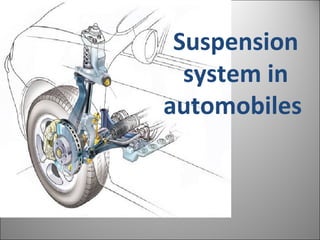
Suspension
  system in
automobiles
What is suspension system
• Suspension is the term given to the
  system of springs, shock absorbers and
  linkages that connects a vehicle to its
  wheels
• Serve a dual purpose – contributing to
  the car's handling and braking.
• Protects the vehicle itself and any cargo
  or luggage from damage and wear
Functions of suspension system:
1. It prevents the vehicle body and frame
from road shocks.
2. It gives stability of the vehicle.
3. It safeguards the passengers and
goods from road shocks.
4. It gives the good road holding while
driving, cornering and braking.
5. It gives cushioning effect.
6. It provides comfort.
Requirements of suspension
           system:
1. There should be minimum deflection.
2. It should be of low initial cost.
3. It should be of minimum weight.
4. It should have low maintenance and
  low operating cost.
5. It should have minimum tyre wear.
SUSPENSION SYSTEM – LAY OUT
Conventional suspension system
• Two wheels are mounted on either side of
  the rigid axle
• When one wheel encounters the bump,
  both the wheel do not execute parallel up
  and down motion
• So it gives rise to gyroscopic effect and
  wheel wobble
• Rear driving wheels mounted on live axle
  suspended by laminated leaf springs and
  shock absorbers
Independent suspension system
• Both the front and the rear wheel are utilized
• One wheel goes down ,the other wheel does
  not have much effect
Common Suspensions
Front Suspension     Rear Suspension
• Solid I-Beam       • Non Independent Rear
• Twin I-Beam          Leaf Springs
• MacPherson Strut   • Non Independent Rear
• Short-Long Arm       Coil Springs
                     • Trailing Arm
                     • Beam
Types of suspension springs
1. Steel Springs : a. Leaf Springs b. Coil Springs
                     c. Torsion bar Springs
2. Rubber Springs:
                    a. Compression Springs
                     b. Progressive Springs
3. Plastic Springs
4. Air Springs: a. Bellow Type
                b. Pestoon Type
5. Hydraulic Type
Types of Leaf Springs
1. Full – elliptic type
2. Semi – elliptic type
3. Three Quarter – elliptic type
4. Transverse Spring type
5. Helper Spring type
Rear Leaf Springs

• Similar to front
  solid I-beam axle
• Large load carrying
  capacity
Rear Coil Springs

          • Uses coils and
            control arms instead
            of leaf springs
          • Good load carrying
            capacity
          • Absorbs road shock
            & carries vehicle
            weight
HELPER SPRING


• DIRECTLY MOUNTED ON MAIN SPRINGS
• TAKE CARE OF LARGE VARIATION IN SPRING LOAD
• DURING LIGHT LOADS ,ONLY MAIN SPIRNG IS
  ACTIVE , AS LOAD INCREASE TO A PARTICULAR
  FIXED VALUE , BOTH THE SPRINGS ARE ACTIVE
Rear Beam
• Non-independent
  design
• Stamped beam
  axles
• Uses coil springs
  and trailing arms
• Light and simple
  design
Trailing Arm

• Independent
  Design
• Uses individual
  lower control
  arms
• Uses coil springs
  and shocks
• Good ride quality
Front Suspension Systems
            Types:-
            • Solid I-Beam
            • Twin I-Beam
            • Macpherson
              Strut
            • Short-Long Arm
I-Beam Suspension
• Solid axle connecting both front steering
  knuckles
• Used on H.D. trucks
Solid I-Beam
• Used on trucks and
  other large vehicles
• Economical
• Simple design
• Low Maintenance
• Excellent load capacity
• Non-independent
  design
• Uncomfortable ride
  quality
• Poor handling
Twin I-Beam
              •Found on many
              Ford trucks
              •Forged, cast, or
              stamped axles
              •Excellent load
              capacity
              •Requires special
              equipment for
              alignment
              adjustments
MACPHERSON STRUT
• the most widely used front
  suspension system in cars
• comprises of a strut-type spring
  and shock absorber combo, which
  pivots on a ball joint on the single,
  lower arm.
• The steering gear is either
  connected directly to the lower
  shock absorber housing, or to an
  arm from the front or back of the
  spindle (in this case
• When you steer, it physically twists
  the strut and shock absorber
  housing (and consequently the
  spring) to turn the wheel
Short & Long Arm Suspension
• Provide for an
  independent
  suspension
  system
• Camber &
  caster angles
  remain fairly
  constant over
  bumps
• Arms connected
  to frame with
  rubber bushings
Multi-link suspension
•   It's currently being used in the Audi A8
    and A4 amongst other cars.
•   The basic principle of it is the same, but
    instead of solid upper and lower
    wishbones, each 'arm' of the wishbone
    is a separate item.
•   These are joined at the top and bottom
    of the spindle thus forming the
    wishbone shape.
•    The super-weird thing about this is that
    as the spindle turns for steering, it alters
    the geometry of the suspension by
    torquing all four suspension arms.
•   Spring is separate from the schock
    absorber.
Advantages ( independent front )
• Bigger deflection of front wheels, no reaction on
  steering
• Greater distance for resisting rolling action
• Front axle (small-stub), improves road holding
  tendency of tyres.
• Minimum vibrations

                  DISADVANTAGES
• Better shock absorber required.
• Expensive
• Tyre wear increases due to transmission of torque.
Advantages ( independent rear suspension)

• Lesser unsprung weight – improves ride ,
  reduces tyre wear.
• Increased passenger space
• Rear wheels remain stable ..

DISADVANTAGES
• Increased cost
• Complicated design
• Steering action is not proper
Air suspension layout
Advantages of air suspension
• These maintain a constant frequency of
  vibration whether the vehicle is laden or
  unladen.
• Constant frame height is maintained.
• It helps to reduce the load while the vehicle in
  motion i.e. the dynamic loading as the spring
  rate variation between laden and unladen
  weight is much less.
• It gives smooth and comfort ride of the vehicle.
• The stiffness of the system increases with the
  increase of the deflection.
COMMON AIR SUSPENSION PROBLEMS
Air bag or air strut failure
 - due to old age, or moisture within the air
 system that damages them from the inside.
Compressor failure
 - Primarily due to leaking air springs or air struts

 - Compressor burnout may also be caused by
 moisture from within the air system coming into
 contact with its electronic parts.
 Dryer failure
  - which functions to remove moisture from the
 air system eventually becomes saturated and
Hydrolastic Suspension


• a system where the front and rear suspension
  systems were connected together in order to
  better level the car when driving.
• The front and rear suspension units have
  Hydrolastic displacers, one per side.
• These are interconnected by a small bore pipe.
  Each displacer incorporates a rubber spring
• Damping of the system is achieved by rubber
  valves.
• when the front wheel encounter bumps ,the piston moves
  upwards pressurising the fluid to enter into the rear unit.
• Hydroelastic was eventually refined into Hydragas
  suspension.......
Hydrogas suspension
• Known as hydro-pneumatic suspension.
• The difference is in the displacer unit itself.
• In the older systems, fluid was used in the
  displacer units with a rubber spring cushion built-
  in.
• With Hydragas, the rubber spring is removed
  completely.
• The fluid still exists but above the fluid there is
  now a separating membrane or diaphragm, and
  above that is a cylinder or sphere which is charged
  with nitrogen gas.
• The nitrogen section is what has become the
  spring and damping unit whilst the fluid is still free
  to run from the front to the rear units and back.
Difference …
Shock Absorbers
• Produce damping force by forcing a non-
  compressible fluid through an orifice or
  valve
• There are two standard types of dampers:
  – Twin tube shock absorber
     • Heavier
     • Run hotter
     • Cheaper, and easier to manufacture
  – Mono tube shock absorber
     • Performance shock
     • More adjustability
Mono Tube Shock Absorber
            • Fluid flows through a
              valve in the piston
            • The mono tube setup
              has some volume of
              compressible gas that
              accounts for any
              volume change in the
              incompressible fluid
              due to the piston
              entering the volume
Twin Tube Shock Absorber
• Outer tube around an
  inner tube
• Outer tube servers as
  a reservoir
• A valve at the bottom
  of the shock allows
  the fluid to flow into
  the reservoir as the
  piston moves up and
  down

Suspenstion

  • 1.
    Suspension systemin automobiles
  • 2.
    What is suspensionsystem • Suspension is the term given to the system of springs, shock absorbers and linkages that connects a vehicle to its wheels • Serve a dual purpose – contributing to the car's handling and braking. • Protects the vehicle itself and any cargo or luggage from damage and wear
  • 3.
    Functions of suspensionsystem: 1. It prevents the vehicle body and frame from road shocks. 2. It gives stability of the vehicle. 3. It safeguards the passengers and goods from road shocks. 4. It gives the good road holding while driving, cornering and braking. 5. It gives cushioning effect. 6. It provides comfort.
  • 4.
    Requirements of suspension system: 1. There should be minimum deflection. 2. It should be of low initial cost. 3. It should be of minimum weight. 4. It should have low maintenance and low operating cost. 5. It should have minimum tyre wear.
  • 5.
  • 6.
    Conventional suspension system •Two wheels are mounted on either side of the rigid axle • When one wheel encounters the bump, both the wheel do not execute parallel up and down motion • So it gives rise to gyroscopic effect and wheel wobble • Rear driving wheels mounted on live axle suspended by laminated leaf springs and shock absorbers
  • 7.
    Independent suspension system •Both the front and the rear wheel are utilized • One wheel goes down ,the other wheel does not have much effect
  • 8.
    Common Suspensions Front Suspension Rear Suspension • Solid I-Beam • Non Independent Rear • Twin I-Beam Leaf Springs • MacPherson Strut • Non Independent Rear • Short-Long Arm Coil Springs • Trailing Arm • Beam
  • 9.
    Types of suspensionsprings 1. Steel Springs : a. Leaf Springs b. Coil Springs c. Torsion bar Springs 2. Rubber Springs: a. Compression Springs b. Progressive Springs 3. Plastic Springs 4. Air Springs: a. Bellow Type b. Pestoon Type 5. Hydraulic Type
  • 10.
    Types of LeafSprings 1. Full – elliptic type 2. Semi – elliptic type 3. Three Quarter – elliptic type 4. Transverse Spring type 5. Helper Spring type
  • 11.
    Rear Leaf Springs •Similar to front solid I-beam axle • Large load carrying capacity
  • 12.
    Rear Coil Springs • Uses coils and control arms instead of leaf springs • Good load carrying capacity • Absorbs road shock & carries vehicle weight
  • 13.
    HELPER SPRING • DIRECTLYMOUNTED ON MAIN SPRINGS • TAKE CARE OF LARGE VARIATION IN SPRING LOAD • DURING LIGHT LOADS ,ONLY MAIN SPIRNG IS ACTIVE , AS LOAD INCREASE TO A PARTICULAR FIXED VALUE , BOTH THE SPRINGS ARE ACTIVE
  • 14.
    Rear Beam • Non-independent design • Stamped beam axles • Uses coil springs and trailing arms • Light and simple design
  • 15.
    Trailing Arm • Independent Design • Uses individual lower control arms • Uses coil springs and shocks • Good ride quality
  • 16.
    Front Suspension Systems Types:- • Solid I-Beam • Twin I-Beam • Macpherson Strut • Short-Long Arm
  • 17.
    I-Beam Suspension • Solidaxle connecting both front steering knuckles • Used on H.D. trucks
  • 18.
    Solid I-Beam • Usedon trucks and other large vehicles • Economical • Simple design • Low Maintenance • Excellent load capacity • Non-independent design • Uncomfortable ride quality • Poor handling
  • 19.
    Twin I-Beam •Found on many Ford trucks •Forged, cast, or stamped axles •Excellent load capacity •Requires special equipment for alignment adjustments
  • 20.
    MACPHERSON STRUT • themost widely used front suspension system in cars • comprises of a strut-type spring and shock absorber combo, which pivots on a ball joint on the single, lower arm. • The steering gear is either connected directly to the lower shock absorber housing, or to an arm from the front or back of the spindle (in this case • When you steer, it physically twists the strut and shock absorber housing (and consequently the spring) to turn the wheel
  • 21.
    Short & LongArm Suspension • Provide for an independent suspension system • Camber & caster angles remain fairly constant over bumps • Arms connected to frame with rubber bushings
  • 22.
    Multi-link suspension • It's currently being used in the Audi A8 and A4 amongst other cars. • The basic principle of it is the same, but instead of solid upper and lower wishbones, each 'arm' of the wishbone is a separate item. • These are joined at the top and bottom of the spindle thus forming the wishbone shape. • The super-weird thing about this is that as the spindle turns for steering, it alters the geometry of the suspension by torquing all four suspension arms. • Spring is separate from the schock absorber.
  • 23.
    Advantages ( independentfront ) • Bigger deflection of front wheels, no reaction on steering • Greater distance for resisting rolling action • Front axle (small-stub), improves road holding tendency of tyres. • Minimum vibrations DISADVANTAGES • Better shock absorber required. • Expensive • Tyre wear increases due to transmission of torque.
  • 24.
    Advantages ( independentrear suspension) • Lesser unsprung weight – improves ride , reduces tyre wear. • Increased passenger space • Rear wheels remain stable .. DISADVANTAGES • Increased cost • Complicated design • Steering action is not proper
  • 25.
  • 26.
    Advantages of airsuspension • These maintain a constant frequency of vibration whether the vehicle is laden or unladen. • Constant frame height is maintained. • It helps to reduce the load while the vehicle in motion i.e. the dynamic loading as the spring rate variation between laden and unladen weight is much less. • It gives smooth and comfort ride of the vehicle. • The stiffness of the system increases with the increase of the deflection.
  • 27.
    COMMON AIR SUSPENSIONPROBLEMS Air bag or air strut failure - due to old age, or moisture within the air system that damages them from the inside. Compressor failure - Primarily due to leaking air springs or air struts - Compressor burnout may also be caused by moisture from within the air system coming into contact with its electronic parts.  Dryer failure - which functions to remove moisture from the air system eventually becomes saturated and
  • 28.
    Hydrolastic Suspension • asystem where the front and rear suspension systems were connected together in order to better level the car when driving. • The front and rear suspension units have Hydrolastic displacers, one per side. • These are interconnected by a small bore pipe. Each displacer incorporates a rubber spring • Damping of the system is achieved by rubber valves.
  • 29.
    • when thefront wheel encounter bumps ,the piston moves upwards pressurising the fluid to enter into the rear unit. • Hydroelastic was eventually refined into Hydragas suspension.......
  • 30.
    Hydrogas suspension • Knownas hydro-pneumatic suspension. • The difference is in the displacer unit itself. • In the older systems, fluid was used in the displacer units with a rubber spring cushion built- in. • With Hydragas, the rubber spring is removed completely. • The fluid still exists but above the fluid there is now a separating membrane or diaphragm, and above that is a cylinder or sphere which is charged with nitrogen gas. • The nitrogen section is what has become the spring and damping unit whilst the fluid is still free to run from the front to the rear units and back.
  • 31.
  • 32.
    Shock Absorbers • Producedamping force by forcing a non- compressible fluid through an orifice or valve • There are two standard types of dampers: – Twin tube shock absorber • Heavier • Run hotter • Cheaper, and easier to manufacture – Mono tube shock absorber • Performance shock • More adjustability
  • 33.
    Mono Tube ShockAbsorber • Fluid flows through a valve in the piston • The mono tube setup has some volume of compressible gas that accounts for any volume change in the incompressible fluid due to the piston entering the volume
  • 34.
    Twin Tube ShockAbsorber • Outer tube around an inner tube • Outer tube servers as a reservoir • A valve at the bottom of the shock allows the fluid to flow into the reservoir as the piston moves up and down