


• ROLLING FRICTION
• ROLLING DRAG
By:
Mr. Shrikant D. Hiwase
Guided by:
Mr. N A Sakale
Rolling Resistance
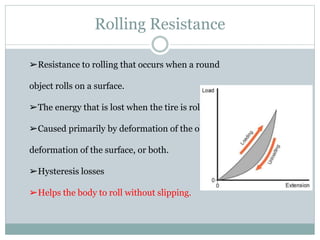
➢Resistance to rolling that occurs when a round
object rolls on a surface.
➢The energy that is lost when the tire is rolling.
➢Caused primarily by deformation of the object,
deformation of the surface, or both.
➢Hysteresis losses
➢Helps the body to roll without slipping.
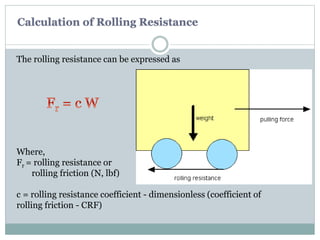
The rolling resistance can be expressed as
Where,
Fr = rolling resistance or
rolling friction (N, lbf)
c = rolling resistance coefficient - dimensionless (coefficient of
rolling friction - CRF)
Calculation of Rolling Resistance
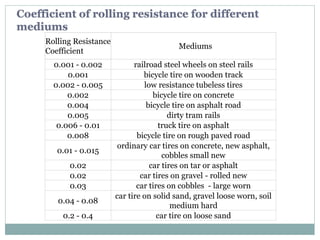
Rolling Resistance
Coefficient
Mediums
0.001 - 0.002 railroad steel wheels on steel rails
0.001 bicycle tire on wooden track
0.002 - 0.005 low resistance tubeless tires
0.002 bicycle tire on concrete
0.004 bicycle tire on asphalt road
0.005 dirty tram rails
0.006 - 0.01 truck tire on asphalt
0.008 bicycle tire on rough paved road
0.01 - 0.015
ordinary car tires on concrete, new asphalt,
cobbles small new
0.02 car tires on tar or asphalt
0.02 car tires on gravel - rolled new
0.03 car tires on cobbles - large worn
0.04 - 0.08
car tire on solid sand, gravel loose worn, soil
medium hard
0.2 - 0.4 car tire on loose sand
Coefficient of rolling resistance for different
mediums
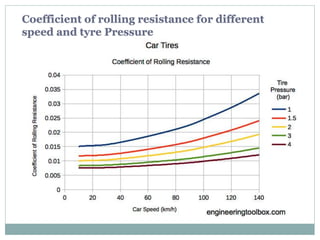
Coefficient of rolling resistance for different
speed and tyre Pressure
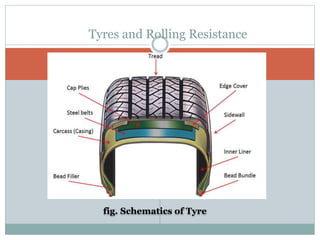
fig. Schematics of Tyre
Tyres and Rolling Resistance
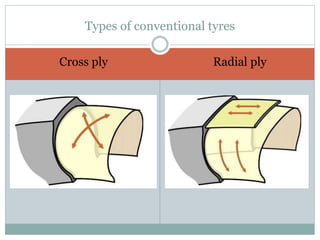
 Cross ply  Radial ply
Types of conventional tyres
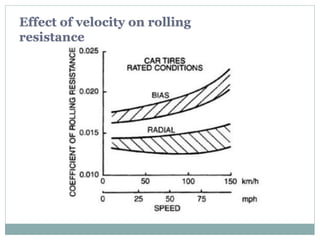
Effect of velocity on rolling
resistance
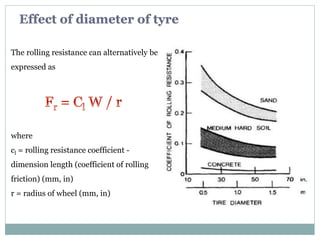
The rolling resistance can alternatively be
expressed as
where
cl = rolling resistance coefficient -
dimension length (coefficient of rolling
friction) (mm, in)
r = radius of wheel (mm, in)
Effect of diameter of tyre
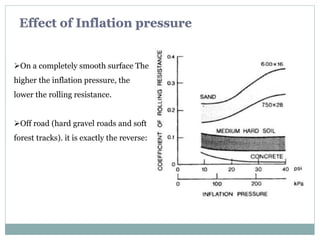
On a completely smooth surface The
higher the inflation pressure, the
lower the rolling resistance.
Off road (hard gravel roads and soft
forest tracks). it is exactly the reverse:
Effect of Inflation pressure
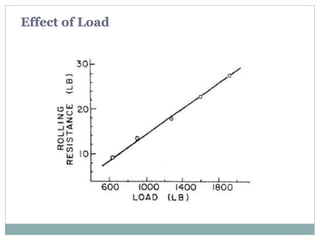
Effect of Load
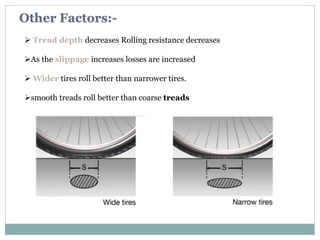
 Tread depth decreases Rolling resistance decreases
As the slippage increases losses are increased
 Wider tires roll better than narrower tires.
smooth treads roll better than coarse treads
Other Factors:-
 Conventional tires  Tubeless tires
Types of Tires
The inner tube is integral within the
tire, known as Inner liner.
The valve is permanently fixed to the
rim.
THE ASSEMBLY IS AIRTIGHT.
 In case of a puncture, loss of air is
very slow
Tube and tire are integral part hence
no friction less rolling losses
Tire, Tube with Valve and Rim.
 Instant air leakage after getting
punctured.
The air under pressure finds a way
between the tube, tire and through the
rim hole.
Due to friction between tube and tire
Rolling resistance is more
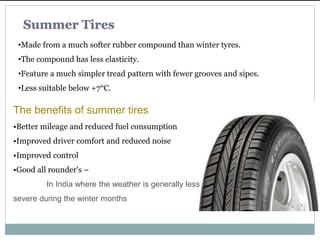
The benefits of summer tires
•Better mileage and reduced fuel consumption
•Improved driver comfort and reduced noise
•Improved control
•Good all rounder's –
In India where the weather is generally less
severe during the winter months
Summer Tires
•Made from a much softer rubber compound than winter tyres.
•The compound has less elasticity.
•Feature a much simpler tread pattern with fewer grooves and sipes.
•Less suitable below +7°C.
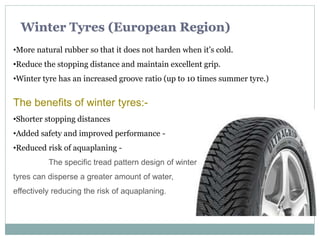
Winter Tyres (European Region)
The benefits of winter tyres:-
•Shorter stopping distances
•Added safety and improved performance -
•Reduced risk of aquaplaning -
The specific tread pattern design of winter
tyres can disperse a greater amount of water,
effectively reducing the risk of aquaplaning.
•More natural rubber so that it does not harden when it’s cold.
•Reduce the stopping distance and maintain excellent grip.
•Winter tyre has an increased groove ratio (up to 10 times summer tyre.)
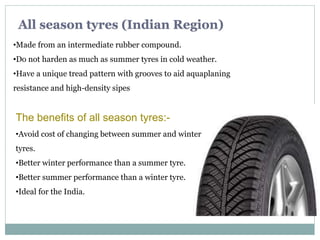
•Made from an intermediate rubber compound.
•Do not harden as much as summer tyres in cold weather.
•Have a unique tread pattern with grooves to aid aquaplaning
resistance and high-density sipes
The benefits of all season tyres:-
•Avoid cost of changing between summer and winter
tyres.
•Better winter performance than a summer tyre.
•Better summer performance than a winter tyre.
•Ideal for the India.
All season tyres (Indian Region)
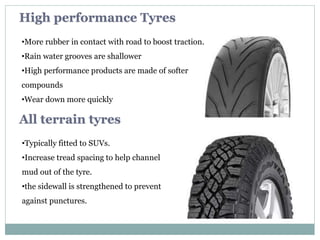
•More rubber in contact with road to boost traction.
•Rain water grooves are shallower
•High performance products are made of softer
compounds
•Wear down more quickly
High performance Tyres
•Typically fitted to SUVs.
•Increase tread spacing to help channel
mud out of the tyre.
•the sidewall is strengthened to prevent
against punctures.
All terrain tyres
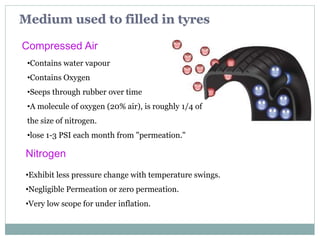
Medium used to filled in tyres
Compressed Air
•Contains water vapour
•Contains Oxygen
•Seeps through rubber over time
•A molecule of oxygen (20% air), is roughly 1/4 of
the size of nitrogen.
•lose 1-3 PSI each month from "permeation."
Nitrogen
•Exhibit less pressure change with temperature swings.
•Negligible Permeation or zero permeation.
•Very low scope for under inflation.
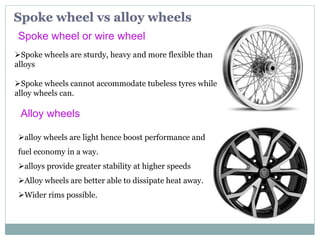
Spoke wheel vs alloy wheels
Spoke wheel or wire wheel
Spoke wheels are sturdy, heavy and more flexible than
alloys
Spoke wheels cannot accommodate tubeless tyres while
alloy wheels can.
alloy wheels are light hence boost performance and
fuel economy in a way.
alloys provide greater stability at higher speeds
Alloy wheels are better able to dissipate heat away.
Wider rims possible.
Alloy wheels
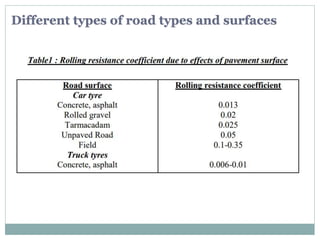
Different types of road types and surfaces
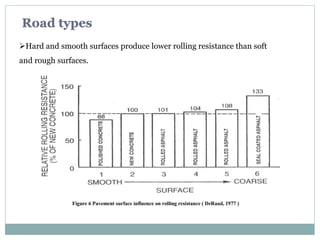
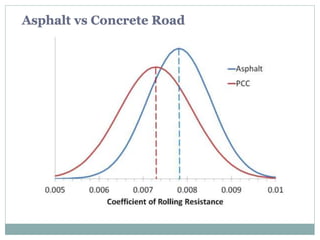
Hard and smooth surfaces produce lower rolling resistance than soft
and rough surfaces.
Road types
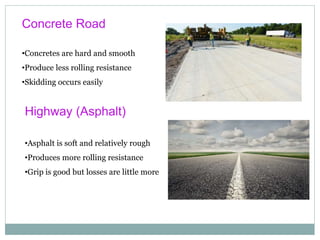
Concrete Road
•Concretes are hard and smooth
•Produce less rolling resistance
•Skidding occurs easily
Highway (Asphalt)
•Asphalt is soft and relatively rough
•Produces more rolling resistance
•Grip is good but losses are little more
Asphalt vs Concrete Road
Different Tyres Brand: (India)
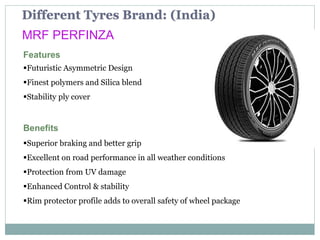
MRF PERFINZA
Features
Futuristic Asymmetric Design
Finest polymers and Silica blend
Stability ply cover
Benefits
Superior braking and better grip
Excellent on road performance in all weather conditions
Protection from UV damage
Enhanced Control & stability
Rim protector profile adds to overall safety of wheel package
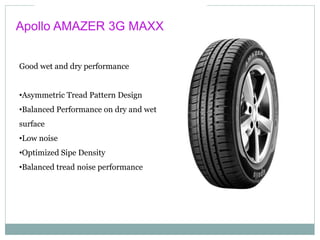
Good wet and dry performance
•Asymmetric Tread Pattern Design
•Balanced Performance on dry and wet
surface
•Low noise
•Optimized Sipe Density
•Balanced tread noise performance
Apollo AMAZER 3G MAXX
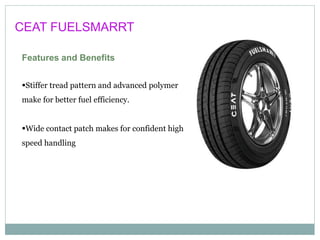
CEAT FUELSMARRT
Features and Benefits
Stiffer tread pattern and advanced polymer
make for better fuel efficiency.
Wide contact patch makes for confident high
speed handling
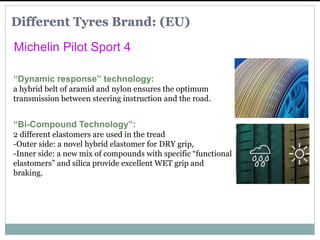
“Dynamic response” technology:
a hybrid belt of aramid and nylon ensures the optimum
transmission between steering instruction and the road.
“Bi-Compound Technology”:
2 different elastomers are used in the tread
-Outer side: a novel hybrid elastomer for DRY grip,
-Inner side: a new mix of compounds with specific “functional
elastomers” and silica provide excellent WET grip and
braking.
Michelin Pilot Sport 4
Different Tyres Brand: (EU)
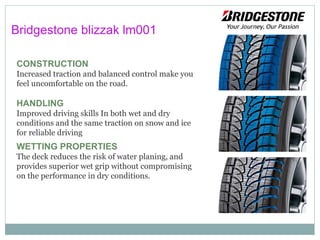
CONSTRUCTION
Increased traction and balanced control make you
feel uncomfortable on the road.
HANDLING
Improved driving skills In both wet and dry
conditions and the same traction on snow and ice
for reliable driving.
WETTING PROPERTIES
The deck reduces the risk of water planing, and
provides superior wet grip without compromising
on the performance in dry conditions.
Bridgestone blizzak lm001
Rolling Resistance.pptx

Rolling Resistance.pptx

  • 1.
    • ROLLING FRICTION •ROLLING DRAG By: Mr. Shrikant D. Hiwase Guided by: Mr. N A Sakale
  • 3.
    Rolling Resistance ➢Resistance torolling that occurs when a round object rolls on a surface. ➢The energy that is lost when the tire is rolling. ➢Caused primarily by deformation of the object, deformation of the surface, or both. ➢Hysteresis losses ➢Helps the body to roll without slipping.
  • 4.
    The rolling resistancecan be expressed as Where, Fr = rolling resistance or rolling friction (N, lbf) c = rolling resistance coefficient - dimensionless (coefficient of rolling friction - CRF) Calculation of Rolling Resistance
  • 5.
    Rolling Resistance Coefficient Mediums 0.001 -0.002 railroad steel wheels on steel rails 0.001 bicycle tire on wooden track 0.002 - 0.005 low resistance tubeless tires 0.002 bicycle tire on concrete 0.004 bicycle tire on asphalt road 0.005 dirty tram rails 0.006 - 0.01 truck tire on asphalt 0.008 bicycle tire on rough paved road 0.01 - 0.015 ordinary car tires on concrete, new asphalt, cobbles small new 0.02 car tires on tar or asphalt 0.02 car tires on gravel - rolled new 0.03 car tires on cobbles - large worn 0.04 - 0.08 car tire on solid sand, gravel loose worn, soil medium hard 0.2 - 0.4 car tire on loose sand Coefficient of rolling resistance for different mediums
  • 6.
    Coefficient of rollingresistance for different speed and tyre Pressure
  • 8.
    fig. Schematics ofTyre Tyres and Rolling Resistance
  • 9.
     Cross ply Radial ply Types of conventional tyres
  • 10.
    Effect of velocityon rolling resistance
  • 11.
    The rolling resistancecan alternatively be expressed as where cl = rolling resistance coefficient - dimension length (coefficient of rolling friction) (mm, in) r = radius of wheel (mm, in) Effect of diameter of tyre
  • 12.
    On a completelysmooth surface The higher the inflation pressure, the lower the rolling resistance. Off road (hard gravel roads and soft forest tracks). it is exactly the reverse: Effect of Inflation pressure
  • 13.
  • 14.
     Tread depthdecreases Rolling resistance decreases As the slippage increases losses are increased  Wider tires roll better than narrower tires. smooth treads roll better than coarse treads Other Factors:-
  • 15.
     Conventional tires Tubeless tires Types of Tires The inner tube is integral within the tire, known as Inner liner. The valve is permanently fixed to the rim. THE ASSEMBLY IS AIRTIGHT.  In case of a puncture, loss of air is very slow Tube and tire are integral part hence no friction less rolling losses Tire, Tube with Valve and Rim.  Instant air leakage after getting punctured. The air under pressure finds a way between the tube, tire and through the rim hole. Due to friction between tube and tire Rolling resistance is more
  • 16.
    The benefits ofsummer tires •Better mileage and reduced fuel consumption •Improved driver comfort and reduced noise •Improved control •Good all rounder's – In India where the weather is generally less severe during the winter months Summer Tires •Made from a much softer rubber compound than winter tyres. •The compound has less elasticity. •Feature a much simpler tread pattern with fewer grooves and sipes. •Less suitable below +7°C.
  • 17.
    Winter Tyres (EuropeanRegion) The benefits of winter tyres:- •Shorter stopping distances •Added safety and improved performance - •Reduced risk of aquaplaning - The specific tread pattern design of winter tyres can disperse a greater amount of water, effectively reducing the risk of aquaplaning. •More natural rubber so that it does not harden when it’s cold. •Reduce the stopping distance and maintain excellent grip. •Winter tyre has an increased groove ratio (up to 10 times summer tyre.)
  • 18.
    •Made from anintermediate rubber compound. •Do not harden as much as summer tyres in cold weather. •Have a unique tread pattern with grooves to aid aquaplaning resistance and high-density sipes The benefits of all season tyres:- •Avoid cost of changing between summer and winter tyres. •Better winter performance than a summer tyre. •Better summer performance than a winter tyre. •Ideal for the India. All season tyres (Indian Region)
  • 19.
    •More rubber incontact with road to boost traction. •Rain water grooves are shallower •High performance products are made of softer compounds •Wear down more quickly High performance Tyres •Typically fitted to SUVs. •Increase tread spacing to help channel mud out of the tyre. •the sidewall is strengthened to prevent against punctures. All terrain tyres
  • 20.
    Medium used tofilled in tyres Compressed Air •Contains water vapour •Contains Oxygen •Seeps through rubber over time •A molecule of oxygen (20% air), is roughly 1/4 of the size of nitrogen. •lose 1-3 PSI each month from "permeation." Nitrogen •Exhibit less pressure change with temperature swings. •Negligible Permeation or zero permeation. •Very low scope for under inflation.
  • 21.
    Spoke wheel vsalloy wheels Spoke wheel or wire wheel Spoke wheels are sturdy, heavy and more flexible than alloys Spoke wheels cannot accommodate tubeless tyres while alloy wheels can. alloy wheels are light hence boost performance and fuel economy in a way. alloys provide greater stability at higher speeds Alloy wheels are better able to dissipate heat away. Wider rims possible. Alloy wheels
  • 22.
    Different types ofroad types and surfaces
  • 23.
    Hard and smoothsurfaces produce lower rolling resistance than soft and rough surfaces. Road types
  • 24.
    Concrete Road •Concretes arehard and smooth •Produce less rolling resistance •Skidding occurs easily Highway (Asphalt) •Asphalt is soft and relatively rough •Produces more rolling resistance •Grip is good but losses are little more
  • 25.
  • 26.
    Different Tyres Brand:(India) MRF PERFINZA Features Futuristic Asymmetric Design Finest polymers and Silica blend Stability ply cover Benefits Superior braking and better grip Excellent on road performance in all weather conditions Protection from UV damage Enhanced Control & stability Rim protector profile adds to overall safety of wheel package
  • 27.
    Good wet anddry performance •Asymmetric Tread Pattern Design •Balanced Performance on dry and wet surface •Low noise •Optimized Sipe Density •Balanced tread noise performance Apollo AMAZER 3G MAXX
  • 28.
    CEAT FUELSMARRT Features andBenefits Stiffer tread pattern and advanced polymer make for better fuel efficiency. Wide contact patch makes for confident high speed handling
  • 29.
    “Dynamic response” technology: ahybrid belt of aramid and nylon ensures the optimum transmission between steering instruction and the road. “Bi-Compound Technology”: 2 different elastomers are used in the tread -Outer side: a novel hybrid elastomer for DRY grip, -Inner side: a new mix of compounds with specific “functional elastomers” and silica provide excellent WET grip and braking. Michelin Pilot Sport 4 Different Tyres Brand: (EU)
  • 30.
    CONSTRUCTION Increased traction andbalanced control make you feel uncomfortable on the road. HANDLING Improved driving skills In both wet and dry conditions and the same traction on snow and ice for reliable driving. WETTING PROPERTIES The deck reduces the risk of water planing, and provides superior wet grip without compromising on the performance in dry conditions. Bridgestone blizzak lm001