Service Information
Document Title: Function Group: Information Type: Date:
Engine, description 200 Service Information 2014/4/1 0
Profile:
WLO, L60F [GB]
Engine, description
D6E
D6E is a straight six-cylinder, four-stroke, turbocharged diesel engine with direct injection and intercooler, as well as wet,
replaceable cylinder liners. The engine is equipped to meet governing legislation according to Tier 3/stage IIIA for exhaust
emissions.
Engine D6E has a fuel system with Common Rail, which is controlled by the software in the engine's electronic control unit
(E-ECU).
The D6E uses V-ACT (Volvo Advanced Combustion Technology). Engine D6EV with ACT features split injection, optimized air
handling and, turbocharger with wastegate. Electronically controlled IEGR (Internal Exhaust Gas Recirculation) reduces NO
contents and reduces emissions without the need for after-treatment of exhausts. All electronic functions in the engine are
controlled by Volvo's latest engine management system, EMS2.
The engine's serial number is stamped on the name plate, on the cylinder block's side and on the valve cover. The engine's
model designation and serial number must be indicated when ordering spare parts.
Figure 1
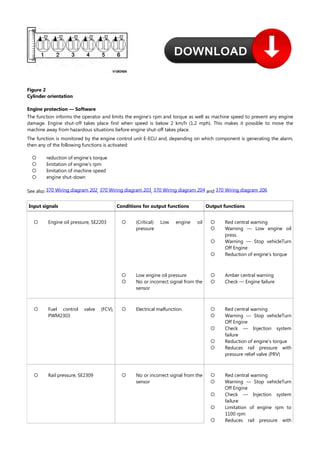
The cylinders are numbered in sequence, starting at the flywheel. Ignition order: 1-5-3-6-2-4. The engine's rotational
direction is counter-clockwise, seen from the flywheel.
Figure 2
Cylinder orientation
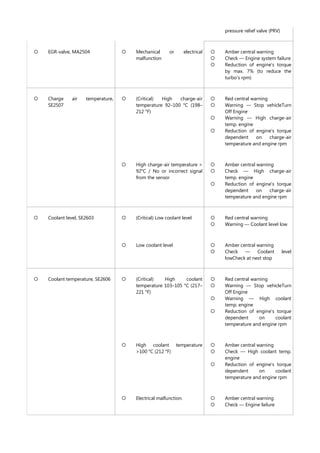
Engine protection — Software
The function informs the operator and limits the engine's rpm and torque as well as machine speed to prevent any engine
damage. Engine shut-off takes place first when speed is below 2 km/h (1.2 mph). This makes it possible to move the
machine away from hazardous situations before engine shut-off takes place.
The function is monitored by the engine control unit E-ECU and, depending on which component is generating the alarm,
then any of the following functions is activated:




reduction of engine's torque
limitation of engine's rpm
limitation of machine speed
engine shut-down
See also , , and
370 Wiring diagram 202 370 Wiring diagram 203 370 Wiring diagram 204 370 Wiring diagram 206
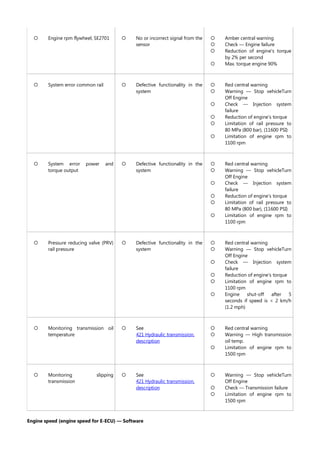
Input signals Conditions for output functions Output functions
 Engine oil pressure, SE2203  (Critical) Low engine oil
pressure




Red central warning
Warning — Low engine oil
press.
Warning — Stop vehicleTurn
Off Engine
Reduction of engine's torque


Low engine oil pressure
No or incorrect signal from the
sensor


Amber central warning
Check — Engine failure
 Fuel control valve (FCV),
PWM2303
 Electrical malfunction. 




Red central warning
Warning — Stop vehicleTurn
Off Engine
Check — Injection system
failure
Reduction of engine's torque
Reduces rail pressure with
pressure relief valve (PRV)
 Rail pressure, SE2309  No or incorrect signal from the
sensor





Red central warning
Warning — Stop vehicleTurn
Off Engine
Check — Injection system
failure
Limitation of engine rpm to
1100 rpm
Reduces rail pressure with
pressure relief valve (PRV)
 EGR-valve, MA2504  Mechanical or electrical
malfunction



Amber central warning
Check — Engine system failure
Reduction of engine's torque
by max. 7% (to reduce the
turbo's rpm)
 Charge air temperature,
SE2507
 (Critical) High charge-air
temperature 92–100 °C (198–
212 °F)




Red central warning
Warning — Stop vehicleTurn
Off Engine
Warning — High charge-air
temp. engine
Reduction of engine's torque
dependent on charge-air
temperature and engine rpm
 High charge-air temperature >
92°C / No or incorrect signal
from the sensor



Amber central warning
Check — High charge-air
temp. engine
Reduction of engine's torque
dependent on charge-air
temperature and engine rpm
 Coolant level, SE2603  (Critical) Low coolant level 

Red central warning
Warning — Coolant level low
 Low coolant level 

Amber central warning
Check — Coolant level
lowCheck at next stop
 Coolant temperature, SE2606  (Critical) High coolant
temperature 103–105 °C (217–
221 °F)




Red central warning
Warning — Stop vehicleTurn
Off Engine
Warning — High coolant
temp. engine
Reduction of engine's torque
dependent on coolant
temperature and engine rpm
 High coolant temperature
>100 °C (212 °F)



Amber central warning
Check — High coolant temp.
engine
Reduction of engine's torque
dependent on coolant
temperature and engine rpm
 Electrical malfunction. 

Amber central warning
Check — Engine failure
 Engine rpm flywheel, SE2701  No or incorrect signal from the
sensor




Amber central warning
Check — Engine failure
Reduction of engine's torque
by 2% per second
Max. torque engine 90%
 System error common rail  Defective functionality in the
system






Red central warning
Warning — Stop vehicleTurn
Off Engine
Check — Injection system
failure
Reduction of engine's torque
Limitation of rail pressure to
80 MPa (800 bar), (11600 PSI)
Limitation of engine rpm to
1100 rpm
 System error power and
torque output
 Defective functionality in the
system






Red central warning
Warning — Stop vehicleTurn
Off Engine
Check — Injection system
failure
Reduction of engine's torque
Limitation of rail pressure to
80 MPa (800 bar), (11600 PSI)
Limitation of engine rpm to
1100 rpm
 Pressure reducing valve (PRV)
rail pressure
 Defective functionality in the
system






Red central warning
Warning — Stop vehicleTurn
Off Engine
Check — Injection system
failure
Reduction of engine's torque
Limitation of engine rpm to
1100 rpm
Engine shut-off after 5
seconds if speed is < 2 km/h
(1.2 mph)
 Monitoring transmission oil
temperature
 See
421 Hydraulic transmission,
description



Red central warning
Warning — High transmission
oil temp.
Limitation of engine rpm to
1500 rpm
 Monitoring slipping
transmission
 See
421 Hydraulic transmission,
description



Warning — Stop vehicleTurn
Off Engine
Check — Transmission failure
Limitation of engine rpm to
1500 rpm
Engine speed (engine speed for E-ECU) — Software
This function monitors boost pressure and informs the operator if there is a system malfunction.
Engine speed is used internally in the E-ECU for engine control and as input signal for engine protection.
In case of engine speed sensor malfunction, the E-ECU uses sensor SE2703 for camshaft speed instead.
See also 370 Wiring diagram 202
Input signals Conditions for output functions Output functions
 Monitoring,
SE2701
 System malfunction, signal missing or abnormal
frequency
See Diagnostics



Amber central warning
Check — Engine system
failure
Reduction of engine's
torque I (engine
protection)
Motor On/Off — Software
Engine On/Off is used as a condition in software functions to define when the engine is considered to be On and Off,
respectively.
See also .
370 Wiring diagram 201
Input signals Conditions for output functions Output functions
 Engine speed < 50 rpm  Engine = Off
 Engine speed,
SE2704
 Engine speed > 600 rpm  Engine = On
Automatic engine shutdown — Software
The function control engine shut-off when the conditions according to the table have been fulfilled, and informs the
operator that the engine will be shut off within 1 minute. When the engine is shut off the parking brake will also be applied.
The operator can interrupt engine shutdown by affecting the throttle pedal, hand throttle, or the gear selector.
See also , , and
370 Wiring diagram 201 370 Wiring diagram 205 370 Wiring diagram 404 370 Wiring diagram 408
Input signals Conditions for output functions Output functions
Overall conditions for the function
 VCADS Pro parameter FAU "On"







VCADS Pro
parameter FAU
VCADS Pro
parameter FAV
Directional gear,
SW4205
Throttle pedal,
SE2702 APS
Hand throttle,
SE2701
Engine On/Off
Travel speed
1.
2.
3.
Activation of the
function automatic
engine shut-off (4–50
min.)
When 1 minute remains
of set time Check —
AutomaticEngine
shutdown is shown. [T1]

Engine shutdown and
parking brake is applied
(MA5501 without
voltage)






VCADS Pro parameter FAV "4–99 minutes"
Directional gear in position N
Accelerator pedal < 5%
Hand throttle not activated
Engine On
Travel speed < 5 km/h (3 mph)
[T1]Engine shutdown is interrupted in case of activation of throttle pedal, hand throttle, or if the gear selector is moved to
position F or R.
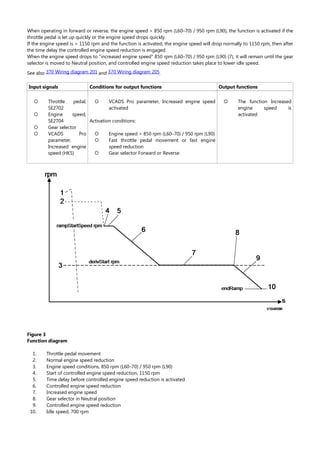
Increased engine speed — Software
The function prevents reduction of engine rpm in case of high power usage.
When operating in forward or reverse, the engine speed > 850 rpm (L60–70) / 950 rpm (L90), the function is activated if the
throttle pedal is let up quickly or the engine speed drops quickly.
If the engine speed is > 1150 rpm and the function is activated, the engine speed will drop normally to 1150 rpm, then after
the time delay the controlled engine speed reduction is engaged.
When the engine speed drops to "increased engine speed" 850 rpm (L60–70) / 950 rpm (L90) (7), it will remain until the gear
selector is moved to Neutral position, and controlled engine speed reduction takes place to lower idle speed.
See also and .
370 Wiring diagram 201 370 Wiring diagram 205
Input signals Conditions for output functions Output functions




Throttle pedal,
SE2702
Engine speed,
SE2704
Gear selector
VCADS Pro
parameter,
Increased engine
speed (HKS)
 VCADS Pro parameter, Increased engine speed
activated
Activation conditions:



Engine speed > 850 rpm (L60–70) / 950 rpm (L90)
Fast throttle pedal movement or fast engine
speed reduction
Gear selector Forward or Reverse
 The function Increased
engine speed is
activated
Figure 3
Function diagram
1.
2.
3.
4.
5.
6.
7.
8.
9.
10.
Throttle pedal movement
Normal engine speed reduction
Engine speed conditions, 850 rpm (L60–70) / 950 rpm (L90)
Start of controlled engine speed reduction, 1150 rpm
Time delay before controlled engine speed reduction is activated
Controlled engine speed reduction
Increased engine speed
Gear selector in Neutral position
Controlled engine speed reduction
Idle speed, 700 rpm
Service Information
Document Title: Function Group: Information Type: Date:
E-ECU, MID 128, changing
non-programmed ECU
200 Service Information 2014/4/1 0
Profile:
WLO, L60F [GB]
E-ECU, MID 128, changing non-programmed ECU
Op nbr 200-068
VCADS Pro VCADS Pro Service Tool
88890180 Interface
88890027 Cable
1. Place the machine in service position 1, see .
191 Service position
2. Connect VCADS Pro and perform the operation 28423-3 MID 128 ECU, programming.
3. Open the engine hood on the left side.
4. Unplug connectors from the E-ECU and loosen the cable harness clamps.
Figure 1
1.
2.
Connectors
Cable harness clamps
5. Change E-ECU.
6. Plug in the connectors for the E-ECU and install the cable harness clamps.
7. Turn on the voltage with the battery disconnector.
8. Finish VCADS Pro operation 28423-3 MID 128 ECU, programming.
9. Start the machine and check that no error messages appear.
10. Restore the machine to operating condition.
Service Information
Document Title: Function Group: Information Type: Date:
E-ECU, MID 128, changing
pre-programmed ECU
200 Service Information 2014/4/1 0
Profile:
WLO, L60F [GB]
E-ECU, MID 128, changing pre-programmed ECU
Op nbr 200-070
VCADS Pro VCADS Pro Service Tool
88890180 Interface
88890027 Cable
1. Place the machine in service position 1, see .
191 Service position
2. The new control unit has basic set parameters for the machine. If it is possible to read out customer parameters,
connect VCADS Pro and perform the operation 17030-3 Parameter, programming. Save all read parameters to job
card.
The operation is used to read out customer parameters from the old control unit to enable later comparison with
parameters in the new control unit.
3. Open the engine hood on the left side.
4. Unplug connectors from the E-ECU and loosen the cable harness clamps.
Figure 1
1.
2.
Connectors
Cable harness clamps
5. Change E-ECU.
6. Plug in the connectors for the E-ECU and install the cable harness clamps.
7. Turn on the voltage with the battery disconnector.
8. If customer parameters have been read out from the old control unit, compare these to the parameters in the new
control unit.



Connect VCADS Pro and perform the operation 17030-3 Parameter, programming. Save all read
parameters to job card.
Compare parameter settings on the job cards.
Perform operation 17030-3 Parameter, programming and change customer parameters according to job
card for the old control unit.
9. Start the machine and check that no error messages appear.
10. Restore the machine to operating condition.
Thank you so much for reading.
Please click the “Buy Now!”
button below to download the
complete manual.
After you pay.
You can download the most
perfect and complete manual in
the world.

Volvo L60f Engine Description Service Manual.pdf

  • 1.
    Service Information Document Title:Function Group: Information Type: Date: Engine, description 200 Service Information 2014/4/1 0 Profile: WLO, L60F [GB] Engine, description D6E D6E is a straight six-cylinder, four-stroke, turbocharged diesel engine with direct injection and intercooler, as well as wet, replaceable cylinder liners. The engine is equipped to meet governing legislation according to Tier 3/stage IIIA for exhaust emissions. Engine D6E has a fuel system with Common Rail, which is controlled by the software in the engine's electronic control unit (E-ECU). The D6E uses V-ACT (Volvo Advanced Combustion Technology). Engine D6EV with ACT features split injection, optimized air handling and, turbocharger with wastegate. Electronically controlled IEGR (Internal Exhaust Gas Recirculation) reduces NO contents and reduces emissions without the need for after-treatment of exhausts. All electronic functions in the engine are controlled by Volvo's latest engine management system, EMS2. The engine's serial number is stamped on the name plate, on the cylinder block's side and on the valve cover. The engine's model designation and serial number must be indicated when ordering spare parts. Figure 1 The cylinders are numbered in sequence, starting at the flywheel. Ignition order: 1-5-3-6-2-4. The engine's rotational direction is counter-clockwise, seen from the flywheel.
  • 2.
    Figure 2 Cylinder orientation Engineprotection — Software The function informs the operator and limits the engine's rpm and torque as well as machine speed to prevent any engine damage. Engine shut-off takes place first when speed is below 2 km/h (1.2 mph). This makes it possible to move the machine away from hazardous situations before engine shut-off takes place. The function is monitored by the engine control unit E-ECU and, depending on which component is generating the alarm, then any of the following functions is activated:     reduction of engine's torque limitation of engine's rpm limitation of machine speed engine shut-down See also , , and 370 Wiring diagram 202 370 Wiring diagram 203 370 Wiring diagram 204 370 Wiring diagram 206 Input signals Conditions for output functions Output functions  Engine oil pressure, SE2203  (Critical) Low engine oil pressure     Red central warning Warning — Low engine oil press. Warning — Stop vehicleTurn Off Engine Reduction of engine's torque   Low engine oil pressure No or incorrect signal from the sensor   Amber central warning Check — Engine failure  Fuel control valve (FCV), PWM2303  Electrical malfunction.      Red central warning Warning — Stop vehicleTurn Off Engine Check — Injection system failure Reduction of engine's torque Reduces rail pressure with pressure relief valve (PRV)  Rail pressure, SE2309  No or incorrect signal from the sensor      Red central warning Warning — Stop vehicleTurn Off Engine Check — Injection system failure Limitation of engine rpm to 1100 rpm Reduces rail pressure with
  • 3.
    pressure relief valve(PRV)  EGR-valve, MA2504  Mechanical or electrical malfunction    Amber central warning Check — Engine system failure Reduction of engine's torque by max. 7% (to reduce the turbo's rpm)  Charge air temperature, SE2507  (Critical) High charge-air temperature 92–100 °C (198– 212 °F)     Red central warning Warning — Stop vehicleTurn Off Engine Warning — High charge-air temp. engine Reduction of engine's torque dependent on charge-air temperature and engine rpm  High charge-air temperature > 92°C / No or incorrect signal from the sensor    Amber central warning Check — High charge-air temp. engine Reduction of engine's torque dependent on charge-air temperature and engine rpm  Coolant level, SE2603  (Critical) Low coolant level   Red central warning Warning — Coolant level low  Low coolant level   Amber central warning Check — Coolant level lowCheck at next stop  Coolant temperature, SE2606  (Critical) High coolant temperature 103–105 °C (217– 221 °F)     Red central warning Warning — Stop vehicleTurn Off Engine Warning — High coolant temp. engine Reduction of engine's torque dependent on coolant temperature and engine rpm  High coolant temperature >100 °C (212 °F)    Amber central warning Check — High coolant temp. engine Reduction of engine's torque dependent on coolant temperature and engine rpm  Electrical malfunction.   Amber central warning Check — Engine failure
  • 4.
     Engine rpmflywheel, SE2701  No or incorrect signal from the sensor     Amber central warning Check — Engine failure Reduction of engine's torque by 2% per second Max. torque engine 90%  System error common rail  Defective functionality in the system       Red central warning Warning — Stop vehicleTurn Off Engine Check — Injection system failure Reduction of engine's torque Limitation of rail pressure to 80 MPa (800 bar), (11600 PSI) Limitation of engine rpm to 1100 rpm  System error power and torque output  Defective functionality in the system       Red central warning Warning — Stop vehicleTurn Off Engine Check — Injection system failure Reduction of engine's torque Limitation of rail pressure to 80 MPa (800 bar), (11600 PSI) Limitation of engine rpm to 1100 rpm  Pressure reducing valve (PRV) rail pressure  Defective functionality in the system       Red central warning Warning — Stop vehicleTurn Off Engine Check — Injection system failure Reduction of engine's torque Limitation of engine rpm to 1100 rpm Engine shut-off after 5 seconds if speed is < 2 km/h (1.2 mph)  Monitoring transmission oil temperature  See 421 Hydraulic transmission, description    Red central warning Warning — High transmission oil temp. Limitation of engine rpm to 1500 rpm  Monitoring slipping transmission  See 421 Hydraulic transmission, description    Warning — Stop vehicleTurn Off Engine Check — Transmission failure Limitation of engine rpm to 1500 rpm Engine speed (engine speed for E-ECU) — Software
  • 5.
    This function monitorsboost pressure and informs the operator if there is a system malfunction. Engine speed is used internally in the E-ECU for engine control and as input signal for engine protection. In case of engine speed sensor malfunction, the E-ECU uses sensor SE2703 for camshaft speed instead. See also 370 Wiring diagram 202 Input signals Conditions for output functions Output functions  Monitoring, SE2701  System malfunction, signal missing or abnormal frequency See Diagnostics    Amber central warning Check — Engine system failure Reduction of engine's torque I (engine protection) Motor On/Off — Software Engine On/Off is used as a condition in software functions to define when the engine is considered to be On and Off, respectively. See also . 370 Wiring diagram 201 Input signals Conditions for output functions Output functions  Engine speed < 50 rpm  Engine = Off  Engine speed, SE2704  Engine speed > 600 rpm  Engine = On Automatic engine shutdown — Software The function control engine shut-off when the conditions according to the table have been fulfilled, and informs the operator that the engine will be shut off within 1 minute. When the engine is shut off the parking brake will also be applied. The operator can interrupt engine shutdown by affecting the throttle pedal, hand throttle, or the gear selector. See also , , and 370 Wiring diagram 201 370 Wiring diagram 205 370 Wiring diagram 404 370 Wiring diagram 408 Input signals Conditions for output functions Output functions Overall conditions for the function  VCADS Pro parameter FAU "On"        VCADS Pro parameter FAU VCADS Pro parameter FAV Directional gear, SW4205 Throttle pedal, SE2702 APS Hand throttle, SE2701 Engine On/Off Travel speed 1. 2. 3. Activation of the function automatic engine shut-off (4–50 min.) When 1 minute remains of set time Check — AutomaticEngine shutdown is shown. [T1]  Engine shutdown and parking brake is applied (MA5501 without voltage)       VCADS Pro parameter FAV "4–99 minutes" Directional gear in position N Accelerator pedal < 5% Hand throttle not activated Engine On Travel speed < 5 km/h (3 mph) [T1]Engine shutdown is interrupted in case of activation of throttle pedal, hand throttle, or if the gear selector is moved to position F or R. Increased engine speed — Software The function prevents reduction of engine rpm in case of high power usage.
  • 6.
    When operating inforward or reverse, the engine speed > 850 rpm (L60–70) / 950 rpm (L90), the function is activated if the throttle pedal is let up quickly or the engine speed drops quickly. If the engine speed is > 1150 rpm and the function is activated, the engine speed will drop normally to 1150 rpm, then after the time delay the controlled engine speed reduction is engaged. When the engine speed drops to "increased engine speed" 850 rpm (L60–70) / 950 rpm (L90) (7), it will remain until the gear selector is moved to Neutral position, and controlled engine speed reduction takes place to lower idle speed. See also and . 370 Wiring diagram 201 370 Wiring diagram 205 Input signals Conditions for output functions Output functions     Throttle pedal, SE2702 Engine speed, SE2704 Gear selector VCADS Pro parameter, Increased engine speed (HKS)  VCADS Pro parameter, Increased engine speed activated Activation conditions:    Engine speed > 850 rpm (L60–70) / 950 rpm (L90) Fast throttle pedal movement or fast engine speed reduction Gear selector Forward or Reverse  The function Increased engine speed is activated Figure 3 Function diagram 1. 2. 3. 4. 5. 6. 7. 8. 9. 10. Throttle pedal movement Normal engine speed reduction Engine speed conditions, 850 rpm (L60–70) / 950 rpm (L90) Start of controlled engine speed reduction, 1150 rpm Time delay before controlled engine speed reduction is activated Controlled engine speed reduction Increased engine speed Gear selector in Neutral position Controlled engine speed reduction Idle speed, 700 rpm
  • 7.
    Service Information Document Title:Function Group: Information Type: Date: E-ECU, MID 128, changing non-programmed ECU 200 Service Information 2014/4/1 0 Profile: WLO, L60F [GB] E-ECU, MID 128, changing non-programmed ECU Op nbr 200-068 VCADS Pro VCADS Pro Service Tool 88890180 Interface 88890027 Cable 1. Place the machine in service position 1, see . 191 Service position 2. Connect VCADS Pro and perform the operation 28423-3 MID 128 ECU, programming. 3. Open the engine hood on the left side. 4. Unplug connectors from the E-ECU and loosen the cable harness clamps. Figure 1 1. 2. Connectors Cable harness clamps 5. Change E-ECU. 6. Plug in the connectors for the E-ECU and install the cable harness clamps. 7. Turn on the voltage with the battery disconnector. 8. Finish VCADS Pro operation 28423-3 MID 128 ECU, programming. 9. Start the machine and check that no error messages appear. 10. Restore the machine to operating condition.
  • 8.
    Service Information Document Title:Function Group: Information Type: Date: E-ECU, MID 128, changing pre-programmed ECU 200 Service Information 2014/4/1 0 Profile: WLO, L60F [GB] E-ECU, MID 128, changing pre-programmed ECU Op nbr 200-070 VCADS Pro VCADS Pro Service Tool 88890180 Interface 88890027 Cable 1. Place the machine in service position 1, see . 191 Service position 2. The new control unit has basic set parameters for the machine. If it is possible to read out customer parameters, connect VCADS Pro and perform the operation 17030-3 Parameter, programming. Save all read parameters to job card. The operation is used to read out customer parameters from the old control unit to enable later comparison with parameters in the new control unit. 3. Open the engine hood on the left side. 4. Unplug connectors from the E-ECU and loosen the cable harness clamps. Figure 1 1. 2. Connectors Cable harness clamps 5. Change E-ECU. 6. Plug in the connectors for the E-ECU and install the cable harness clamps. 7. Turn on the voltage with the battery disconnector. 8. If customer parameters have been read out from the old control unit, compare these to the parameters in the new control unit.
  • 9.
       Connect VCADS Proand perform the operation 17030-3 Parameter, programming. Save all read parameters to job card. Compare parameter settings on the job cards. Perform operation 17030-3 Parameter, programming and change customer parameters according to job card for the old control unit. 9. Start the machine and check that no error messages appear. 10. Restore the machine to operating condition.
  • 10.
    Thank you somuch for reading. Please click the “Buy Now!” button below to download the complete manual. After you pay. You can download the most perfect and complete manual in the world.