6
6.1
© 2012 Pearson Education, Inc.
Orthogonality
INNER PRODUCT, LENGTH,
AND ORTHOGONALITY
Slide 6.1- 2© 2012 Pearson Education, Inc.
INNER PRODUCT
 If u and v are vectors in Rn, then we regard u
and v as nx1 matrices
 The number uTv is called the inner product of
u and v, and it is written as u∙v
 aka dot product
 Scalar
Slide 6.1- 3© 2012 Pearson Education, Inc.
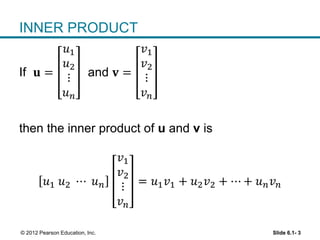
INNER PRODUCT
If 𝐮 =
𝑢1
𝑢2
⋮
𝑢 𝑛
and 𝐯 =
𝑣1
𝑣2
⋮
𝑣 𝑛
then the inner product of u and v is
𝑢1 𝑢2 ⋯ 𝑢 𝑛
𝑣1
𝑣2
⋮
𝑣 𝑛
= 𝑢1 𝑣1 + 𝑢2 𝑣2 + ⋯ + 𝑢 𝑛 𝑣 𝑛
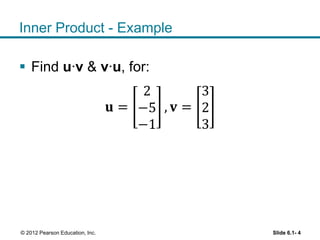
Inner Product - Example
 Find u∙v & v∙u, for:
𝐮 =
2
−5
−1
, 𝐯 =
3
2
3
Slide 6.1- 4© 2012 Pearson Education, Inc.
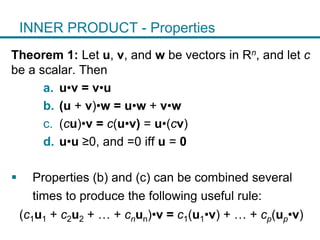
INNER PRODUCT - Properties
Theorem 1: Let u, v, and w be vectors in Rn, and let c
be a scalar. Then
a. u•v = v•u
b. (u + v)•w = u•w + v•w
c. (cu)•v = c(u•v) = u•(cv)
d. u•u ≥0, and =0 iff u = 0
 Properties (b) and (c) can be combined several
times to produce the following useful rule:
(c1u1 + c2u2 + … + cnun)•v = c1(u1•v) + … + cp(up•v)
Slide 6.1- 6© 2012 Pearson Education, Inc.
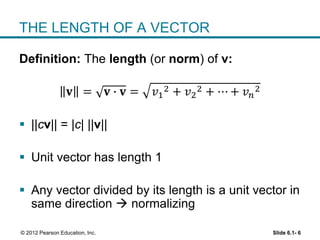
THE LENGTH OF A VECTOR
Definition: The length (or norm) of v:
𝐯 = 𝐯 ∙ 𝐯 = 𝑣1
2 + 𝑣2
2 + ⋯ + 𝑣 𝑛
2
 ||cv|| = |c| ||v||
 Unit vector has length 1
 Any vector divided by its length is a unit vector in
same direction  normalizing
Slide 6.1- 7© 2012 Pearson Education, Inc.
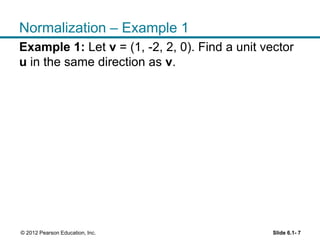
Normalization – Example 1
Example 1: Let v = (1, -2, 2, 0). Find a unit vector
u in the same direction as v.
Slide 6.1- 8© 2012 Pearson Education, Inc.
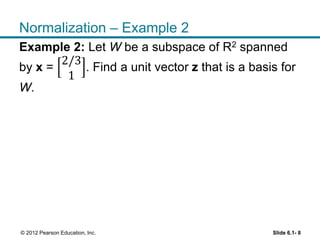
Normalization – Example 2
Example 2: Let W be a subspace of R2 spanned
by x =
2/3
1
. Find a unit vector z that is a basis for
W.
Slide 6.1- 9© 2012 Pearson Education, Inc.
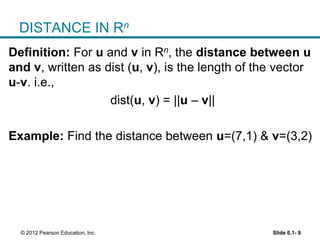
DISTANCE IN Rn
Definition: For u and v in Rn, the distance between u
and v, written as dist (u, v), is the length of the vector
u-v. i.e.,
dist(u, v) = ||u – v||
Example: Find the distance between u=(7,1) & v=(3,2)
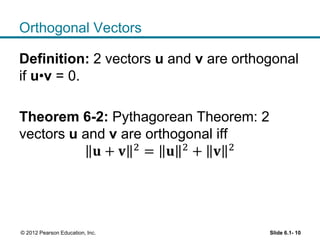
Orthogonal Vectors
Definition: 2 vectors u and v are orthogonal
if u•v = 0.
Theorem 6-2: Pythagorean Theorem: 2
vectors u and v are orthogonal iff
𝐮 + 𝐯 2
= 𝐮 2
+ 𝐯 2
Slide 6.1- 10© 2012 Pearson Education, Inc.
Slide 6.1- 11© 2012 Pearson Education, Inc.
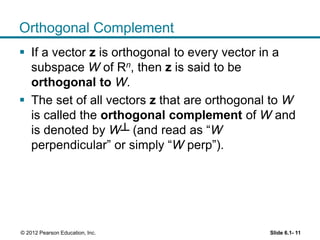
Orthogonal Complement
 If a vector z is orthogonal to every vector in a
subspace W of Rn, then z is said to be
orthogonal to W.
 The set of all vectors z that are orthogonal to W
is called the orthogonal complement of W and
is denoted by W┴ (and read as “W
perpendicular” or simply “W perp”).
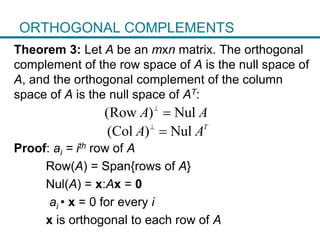
ORTHOGONAL COMPLEMENTS
Theorem 3: Let A be an mxn matrix. The orthogonal
complement of the row space of A is the null space of
A, and the orthogonal complement of the column
space of A is the null space of AT:
Proof: ai = ith row of A
Row(A) = Span{rows of A}
Nul(A) = x:Ax = 0
ai • x = 0 for every i
x is orthogonal to each row of A
(Row ) NulA A

(Col ) Nul T
A A

Slide 6.1- 13© 2012 Pearson Education, Inc.
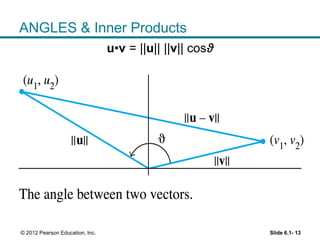
ANGLES & Inner Products
u•v = ||u|| ||v|| cosϑ
Slide 6.1- 14© 2012 Pearson Education, Inc.
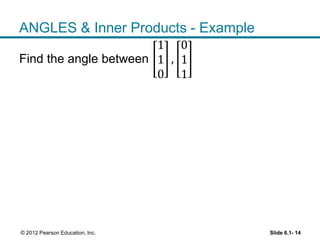
ANGLES & Inner Products - Example
Find the angle between
1
1
0
,
0
1
1
6
6.1
© 2012 Pearson Education, Inc.
Orthogonal Sets
Slide 6.2- 16© 2012 Pearson Education, Inc.
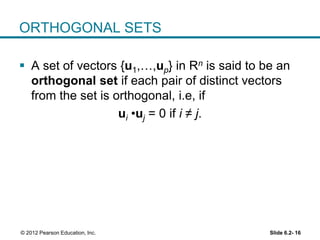
ORTHOGONAL SETS
 A set of vectors {u1,…,up} in Rn is said to be an
orthogonal set if each pair of distinct vectors
from the set is orthogonal, i.e, if
ui •uj = 0 if i ≠ j.
Orthogonal Sets - Example
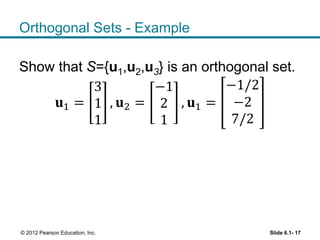
Show that S={u1,u2,u3} is an orthogonal set.
𝐮1 =
3
1
1
, 𝐮2 =
−1
2
1
, 𝐮1 =
−1/2
−2
7/2
Slide 6.1- 17© 2012 Pearson Education, Inc.
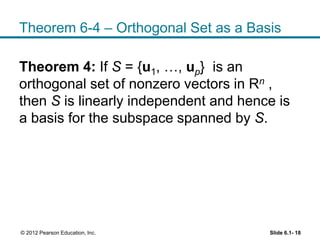
Theorem 6-4 – Orthogonal Set as a Basis
Theorem 4: If S = {u1, …, up} is an
orthogonal set of nonzero vectors in Rn ,
then S is linearly independent and hence is
a basis for the subspace spanned by S.
Slide 6.1- 18© 2012 Pearson Education, Inc.
Slide 6.2- 19© 2012 Pearson Education, Inc.
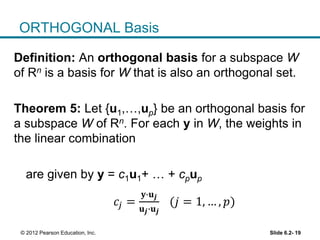
ORTHOGONAL Basis
Definition: An orthogonal basis for a subspace W
of Rn is a basis for W that is also an orthogonal set.
Theorem 5: Let {u1,…,up} be an orthogonal basis for
a subspace W of Rn. For each y in W, the weights in
the linear combination
are given by y = c1u1+ … + cpup
𝑐𝑗 =
𝐲∙𝐮 𝒋
𝐮 𝒋∙𝐮 𝒋
(𝑗 = 1, … , 𝑝)
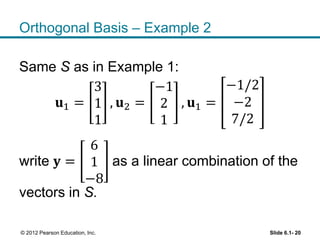
Orthogonal Basis – Example 2
Same S as in Example 1:
𝐮1 =
3
1
1
, 𝐮2 =
−1
2
1
, 𝐮1 =
−1/2
−2
7/2
write 𝐲 =
6
1
−8
as a linear combination of the
vectors in S.
Slide 6.1- 20© 2012 Pearson Education, Inc.
Slide 6.2- 21© 2012 Pearson Education, Inc.
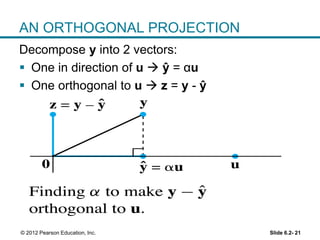
AN ORTHOGONAL PROJECTION
Decompose y into 2 vectors:
 One in direction of u  ŷ = αu
 One orthogonal to u  z = y - ŷ
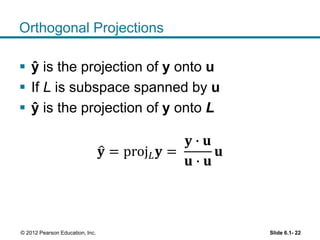
Orthogonal Projections
 ŷ is the projection of y onto u
 If L is subspace spanned by u
 ŷ is the projection of y onto L
𝐲 = proj 𝐿 𝐲 =
𝐲 ∙ 𝐮
𝐮 ∙ 𝐮
𝐮
Slide 6.1- 22© 2012 Pearson Education, Inc.
Slide 6.2- 23© 2012 Pearson Education, Inc.
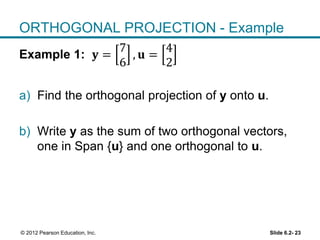
ORTHOGONAL PROJECTION - Example
Example 1: 𝐲 =
7
6
, 𝐮 =
4
2
a) Find the orthogonal projection of y onto u.
b) Write y as the sum of two orthogonal vectors,
one in Span {u} and one orthogonal to u.
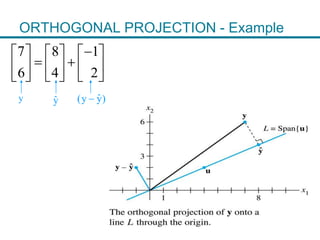
ORTHOGONAL PROJECTION - Example
7 8 1
6 4 2
     
      
     
ˆyy ˆ(y y)
Slide 6.2- 25© 2012 Pearson Education, Inc.
AN ORTHOGONAL PROJECTION
 Check: ŷ•z = 0?
 Distance from y to L?
 Distance from y to u?
Slide 6.2- 26© 2012 Pearson Education, Inc.
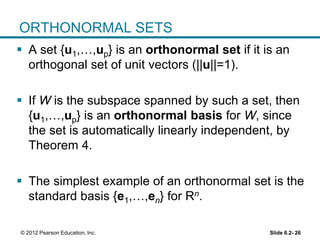
ORTHONORMAL SETS
 A set {u1,…,up} is an orthonormal set if it is an
orthogonal set of unit vectors (||u||=1).
 If W is the subspace spanned by such a set, then
{u1,…,up} is an orthonormal basis for W, since
the set is automatically linearly independent, by
Theorem 4.
 The simplest example of an orthonormal set is the
standard basis {e1,…,en} for Rn.
Slide 6.2- 27© 2012 Pearson Education, Inc.
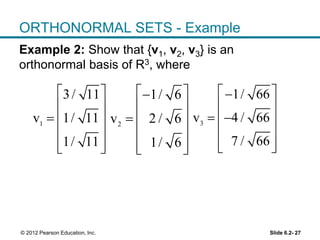
ORTHONORMAL SETS - Example
Example 2: Show that {v1, v2, v3} is an
orthonormal basis of R3, where
1
3/ 11
v 1/ 11
1/ 11
 
 
  
 
  
2
1/ 6
v 2 / 6
1/ 6
 
 
  
 
  
3
1/ 66
v 4 / 66
7 / 66
 
 
  
 
  
Slide 6.2- 28© 2012 Pearson Education, Inc.
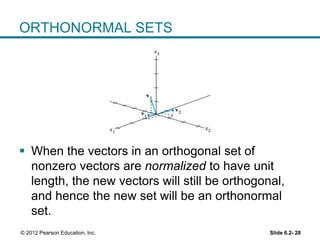
ORTHONORMAL SETS
 When the vectors in an orthogonal set of
nonzero vectors are normalized to have unit
length, the new vectors will still be orthogonal,
and hence the new set will be an orthonormal
set.
Slide 6.2- 29© 2012 Pearson Education, Inc.
ORTHONORMAL SETS
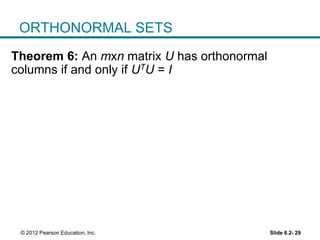
Theorem 6: An mxn matrix U has orthonormal
columns if and only if UTU = I
Slide 6.2- 30© 2012 Pearson Education, Inc.
ORTHONORMAL SETS
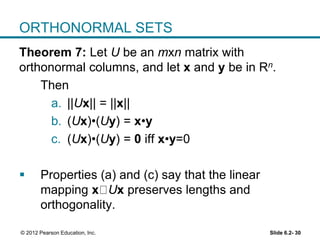
Theorem 7: Let U be an mxn matrix with
orthonormal columns, and let x and y be in Rn.
Then
a. ||Ux|| = ||x||
b. (Ux)•(Uy) = x•y
c. (Ux)•(Uy) = 0 iff x•y=0
 Properties (a) and (c) say that the linear
mapping x Ux preserves lengths and
orthogonality.
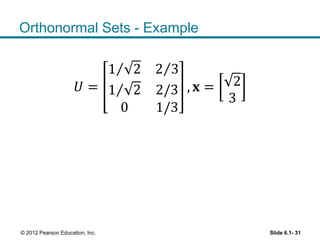
Orthonormal Sets - Example
𝑈 =
1 2 2 3
1 2 2/3
0 1/3
, 𝐱 = 2
3
Slide 6.1- 31© 2012 Pearson Education, Inc.
Orthogonal Matrix
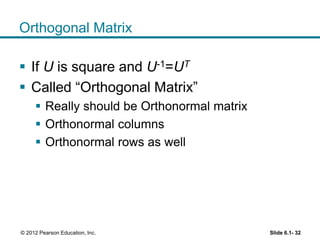
 If U is square and U-1=UT
 Called “Orthogonal Matrix”
 Really should be Orthonormal matrix
 Orthonormal columns
 Orthonormal rows as well
Slide 6.1- 32© 2012 Pearson Education, Inc.
6
6.1
© 2012 Pearson Education, Inc.
Orthogonal Projections
Slide 6.3- 34© 2012 Pearson Education, Inc.
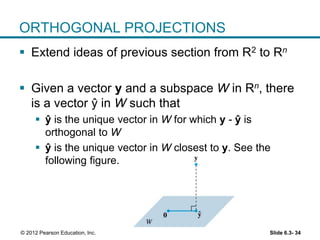
ORTHOGONAL PROJECTIONS
 Extend ideas of previous section from R2 to Rn
 Given a vector y and a subspace W in Rn, there
is a vector ŷ in W such that
 ŷ is the unique vector in W for which y - ŷ is
orthogonal to W
 ŷ is the unique vector in W closest to y. See the
following figure.
ˆy
Slide 6.3- 35© 2012 Pearson Education, Inc.
THE ORTHOGONAL DECOMPOSITION
THEOREM
Theorem 8: Let W be a subspace of Rn . Then
each y in Rn can be written uniquely in the form
y = ŷ + z
where ŷ is in W and z is in W┴ .
If {u1,…,up} is any orthogonal basis of W, then
𝐲 =
𝐲 ∙ 𝐮1
𝐮1 ∙ 𝐮1
𝐮1 + ⋯ +
𝐲 ∙ 𝐮 𝑝
𝐮 𝑝 ∙ 𝐮 𝑝
𝐮 𝑝
and
z = y - ŷ
Slide 6.3- 36© 2012 Pearson Education, Inc.
THE ORTHOGONAL DECOMPOSITION
THEOREM
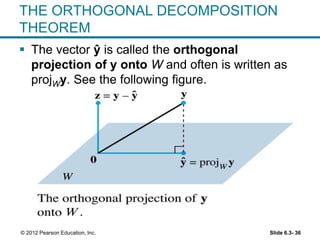
 The vector ŷ is called the orthogonal
projection of y onto W and often is written as
projWy. See the following figure.
Slide 6.3- 37© 2012 Pearson Education, Inc.
THE ORTHOGONAL DECOMPOSITION
THEOREM - Example
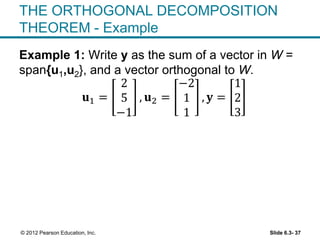
Example 1: Write y as the sum of a vector in W =
span{u1,u2}, and a vector orthogonal to W.
𝐮1 =
2
5
−1
, 𝐮2 =
−2
1
1
, 𝐲 =
1
2
3
Slide 6.3- 38© 2012 Pearson Education, Inc.
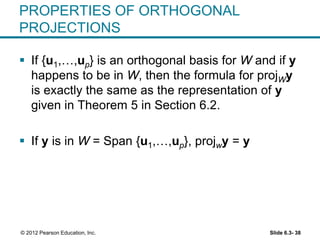
PROPERTIES OF ORTHOGONAL
PROJECTIONS
 If {u1,…,up} is an orthogonal basis for W and if y
happens to be in W, then the formula for projWy
is exactly the same as the representation of y
given in Theorem 5 in Section 6.2.
 If y is in W = Span {u1,…,up}, projwy = y
Slide 6.3- 39© 2012 Pearson Education, Inc.
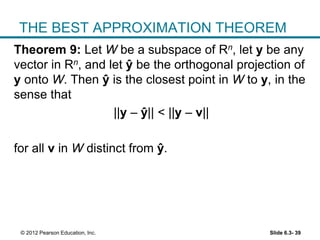
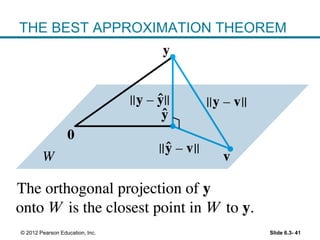
THE BEST APPROXIMATION THEOREM
Theorem 9: Let W be a subspace of Rn, let y be any
vector in Rn, and let ŷ be the orthogonal projection of
y onto W. Then ŷ is the closest point in W to y, in the
sense that
||y – ŷ|| < ||y – v||
for all v in W distinct from ŷ.
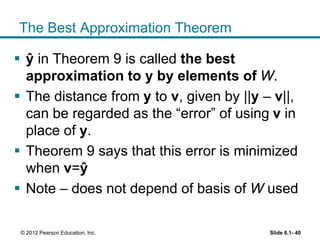
The Best Approximation Theorem
 ŷ in Theorem 9 is called the best
approximation to y by elements of W.
 The distance from y to v, given by ||y – v||,
can be regarded as the “error” of using v in
place of y.
 Theorem 9 says that this error is minimized
when v=ŷ
 Note – does not depend of basis of W used
Slide 6.1- 40© 2012 Pearson Education, Inc.
Slide 6.3- 41© 2012 Pearson Education, Inc.
THE BEST APPROXIMATION THEOREM
Slide 6.3- 42© 2012 Pearson Education, Inc.
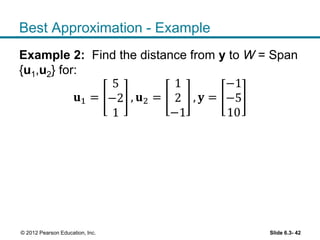
Best Approximation - Example
Example 2: Find the distance from y to W = Span
{u1,u2} for:
𝐮1 =
5
−2
1
, 𝐮2 =
1
2
−1
, 𝐲 =
−1
−5
10

Lecture 12 orhogonality - 6.1 6.2 6.3

  • 1.
    6 6.1 © 2012 PearsonEducation, Inc. Orthogonality INNER PRODUCT, LENGTH, AND ORTHOGONALITY
  • 2.
    Slide 6.1- 2©2012 Pearson Education, Inc. INNER PRODUCT  If u and v are vectors in Rn, then we regard u and v as nx1 matrices  The number uTv is called the inner product of u and v, and it is written as u∙v  aka dot product  Scalar
  • 3.
    Slide 6.1- 3©2012 Pearson Education, Inc. INNER PRODUCT If 𝐮 = 𝑢1 𝑢2 ⋮ 𝑢 𝑛 and 𝐯 = 𝑣1 𝑣2 ⋮ 𝑣 𝑛 then the inner product of u and v is 𝑢1 𝑢2 ⋯ 𝑢 𝑛 𝑣1 𝑣2 ⋮ 𝑣 𝑛 = 𝑢1 𝑣1 + 𝑢2 𝑣2 + ⋯ + 𝑢 𝑛 𝑣 𝑛
  • 4.
    Inner Product -Example  Find u∙v & v∙u, for: 𝐮 = 2 −5 −1 , 𝐯 = 3 2 3 Slide 6.1- 4© 2012 Pearson Education, Inc.
  • 5.
    INNER PRODUCT -Properties Theorem 1: Let u, v, and w be vectors in Rn, and let c be a scalar. Then a. u•v = v•u b. (u + v)•w = u•w + v•w c. (cu)•v = c(u•v) = u•(cv) d. u•u ≥0, and =0 iff u = 0  Properties (b) and (c) can be combined several times to produce the following useful rule: (c1u1 + c2u2 + … + cnun)•v = c1(u1•v) + … + cp(up•v)
  • 6.
    Slide 6.1- 6©2012 Pearson Education, Inc. THE LENGTH OF A VECTOR Definition: The length (or norm) of v: 𝐯 = 𝐯 ∙ 𝐯 = 𝑣1 2 + 𝑣2 2 + ⋯ + 𝑣 𝑛 2  ||cv|| = |c| ||v||  Unit vector has length 1  Any vector divided by its length is a unit vector in same direction  normalizing
  • 7.
    Slide 6.1- 7©2012 Pearson Education, Inc. Normalization – Example 1 Example 1: Let v = (1, -2, 2, 0). Find a unit vector u in the same direction as v.
  • 8.
    Slide 6.1- 8©2012 Pearson Education, Inc. Normalization – Example 2 Example 2: Let W be a subspace of R2 spanned by x = 2/3 1 . Find a unit vector z that is a basis for W.
  • 9.
    Slide 6.1- 9©2012 Pearson Education, Inc. DISTANCE IN Rn Definition: For u and v in Rn, the distance between u and v, written as dist (u, v), is the length of the vector u-v. i.e., dist(u, v) = ||u – v|| Example: Find the distance between u=(7,1) & v=(3,2)
  • 10.
    Orthogonal Vectors Definition: 2vectors u and v are orthogonal if u•v = 0. Theorem 6-2: Pythagorean Theorem: 2 vectors u and v are orthogonal iff 𝐮 + 𝐯 2 = 𝐮 2 + 𝐯 2 Slide 6.1- 10© 2012 Pearson Education, Inc.
  • 11.
    Slide 6.1- 11©2012 Pearson Education, Inc. Orthogonal Complement  If a vector z is orthogonal to every vector in a subspace W of Rn, then z is said to be orthogonal to W.  The set of all vectors z that are orthogonal to W is called the orthogonal complement of W and is denoted by W┴ (and read as “W perpendicular” or simply “W perp”).
  • 12.
    ORTHOGONAL COMPLEMENTS Theorem 3:Let A be an mxn matrix. The orthogonal complement of the row space of A is the null space of A, and the orthogonal complement of the column space of A is the null space of AT: Proof: ai = ith row of A Row(A) = Span{rows of A} Nul(A) = x:Ax = 0 ai • x = 0 for every i x is orthogonal to each row of A (Row ) NulA A  (Col ) Nul T A A 
  • 13.
    Slide 6.1- 13©2012 Pearson Education, Inc. ANGLES & Inner Products u•v = ||u|| ||v|| cosϑ
  • 14.
    Slide 6.1- 14©2012 Pearson Education, Inc. ANGLES & Inner Products - Example Find the angle between 1 1 0 , 0 1 1
  • 15.
    6 6.1 © 2012 PearsonEducation, Inc. Orthogonal Sets
  • 16.
    Slide 6.2- 16©2012 Pearson Education, Inc. ORTHOGONAL SETS  A set of vectors {u1,…,up} in Rn is said to be an orthogonal set if each pair of distinct vectors from the set is orthogonal, i.e, if ui •uj = 0 if i ≠ j.
  • 17.
    Orthogonal Sets -Example Show that S={u1,u2,u3} is an orthogonal set. 𝐮1 = 3 1 1 , 𝐮2 = −1 2 1 , 𝐮1 = −1/2 −2 7/2 Slide 6.1- 17© 2012 Pearson Education, Inc.
  • 18.
    Theorem 6-4 –Orthogonal Set as a Basis Theorem 4: If S = {u1, …, up} is an orthogonal set of nonzero vectors in Rn , then S is linearly independent and hence is a basis for the subspace spanned by S. Slide 6.1- 18© 2012 Pearson Education, Inc.
  • 19.
    Slide 6.2- 19©2012 Pearson Education, Inc. ORTHOGONAL Basis Definition: An orthogonal basis for a subspace W of Rn is a basis for W that is also an orthogonal set. Theorem 5: Let {u1,…,up} be an orthogonal basis for a subspace W of Rn. For each y in W, the weights in the linear combination are given by y = c1u1+ … + cpup 𝑐𝑗 = 𝐲∙𝐮 𝒋 𝐮 𝒋∙𝐮 𝒋 (𝑗 = 1, … , 𝑝)
  • 20.
    Orthogonal Basis –Example 2 Same S as in Example 1: 𝐮1 = 3 1 1 , 𝐮2 = −1 2 1 , 𝐮1 = −1/2 −2 7/2 write 𝐲 = 6 1 −8 as a linear combination of the vectors in S. Slide 6.1- 20© 2012 Pearson Education, Inc.
  • 21.
    Slide 6.2- 21©2012 Pearson Education, Inc. AN ORTHOGONAL PROJECTION Decompose y into 2 vectors:  One in direction of u  ŷ = αu  One orthogonal to u  z = y - ŷ
  • 22.
    Orthogonal Projections  ŷis the projection of y onto u  If L is subspace spanned by u  ŷ is the projection of y onto L 𝐲 = proj 𝐿 𝐲 = 𝐲 ∙ 𝐮 𝐮 ∙ 𝐮 𝐮 Slide 6.1- 22© 2012 Pearson Education, Inc.
  • 23.
    Slide 6.2- 23©2012 Pearson Education, Inc. ORTHOGONAL PROJECTION - Example Example 1: 𝐲 = 7 6 , 𝐮 = 4 2 a) Find the orthogonal projection of y onto u. b) Write y as the sum of two orthogonal vectors, one in Span {u} and one orthogonal to u.
  • 24.
    ORTHOGONAL PROJECTION -Example 7 8 1 6 4 2                    ˆyy ˆ(y y)
  • 25.
    Slide 6.2- 25©2012 Pearson Education, Inc. AN ORTHOGONAL PROJECTION  Check: ŷ•z = 0?  Distance from y to L?  Distance from y to u?
  • 26.
    Slide 6.2- 26©2012 Pearson Education, Inc. ORTHONORMAL SETS  A set {u1,…,up} is an orthonormal set if it is an orthogonal set of unit vectors (||u||=1).  If W is the subspace spanned by such a set, then {u1,…,up} is an orthonormal basis for W, since the set is automatically linearly independent, by Theorem 4.  The simplest example of an orthonormal set is the standard basis {e1,…,en} for Rn.
  • 27.
    Slide 6.2- 27©2012 Pearson Education, Inc. ORTHONORMAL SETS - Example Example 2: Show that {v1, v2, v3} is an orthonormal basis of R3, where 1 3/ 11 v 1/ 11 1/ 11             2 1/ 6 v 2 / 6 1/ 6             3 1/ 66 v 4 / 66 7 / 66            
  • 28.
    Slide 6.2- 28©2012 Pearson Education, Inc. ORTHONORMAL SETS  When the vectors in an orthogonal set of nonzero vectors are normalized to have unit length, the new vectors will still be orthogonal, and hence the new set will be an orthonormal set.
  • 29.
    Slide 6.2- 29©2012 Pearson Education, Inc. ORTHONORMAL SETS Theorem 6: An mxn matrix U has orthonormal columns if and only if UTU = I
  • 30.
    Slide 6.2- 30©2012 Pearson Education, Inc. ORTHONORMAL SETS Theorem 7: Let U be an mxn matrix with orthonormal columns, and let x and y be in Rn. Then a. ||Ux|| = ||x|| b. (Ux)•(Uy) = x•y c. (Ux)•(Uy) = 0 iff x•y=0  Properties (a) and (c) say that the linear mapping x Ux preserves lengths and orthogonality.
  • 31.
    Orthonormal Sets -Example 𝑈 = 1 2 2 3 1 2 2/3 0 1/3 , 𝐱 = 2 3 Slide 6.1- 31© 2012 Pearson Education, Inc.
  • 32.
    Orthogonal Matrix  IfU is square and U-1=UT  Called “Orthogonal Matrix”  Really should be Orthonormal matrix  Orthonormal columns  Orthonormal rows as well Slide 6.1- 32© 2012 Pearson Education, Inc.
  • 33.
    6 6.1 © 2012 PearsonEducation, Inc. Orthogonal Projections
  • 34.
    Slide 6.3- 34©2012 Pearson Education, Inc. ORTHOGONAL PROJECTIONS  Extend ideas of previous section from R2 to Rn  Given a vector y and a subspace W in Rn, there is a vector ŷ in W such that  ŷ is the unique vector in W for which y - ŷ is orthogonal to W  ŷ is the unique vector in W closest to y. See the following figure. ˆy
  • 35.
    Slide 6.3- 35©2012 Pearson Education, Inc. THE ORTHOGONAL DECOMPOSITION THEOREM Theorem 8: Let W be a subspace of Rn . Then each y in Rn can be written uniquely in the form y = ŷ + z where ŷ is in W and z is in W┴ . If {u1,…,up} is any orthogonal basis of W, then 𝐲 = 𝐲 ∙ 𝐮1 𝐮1 ∙ 𝐮1 𝐮1 + ⋯ + 𝐲 ∙ 𝐮 𝑝 𝐮 𝑝 ∙ 𝐮 𝑝 𝐮 𝑝 and z = y - ŷ
  • 36.
    Slide 6.3- 36©2012 Pearson Education, Inc. THE ORTHOGONAL DECOMPOSITION THEOREM  The vector ŷ is called the orthogonal projection of y onto W and often is written as projWy. See the following figure.
  • 37.
    Slide 6.3- 37©2012 Pearson Education, Inc. THE ORTHOGONAL DECOMPOSITION THEOREM - Example Example 1: Write y as the sum of a vector in W = span{u1,u2}, and a vector orthogonal to W. 𝐮1 = 2 5 −1 , 𝐮2 = −2 1 1 , 𝐲 = 1 2 3
  • 38.
    Slide 6.3- 38©2012 Pearson Education, Inc. PROPERTIES OF ORTHOGONAL PROJECTIONS  If {u1,…,up} is an orthogonal basis for W and if y happens to be in W, then the formula for projWy is exactly the same as the representation of y given in Theorem 5 in Section 6.2.  If y is in W = Span {u1,…,up}, projwy = y
  • 39.
    Slide 6.3- 39©2012 Pearson Education, Inc. THE BEST APPROXIMATION THEOREM Theorem 9: Let W be a subspace of Rn, let y be any vector in Rn, and let ŷ be the orthogonal projection of y onto W. Then ŷ is the closest point in W to y, in the sense that ||y – ŷ|| < ||y – v|| for all v in W distinct from ŷ.
  • 40.
    The Best ApproximationTheorem  ŷ in Theorem 9 is called the best approximation to y by elements of W.  The distance from y to v, given by ||y – v||, can be regarded as the “error” of using v in place of y.  Theorem 9 says that this error is minimized when v=ŷ  Note – does not depend of basis of W used Slide 6.1- 40© 2012 Pearson Education, Inc.
  • 41.
    Slide 6.3- 41©2012 Pearson Education, Inc. THE BEST APPROXIMATION THEOREM
  • 42.
    Slide 6.3- 42©2012 Pearson Education, Inc. Best Approximation - Example Example 2: Find the distance from y to W = Span {u1,u2} for: 𝐮1 = 5 −2 1 , 𝐮2 = 1 2 −1 , 𝐲 = −1 −5 10