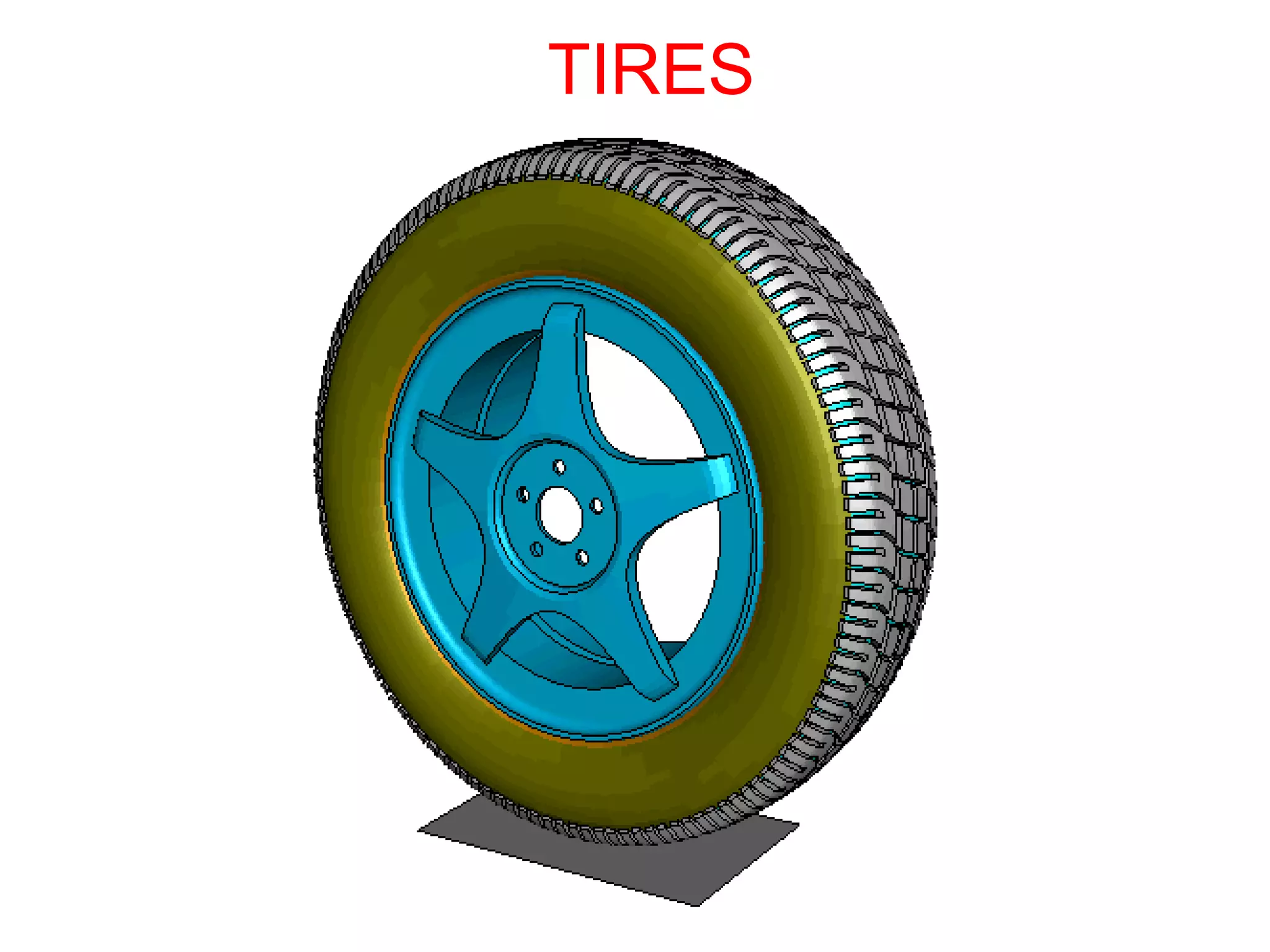

TIRES
Who Invented The First Tire?
 It was invented in
1888, by John
Dunlop.
 This would be the
end of the solid tire.
Tyres (Introduction)
Basis Functions
 The tyre acts as the primary suspension,
cushioning the vehicle from the effects of a
rough surface.
 It also provides frictional contact with the road
surface.
 This allows the driving wheels to move the
vehicle.
 The front tyres allows the wheels to steer .
 The tyres allow the brakes to slow or stop the
vehicle
Components that go
into a tire.
 Raw Rubber
 Steel
 Nylon
 Polyester
 Rayon
 Carbon Black
 Synthetic
Rubber
 Fiberglass
 Aramid
 Brass
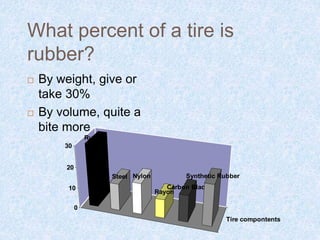
What percent of a tire is
rubber?
 By weight, give or
take 30%
 By volume, quite a
bite more.
Tire compontents
Rubber
Steel Nylon
Rayon
Carbon Black
Synthetic Rubber
0
10
20
30
Why are Tires Black?
 To protect the rubber
from the harmful UV
rays.
 A common type of
UV stabilizer called a
competitive absorber
is added to capture
and absorb these
harmful UV light
wave energy.
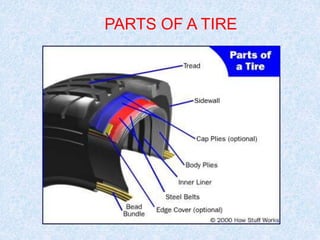
PARTS OF A TIRE
TIRE PART
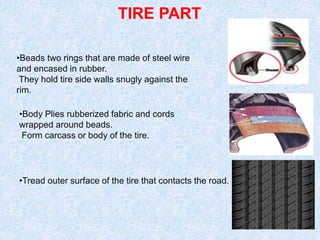
•Beads two rings that are made of steel wire
and encased in rubber.
They hold tire side walls snugly against the
rim.
•Body Plies rubberized fabric and cords
wrapped around beads.
Form carcass or body of the tire.
•Tread outer surface of the tire that contacts the road.
TIRES PARTS
•Sidewall outer part of the tire that extends
from
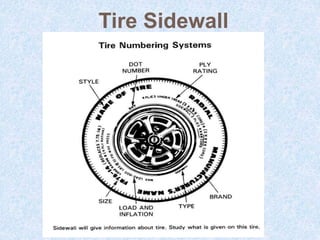
the bead to the tread. Marking on the sidewall
provides the information about the tire.
•Liner thin layer of rubber that is bonded to
the inside of the plies. It provides a leak proof
membrane for tubeless tires.
•Belts used to strengthen the body plies and
and stiffen the tread. They lay between the
tread and plies.
Wheel & Rim
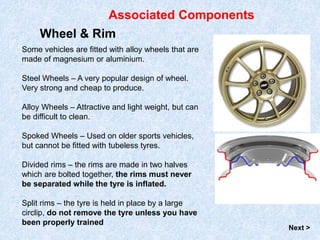
Some vehicles are fitted with alloy wheels that are
made of magnesium or aluminium.
Steel Wheels – A very popular design of wheel.
Very strong and cheap to produce.
Alloy Wheels – Attractive and light weight, but can
be difficult to clean.
Spoked Wheels – Used on older sports vehicles,
but cannot be fitted with tubeless tyres.
Divided rims – the rims are made in two halves
which are bolted together, the rims must never
be separated while the tyre is inflated.
Split rims – the tyre is held in place by a large
circlip, do not remove the tyre unless you have
been properly trained
Next >
Associated Components
Valve Stems
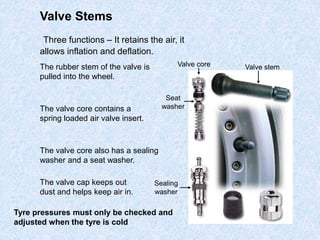
Three functions – It retains the air, it
allows inflation and deflation.
The rubber stem of the valve is
pulled into the wheel.
The valve core contains a
spring loaded air valve insert.
The valve core also has a sealing
washer and a seat washer.
The valve cap keeps out
dust and helps keep air in.
Sealing
washer
Seat
washer
Valve stemValve core
Tyre pressures must only be checked and
adjusted when the tyre is cold
TIRE CONSTRUCTION
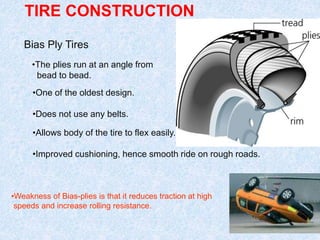
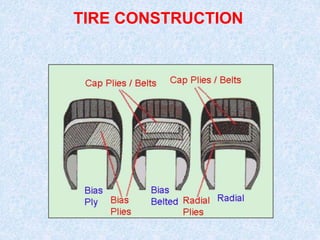
Bias Ply Tires
•The plies run at an angle from
bead to bead.
•One of the oldest design.
•Does not use any belts.
•Allows body of the tire to flex easily.
•Improved cushioning, hence smooth ride on rough roads.
•Weakness of Bias-plies is that it reduces traction at high
speeds and increase rolling resistance.
TIRE CONSTRUCTION
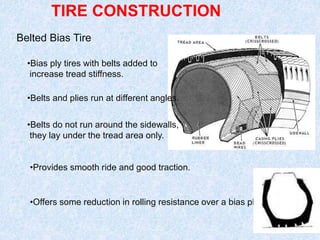
Belted Bias Tire
•Bias ply tires with belts added to
increase tread stiffness.
•Belts and plies run at different angles.
•Belts do not run around the sidewalls,
they lay under the tread area only.
•Provides smooth ride and good traction.
•Offers some reduction in rolling resistance over a bias ply tire.
TIRE CONSTRUCTION
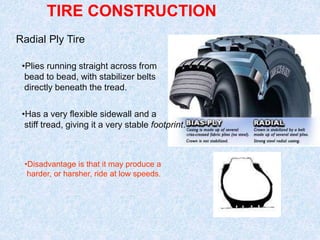
Radial Ply Tire
•Plies running straight across from
bead to bead, with stabilizer belts
directly beneath the tread.
•Has a very flexible sidewall and a
stiff tread, giving it a very stable footprint.
•Disadvantage is that it may produce a
harder, or harsher, ride at low speeds.
TIRE CONSTRUCTION
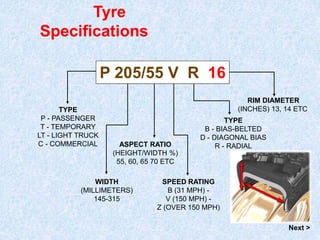
Tyre
Specifications
P 205/55 V R 16
TYPE
P - PASSENGER
T - TEMPORARY
LT - LIGHT TRUCK
C - COMMERCIAL
WIDTH
(MILLIMETERS)
145-315
ASPECT RATIO
(HEIGHT/WIDTH %)
55, 60, 65 70 ETC
TYPE
B - BIAS-BELTED
D - DIAGONAL BIAS
R - RADIAL
RIM DIAMETER
(INCHES) 13, 14 ETC
P 205/55 V R 16P 205/55 V R 16P 205/55 V R 16P 205/55 V R 16P 205/55 V R 16P 205/55 V R 16P 205/55 V R 16
SPEED RATING
B (31 MPH) -
V (150 MPH) -
Z (OVER 150 MPH)
Next >
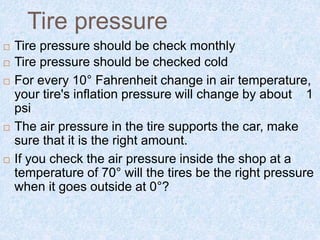
Tire pressure
 Tire pressure should be check monthly
 Tire pressure should be checked cold
 For every 10° Fahrenheit change in air temperature,
your tire's inflation pressure will change by about 1
psi
 The air pressure in the tire supports the car, make
sure that it is the right amount.
 If you check the air pressure inside the shop at a
temperature of 70° will the tires be the right pressure
when it goes outside at 0°?
Nitrogen in tires
 Nitrogen is a dry inert gas. That means
moisture free.
 Nitrogen leaks out of the sidewall three times
slower then oxygen.
 Oxygen oxidizes the rubber in the sidewall.
Plus the moisture in the air will rust the steel
rims.
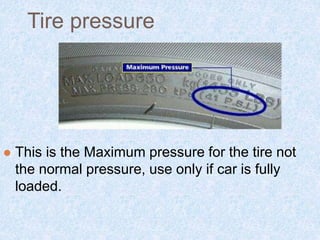
Tire pressure
 This is the Maximum pressure for the tire not
the normal pressure, use only if car is fully
loaded.
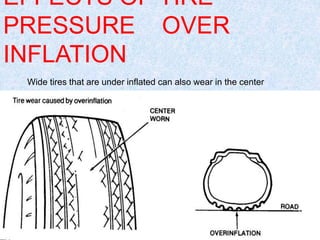
EFFECTS OF TIRE
PRESSURE OVER
INFLATION
Wide tires that are under inflated can also wear in the center
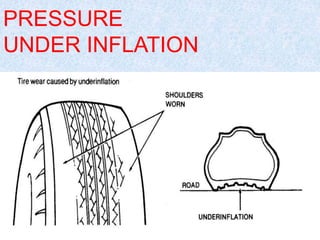
PRESSURE
UNDER INFLATION
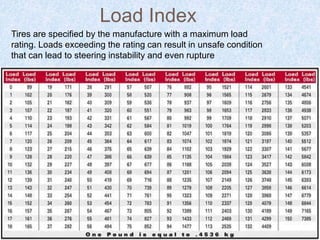
Load Index
Tires are specified by the manufacture with a maximum load
rating. Loads exceeding the rating can result in unsafe condition
that can lead to steering instability and even rupture
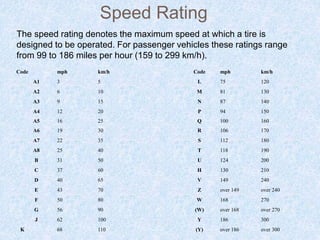
Speed Rating
Code mph km/h Code mph km/h
A1 3 5 L 75 120
A2 6 10 M 81 130
A3 9 15 N 87 140
A4 12 20 P 94 150
A5 16 25 Q 100 160
A6 19 30 R 106 170
A7 22 35 S 112 180
A8 25 40 T 118 190
B 31 50 U 124 200
C 37 60 H 130 210
D 40 65 V 149 240
E 43 70 Z over 149 over 240
F 50 80 W 168 270
G 56 90 (W) over 168 over 270
J 62 100 Y 186 300
K 68 110 (Y) over 186 over 300
The speed rating denotes the maximum speed at which a tire is
designed to be operated. For passenger vehicles these ratings range
from 99 to 186 miles per hour (159 to 299 km/h).
EFFECTS OF SPEED ON A
TIRE
Tires are tested under Laboratory conditions they are not
worn out, are properly inflated, not over loaded, damaged
or altered.
Just because the tire is rated at these speeds does not
mean the car is safe or legal to drive at those speeds.
Tire Sidewall
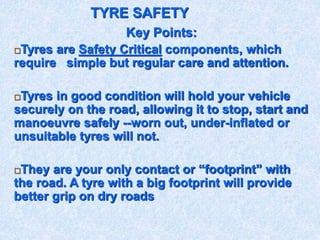
TYRE SAFETY
Key Points:
Tyres are Safety Critical components, which
require simple but regular care and attention.
Tyres in good condition will hold your vehicle
securely on the road, allowing it to stop, start and
manoeuvre safely --worn out, under-inflated or
unsuitable tyres will not.
They are your only contact or “footprint” with
the road. A tyre with a big footprint will provide
better grip on dry roads
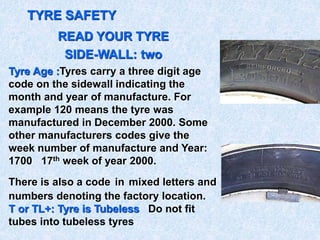
TYRE SAFETY
READ YOUR TYRE
SIDE-WALL: two
Tyre Age :Tyres carry a three digit age
code on the sidewall indicating the
month and year of manufacture. For
example 120 means the tyre was
manufactured in December 2000. Some
other manufacturers codes give the
week number of manufacture and Year:
1700 17th week of year 2000.
There is also a code in mixed letters and
numbers denoting the factory location.
T or TL+: Tyre is Tubeless Do not fit
tubes into tubeless tyres
TYRE SAFETY
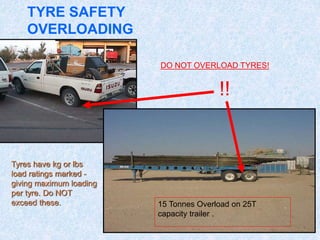
OVERLOADING
Csm15 Jun 03
15 Tonnes Overload on 25T
capacity trailer .
!!
DO NOT OVERLOAD TYRES!
Tyres have kg or lbs
load ratings marked -
giving maximum loading
per tyre. Do NOT
exceed these.
TYRE SAFETY
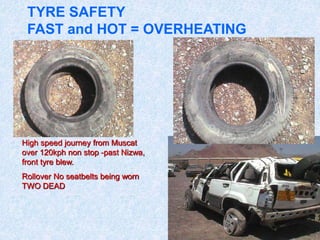
FAST and HOT = OVERHEATING
Csm15 Jun 03
High speed journey from Muscat
over 120kph non stop -past Nizwa,
front tyre blew.
Rollover No seatbelts being worn
TWO DEAD
THANK YOU
BY Pardeep Pal
2k12/PS/031

Tires

  • 1.
  • 2.
    Who Invented TheFirst Tire?  It was invented in 1888, by John Dunlop.  This would be the end of the solid tire.
  • 3.
    Tyres (Introduction) Basis Functions The tyre acts as the primary suspension, cushioning the vehicle from the effects of a rough surface.  It also provides frictional contact with the road surface.  This allows the driving wheels to move the vehicle.  The front tyres allows the wheels to steer .  The tyres allow the brakes to slow or stop the vehicle
  • 4.
    Components that go intoa tire.  Raw Rubber  Steel  Nylon  Polyester  Rayon  Carbon Black  Synthetic Rubber  Fiberglass  Aramid  Brass
  • 5.
    What percent ofa tire is rubber?  By weight, give or take 30%  By volume, quite a bite more. Tire compontents Rubber Steel Nylon Rayon Carbon Black Synthetic Rubber 0 10 20 30
  • 6.
    Why are TiresBlack?  To protect the rubber from the harmful UV rays.  A common type of UV stabilizer called a competitive absorber is added to capture and absorb these harmful UV light wave energy.
  • 7.
  • 8.
    TIRE PART •Beads tworings that are made of steel wire and encased in rubber. They hold tire side walls snugly against the rim. •Body Plies rubberized fabric and cords wrapped around beads. Form carcass or body of the tire. •Tread outer surface of the tire that contacts the road.
  • 9.
    TIRES PARTS •Sidewall outerpart of the tire that extends from the bead to the tread. Marking on the sidewall provides the information about the tire. •Liner thin layer of rubber that is bonded to the inside of the plies. It provides a leak proof membrane for tubeless tires. •Belts used to strengthen the body plies and and stiffen the tread. They lay between the tread and plies.
  • 10.
    Wheel & Rim Somevehicles are fitted with alloy wheels that are made of magnesium or aluminium. Steel Wheels – A very popular design of wheel. Very strong and cheap to produce. Alloy Wheels – Attractive and light weight, but can be difficult to clean. Spoked Wheels – Used on older sports vehicles, but cannot be fitted with tubeless tyres. Divided rims – the rims are made in two halves which are bolted together, the rims must never be separated while the tyre is inflated. Split rims – the tyre is held in place by a large circlip, do not remove the tyre unless you have been properly trained Next > Associated Components
  • 11.
    Valve Stems Three functions– It retains the air, it allows inflation and deflation. The rubber stem of the valve is pulled into the wheel. The valve core contains a spring loaded air valve insert. The valve core also has a sealing washer and a seat washer. The valve cap keeps out dust and helps keep air in. Sealing washer Seat washer Valve stemValve core Tyre pressures must only be checked and adjusted when the tyre is cold
  • 12.
    TIRE CONSTRUCTION Bias PlyTires •The plies run at an angle from bead to bead. •One of the oldest design. •Does not use any belts. •Allows body of the tire to flex easily. •Improved cushioning, hence smooth ride on rough roads. •Weakness of Bias-plies is that it reduces traction at high speeds and increase rolling resistance.
  • 13.
    TIRE CONSTRUCTION Belted BiasTire •Bias ply tires with belts added to increase tread stiffness. •Belts and plies run at different angles. •Belts do not run around the sidewalls, they lay under the tread area only. •Provides smooth ride and good traction. •Offers some reduction in rolling resistance over a bias ply tire.
  • 14.
    TIRE CONSTRUCTION Radial PlyTire •Plies running straight across from bead to bead, with stabilizer belts directly beneath the tread. •Has a very flexible sidewall and a stiff tread, giving it a very stable footprint. •Disadvantage is that it may produce a harder, or harsher, ride at low speeds.
  • 15.
  • 16.
    Tyre Specifications P 205/55 VR 16 TYPE P - PASSENGER T - TEMPORARY LT - LIGHT TRUCK C - COMMERCIAL WIDTH (MILLIMETERS) 145-315 ASPECT RATIO (HEIGHT/WIDTH %) 55, 60, 65 70 ETC TYPE B - BIAS-BELTED D - DIAGONAL BIAS R - RADIAL RIM DIAMETER (INCHES) 13, 14 ETC P 205/55 V R 16P 205/55 V R 16P 205/55 V R 16P 205/55 V R 16P 205/55 V R 16P 205/55 V R 16P 205/55 V R 16 SPEED RATING B (31 MPH) - V (150 MPH) - Z (OVER 150 MPH) Next >
  • 17.
    Tire pressure  Tirepressure should be check monthly  Tire pressure should be checked cold  For every 10° Fahrenheit change in air temperature, your tire's inflation pressure will change by about 1 psi  The air pressure in the tire supports the car, make sure that it is the right amount.  If you check the air pressure inside the shop at a temperature of 70° will the tires be the right pressure when it goes outside at 0°?
  • 18.
    Nitrogen in tires Nitrogen is a dry inert gas. That means moisture free.  Nitrogen leaks out of the sidewall three times slower then oxygen.  Oxygen oxidizes the rubber in the sidewall. Plus the moisture in the air will rust the steel rims.
  • 19.
    Tire pressure  Thisis the Maximum pressure for the tire not the normal pressure, use only if car is fully loaded.
  • 20.
    EFFECTS OF TIRE PRESSUREOVER INFLATION Wide tires that are under inflated can also wear in the center
  • 21.
  • 22.
    Load Index Tires arespecified by the manufacture with a maximum load rating. Loads exceeding the rating can result in unsafe condition that can lead to steering instability and even rupture
  • 23.
    Speed Rating Code mphkm/h Code mph km/h A1 3 5 L 75 120 A2 6 10 M 81 130 A3 9 15 N 87 140 A4 12 20 P 94 150 A5 16 25 Q 100 160 A6 19 30 R 106 170 A7 22 35 S 112 180 A8 25 40 T 118 190 B 31 50 U 124 200 C 37 60 H 130 210 D 40 65 V 149 240 E 43 70 Z over 149 over 240 F 50 80 W 168 270 G 56 90 (W) over 168 over 270 J 62 100 Y 186 300 K 68 110 (Y) over 186 over 300 The speed rating denotes the maximum speed at which a tire is designed to be operated. For passenger vehicles these ratings range from 99 to 186 miles per hour (159 to 299 km/h).
  • 24.
    EFFECTS OF SPEEDON A TIRE Tires are tested under Laboratory conditions they are not worn out, are properly inflated, not over loaded, damaged or altered. Just because the tire is rated at these speeds does not mean the car is safe or legal to drive at those speeds.
  • 25.
  • 26.
    TYRE SAFETY Key Points: Tyresare Safety Critical components, which require simple but regular care and attention. Tyres in good condition will hold your vehicle securely on the road, allowing it to stop, start and manoeuvre safely --worn out, under-inflated or unsuitable tyres will not. They are your only contact or “footprint” with the road. A tyre with a big footprint will provide better grip on dry roads
  • 27.
    TYRE SAFETY READ YOURTYRE SIDE-WALL: two Tyre Age :Tyres carry a three digit age code on the sidewall indicating the month and year of manufacture. For example 120 means the tyre was manufactured in December 2000. Some other manufacturers codes give the week number of manufacture and Year: 1700 17th week of year 2000. There is also a code in mixed letters and numbers denoting the factory location. T or TL+: Tyre is Tubeless Do not fit tubes into tubeless tyres
  • 28.
    TYRE SAFETY OVERLOADING Csm15 Jun03 15 Tonnes Overload on 25T capacity trailer . !! DO NOT OVERLOAD TYRES! Tyres have kg or lbs load ratings marked - giving maximum loading per tyre. Do NOT exceed these.
  • 29.
    TYRE SAFETY FAST andHOT = OVERHEATING Csm15 Jun 03 High speed journey from Muscat over 120kph non stop -past Nizwa, front tyre blew. Rollover No seatbelts being worn TWO DEAD
  • 30.
    THANK YOU BY PardeepPal 2k12/PS/031