Torsion Bars in
suspension system
(Automobile)
BY
D.Mahesh
G.Lokesh
Manoj
suspension system is a mechanical system
of springs or shock absorbers connecting
the wheels and axles to the chassis of a
wheeled vehicle.
 Control Arm
 Steering knuckle
 Ball joints
 Springs
 Shock absorber
Suspension:
Basic parts of suspension
• Leaf springs
• Coil springs
• Torsion bars
• Air springs.
Types of suspensions:
Purpose of suspension in car:
• Supports the weight
• Provides a smooth drive
• Keeps tires in firm contact with the
road
• It isolates the passengers and
cargo from vibration and shock
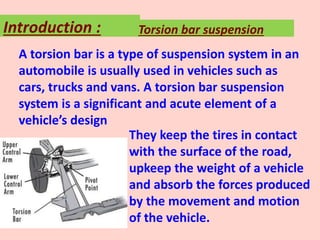
A torsion bar is a type of suspension system in an
automobile is usually used in vehicles such as
cars, trucks and vans. A torsion bar suspension
system is a significant and acute element of a
vehicle’s design
They keep the tires in contact
with the surface of the road,
upkeep the weight of a vehicle
and absorb the forces produced
by the movement and motion
of the vehicle.
Introduction : Torsion bar suspension
Torsion bar suspensions are basically metal
bars that perform the role of a spring. At one
end, the bar is fixed rigidly in place to the
chassis of a vehicle. The last end of the bar
may be fastened to the axle, suspension arm,
or a spindle, depending on the vehicle’s
design. For instance a vehicle travels alongside
the road, the forces made by the motion of
the vehicle produce torque on the bar, which
turns it along its axis.
Construction:
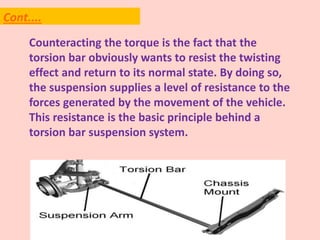
Counteracting the torque is the fact that the
torsion bar obviously wants to resist the twisting
effect and return to its normal state. By doing so,
the suspension supplies a level of resistance to the
forces generated by the movement of the vehicle.
This resistance is the basic principle behind a
torsion bar suspension system.
Cont....
The working principle of a torsion bar is a
shaft under torsion stresses. There is no other
kind of force being applied and material is
working up to the elastic limit.Torsion bars use
the twisting properties of a steel bar to offer
coil-spring-like functions. One end of a bar is
fixed rigidly to the vehicle frame. The further
end is fastened to a wishbone, which acts like
a lever that travels perpendicular to the
torsion bar.
Working:
When the wheel hits at a stone or projections,
vertical motion is shifted to the wishbone and
then, through the levering act, to the torsion bar.
The torsion bar then twists sideways its axis to
offer the spring force.
The torsion bar is basically a length of metal rod
anchored at one end to the car body and at the
other end to the suspension lower link. As the
wheel passes over a bump the bar twists. It
returns to its original position when the bump is
passed and restores the car to its normal drive
height.
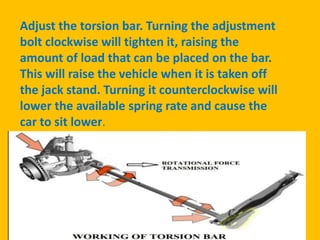
Adjust the torsion bar. Turning the adjustment
bolt clockwise will tighten it, raising the
amount of load that can be placed on the bar.
This will raise the vehicle when it is taken off
the jack stand. Turning it counterclockwise will
lower the available spring rate and cause the
car to sit lower.
 Some vehicles use torsion bars to provide
automatic levelling, using a motor to pre-stress
the bars to provide greater resistance to load
and, in some cases to respond to changes in
road conditions.
Features of Torsion bar suspension
 When adjusted, the torsion bar beneath
your vehicle raises and lowers your front
tires. While you can adjust this bar to create
a large wheel gap between your tire and
fender, you can also lower the height of
your car. Before making any changes to your
vehicle, measure the wheel gap on both
sides of your car or truck.
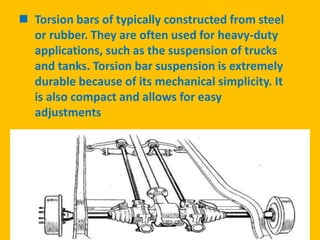
 Torsion bars of typically constructed from steel
or rubber. They are often used for heavy-duty
applications, such as the suspension of trucks
and tanks. Torsion bar suspension is extremely
durable because of its mechanical simplicity. It
is also compact and allows for easy
adjustments
Torsion bar suspensions are used on combat
vehicles and tanks like the T-72, Leopard 1,
Leopard 2, M26 Pershing, M18 Hellcat and on
modern trucks and SUVs from Ford, Chrysler,
GM, Mitsubishi, Mazda, Nissan, Isuzu, LuAZ,
and Toyota.
Application
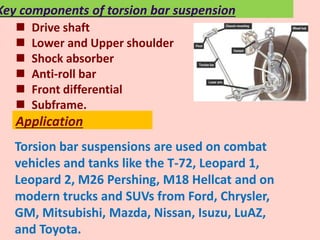
 Drive shaft
 Lower and Upper shoulder
 Shock absorber
 Anti-roll bar
 Front differential
 Subframe.
Key components of torsion bar suspension
 Soft ride due to elasticity of the bar
 Long Durability
 Easy adjustability of ride height and small
profile along the width of the vehicle
 It takes up less of the vehicle's interior
volume than coil springs.
 It can be produced quickly and at a minimal
cost
 They're easy to maintain
 Their parts can be easily replaced
 Restores the car to its normal drive height.
Advantages:
Disadvantages:
 It Do not offer progressive spring rate.
 The coils of the spring are spaced at
dissimilar distances from each other
 In most torsion bar systems, ride height
may be changed by simply adjusting bolts
that connect the torsion bars to the
steering knuckles.
 When the torsion bars are set to maximum
height, the truck's ride tends to turn horribly
harsh
ThankYou🌹

Torsion bars suspension

  • 1.
    Torsion Bars in suspensionsystem (Automobile) BY D.Mahesh G.Lokesh Manoj
  • 2.
    suspension system isa mechanical system of springs or shock absorbers connecting the wheels and axles to the chassis of a wheeled vehicle.  Control Arm  Steering knuckle  Ball joints  Springs  Shock absorber Suspension: Basic parts of suspension
  • 3.
    • Leaf springs •Coil springs • Torsion bars • Air springs. Types of suspensions: Purpose of suspension in car: • Supports the weight • Provides a smooth drive • Keeps tires in firm contact with the road • It isolates the passengers and cargo from vibration and shock
  • 4.
    A torsion baris a type of suspension system in an automobile is usually used in vehicles such as cars, trucks and vans. A torsion bar suspension system is a significant and acute element of a vehicle’s design They keep the tires in contact with the surface of the road, upkeep the weight of a vehicle and absorb the forces produced by the movement and motion of the vehicle. Introduction : Torsion bar suspension
  • 5.
    Torsion bar suspensionsare basically metal bars that perform the role of a spring. At one end, the bar is fixed rigidly in place to the chassis of a vehicle. The last end of the bar may be fastened to the axle, suspension arm, or a spindle, depending on the vehicle’s design. For instance a vehicle travels alongside the road, the forces made by the motion of the vehicle produce torque on the bar, which turns it along its axis. Construction:
  • 6.
    Counteracting the torqueis the fact that the torsion bar obviously wants to resist the twisting effect and return to its normal state. By doing so, the suspension supplies a level of resistance to the forces generated by the movement of the vehicle. This resistance is the basic principle behind a torsion bar suspension system. Cont....
  • 7.
    The working principleof a torsion bar is a shaft under torsion stresses. There is no other kind of force being applied and material is working up to the elastic limit.Torsion bars use the twisting properties of a steel bar to offer coil-spring-like functions. One end of a bar is fixed rigidly to the vehicle frame. The further end is fastened to a wishbone, which acts like a lever that travels perpendicular to the torsion bar. Working:
  • 8.
    When the wheelhits at a stone or projections, vertical motion is shifted to the wishbone and then, through the levering act, to the torsion bar. The torsion bar then twists sideways its axis to offer the spring force. The torsion bar is basically a length of metal rod anchored at one end to the car body and at the other end to the suspension lower link. As the wheel passes over a bump the bar twists. It returns to its original position when the bump is passed and restores the car to its normal drive height.
  • 9.
    Adjust the torsionbar. Turning the adjustment bolt clockwise will tighten it, raising the amount of load that can be placed on the bar. This will raise the vehicle when it is taken off the jack stand. Turning it counterclockwise will lower the available spring rate and cause the car to sit lower.
  • 10.
     Some vehiclesuse torsion bars to provide automatic levelling, using a motor to pre-stress the bars to provide greater resistance to load and, in some cases to respond to changes in road conditions. Features of Torsion bar suspension  When adjusted, the torsion bar beneath your vehicle raises and lowers your front tires. While you can adjust this bar to create a large wheel gap between your tire and fender, you can also lower the height of your car. Before making any changes to your vehicle, measure the wheel gap on both sides of your car or truck.
  • 11.
     Torsion barsof typically constructed from steel or rubber. They are often used for heavy-duty applications, such as the suspension of trucks and tanks. Torsion bar suspension is extremely durable because of its mechanical simplicity. It is also compact and allows for easy adjustments
  • 12.
    Torsion bar suspensionsare used on combat vehicles and tanks like the T-72, Leopard 1, Leopard 2, M26 Pershing, M18 Hellcat and on modern trucks and SUVs from Ford, Chrysler, GM, Mitsubishi, Mazda, Nissan, Isuzu, LuAZ, and Toyota. Application  Drive shaft  Lower and Upper shoulder  Shock absorber  Anti-roll bar  Front differential  Subframe. Key components of torsion bar suspension
  • 13.
     Soft ridedue to elasticity of the bar  Long Durability  Easy adjustability of ride height and small profile along the width of the vehicle  It takes up less of the vehicle's interior volume than coil springs.  It can be produced quickly and at a minimal cost  They're easy to maintain  Their parts can be easily replaced  Restores the car to its normal drive height. Advantages:
  • 14.
    Disadvantages:  It Donot offer progressive spring rate.  The coils of the spring are spaced at dissimilar distances from each other  In most torsion bar systems, ride height may be changed by simply adjusting bolts that connect the torsion bars to the steering knuckles.  When the torsion bars are set to maximum height, the truck's ride tends to turn horribly harsh
  • 15.