STEERING SYSTEM DESIGN
    KEY TERMS
   Camber
   Caster
   Directional Stability
   Geometric Centerline
   Lead
   Parallelism
   Pull
   Steering Axis
   Thrust Angle
   Toe
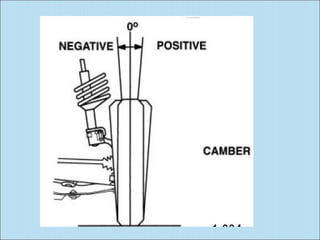
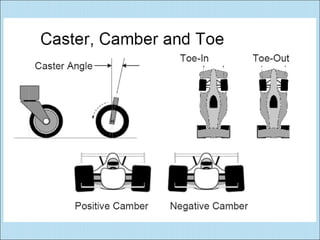
CAMBER:-
 Camber is the inward or outward tilt of the
  wheel when compared with a true vertical line.
 Camber is positive when the top of the wheel
  is tilted out.
 Camber is negative when the top of the wheel
  is tilted in.
 It is at zero when the wheel is vertical
  (straight up and down). Front wheels usually
  have small positive camber.
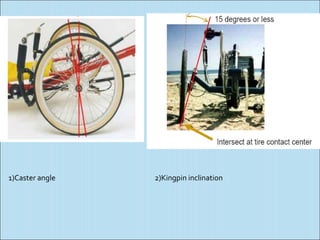
CASTER:-
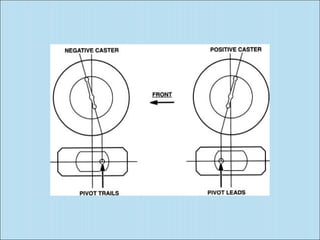
 Caster is the forward or backward tilt of the
    steering axis when compared with a true
    vertical line.
 Caster is positive if the axis is leaning
    rearward.
   Caster is negative if the axis is leaning
    forward.
   It is zero when the steering axis is straight up
    or down.
   Caster is measured in degrees. Most vehicles
   have a small amount of positive caster.
Caster gives the front wheels the ability to return to
 the straight ahead position after a turn. Caster also
provides directional stability.

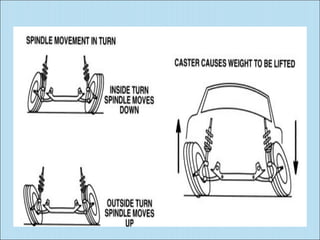
When a wheel is turned out, the spindle lowers and raises
the vehicle. When a wheel is turned in, the spindle raises
and lowers the vehicle.

When the wheels are released from a turn, the weight of
the vehicle helps move each spindle back toward the
mid-point until the load is equal on both front wheels.
1)Caster angle   2)Kingpin inclination
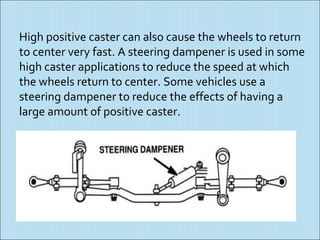
High positive caster can also cause the wheels to return
to center very fast. A steering dampener is used in some
high caster applications to reduce the speed at which
the wheels return to center. Some vehicles use a
steering dampener to reduce the effects of having a
large amount of positive caster.
DIRECTIONAL STABILITY:-
 Directional stability is needed to keep vehicles
  going ion a straight line or in line with the
  direction of the steering wheel.
 Steering and suspension systems are closely
  related, and in most cases, are dependent
  upon each other.
 The steering system allows the driver to
  direct the movement of the vehicle.
 The most common front steering systems are
  the parallelogram and rack-and-pinion
  steering systems.
TOE:-
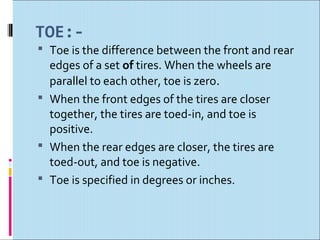
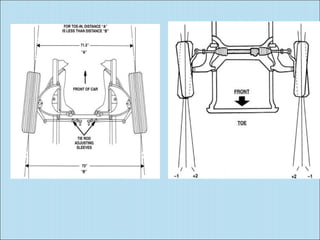
 Toe is the difference between the front and rear
  edges of a set of tires. When the wheels are
  parallel to each other, toe is zero.
 When the front edges of the tires are closer
  together, the tires are toed-in, and toe is
  positive.
 When the rear edges are closer, the tires are
  toed-out, and toe is negative.
 Toe is specified in degrees or inches.
GEOMETRIC CENTERLINE:-
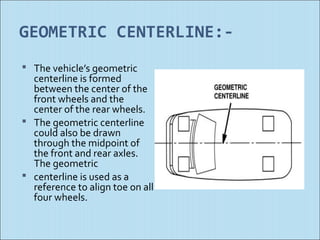
 The vehicle’s geometric
  centerline is formed
  between the center of the
  front wheels and the
  center of the rear wheels.
 The geometric centerline
  could also be drawn
  through the midpoint of
  the front and rear axles.
  The geometric
 centerline is used as a
  reference to align toe on all
  four wheels.
THRUST ANGLE:-
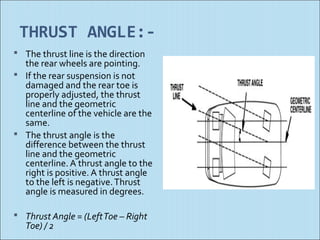
 The thrust line is the direction
  the rear wheels are pointing.
 If the rear suspension is not
  damaged and the rear toe is
  properly adjusted, the thrust
  line and the geometric
  centerline of the vehicle are the
  same.
 The thrust angle is the
  difference between the thrust
  line and the geometric
  centerline. A thrust angle to the
  right is positive. A thrust angle
  to the left is negative. Thrust
  angle is measured in degrees.

 Thrust Angle = (Left Toe – Right
   Toe) / 2
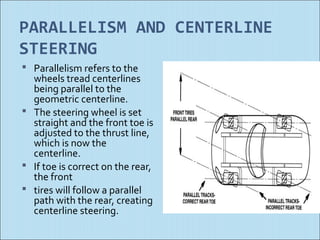
PARALLELISM AND CENTERLINE
STEERING
 Parallelism refers to the
  wheels tread centerlines
  being parallel to the
  geometric centerline.
 The steering wheel is set
  straight and the front toe is
  adjusted to the thrust line,
  which is now the
  centerline.
 If toe is correct on the rear,
  the front
 tires will follow a parallel
  path with the rear, creating
  centerline steering.
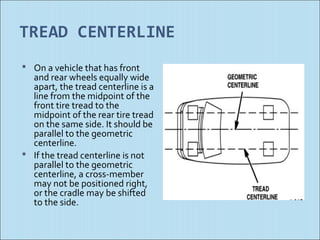
TREAD CENTERLINE
 On a vehicle that has front
  and rear wheels equally wide
  apart, the tread centerline is a
  line from the midpoint of the
  front tire tread to the
  midpoint of the rear tire tread
  on the same side. It should be
  parallel to the geometric
  centerline.
 If the tread centerline is not
  parallel to the geometric
  centerline, a cross-member
  may not be positioned right,
  or the cradle may be shifted
  to the side.
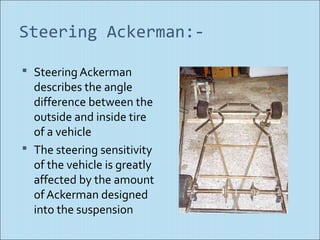
Steering Ackerman:-

 Steering Ackerman
  describes the angle
  difference between the
  outside and inside tire
  of a vehicle
 The steering sensitivity
  of the vehicle is greatly
  affected by the amount
  of Ackerman designed
  into the suspension
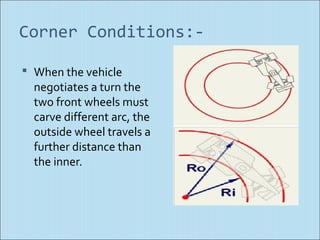
Corner Conditions:-

 When the vehicle
  negotiates a turn the
  two front wheels must
  carve different arc, the
  outside wheel travels a
  further distance than
  the inner.
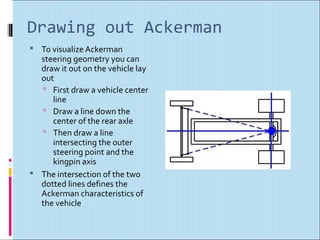
Drawing out Ackerman
 To visualize Ackerman
  steering geometry you can
  draw it out on the vehicle lay
  out
   First draw a vehicle center
     line
   Draw a line down the
     center of the rear axle
   Then draw a line
     intersecting the outer
     steering point and the
     kingpin axis
 The intersection of the two
  dotted lines defines the
  Ackerman characteristics of
  the vehicle
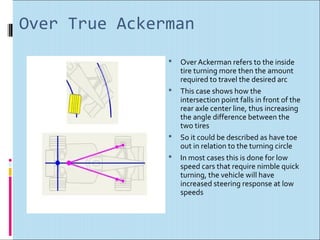
Over True Ackerman
                  Over Ackerman refers to the inside
                   tire turning more then the amount
                   required to travel the desired arc
                  This case shows how the
                   intersection point falls in front of the
                   rear axle center line, thus increasing
                   the angle difference between the
                   two tires
                  So it could be described as have toe
                   out in relation to the turning circle
                  In most cases this is done for low
                   speed cars that require nimble quick
                   turning, the vehicle will have
                   increased steering response at low
                   speeds
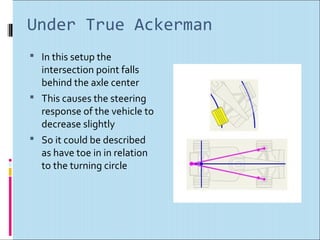
Under True Ackerman
 In this setup the
  intersection point falls
  behind the axle center
 This causes the steering
  response of the vehicle to
  decrease slightly
 So it could be described
  as have toe in in relation
  to the turning circle
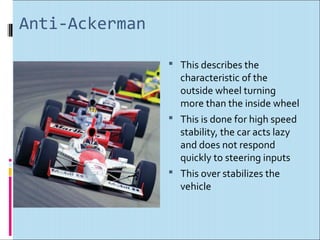
Anti-Ackerman

                 This describes the
                  characteristic of the
                  outside wheel turning
                  more than the inside wheel
                 This is done for high speed
                  stability, the car acts lazy
                  and does not respond
                  quickly to steering inputs
                 This over stabilizes the
                  vehicle
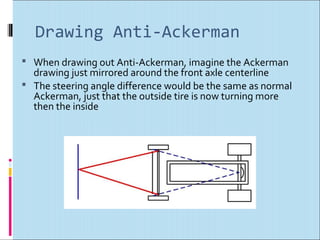
Drawing Anti-Ackerman
 When drawing out Anti-Ackerman, imagine the Ackerman
  drawing just mirrored around the front axle centerline
 The steering angle difference would be the same as normal
  Ackerman, just that the outside tire is now turning more
  then the inside
Requirements

 On passenger cars, the driver must select the
  steering wheel angle to keep deviation from
  the desired course low.
 turns of the steering wheel;
 alteration of steer angle at the front wheels;
 development of lateral tyre forces;
 alteration of driving direction.
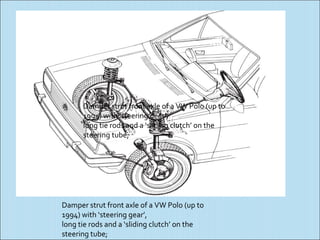
Damper strut front axle of a VW Polo (up to
      1994) with ‘steering gear’,
      long tie rods and a ‘sliding clutch’ on the
      steering tube;


Damper strut front axle of a VW Polo (up to
1994) with ‘steering gear’,
long tie rods and a ‘sliding clutch’ on the
steering tube;
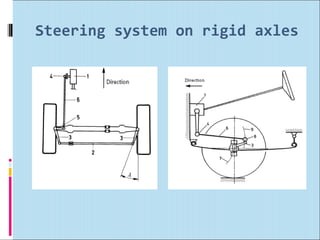
Steering system on rigid axles
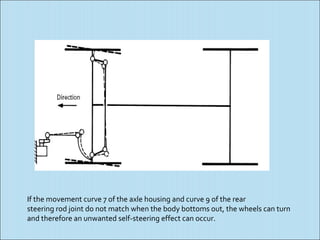
If the movement curve 7 of the axle housing and curve 9 of the rear
steering rod joint do not match when the body bottoms out, the wheels can turn
and therefore an unwanted self-steering effect can occur.
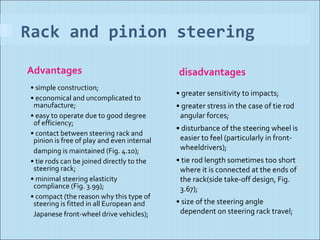
Rack and pinion steering

Advantages                                  disadvantages
• simple construction;
                                            • greater sensitivity to impacts;
• economical and uncomplicated to
 manufacture;                               • greater stress in the case of tie rod
• easy to operate due to good degree         angular forces;
 of efficiency;
                                            • disturbance of the steering wheel is
• contact between steering rack and
 pinion is free of play and even internal    easier to feel (particularly in front-
 damping is maintained (Fig. 4.10);          wheeldrivers);
• tie rods can be joined directly to the    • tie rod length sometimes too short
 steering rack;                              where it is connected at the ends of
• minimal steering elasticity                the rack(side take-off design, Fig.
 compliance (Fig. 3.99);                     3.67);
• compact (the reason why this type of
 steering is fitted in all European and     • size of the steering angle
 Japanese front-wheel drive vehicles);       dependent on steering rack travel;
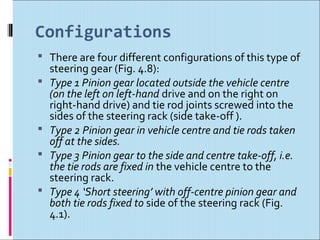
Configurations
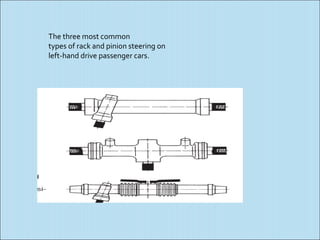
 There are four different configurations of this type of
    steering gear (Fig. 4.8):
   Type 1 Pinion gear located outside the vehicle centre
    (on the left on left-hand drive and on the right on
    right-hand drive) and tie rod joints screwed into the
    sides of the steering rack (side take-off ).
   Type 2 Pinion gear in vehicle centre and tie rods taken
    off at the sides.
   Type 3 Pinion gear to the side and centre take-off, i.e.
    the tie rods are fixed in the vehicle centre to the
    steering rack.
   Type 4 ‘Short steering’ with off-centre pinion gear and
    both tie rods fixed to side of the steering rack (Fig.
    4.1).
The three most common
types of rack and pinion steering on
left-hand drive passenger cars.
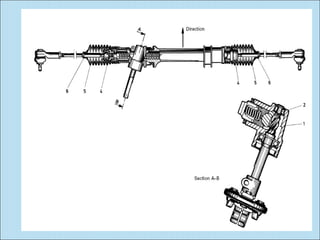
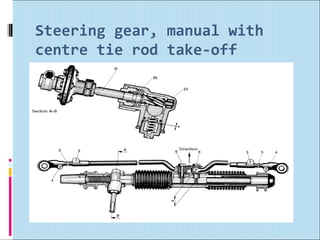
Steering gear, manual with
centre tie rod take-off
Recirculating ball steering

Advantage                       Disadvantage
 • Can be used on rigid         • This type of steering system
 axles.                           is more complicated on the
                                  whole in passenger cars with
 • Ability to transfer high       independently suspended
 forces.                          front wheels.
 • A large wheel input angle    • more expensive than rack and
                                  pinion steering systems.
 possible – the steering gear
                                • it sometimes has greater
 shaft has a rotation range
                                  steering elasticity, which
 up to ±45°, which can be         reduces the responsiveness
 further increased by the         and steering feel in the on-
 steering ratio.                  centre range
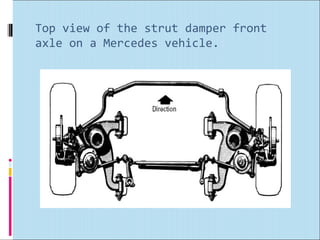
Top view of the strut damper front
axle on a Mercedes vehicle.
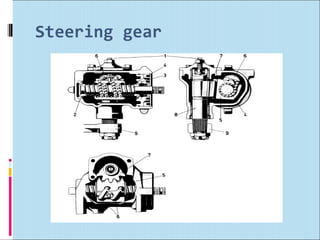
Steering gear
Power steering systems
 Power steering systems have become more and
  more widely used in the last few years.
 Manual steering systems are used as a basis for
  power steering systems, with the advantage that
  the mechanical connection between the steering
  wheel and the wheel and all the components
  continues to be maintained with or without the
  help of the auxiliary power.
 The steering boost is thereby reduced, with the
  aim of achieving better road contact at higher
  speeds.
Hydraulic power steering
systems
 The method of using oil under pressure to boost
  the servo is sophisticated and advantageous in
  terms of cost, space and weight.
 This can be attributed to the hydraulic self-
  damping.
 The oil pump is directly driven by the engine and
  constantly generates hydraulic power.
 Depending on the driving assembly and pump
  design, the additional consumption of fuel can lie
  between 0.2 and 0.7 l per 100 km.
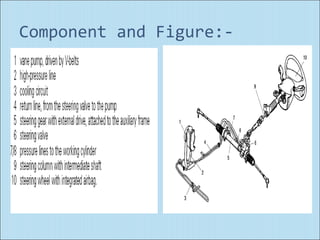
Component and Figure:-
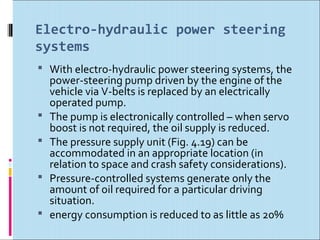
Electro-hydraulic power steering
systems
 With electro-hydraulic power steering systems, the
    power-steering pump driven by the engine of the
    vehicle via V-belts is replaced by an electrically
    operated pump.
   The pump is electronically controlled – when servo
    boost is not required, the oil supply is reduced.
   The pressure supply unit (Fig. 4.19) can be
    accommodated in an appropriate location (in
    relation to space and crash safety considerations).
   Pressure-controlled systems generate only the
    amount of oil required for a particular driving
    situation.
   energy consumption is reduced to as little as 20%
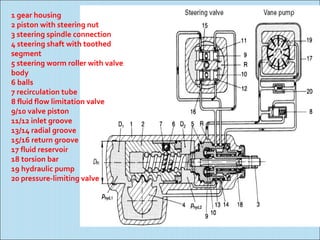
1 gear housing
2 piston with steering nut
3 steering spindle connection
4 steering shaft with toothed
segment
5 steering worm roller with valve
body
6 balls
7 recirculation tube
8 fluid flow limitation valve
9/10 valve piston
11/12 inlet groove
13/14 radial groove
15/16 return groove
17 fluid reservoir
18 torsion bar
19 hydraulic pump
20 pressure-limiting valve
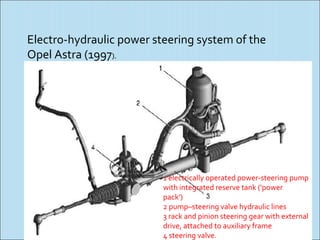
Electro-hydraulic power steering system of the
Opel Astra (1997).


                          1 electrically operated power-steering pump
                          with integrated reserve tank (‘power
                          pack’)
                          2 pump–steering valve hydraulic lines
                          3 rack and pinion steering gear with external
                          drive, attached to auxiliary frame
                          4 steering valve.
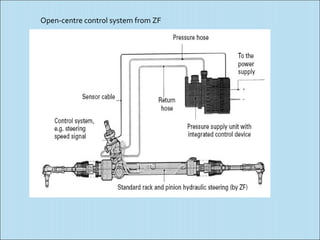
Open-centre control system from ZF
Electrical power steering systems
 The bypass of the hydraulic circuit and direct
    steering boost with the aid of an electric motor
    has additional advantages in terms of weight.
   Engine bay space compared with electro-
    hydraulic steering, because of the omission of all
    the hydraulic components.
   more variations of the steering boost because of
    the purely electrical signal processing.
   The systems only have limited power because
    the current is limited by an operating voltage of
    12 V.
   They are of interest though for smaller vehicles.
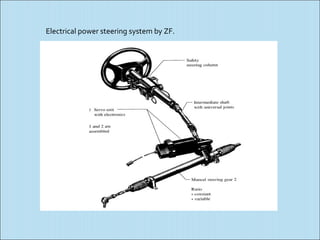
Electrical power steering system by ZF.
Steering column
 the steering column consists of the jacket tube
  (also known as the outer tube or protective
  sleeve), which is fixed to the body.
 The steering shaft, also called the steering tube.
  This is only mounted in bearings at the top (or
  top and bottom) and transfers the steering-
  wheel moment MH to the steering gear.
 If the steering column does not align with the
  extension of the pinion gear axis (or the steering
  screw), an intermediate shaft with two universal
  joints is necessary
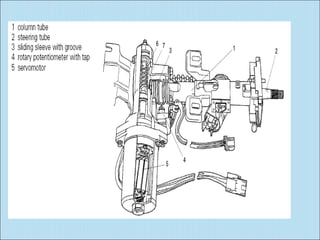
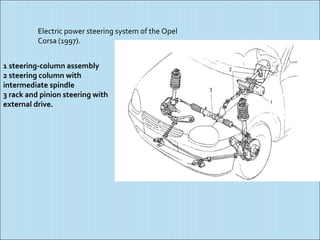
Electric power steering system of the Opel
          Corsa (1997).


1 steering-column assembly
2 steering column with
intermediate spindle
3 rack and pinion steering with
external drive.
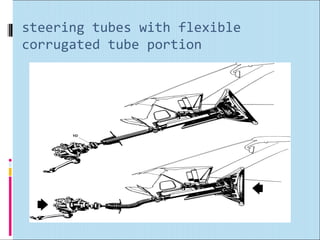
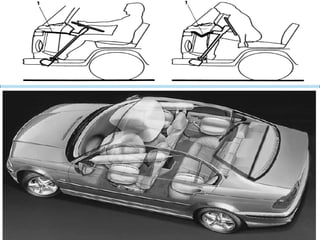
steering tubes with flexible
corrugated tube portion
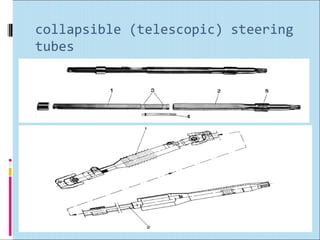
collapsible (telescopic) steering
tubes
Thank You

Steering

  • 2.
    STEERING SYSTEM DESIGN KEY TERMS  Camber  Caster  Directional Stability  Geometric Centerline  Lead  Parallelism  Pull  Steering Axis  Thrust Angle  Toe
  • 3.
    CAMBER:-  Camber isthe inward or outward tilt of the wheel when compared with a true vertical line.  Camber is positive when the top of the wheel is tilted out.  Camber is negative when the top of the wheel is tilted in.  It is at zero when the wheel is vertical (straight up and down). Front wheels usually have small positive camber.
  • 5.
    CASTER:-  Caster isthe forward or backward tilt of the steering axis when compared with a true vertical line.  Caster is positive if the axis is leaning rearward.  Caster is negative if the axis is leaning forward.  It is zero when the steering axis is straight up or down.  Caster is measured in degrees. Most vehicles  have a small amount of positive caster.
  • 6.
    Caster gives thefront wheels the ability to return to the straight ahead position after a turn. Caster also provides directional stability. When a wheel is turned out, the spindle lowers and raises the vehicle. When a wheel is turned in, the spindle raises and lowers the vehicle. When the wheels are released from a turn, the weight of the vehicle helps move each spindle back toward the mid-point until the load is equal on both front wheels.
  • 8.
    1)Caster angle 2)Kingpin inclination
  • 9.
    High positive castercan also cause the wheels to return to center very fast. A steering dampener is used in some high caster applications to reduce the speed at which the wheels return to center. Some vehicles use a steering dampener to reduce the effects of having a large amount of positive caster.
  • 11.
    DIRECTIONAL STABILITY:-  Directionalstability is needed to keep vehicles going ion a straight line or in line with the direction of the steering wheel.  Steering and suspension systems are closely related, and in most cases, are dependent upon each other.  The steering system allows the driver to direct the movement of the vehicle.  The most common front steering systems are the parallelogram and rack-and-pinion steering systems.
  • 12.
    TOE:-  Toe isthe difference between the front and rear edges of a set of tires. When the wheels are parallel to each other, toe is zero.  When the front edges of the tires are closer together, the tires are toed-in, and toe is positive.  When the rear edges are closer, the tires are toed-out, and toe is negative.  Toe is specified in degrees or inches.
  • 14.
    GEOMETRIC CENTERLINE:-  Thevehicle’s geometric centerline is formed between the center of the front wheels and the center of the rear wheels.  The geometric centerline could also be drawn through the midpoint of the front and rear axles. The geometric  centerline is used as a reference to align toe on all four wheels.
  • 15.
    THRUST ANGLE:-  Thethrust line is the direction the rear wheels are pointing.  If the rear suspension is not damaged and the rear toe is properly adjusted, the thrust line and the geometric centerline of the vehicle are the same.  The thrust angle is the difference between the thrust line and the geometric centerline. A thrust angle to the right is positive. A thrust angle to the left is negative. Thrust angle is measured in degrees.  Thrust Angle = (Left Toe – Right Toe) / 2
  • 16.
    PARALLELISM AND CENTERLINE STEERING Parallelism refers to the wheels tread centerlines being parallel to the geometric centerline.  The steering wheel is set straight and the front toe is adjusted to the thrust line, which is now the centerline.  If toe is correct on the rear, the front  tires will follow a parallel path with the rear, creating centerline steering.
  • 17.
    TREAD CENTERLINE  Ona vehicle that has front and rear wheels equally wide apart, the tread centerline is a line from the midpoint of the front tire tread to the midpoint of the rear tire tread on the same side. It should be parallel to the geometric centerline.  If the tread centerline is not parallel to the geometric centerline, a cross-member may not be positioned right, or the cradle may be shifted to the side.
  • 19.
    Steering Ackerman:-  SteeringAckerman describes the angle difference between the outside and inside tire of a vehicle  The steering sensitivity of the vehicle is greatly affected by the amount of Ackerman designed into the suspension
  • 20.
    Corner Conditions:-  Whenthe vehicle negotiates a turn the two front wheels must carve different arc, the outside wheel travels a further distance than the inner.
  • 21.
    Drawing out Ackerman To visualize Ackerman steering geometry you can draw it out on the vehicle lay out  First draw a vehicle center line  Draw a line down the center of the rear axle  Then draw a line intersecting the outer steering point and the kingpin axis  The intersection of the two dotted lines defines the Ackerman characteristics of the vehicle
  • 22.
    Over True Ackerman  Over Ackerman refers to the inside tire turning more then the amount required to travel the desired arc  This case shows how the intersection point falls in front of the rear axle center line, thus increasing the angle difference between the two tires  So it could be described as have toe out in relation to the turning circle  In most cases this is done for low speed cars that require nimble quick turning, the vehicle will have increased steering response at low speeds
  • 23.
    Under True Ackerman In this setup the intersection point falls behind the axle center  This causes the steering response of the vehicle to decrease slightly  So it could be described as have toe in in relation to the turning circle
  • 24.
    Anti-Ackerman  This describes the characteristic of the outside wheel turning more than the inside wheel  This is done for high speed stability, the car acts lazy and does not respond quickly to steering inputs  This over stabilizes the vehicle
  • 25.
    Drawing Anti-Ackerman  Whendrawing out Anti-Ackerman, imagine the Ackerman drawing just mirrored around the front axle centerline  The steering angle difference would be the same as normal Ackerman, just that the outside tire is now turning more then the inside
  • 26.
    Requirements On passengercars, the driver must select the steering wheel angle to keep deviation from the desired course low.  turns of the steering wheel;  alteration of steer angle at the front wheels;  development of lateral tyre forces;  alteration of driving direction.
  • 27.
    Damper strut frontaxle of a VW Polo (up to 1994) with ‘steering gear’, long tie rods and a ‘sliding clutch’ on the steering tube; Damper strut front axle of a VW Polo (up to 1994) with ‘steering gear’, long tie rods and a ‘sliding clutch’ on the steering tube;
  • 28.
    Steering system onrigid axles
  • 29.
    If the movementcurve 7 of the axle housing and curve 9 of the rear steering rod joint do not match when the body bottoms out, the wheels can turn and therefore an unwanted self-steering effect can occur.
  • 30.
    Rack and pinionsteering Advantages disadvantages • simple construction; • greater sensitivity to impacts; • economical and uncomplicated to manufacture; • greater stress in the case of tie rod • easy to operate due to good degree angular forces; of efficiency; • disturbance of the steering wheel is • contact between steering rack and pinion is free of play and even internal easier to feel (particularly in front- damping is maintained (Fig. 4.10); wheeldrivers); • tie rods can be joined directly to the • tie rod length sometimes too short steering rack; where it is connected at the ends of • minimal steering elasticity the rack(side take-off design, Fig. compliance (Fig. 3.99); 3.67); • compact (the reason why this type of steering is fitted in all European and • size of the steering angle Japanese front-wheel drive vehicles); dependent on steering rack travel;
  • 31.
    Configurations  There arefour different configurations of this type of steering gear (Fig. 4.8):  Type 1 Pinion gear located outside the vehicle centre (on the left on left-hand drive and on the right on right-hand drive) and tie rod joints screwed into the sides of the steering rack (side take-off ).  Type 2 Pinion gear in vehicle centre and tie rods taken off at the sides.  Type 3 Pinion gear to the side and centre take-off, i.e. the tie rods are fixed in the vehicle centre to the steering rack.  Type 4 ‘Short steering’ with off-centre pinion gear and both tie rods fixed to side of the steering rack (Fig. 4.1).
  • 32.
    The three mostcommon types of rack and pinion steering on left-hand drive passenger cars.
  • 34.
    Steering gear, manualwith centre tie rod take-off
  • 35.
    Recirculating ball steering Advantage Disadvantage • Can be used on rigid • This type of steering system axles. is more complicated on the whole in passenger cars with • Ability to transfer high independently suspended forces. front wheels. • A large wheel input angle • more expensive than rack and pinion steering systems. possible – the steering gear • it sometimes has greater shaft has a rotation range steering elasticity, which up to ±45°, which can be reduces the responsiveness further increased by the and steering feel in the on- steering ratio. centre range
  • 36.
    Top view ofthe strut damper front axle on a Mercedes vehicle.
  • 37.
  • 38.
    Power steering systems Power steering systems have become more and more widely used in the last few years.  Manual steering systems are used as a basis for power steering systems, with the advantage that the mechanical connection between the steering wheel and the wheel and all the components continues to be maintained with or without the help of the auxiliary power.  The steering boost is thereby reduced, with the aim of achieving better road contact at higher speeds.
  • 39.
    Hydraulic power steering systems The method of using oil under pressure to boost the servo is sophisticated and advantageous in terms of cost, space and weight.  This can be attributed to the hydraulic self- damping.  The oil pump is directly driven by the engine and constantly generates hydraulic power.  Depending on the driving assembly and pump design, the additional consumption of fuel can lie between 0.2 and 0.7 l per 100 km.
  • 40.
  • 41.
    Electro-hydraulic power steering systems With electro-hydraulic power steering systems, the power-steering pump driven by the engine of the vehicle via V-belts is replaced by an electrically operated pump.  The pump is electronically controlled – when servo boost is not required, the oil supply is reduced.  The pressure supply unit (Fig. 4.19) can be accommodated in an appropriate location (in relation to space and crash safety considerations).  Pressure-controlled systems generate only the amount of oil required for a particular driving situation.  energy consumption is reduced to as little as 20%
  • 42.
    1 gear housing 2piston with steering nut 3 steering spindle connection 4 steering shaft with toothed segment 5 steering worm roller with valve body 6 balls 7 recirculation tube 8 fluid flow limitation valve 9/10 valve piston 11/12 inlet groove 13/14 radial groove 15/16 return groove 17 fluid reservoir 18 torsion bar 19 hydraulic pump 20 pressure-limiting valve
  • 43.
    Electro-hydraulic power steeringsystem of the Opel Astra (1997). 1 electrically operated power-steering pump with integrated reserve tank (‘power pack’) 2 pump–steering valve hydraulic lines 3 rack and pinion steering gear with external drive, attached to auxiliary frame 4 steering valve.
  • 44.
  • 45.
    Electrical power steeringsystems  The bypass of the hydraulic circuit and direct steering boost with the aid of an electric motor has additional advantages in terms of weight.  Engine bay space compared with electro- hydraulic steering, because of the omission of all the hydraulic components.  more variations of the steering boost because of the purely electrical signal processing.  The systems only have limited power because the current is limited by an operating voltage of 12 V.  They are of interest though for smaller vehicles.
  • 47.
  • 48.
    Steering column  thesteering column consists of the jacket tube (also known as the outer tube or protective sleeve), which is fixed to the body.  The steering shaft, also called the steering tube. This is only mounted in bearings at the top (or top and bottom) and transfers the steering- wheel moment MH to the steering gear.  If the steering column does not align with the extension of the pinion gear axis (or the steering screw), an intermediate shaft with two universal joints is necessary
  • 49.
    Electric power steeringsystem of the Opel Corsa (1997). 1 steering-column assembly 2 steering column with intermediate spindle 3 rack and pinion steering with external drive.
  • 50.
    steering tubes withflexible corrugated tube portion
  • 52.
  • 53.