SUMMER INTERNSHIP 2015
“WHEELS AND TYRES”
KHANDELWAL MOTOR AGENCIES,
MATHURA
Supervisor Co-Supervisor
Mr. A Kumar Mr. Vashisth
By
KHUSHIN LAKSHKAR
15 SEPTEMBER 2015 BY: KHUSHIN LAKSHKAR 1
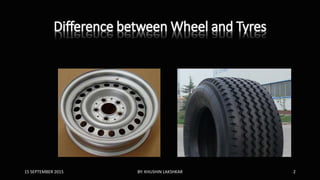
Difference between Wheel and Tyres
15 SEPTEMBER 2015 BY: KHUSHIN LAKSHKAR 2
TYRES
• A cushion provided with wheel.
• It consists of mainly the outer cover i.e. the tyre proper and the tube
inside.
• The tube assembly is mounted over the wheel rim.
• Air inside the tube that carries the entire load and provides the cushion.
• Deal with the worst possible forces, shocks and other parameters and also
absorb most of the shocks thus providing a smooth ride.
• Modern tyre consist of an inflatable rubber ring fitted round the wheel.
• Vehicles activities such as acceleration, vehicle control and braking occurs
through the tyres and their contact on the road surface.
15 SEPTEMBER 2015 BY: KHUSHIN LAKSHKAR 3
Function Of Tyre
• To support the vehicle load.
• To provide cushion against shock.
• To transmit driving and braking forces to the road.
• To provide cornering power for smooth steering.
• It must be strong enough to carry loads and resist damage.
• It must have a long lifetime and run smoothly.
• Must meet all the requirement of all weather conditions and on all surfaces
without overheating.
• It must provide good road grip for traction, cornering, accelerating and
braking.
15 SEPTEMBER 2015 BY: KHUSHIN LAKSHKAR 4
Desirable Properties
• NON SKIDDING :-Tread pattern on the tyre must be suitably designed
to permit the least amount of skidding.
• UNIFORM WEAR :-To maintain the non-skidding property, the wear
on the tyre tread must be uniform. The ribbed pattern on the tyre
help to accomplish this.
• LOAD CARRYING:-Tyre material and the design must be able to
ensure that the tyre is able to sustain stresses developed in all
conditions.
• CUSHIONING :- Tyre should be able to absorb small high frequency
vibration set up by the road surface and thus providing cushioning
effect.
15 SEPTEMBER 2015 BY: KHUSHIN LAKSHKAR 5
Desirable Properties
• POWER CONSUMPPTION :- The automotive tyre absorb some power
due to friction between the tread rubber and the road surface and
also due to hysteresis loss on account of the tyre being continuously
fixed release, should be least as less as possible.
• TYRES NOISE :- Tyre noise may be in the form of definite pattern sing,
a sequel, or aloud sound, Should be minimum.
• BALANCING :- As a rotating part of automobile, must be balance
statically and dynamically. Absence of balance give rise to peculiar
oscillation called wheel tramp and wheel wobble.
15 SEPTEMBER 2015 BY: KHUSHIN LAKSHKAR 6
Classification of Tyres
On basis of Construction
Conventional Tyre
Tubeless Tyre
On basis of Carcass or Skelton
 Cross Ply Tyre
 Radial Ply Tyre
 Belted-Bias Tyre
15 SEPTEMBER 2015 BY: KHUSHIN LAKSHKAR 7
Conventional Tube Tyre
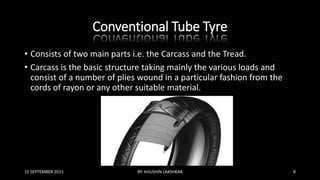
• Consists of two main parts i.e. the Carcass and the Tread.
• Carcass is the basic structure taking mainly the various loads and
consist of a number of plies wound in a particular fashion from the
cords of rayon or any other suitable material.
15 SEPTEMBER 2015 BY: KHUSHIN LAKSHKAR 8
Conventional Tube Tyre
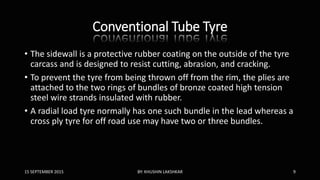
• The sidewall is a protective rubber coating on the outside of the tyre
carcass and is designed to resist cutting, abrasion, and cracking.
• To prevent the tyre from being thrown off from the rim, the plies are
attached to the two rings of bundles of bronze coated high tension
steel wire strands insulated with rubber.
• A radial load tyre normally has one such bundle in the lead whereas a
cross ply tyre for off road use may have two or three bundles.
15 SEPTEMBER 2015 BY: KHUSHIN LAKSHKAR 9
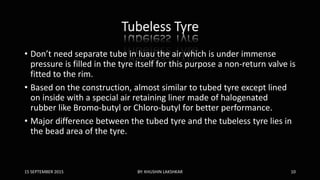
• Don’t need separate tube in luau the air which is under immense
pressure is filled in the tyre itself for this purpose a non-return valve is
fitted to the rim.
• Based on the construction, almost similar to tubed tyre except lined
on inside with a special air retaining liner made of halogenated
rubber like Bromo-butyl or Chloro-butyl for better performance.
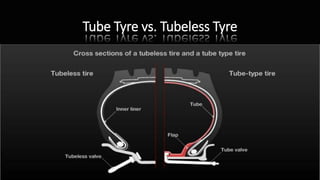
• Major difference between the tubed tyre and the tubeless tyre lies in
the bead area of the tyre.
15 SEPTEMBER 2015 BY: KHUSHIN LAKSHKAR 10
Tube Tyre vs. Tubeless Tyre
15 SEPTEMBER 2015 BY: KHUSHIN LAKSHKAR 11
Excellence of Tubeless Tyre over Tube Tyre
• LESSER UN-SPRUNG WEIGHT :- Lighter compared to tubed tyre, reduces
wheel bounce and un-sprung weight overall it saves fuel.
• BETTER COOLING :- In case of tubed tyres, the heat associated with the
compressed air has to passed though the tube material i.e. rubber which is
a good conductor of heat. The absence of tube makes it possible for the
heat to be transferred to the atmosphere directly resulting in better cooling
ultimately increasing the life time of the tyre.
• COMFORTABLE RIDE :- Tubeless tyre absorb shock and vibration are
absorbed at the tyre level thus making the ride softer, less noisy and more
comfortable.
• SLOWER LEAKAGE OF AIR :- The inner liner in the tubeless tyre is not
stretched like the tube it retains the air better resulting in its slower
leakage.
15 SEPTEMBER 2015 BY: KHUSHIN LAKSHKAR 12
Excellence of Tubeless Tyre over Tube Tyre
• SIMPLE ASSEMBLY :- Tubeless tyre only the tyre has to be fitted to the rim
making it invulnerable to punctured during its operation.
• LESSER ROLLING RESISTANCE :- Rolling resistance in the tubeless tyre is less
compared to the tubed based tyre, tubeless tyre sidewall is more mobile as
there is no internal tube to generate heat and friction. This also helps the
tyre to remain cooler by eliminating the risk of generating heat.
• IMPROVED SAFETY :- In the presence of hole in the tyre it can be repaired
simply by plugging whereas in case of conventional tubed tyres it is time
consuming as the whole tyre has to be remove for repair. A tubeless tyre
retains the air pressure for a long period even when it is punctured by a
nail provided, placed at the same position. Thus the risk of being punctured
is greatly reduced promoting reduce accident or improved safety.
15 SEPTEMBER 2015 BY: KHUSHIN LAKSHKAR 13
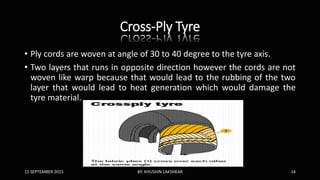
Cross-Ply Tyre
• Ply cords are woven at angle of 30 to 40 degree to the tyre axis.
• Two layers that runs in opposite direction however the cords are not
woven like warp because that would lead to the rubbing of the two
layer that would lead to heat generation which would damage the
tyre material.
15 SEPTEMBER 2015 BY: KHUSHIN LAKSHKAR 14
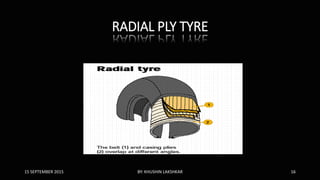
RADIAL PLY TYRE
• Ply cords run in the radial direction i.e. in the direction of the tyre
axis.
• Over this runs a number of breaker strips in the circumferential
direction.
• The material for breaker strip must be flexible and inextensible so
that no change of circumference takes place with change in the
amount of inflation.
• The inextensible breaker provides the direction stability and the belt
increase the rigidity of the tread thereby improving its resistance over
cut and other effects.
15 SEPTEMBER 2015 BY: KHUSHIN LAKSHKAR 15
RADIAL PLY TYRE
15 SEPTEMBER 2015 BY: KHUSHIN LAKSHKAR 16
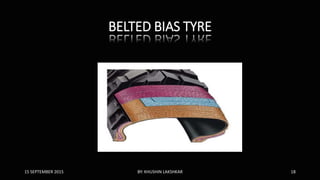
BELTED BIAS TYRE
• Combination of both the radial and cross ply type.
• Basic construction is the bias ply over which run a number of breaker
belts .
• The belt improve the characteristic of the bias ply to a large extent
1. The stresses in the carcass are restricted and the tread area is
stabilized due to belts thus results in reduction of tread scrubbing
and ultimately increase the life of the tyre.
2. The breaker belt hold the tread flatter against the road surface
thus causing increase of traction and safety
3. The belt increase the resistance of the tyre to cut and puncture.
15 SEPTEMBER 2015 BY: KHUSHIN LAKSHKAR 17
BELTED BIAS TYRE
15 SEPTEMBER 2015 BY: KHUSHIN LAKSHKAR 18
Maintenance of Tyres
• Most important is to maintain proper inflation pressure. Both the under
inflation and over inflation results in unsatisfactory performance of the
vehicle.
• Two important steps for maintenance
1. TYRE ROTATION
2. TYRE INSPECTION
• TYRE ROTATION :- Tyre rotation in such a way that the tyres does not run in
the same position for more than a specified mileage say 5000 to 10000
miles. Rotation equalise wear and minimises the noise of the tyre. The tyre
must be rotated in a definite pattern and the same pattern must be carried
out after every rotation.
15 SEPTEMBER 2015 BY: KHUSHIN LAKSHKAR 19
Maintenance of Tyres
• TYRE INSPECTION :- A Regular inspection of the tyre for wear is
mandatory in Order to get the optimum performance out of the tyre.
• Tyre tread should not wear out to a depth less than 1.6 mm. This
wear should be even through the tread.
• Tyres have tread wear bands which appear when the tread depth
reduces to less than 1.6 mm. When these bands appear on the tyres
in two or more adjacent groves the tyre should be replaced.
• The tyre should not only be inspected for tread wear but also for side
wear and damage.
15 SEPTEMBER 2015 BY: KHUSHIN LAKSHKAR 20
WHEELS
• Wheels along with the tyre has to take the vehicle load, provide a
cushioning effect and cope with the steering control.
• Various requirement of an automobile requirement are:
1. Strong enough to perform the above functions.
2. Balanced both statically and dynamically.
3. Possible to remove or stand the vehicle wheel easily.
4. As lightest as possible so that the un-sprung weight is least.
5. Easy to clean, easy to wash and be of good quality.
15 SEPTEMBER 2015 BY: KHUSHIN LAKSHKAR 21
WHEELS
6. Should not deteriorate with age and weathering. If material is
vulnerable to corrosion, must be given suitable protective
treatment.
7. must be of maximum strength to take the weight road shocks,
driving torque and must be able to compensate all sorts of load
varying in magnitude and direction.
8. must be strong enough to resist local deformation or when it hits
a road kerb or any other obstacle.
15 SEPTEMBER 2015 BY: KHUSHIN LAKSHKAR 22
TYPES OF AUTOMOBILES WHEELS
1. PRESSED STEEL DISC
2. WHEELS WITH STEELWIRE SPOKES
3. LIGHT ALLOY CASTING WHEELS.
15 SEPTEMBER 2015 BY: KHUSHIN LAKSHKAR 23
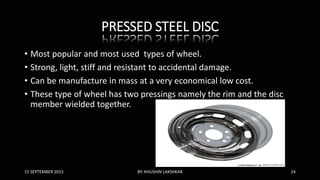
PRESSED STEEL DISC
• Most popular and most used types of wheel.
• Strong, light, stiff and resistant to accidental damage.
• Can be manufacture in mass at a very economical low cost.
• These type of wheel has two pressings namely the rim and the disc
member wielded together.
15 SEPTEMBER 2015 BY: KHUSHIN LAKSHKAR 24
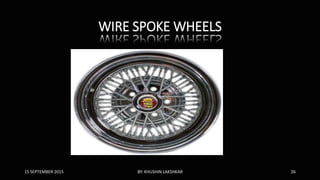
WIRE SPOKE WHEELS
• Oldest in design but remained in use largely because of light weight and
strong construction but costly.
• Rim attached to the hub through wire spokes.
• Much stronger in tension and transmit all the forces to the rim.
• Spoke has very little resistance to the bending, fastened so that complex
loads coming on the wheels are resolved into tensile load evenly
distributed among the adequate number of spokes.
• The stress and loads faced by car wheel are very complex, more critical in
cases such as accelerating, braking and cornering and when such action is
required. More often the spokes have different sets to take the
acceleration, braking and weight forces.
• Also able to take the side thrust during cornering by having a triangular
pattern.
15 SEPTEMBER 2015 BY: KHUSHIN LAKSHKAR 25
WIRE SPOKE WHEELS
15 SEPTEMBER 2015 BY: KHUSHIN LAKSHKAR 26
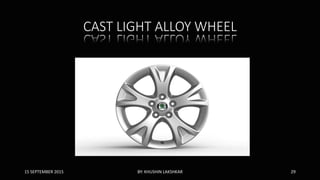
LIGHT ALLOY CAST WHEEL
• made from casting of light alloys of aluminium and magnesium.
• Wider rims and radial ribs, also acts as angled spokes to provide
strength and air circulation.
• Construction avoids any sharp lines and angles to improve strength.
• Disadvantages over the other two, specially use in racing car.
• Aluminium and magnesium are usually.
15 SEPTEMBER 2015 BY: KHUSHIN LAKSHKAR 27
LIGHT ALLOY CAST WHEEL
• Light in weight.
• Heavier sections can be used to improve the stiffness of the wheel and
result in better stress distribution.
• Rims with larger area can be used, results in the use of wider tyres with
less diameter, an absolute advantage in racing car since the lower centre of
gravity and wider tyres result in better road grip particularly during
cornering.
• Better conductor of heat and hence heat dissipation from tyres and brakes
is improved.
• Only corrosion is the main problem, chemically sensitive to salt spray and
need regular checking and inspection for corrosion.
15 SEPTEMBER 2015 BY: KHUSHIN LAKSHKAR 28
CAST LIGHT ALLOY WHEEL
15 SEPTEMBER 2015 BY: KHUSHIN LAKSHKAR 29
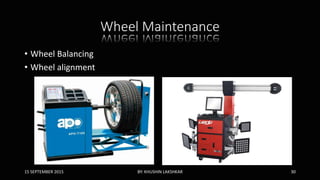
Wheel Maintenance
• Wheel Balancing
• Wheel alignment
15 SEPTEMBER 2015 BY: KHUSHIN LAKSHKAR 30
15 SEPTEMBER 2015 BY: KHUSHIN LAKSHKAR 31

Wheel And tyres

  • 1.
    SUMMER INTERNSHIP 2015 “WHEELSAND TYRES” KHANDELWAL MOTOR AGENCIES, MATHURA Supervisor Co-Supervisor Mr. A Kumar Mr. Vashisth By KHUSHIN LAKSHKAR 15 SEPTEMBER 2015 BY: KHUSHIN LAKSHKAR 1
  • 2.
    Difference between Wheeland Tyres 15 SEPTEMBER 2015 BY: KHUSHIN LAKSHKAR 2
  • 3.
    TYRES • A cushionprovided with wheel. • It consists of mainly the outer cover i.e. the tyre proper and the tube inside. • The tube assembly is mounted over the wheel rim. • Air inside the tube that carries the entire load and provides the cushion. • Deal with the worst possible forces, shocks and other parameters and also absorb most of the shocks thus providing a smooth ride. • Modern tyre consist of an inflatable rubber ring fitted round the wheel. • Vehicles activities such as acceleration, vehicle control and braking occurs through the tyres and their contact on the road surface. 15 SEPTEMBER 2015 BY: KHUSHIN LAKSHKAR 3
  • 4.
    Function Of Tyre •To support the vehicle load. • To provide cushion against shock. • To transmit driving and braking forces to the road. • To provide cornering power for smooth steering. • It must be strong enough to carry loads and resist damage. • It must have a long lifetime and run smoothly. • Must meet all the requirement of all weather conditions and on all surfaces without overheating. • It must provide good road grip for traction, cornering, accelerating and braking. 15 SEPTEMBER 2015 BY: KHUSHIN LAKSHKAR 4
  • 5.
    Desirable Properties • NONSKIDDING :-Tread pattern on the tyre must be suitably designed to permit the least amount of skidding. • UNIFORM WEAR :-To maintain the non-skidding property, the wear on the tyre tread must be uniform. The ribbed pattern on the tyre help to accomplish this. • LOAD CARRYING:-Tyre material and the design must be able to ensure that the tyre is able to sustain stresses developed in all conditions. • CUSHIONING :- Tyre should be able to absorb small high frequency vibration set up by the road surface and thus providing cushioning effect. 15 SEPTEMBER 2015 BY: KHUSHIN LAKSHKAR 5
  • 6.
    Desirable Properties • POWERCONSUMPPTION :- The automotive tyre absorb some power due to friction between the tread rubber and the road surface and also due to hysteresis loss on account of the tyre being continuously fixed release, should be least as less as possible. • TYRES NOISE :- Tyre noise may be in the form of definite pattern sing, a sequel, or aloud sound, Should be minimum. • BALANCING :- As a rotating part of automobile, must be balance statically and dynamically. Absence of balance give rise to peculiar oscillation called wheel tramp and wheel wobble. 15 SEPTEMBER 2015 BY: KHUSHIN LAKSHKAR 6
  • 7.
    Classification of Tyres Onbasis of Construction Conventional Tyre Tubeless Tyre On basis of Carcass or Skelton  Cross Ply Tyre  Radial Ply Tyre  Belted-Bias Tyre 15 SEPTEMBER 2015 BY: KHUSHIN LAKSHKAR 7
  • 8.
    Conventional Tube Tyre •Consists of two main parts i.e. the Carcass and the Tread. • Carcass is the basic structure taking mainly the various loads and consist of a number of plies wound in a particular fashion from the cords of rayon or any other suitable material. 15 SEPTEMBER 2015 BY: KHUSHIN LAKSHKAR 8
  • 9.
    Conventional Tube Tyre •The sidewall is a protective rubber coating on the outside of the tyre carcass and is designed to resist cutting, abrasion, and cracking. • To prevent the tyre from being thrown off from the rim, the plies are attached to the two rings of bundles of bronze coated high tension steel wire strands insulated with rubber. • A radial load tyre normally has one such bundle in the lead whereas a cross ply tyre for off road use may have two or three bundles. 15 SEPTEMBER 2015 BY: KHUSHIN LAKSHKAR 9
  • 10.
    • Don’t needseparate tube in luau the air which is under immense pressure is filled in the tyre itself for this purpose a non-return valve is fitted to the rim. • Based on the construction, almost similar to tubed tyre except lined on inside with a special air retaining liner made of halogenated rubber like Bromo-butyl or Chloro-butyl for better performance. • Major difference between the tubed tyre and the tubeless tyre lies in the bead area of the tyre. 15 SEPTEMBER 2015 BY: KHUSHIN LAKSHKAR 10
  • 11.
    Tube Tyre vs.Tubeless Tyre 15 SEPTEMBER 2015 BY: KHUSHIN LAKSHKAR 11
  • 12.
    Excellence of TubelessTyre over Tube Tyre • LESSER UN-SPRUNG WEIGHT :- Lighter compared to tubed tyre, reduces wheel bounce and un-sprung weight overall it saves fuel. • BETTER COOLING :- In case of tubed tyres, the heat associated with the compressed air has to passed though the tube material i.e. rubber which is a good conductor of heat. The absence of tube makes it possible for the heat to be transferred to the atmosphere directly resulting in better cooling ultimately increasing the life time of the tyre. • COMFORTABLE RIDE :- Tubeless tyre absorb shock and vibration are absorbed at the tyre level thus making the ride softer, less noisy and more comfortable. • SLOWER LEAKAGE OF AIR :- The inner liner in the tubeless tyre is not stretched like the tube it retains the air better resulting in its slower leakage. 15 SEPTEMBER 2015 BY: KHUSHIN LAKSHKAR 12
  • 13.
    Excellence of TubelessTyre over Tube Tyre • SIMPLE ASSEMBLY :- Tubeless tyre only the tyre has to be fitted to the rim making it invulnerable to punctured during its operation. • LESSER ROLLING RESISTANCE :- Rolling resistance in the tubeless tyre is less compared to the tubed based tyre, tubeless tyre sidewall is more mobile as there is no internal tube to generate heat and friction. This also helps the tyre to remain cooler by eliminating the risk of generating heat. • IMPROVED SAFETY :- In the presence of hole in the tyre it can be repaired simply by plugging whereas in case of conventional tubed tyres it is time consuming as the whole tyre has to be remove for repair. A tubeless tyre retains the air pressure for a long period even when it is punctured by a nail provided, placed at the same position. Thus the risk of being punctured is greatly reduced promoting reduce accident or improved safety. 15 SEPTEMBER 2015 BY: KHUSHIN LAKSHKAR 13
  • 14.
    Cross-Ply Tyre • Plycords are woven at angle of 30 to 40 degree to the tyre axis. • Two layers that runs in opposite direction however the cords are not woven like warp because that would lead to the rubbing of the two layer that would lead to heat generation which would damage the tyre material. 15 SEPTEMBER 2015 BY: KHUSHIN LAKSHKAR 14
  • 15.
    RADIAL PLY TYRE •Ply cords run in the radial direction i.e. in the direction of the tyre axis. • Over this runs a number of breaker strips in the circumferential direction. • The material for breaker strip must be flexible and inextensible so that no change of circumference takes place with change in the amount of inflation. • The inextensible breaker provides the direction stability and the belt increase the rigidity of the tread thereby improving its resistance over cut and other effects. 15 SEPTEMBER 2015 BY: KHUSHIN LAKSHKAR 15
  • 16.
    RADIAL PLY TYRE 15SEPTEMBER 2015 BY: KHUSHIN LAKSHKAR 16
  • 17.
    BELTED BIAS TYRE •Combination of both the radial and cross ply type. • Basic construction is the bias ply over which run a number of breaker belts . • The belt improve the characteristic of the bias ply to a large extent 1. The stresses in the carcass are restricted and the tread area is stabilized due to belts thus results in reduction of tread scrubbing and ultimately increase the life of the tyre. 2. The breaker belt hold the tread flatter against the road surface thus causing increase of traction and safety 3. The belt increase the resistance of the tyre to cut and puncture. 15 SEPTEMBER 2015 BY: KHUSHIN LAKSHKAR 17
  • 18.
    BELTED BIAS TYRE 15SEPTEMBER 2015 BY: KHUSHIN LAKSHKAR 18
  • 19.
    Maintenance of Tyres •Most important is to maintain proper inflation pressure. Both the under inflation and over inflation results in unsatisfactory performance of the vehicle. • Two important steps for maintenance 1. TYRE ROTATION 2. TYRE INSPECTION • TYRE ROTATION :- Tyre rotation in such a way that the tyres does not run in the same position for more than a specified mileage say 5000 to 10000 miles. Rotation equalise wear and minimises the noise of the tyre. The tyre must be rotated in a definite pattern and the same pattern must be carried out after every rotation. 15 SEPTEMBER 2015 BY: KHUSHIN LAKSHKAR 19
  • 20.
    Maintenance of Tyres •TYRE INSPECTION :- A Regular inspection of the tyre for wear is mandatory in Order to get the optimum performance out of the tyre. • Tyre tread should not wear out to a depth less than 1.6 mm. This wear should be even through the tread. • Tyres have tread wear bands which appear when the tread depth reduces to less than 1.6 mm. When these bands appear on the tyres in two or more adjacent groves the tyre should be replaced. • The tyre should not only be inspected for tread wear but also for side wear and damage. 15 SEPTEMBER 2015 BY: KHUSHIN LAKSHKAR 20
  • 21.
    WHEELS • Wheels alongwith the tyre has to take the vehicle load, provide a cushioning effect and cope with the steering control. • Various requirement of an automobile requirement are: 1. Strong enough to perform the above functions. 2. Balanced both statically and dynamically. 3. Possible to remove or stand the vehicle wheel easily. 4. As lightest as possible so that the un-sprung weight is least. 5. Easy to clean, easy to wash and be of good quality. 15 SEPTEMBER 2015 BY: KHUSHIN LAKSHKAR 21
  • 22.
    WHEELS 6. Should notdeteriorate with age and weathering. If material is vulnerable to corrosion, must be given suitable protective treatment. 7. must be of maximum strength to take the weight road shocks, driving torque and must be able to compensate all sorts of load varying in magnitude and direction. 8. must be strong enough to resist local deformation or when it hits a road kerb or any other obstacle. 15 SEPTEMBER 2015 BY: KHUSHIN LAKSHKAR 22
  • 23.
    TYPES OF AUTOMOBILESWHEELS 1. PRESSED STEEL DISC 2. WHEELS WITH STEELWIRE SPOKES 3. LIGHT ALLOY CASTING WHEELS. 15 SEPTEMBER 2015 BY: KHUSHIN LAKSHKAR 23
  • 24.
    PRESSED STEEL DISC •Most popular and most used types of wheel. • Strong, light, stiff and resistant to accidental damage. • Can be manufacture in mass at a very economical low cost. • These type of wheel has two pressings namely the rim and the disc member wielded together. 15 SEPTEMBER 2015 BY: KHUSHIN LAKSHKAR 24
  • 25.
    WIRE SPOKE WHEELS •Oldest in design but remained in use largely because of light weight and strong construction but costly. • Rim attached to the hub through wire spokes. • Much stronger in tension and transmit all the forces to the rim. • Spoke has very little resistance to the bending, fastened so that complex loads coming on the wheels are resolved into tensile load evenly distributed among the adequate number of spokes. • The stress and loads faced by car wheel are very complex, more critical in cases such as accelerating, braking and cornering and when such action is required. More often the spokes have different sets to take the acceleration, braking and weight forces. • Also able to take the side thrust during cornering by having a triangular pattern. 15 SEPTEMBER 2015 BY: KHUSHIN LAKSHKAR 25
  • 26.
    WIRE SPOKE WHEELS 15SEPTEMBER 2015 BY: KHUSHIN LAKSHKAR 26
  • 27.
    LIGHT ALLOY CASTWHEEL • made from casting of light alloys of aluminium and magnesium. • Wider rims and radial ribs, also acts as angled spokes to provide strength and air circulation. • Construction avoids any sharp lines and angles to improve strength. • Disadvantages over the other two, specially use in racing car. • Aluminium and magnesium are usually. 15 SEPTEMBER 2015 BY: KHUSHIN LAKSHKAR 27
  • 28.
    LIGHT ALLOY CASTWHEEL • Light in weight. • Heavier sections can be used to improve the stiffness of the wheel and result in better stress distribution. • Rims with larger area can be used, results in the use of wider tyres with less diameter, an absolute advantage in racing car since the lower centre of gravity and wider tyres result in better road grip particularly during cornering. • Better conductor of heat and hence heat dissipation from tyres and brakes is improved. • Only corrosion is the main problem, chemically sensitive to salt spray and need regular checking and inspection for corrosion. 15 SEPTEMBER 2015 BY: KHUSHIN LAKSHKAR 28
  • 29.
    CAST LIGHT ALLOYWHEEL 15 SEPTEMBER 2015 BY: KHUSHIN LAKSHKAR 29
  • 30.
    Wheel Maintenance • WheelBalancing • Wheel alignment 15 SEPTEMBER 2015 BY: KHUSHIN LAKSHKAR 30
  • 31.
    15 SEPTEMBER 2015BY: KHUSHIN LAKSHKAR 31

Editor's Notes

  • #8 The use of solid tyres on automobile is now outdated and only the pneumatic tyres are used universally. These pneumatic tyres may be classified according to the following consideration 1.Basic construction 2.Use 3.Ability to run flat
  • #9 term ply rating which is often used in tyre industry does not indicate exact number of plies in the tyre