TYRE TYPES
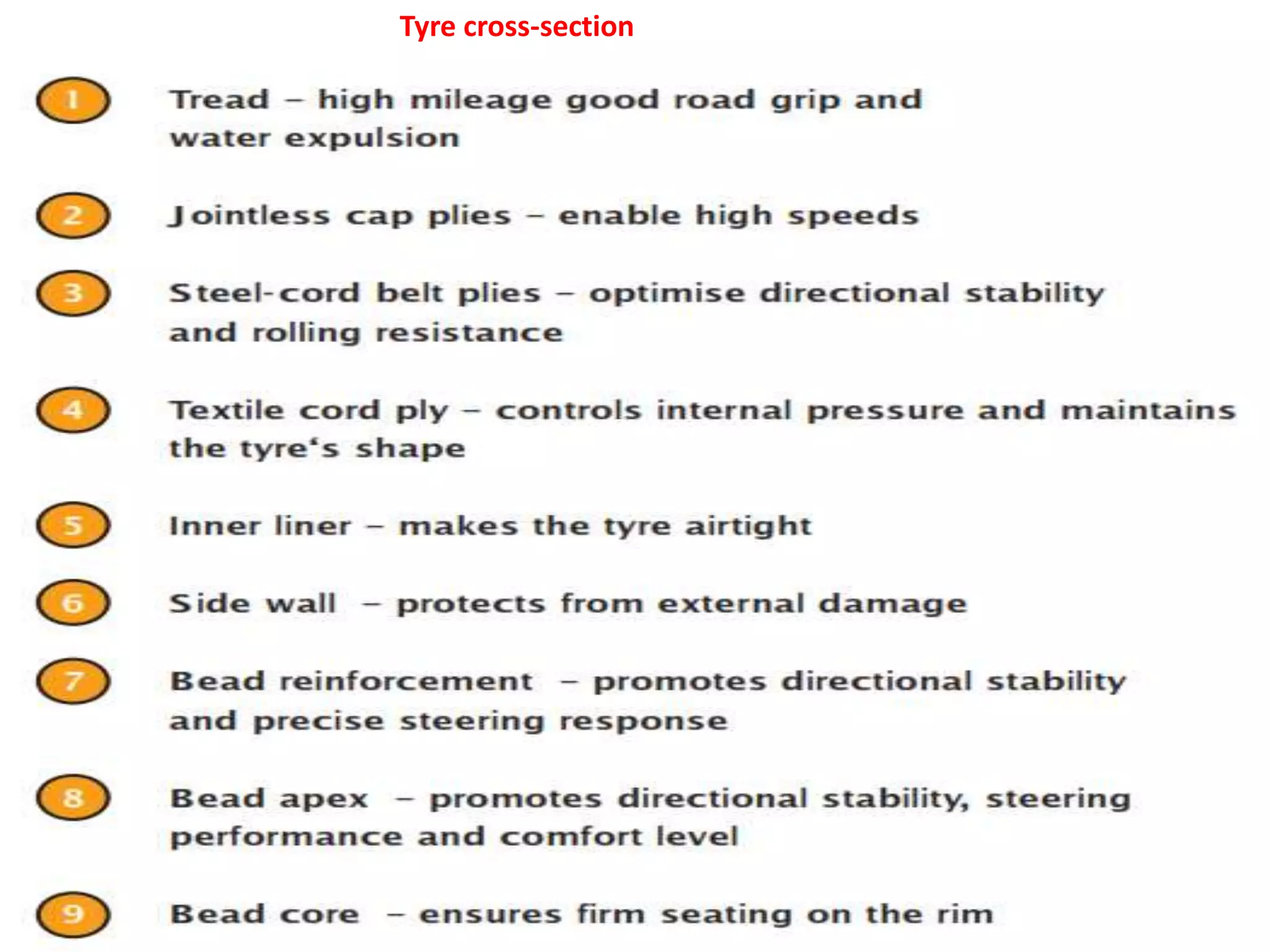
Tyre cross-section
Tyre cross-section
Tire Cutaway
Types of Tyres
Types of tyres
Conventional tubed tyre.
Tubeless tyre.
Tubed tyre
Tubeless tyre
Advantages of tubeless tyres
Lesser unsprung weight.
Better cooling.
Lesser rolling resistance.
Comfortable ride.
Slower leakage of air.
Simpler assembly.
Improved safety.
Tyre Construction
OR
Types of carcass(Tread)
OR
Tyre Construction
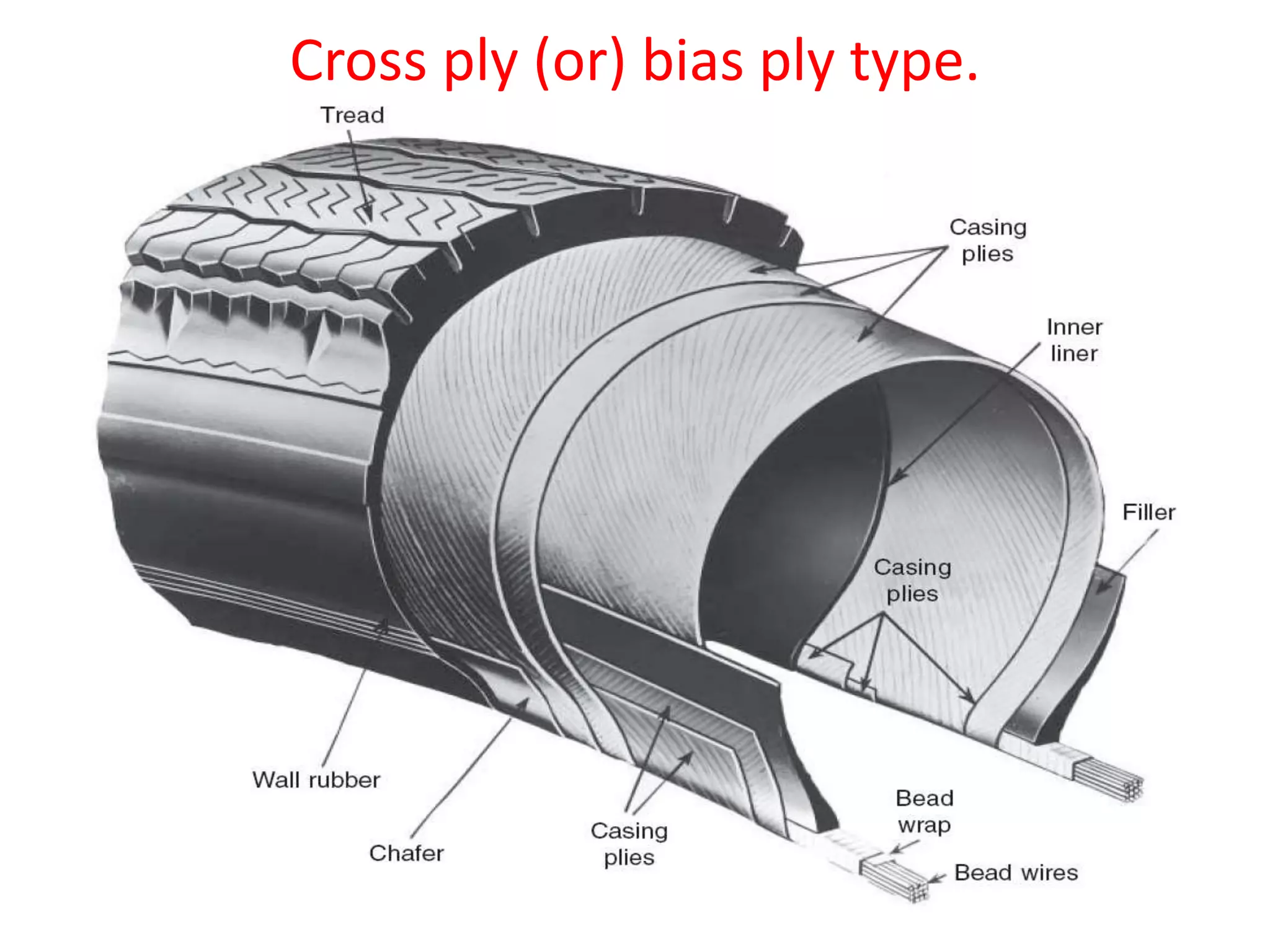
Cross ply (or) bias ply type.
Radial ply type.
Belted bias ply type.
Cross ply (or) bias ply type.
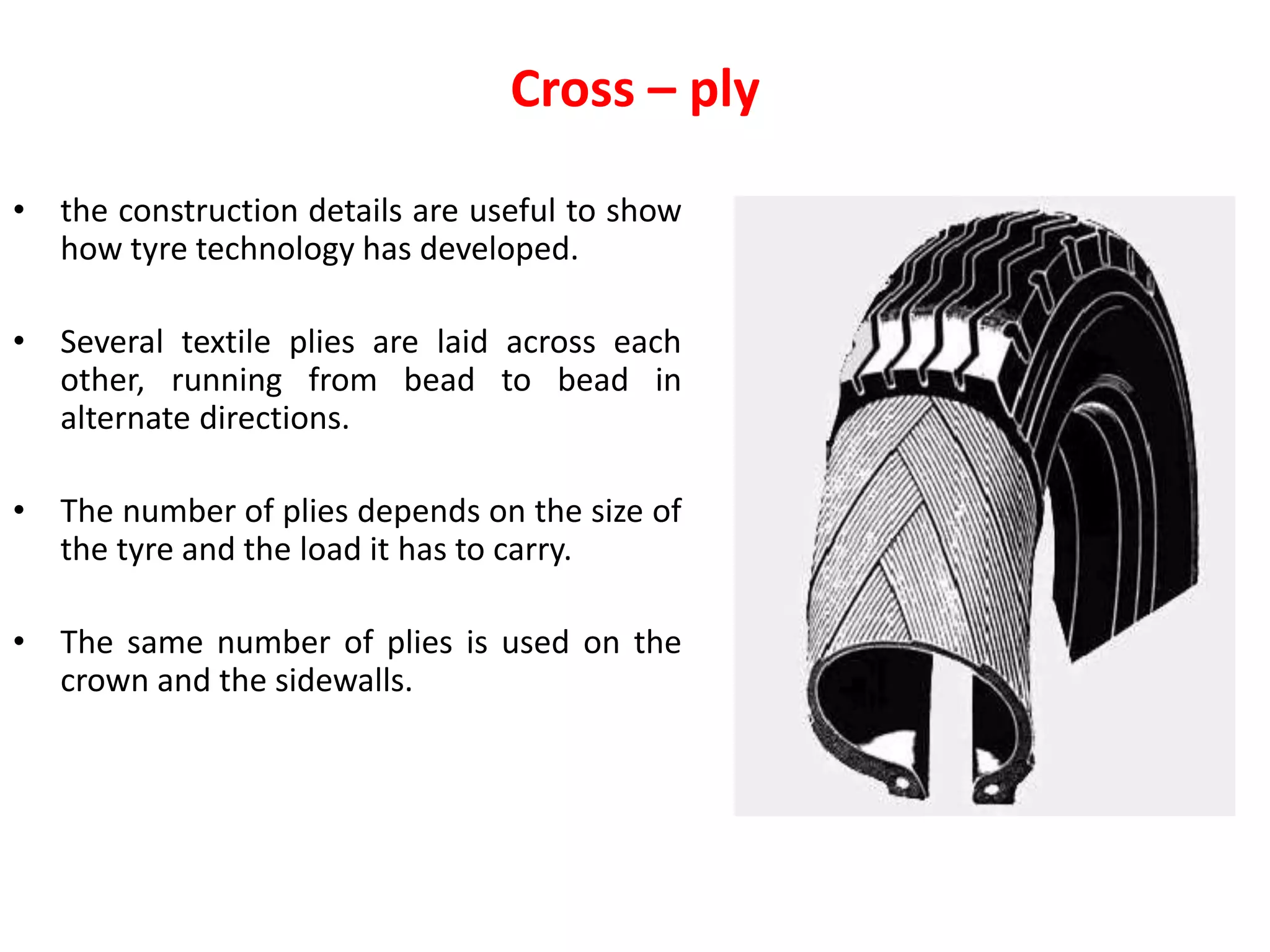
Cross – ply
• the construction details are useful to show
how tyre technology has developed.
• Several textile plies are laid across each
other, running from bead to bead in
alternate directions.
• The number of plies depends on the size of
the tyre and the load it has to carry.
• The same number of plies is used on the
crown and the sidewalls.
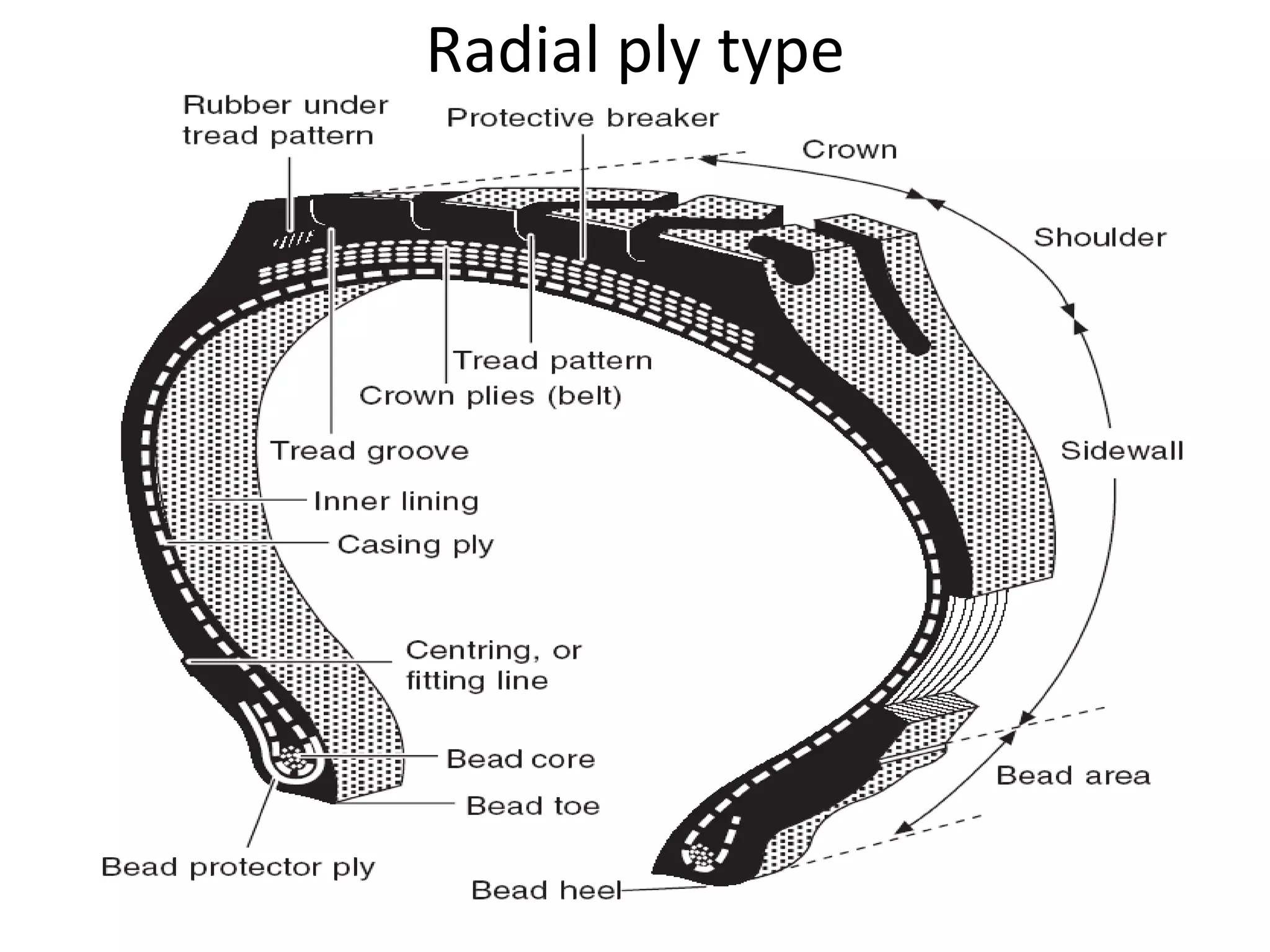
Radial ply type
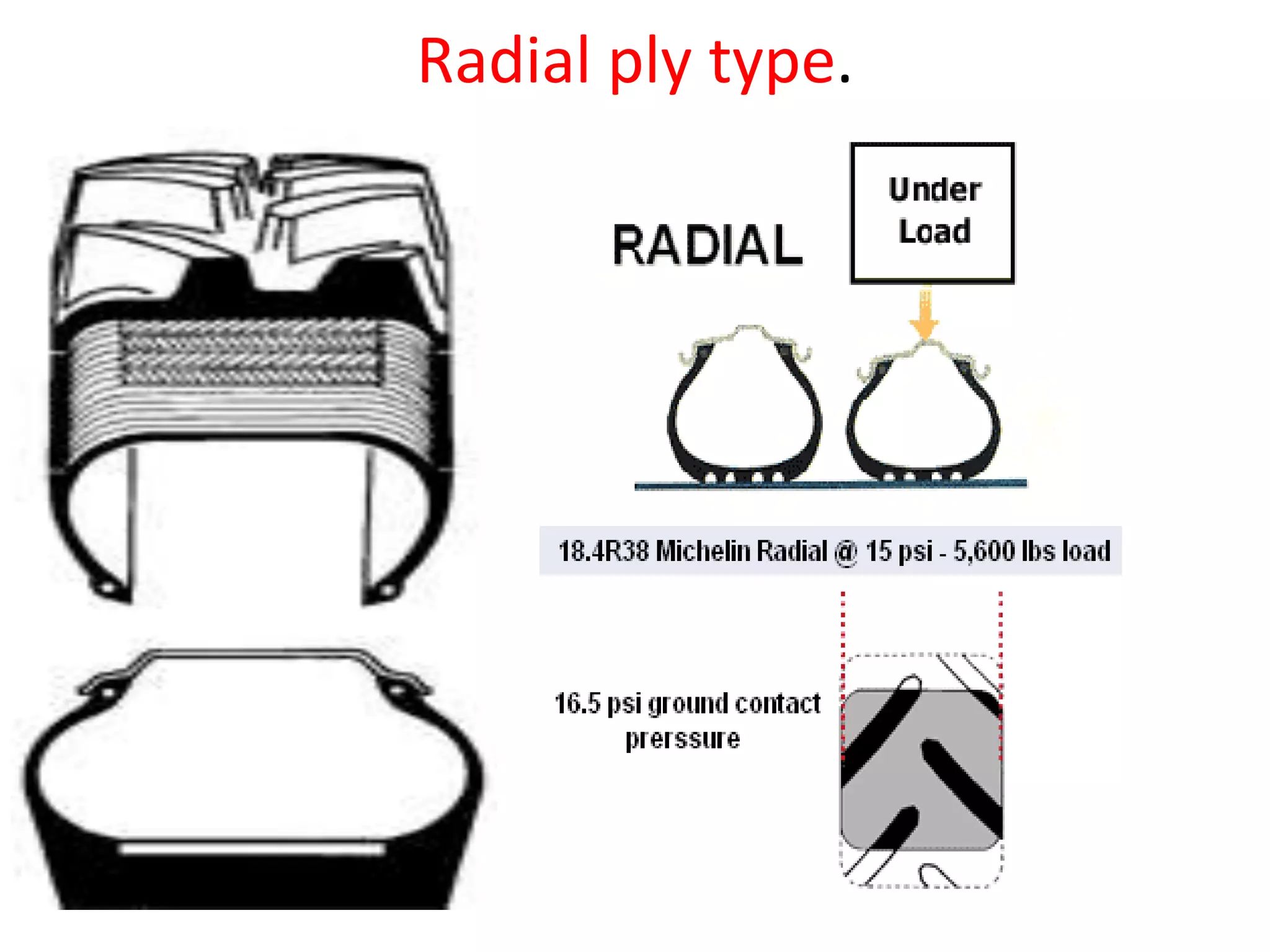
Radial ply type.
Radial – Ply
• Radial – Ply tyres consist of a carcass ply
formed by textile arcs running from one
bead to the other.
• Each ply which is laid in an arc at an angle
of 90 degrees to the direction the tyre
rolls.
• At the top of the tyre crown (under the
tread), there is a belt made up of several
plies reinforced with metal wire, laid on
top of the carcass ply.
• These crown plies, laid one on top of the
other, overlap at an angle determined by
the type of the tyre.
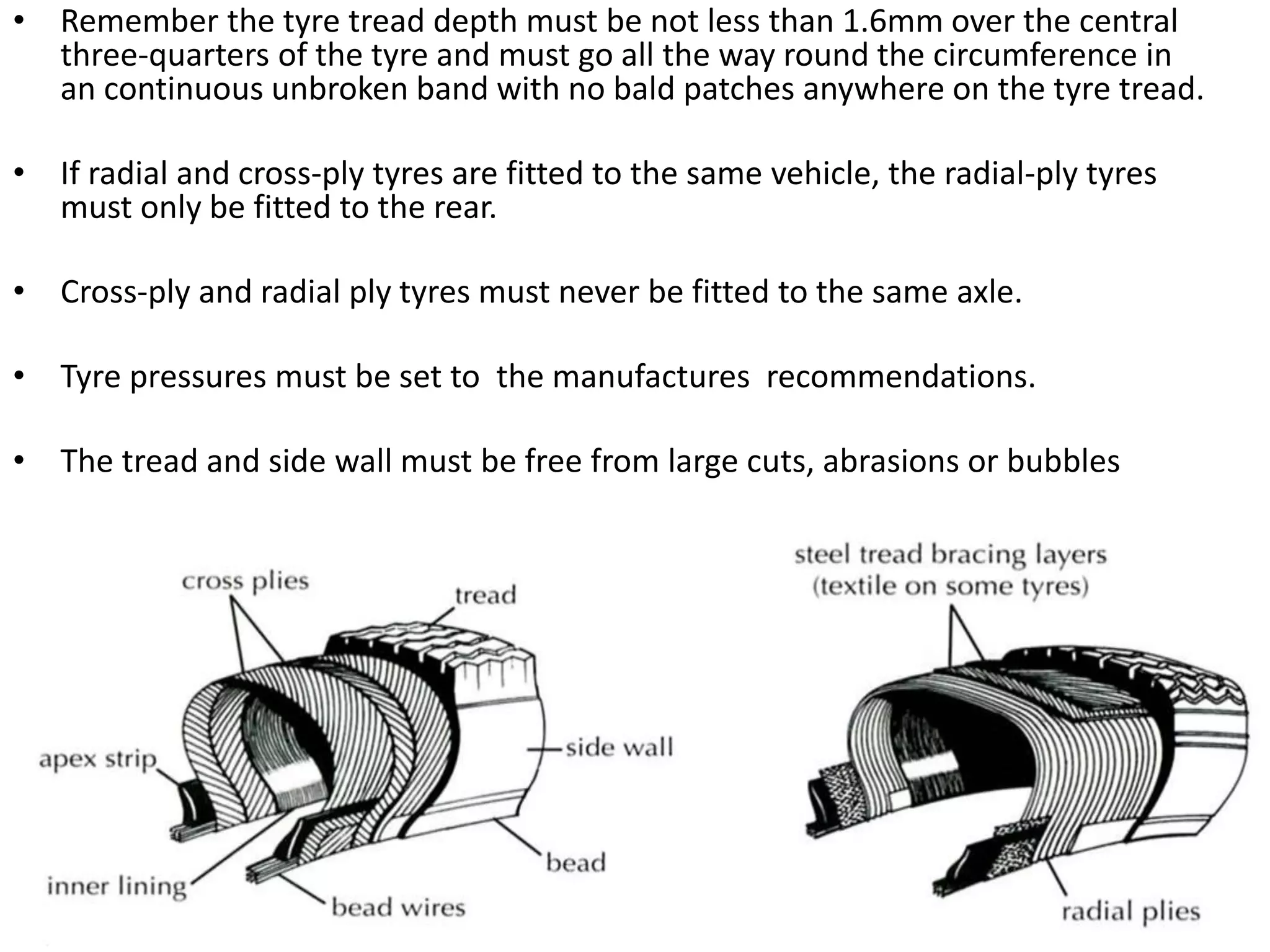
• Remember the tyre tread depth must be not less than 1.6mm over the central
three-quarters of the tyre and must go all the way round the circumference in
an continuous unbroken band with no bald patches anywhere on the tyre tread.
• If radial and cross-ply tyres are fitted to the same vehicle, the radial-ply tyres
must only be fitted to the rear.
• Cross-ply and radial ply tyres must never be fitted to the same axle.
• Tyre pressures must be set to the manufactures recommendations.
• The tread and side wall must be free from large cuts, abrasions or bubbles
Belted bias ply type
Comparison of radial and Cross-ply Tyres
Advantages of radial ply Tyres:-
 The side walls can be bend readily ,its shock absorbing
capacity is 25% more than bias ply or cross ply.
 The breaker strips of radial Tyres act independently of
the wall plies unlike in cross ply where there is no
breaker strip.
 Lower rolling resistance and hysteresis loss leads to less
fuel consumption.
 Longer tread life because of less heat build in Tyre.
 Breaking efficiency on wet roads is better because of
greater sidewall flexibility and tread stiffness.
 Smaller slip angles and higher cornering power which
results in Better steering characteristics.
 While taking turns it has less tendency to distort and lift
off the road from one side.
 Larger resistance to punctures ,cuts and impacts in the
tread area.

3 tyre types

  • 1.
  • 2.
  • 4.
  • 5.
  • 6.
  • 7.
    Types of tyres Conventionaltubed tyre. Tubeless tyre.
  • 8.
  • 9.
  • 10.
    Advantages of tubelesstyres Lesser unsprung weight. Better cooling. Lesser rolling resistance. Comfortable ride. Slower leakage of air. Simpler assembly. Improved safety.
  • 11.
  • 12.
    Types of carcass(Tread) OR TyreConstruction Cross ply (or) bias ply type. Radial ply type. Belted bias ply type.
  • 13.
    Cross ply (or)bias ply type.
  • 14.
    Cross ply (or)bias ply type.
  • 15.
    Cross – ply •the construction details are useful to show how tyre technology has developed. • Several textile plies are laid across each other, running from bead to bead in alternate directions. • The number of plies depends on the size of the tyre and the load it has to carry. • The same number of plies is used on the crown and the sidewalls.
  • 16.
  • 17.
  • 18.
    Radial – Ply •Radial – Ply tyres consist of a carcass ply formed by textile arcs running from one bead to the other. • Each ply which is laid in an arc at an angle of 90 degrees to the direction the tyre rolls. • At the top of the tyre crown (under the tread), there is a belt made up of several plies reinforced with metal wire, laid on top of the carcass ply. • These crown plies, laid one on top of the other, overlap at an angle determined by the type of the tyre.
  • 19.
    • Remember thetyre tread depth must be not less than 1.6mm over the central three-quarters of the tyre and must go all the way round the circumference in an continuous unbroken band with no bald patches anywhere on the tyre tread. • If radial and cross-ply tyres are fitted to the same vehicle, the radial-ply tyres must only be fitted to the rear. • Cross-ply and radial ply tyres must never be fitted to the same axle. • Tyre pressures must be set to the manufactures recommendations. • The tread and side wall must be free from large cuts, abrasions or bubbles
  • 20.
  • 22.
    Comparison of radialand Cross-ply Tyres Advantages of radial ply Tyres:-  The side walls can be bend readily ,its shock absorbing capacity is 25% more than bias ply or cross ply.  The breaker strips of radial Tyres act independently of the wall plies unlike in cross ply where there is no breaker strip.  Lower rolling resistance and hysteresis loss leads to less fuel consumption.
  • 23.
     Longer treadlife because of less heat build in Tyre.  Breaking efficiency on wet roads is better because of greater sidewall flexibility and tread stiffness.  Smaller slip angles and higher cornering power which results in Better steering characteristics.  While taking turns it has less tendency to distort and lift off the road from one side.  Larger resistance to punctures ,cuts and impacts in the tread area.