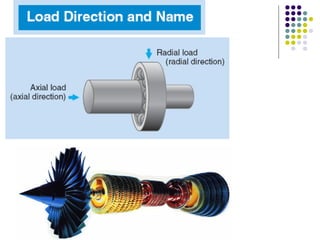
Bearing
FUNCTION OF A BEARING
 The main function of a rotating shaft is to transmit
power from one end of the line to the other.
 It needs a good supportsupport to ensure stabilitystability and
frictionless rotation. The supportsupport for the shaft is
known as “bearing”.
 The shaft has a “running fit” in a bearing. All
bearing are provided some lubrication arrangement
to reduced friction between shaft and bearing.
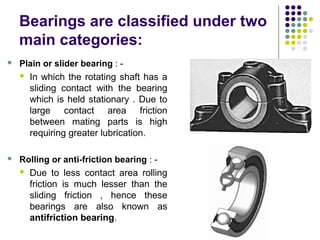
Bearings are classified under two
main categories:
 Plain or slider bearing : -
 In which the rotating shaft has a
sliding contact with the bearing
which is held stationary . Due to
large contact area friction
between mating parts is high
requiring greater lubrication.
 Rolling or anti-friction bearing : -
 Due to less contact area rolling
friction is much lesser than the
sliding friction , hence these
bearings are also known as
antifriction bearing.
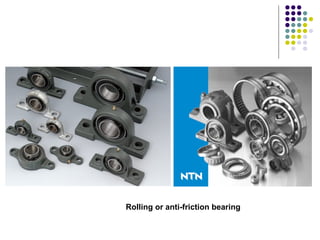
Rolling or anti-friction bearing
Ball and roller bearings
due to low rolling friction these bearings are aptly called
“antifriction” bearing.
 Frictional resistance considerably less than in plain bearings
 Rotating – non-rotating pairs separated by balls or rollers
 Ball or rollers has rolling contact and sliding friction is
eliminated and replaced by much lower rolling friction.
 In plain bearing the starting resistance is much larger than the
running resistance due to absence of oil film.
 In ball and rolling bearings the initial resistance to motion is
only slightly more than their resistance to continuous running.
 Hence ball and rolling bearing are more suitable to drives
subject to frequent starting and stopping as they save power.
 Owing to the low starting torque, a low power motor can be
used for a line shaft running in ball bearing.
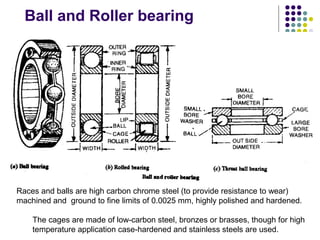
Ball and Roller bearing
Races and balls are high carbon chrome steel (to provide resistance to wear)
machined and ground to fine limits of 0.0025 mm, highly polished and hardened.
The cages are made of low-carbon steel, bronzes or brasses, though for high
temperature application case-hardened and stainless steels are used.
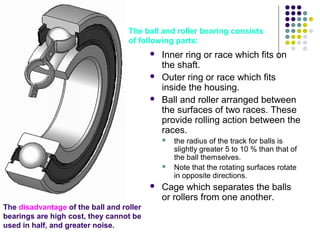
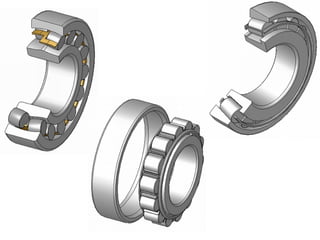
 Inner ring or race which fits on
the shaft.
 Outer ring or race which fits
inside the housing.
 Ball and roller arranged between
the surfaces of two races. These
provide rolling action between the
races.
 the radius of the track for balls is
slightly greater 5 to 10 % than that of
the ball themselves.
 Note that the rotating surfaces rotate
in opposite directions.
 Cage which separates the balls
or rollers from one another.
The disadvantage of the ball and roller
bearings are high cost, they cannot be
used in half, and greater noise.
The ball and roller bearing consists
of following parts:
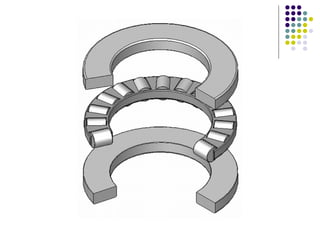
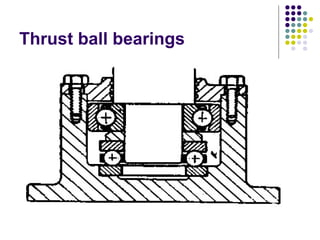
Thrust ball bearings
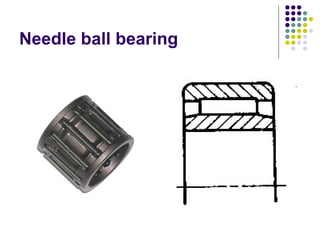
Needle ball bearing
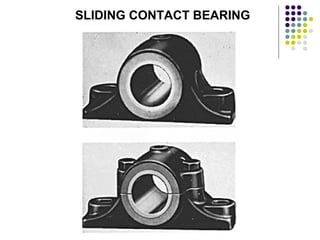
SLIDING CONTACT BEARING
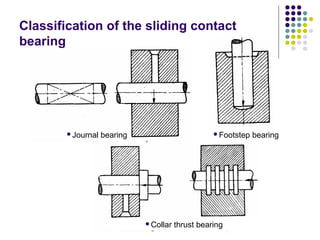
Classification of the sliding contact
bearing
Collar thrust bearing
Footstep bearingJournal bearing
 Journal bearing – in this the bearing pressure is
exerted at right angles to the axis of the axis of the
shaft. The portion of the shaft lying within the
bearing in known as journal. Shaft are generally
made of mild steel.
 Foot step or pivot bearing – in this bearing the
bearing pressure is exerted parallel to the shaft
whose axis is vertical. Note that in this case the
end of the shaft rests within the bearing.
 Thrust bearing – in this bearing supporting
pressure is parallel to the axis of the shaft having
end thrust. Thrust bearing are used in bevel
mountings, propeller drives, turbines, etc. note
here the shaft ,unlike foot-strep bearing passes
through and beyond the bearing.
 Thrust bearings also known as “collar bearing”.
Journal bearing
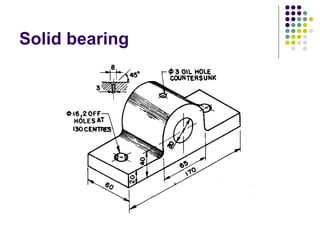
 Simple journal or solid bearing
 It is simply a block of cast iron with a hole for
the shaft providing running fit. An oil hole is
drilled at the top for lubrication.
 The main disadvantage of this type of bearing
are
 There is no provision for wear and adjustment on account of
wear.
 The shaft must be passed into the bearing axially, i.e.
endwise.
 Limited load on shaft and speed of shaft is low.
Solid bearing
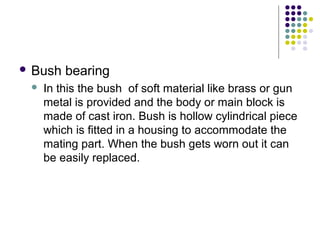
 Bush bearing
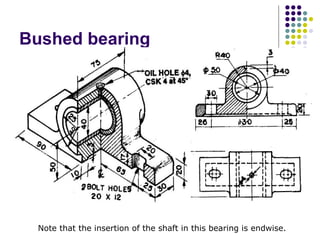
 In this the bush of soft material like brass or gun
metal is provided and the body or main block is
made of cast iron. Bush is hollow cylindrical piece
which is fitted in a housing to accommodate the
mating part. When the bush gets worn out it can
be easily replaced.
Bushed bearing
Note that the insertion of the shaft in this bearing is endwise.
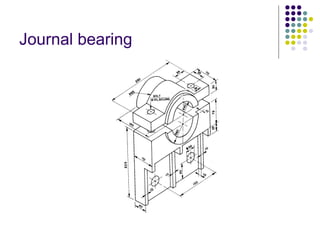
Plummer block or Pedestal
bearing
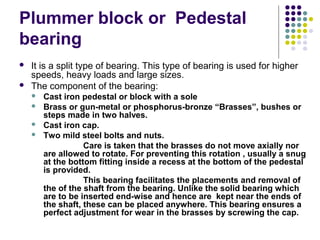
 It is a split type of bearing. This type of bearing is used for higher
speeds, heavy loads and large sizes.
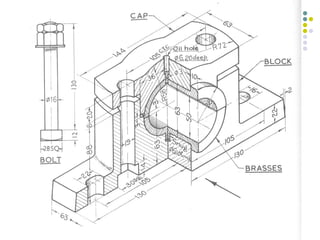
 The component of the bearing:
 Cast iron pedestal or block with a sole
 Brass or gun-metal or phosphorus-bronze “Brasses”, bushes or
steps made in two halves.
 Cast iron cap.
 Two mild steel bolts and nuts.
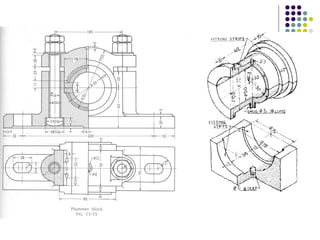
Care is taken that the brasses do not move axially nor
are allowed to rotate. For preventing this rotation , usually a snug
at the bottom fitting inside a recess at the bottom of the pedestal
is provided.
This bearing facilitates the placements and removal of
the of the shaft from the bearing. Unlike the solid bearing which
are to be inserted end-wise and hence are kept near the ends of
the shaft, these can be placed anywhere. This bearing ensures a
perfect adjustment for wear in the brasses by screwing the cap.
Journal bearing
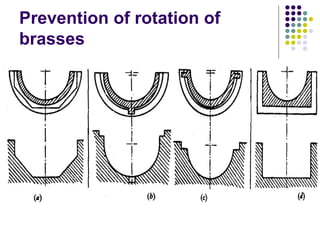
Prevention of rotation of
brasses
 The steps are made octagonal on the outside and
they are made to fit inside a corresponding hole.
 A snug is cast on the lower brass top which fits a
corresponding hole in the casting. The oil hole is
drilled through the sung.
 Snug are provided at the side, and the
corresponding recesses left in the casting
 The steps on the lower brass are made rectangular
on the outside and they are made to fit inside a
corresponding hole.
Prevention of rotation of
brasses
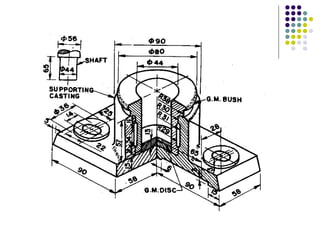
Footstep or pivot bearing
 suitable for supporting a vertical shaft with axial loads.
 In a footstep bearing a gun metal bush having a collar on
top is placed inside the C.I. sole. The end of the shaft
rests on a gun metal disc placed at the bottom in the
bush. The disc is prevented from rotation with the help of
a pin or sung fitted in the sole. The disc act as a thrust
bearing whereas the bush fitted in the casting supports
the shaft in position. The bush can take radial loads, if
any, on the shaft.
 The disadvantage of footstep bearing is that it cannot be
efficiently lubricated and there is unequal wear on the
bottom disc.
Advantages and disadvantages of
the plain bearing
 Plain bearing are cheap to produce and have
noiseless operation. They can be easily machined,
occupy small radial space and have vibration
damping properties. Also they can cope with
tapped foreign matter.
 Disadvantages are they require large supply of
lubricating oil, they are suitable only for relative
low temperature and speed; and starting
resistance is much greater than running
resistance due to slow build up of lubricant film
around the bearing surface.

Bearing types

  • 1.
  • 2.
    FUNCTION OF ABEARING  The main function of a rotating shaft is to transmit power from one end of the line to the other.  It needs a good supportsupport to ensure stabilitystability and frictionless rotation. The supportsupport for the shaft is known as “bearing”.  The shaft has a “running fit” in a bearing. All bearing are provided some lubrication arrangement to reduced friction between shaft and bearing.
  • 3.
    Bearings are classifiedunder two main categories:  Plain or slider bearing : -  In which the rotating shaft has a sliding contact with the bearing which is held stationary . Due to large contact area friction between mating parts is high requiring greater lubrication.  Rolling or anti-friction bearing : -  Due to less contact area rolling friction is much lesser than the sliding friction , hence these bearings are also known as antifriction bearing.
  • 4.
  • 6.
    Ball and rollerbearings due to low rolling friction these bearings are aptly called “antifriction” bearing.  Frictional resistance considerably less than in plain bearings  Rotating – non-rotating pairs separated by balls or rollers  Ball or rollers has rolling contact and sliding friction is eliminated and replaced by much lower rolling friction.  In plain bearing the starting resistance is much larger than the running resistance due to absence of oil film.  In ball and rolling bearings the initial resistance to motion is only slightly more than their resistance to continuous running.  Hence ball and rolling bearing are more suitable to drives subject to frequent starting and stopping as they save power.  Owing to the low starting torque, a low power motor can be used for a line shaft running in ball bearing.
  • 7.
    Ball and Rollerbearing Races and balls are high carbon chrome steel (to provide resistance to wear) machined and ground to fine limits of 0.0025 mm, highly polished and hardened. The cages are made of low-carbon steel, bronzes or brasses, though for high temperature application case-hardened and stainless steels are used.
  • 8.
     Inner ringor race which fits on the shaft.  Outer ring or race which fits inside the housing.  Ball and roller arranged between the surfaces of two races. These provide rolling action between the races.  the radius of the track for balls is slightly greater 5 to 10 % than that of the ball themselves.  Note that the rotating surfaces rotate in opposite directions.  Cage which separates the balls or rollers from one another. The disadvantage of the ball and roller bearings are high cost, they cannot be used in half, and greater noise. The ball and roller bearing consists of following parts:
  • 12.
  • 13.
  • 14.
  • 15.
    Classification of thesliding contact bearing Collar thrust bearing Footstep bearingJournal bearing
  • 16.
     Journal bearing– in this the bearing pressure is exerted at right angles to the axis of the axis of the shaft. The portion of the shaft lying within the bearing in known as journal. Shaft are generally made of mild steel.  Foot step or pivot bearing – in this bearing the bearing pressure is exerted parallel to the shaft whose axis is vertical. Note that in this case the end of the shaft rests within the bearing.  Thrust bearing – in this bearing supporting pressure is parallel to the axis of the shaft having end thrust. Thrust bearing are used in bevel mountings, propeller drives, turbines, etc. note here the shaft ,unlike foot-strep bearing passes through and beyond the bearing.  Thrust bearings also known as “collar bearing”.
  • 17.
    Journal bearing  Simplejournal or solid bearing  It is simply a block of cast iron with a hole for the shaft providing running fit. An oil hole is drilled at the top for lubrication.  The main disadvantage of this type of bearing are  There is no provision for wear and adjustment on account of wear.  The shaft must be passed into the bearing axially, i.e. endwise.  Limited load on shaft and speed of shaft is low.
  • 18.
  • 19.
     Bush bearing In this the bush of soft material like brass or gun metal is provided and the body or main block is made of cast iron. Bush is hollow cylindrical piece which is fitted in a housing to accommodate the mating part. When the bush gets worn out it can be easily replaced.
  • 20.
    Bushed bearing Note thatthe insertion of the shaft in this bearing is endwise.
  • 21.
    Plummer block orPedestal bearing  It is a split type of bearing. This type of bearing is used for higher speeds, heavy loads and large sizes.  The component of the bearing:  Cast iron pedestal or block with a sole  Brass or gun-metal or phosphorus-bronze “Brasses”, bushes or steps made in two halves.  Cast iron cap.  Two mild steel bolts and nuts. Care is taken that the brasses do not move axially nor are allowed to rotate. For preventing this rotation , usually a snug at the bottom fitting inside a recess at the bottom of the pedestal is provided. This bearing facilitates the placements and removal of the of the shaft from the bearing. Unlike the solid bearing which are to be inserted end-wise and hence are kept near the ends of the shaft, these can be placed anywhere. This bearing ensures a perfect adjustment for wear in the brasses by screwing the cap.
  • 22.
  • 25.
    Prevention of rotationof brasses  The steps are made octagonal on the outside and they are made to fit inside a corresponding hole.  A snug is cast on the lower brass top which fits a corresponding hole in the casting. The oil hole is drilled through the sung.  Snug are provided at the side, and the corresponding recesses left in the casting  The steps on the lower brass are made rectangular on the outside and they are made to fit inside a corresponding hole.
  • 26.
  • 27.
    Footstep or pivotbearing  suitable for supporting a vertical shaft with axial loads.  In a footstep bearing a gun metal bush having a collar on top is placed inside the C.I. sole. The end of the shaft rests on a gun metal disc placed at the bottom in the bush. The disc is prevented from rotation with the help of a pin or sung fitted in the sole. The disc act as a thrust bearing whereas the bush fitted in the casting supports the shaft in position. The bush can take radial loads, if any, on the shaft.  The disadvantage of footstep bearing is that it cannot be efficiently lubricated and there is unequal wear on the bottom disc.
  • 29.
    Advantages and disadvantagesof the plain bearing  Plain bearing are cheap to produce and have noiseless operation. They can be easily machined, occupy small radial space and have vibration damping properties. Also they can cope with tapped foreign matter.  Disadvantages are they require large supply of lubricating oil, they are suitable only for relative low temperature and speed; and starting resistance is much greater than running resistance due to slow build up of lubricant film around the bearing surface.