F R A M E
CONTENTS
• Frame
• Construction of frames
• Classification of frames
• Types of frames
• Frame loads
• Frame materials
FRAME
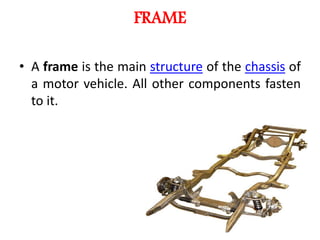
• A frame is the main structure of the chassis of
a motor vehicle. All other components fasten
to it.
Construction of a frame
Classification of frames
1. Conventional frame
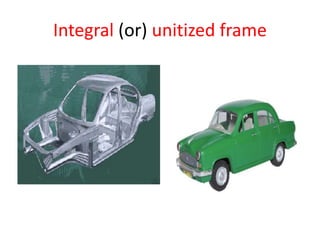
2. Integral frame
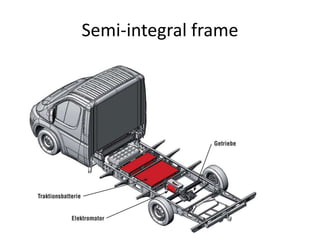
3. Semi-integral frame
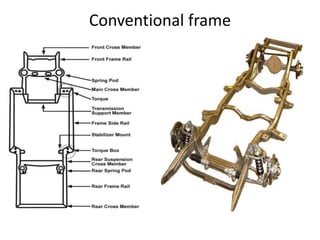
Conventional frame
Integral (or) unitized frame
Semi-integral frame
Types of frames
1. Ladder Frame
2. Backbone Frame
3. X-frame
4. Perimeter Frame
5. Platform Frame
6. Unibody (or) Unit body
7. Sub Frame
1.Ladder Frame
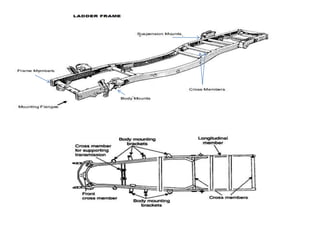
• The ladder frame is the simplest and oldest of all designs.
• It consists of two symmetrical rails, or beams, and cross
member connecting them.
• Originally seen on almost all vehicles, the ladder frame was
gradually phased out on cars around the 1940s and is now
seen mainly on trucks.
• This design offers good beam resistance because of its
continuous rails from front to rear, but poor resistance to
torsion.
• Also, the vehicle's overall height will be higher due to the
floor pan sitting above the frame instead of inside it
2.Backbone frame
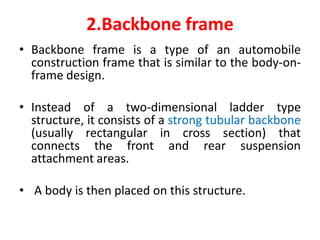
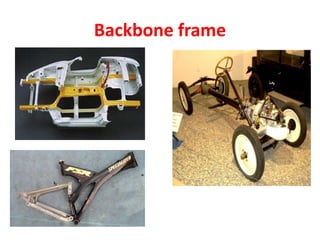
• Backbone frame is a type of an automobile
construction frame that is similar to the body-on-
frame design.
• Instead of a two-dimensional ladder type
structure, it consists of a strong tubular backbone
(usually rectangular in cross section) that
connects the front and rear suspension
attachment areas.
• A body is then placed on this structure.
Backbone frame
3.X-frame
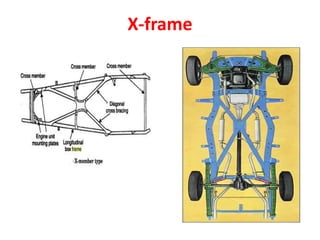
• This is the design used for the full-size American models of
General Motors.
• In which the rails from alongside the engine seemed to cross
in the passenger compartment, each continuing to the
opposite end of the cross member at the extreme rear of the
vehicle.
• It was specifically chosen to decrease the overall height of
the vehicles, and to increase in the space for transmission.
• The X-frame was claimed to improve on previous designs, but
it lacked side rails and thus did not provide adequate side-
impact and collision protection.
• So This design was replaced by perimeter frames.
X-frame
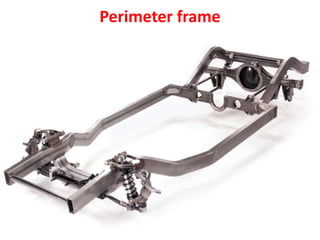
4.Perimeter frame
• Similar to a ladder frame, but the middle sections of
the frame rails sit outboard of the front and rear rails.
• This was done to allow for a lower floor pan, and
therefore lower overall vehicle in passenger cars.
• In addition to the perimeter frame allows lower seating
positions when that is desirable, and offers better
safety in the event of a side impact.
• However, the design lacks stiffness, because the
transition areas from front to center and center to rear
reduce beam and torsional resistance.
Perimeter frame
5.Platform Frame
• This is a modification of the perimeter frame in which the
passenger compartment floor and often the luggage
compartment floor were permanently attached to the
frame, for extra strength.
• Neither floor pieces were sheet metal straight off the roll,
but had been stamped with ridges and hollows for extra
strength.
• This was used by the Germans on the Volkswagen Beetle and
the Mercedes-Benz "Ponton" cars of the 1950s and 1960s,
where it was called in English-language advertisements as
the "frame floor".
Platform Frame
6.Unibody
• In an unibody (also unit body, unitary construction, or
unitized construction) design.
• the frame and body are constructed as a single unit.
• This became the preferred construction for mass
market automobiles and crossovers especially in the
wake of the two energy crises of the 1970s and the
mid-2000s oil price increases.
7.Sub frame
• A subframe is a structural component of a vehicle.
• Such as an automobile or an aircraft, that uses a
separate structure within a larger body-on-frame or
unit body to carry certain components, such as the
engine, drivetrain, or suspension.
• The sub frame is bolted and/or welded to the vehicle.
• When bolted, it is sometimes equipped with rubber
bushings or springs to dampen vibration.
•The principal purposes of using a subframe are, to spread high
chassis loads over a wide area of relatively thin sheet metal of a
monocoque body shell, and to isolate vibration and harshness from
the rest of the body.
•For example, in an automobile with its power train contained in a
subframe, forces generated by the engine and transmission can be
damped enough that they will not disturb passengers.
•As a natural development from a car with a full chassis, separate
front and rear subframes are used in modern vehicles to reduce the
overall weight and cost.
Sub frame
VARIOUS LOADS ACTING ON THE
FRAME
1. Short duration Load – While crossing a broken patch.
2. Momentary duration Load – While taking a curve.
3. Impact Loads – Due to the collision of the vehicle.
4. Inertia Load – While applying brakes.
5. Static Loads – Loads due to chassis parts.
6. Over Loads – Beyond Design capacity.
MATERIALS FOR FRAME

2.frame

  • 1.
    F R AM E
  • 2.
    CONTENTS • Frame • Constructionof frames • Classification of frames • Types of frames • Frame loads • Frame materials
  • 3.
    FRAME • A frameis the main structure of the chassis of a motor vehicle. All other components fasten to it.
  • 4.
  • 5.
    Classification of frames 1.Conventional frame 2. Integral frame 3. Semi-integral frame
  • 7.
  • 9.
  • 11.
  • 12.
    Types of frames 1.Ladder Frame 2. Backbone Frame 3. X-frame 4. Perimeter Frame 5. Platform Frame 6. Unibody (or) Unit body 7. Sub Frame
  • 13.
    1.Ladder Frame • Theladder frame is the simplest and oldest of all designs. • It consists of two symmetrical rails, or beams, and cross member connecting them. • Originally seen on almost all vehicles, the ladder frame was gradually phased out on cars around the 1940s and is now seen mainly on trucks. • This design offers good beam resistance because of its continuous rails from front to rear, but poor resistance to torsion. • Also, the vehicle's overall height will be higher due to the floor pan sitting above the frame instead of inside it
  • 15.
    2.Backbone frame • Backboneframe is a type of an automobile construction frame that is similar to the body-on- frame design. • Instead of a two-dimensional ladder type structure, it consists of a strong tubular backbone (usually rectangular in cross section) that connects the front and rear suspension attachment areas. • A body is then placed on this structure.
  • 16.
  • 17.
    3.X-frame • This isthe design used for the full-size American models of General Motors. • In which the rails from alongside the engine seemed to cross in the passenger compartment, each continuing to the opposite end of the cross member at the extreme rear of the vehicle. • It was specifically chosen to decrease the overall height of the vehicles, and to increase in the space for transmission. • The X-frame was claimed to improve on previous designs, but it lacked side rails and thus did not provide adequate side- impact and collision protection. • So This design was replaced by perimeter frames.
  • 18.
  • 19.
    4.Perimeter frame • Similarto a ladder frame, but the middle sections of the frame rails sit outboard of the front and rear rails. • This was done to allow for a lower floor pan, and therefore lower overall vehicle in passenger cars. • In addition to the perimeter frame allows lower seating positions when that is desirable, and offers better safety in the event of a side impact. • However, the design lacks stiffness, because the transition areas from front to center and center to rear reduce beam and torsional resistance.
  • 20.
  • 21.
    5.Platform Frame • Thisis a modification of the perimeter frame in which the passenger compartment floor and often the luggage compartment floor were permanently attached to the frame, for extra strength. • Neither floor pieces were sheet metal straight off the roll, but had been stamped with ridges and hollows for extra strength. • This was used by the Germans on the Volkswagen Beetle and the Mercedes-Benz "Ponton" cars of the 1950s and 1960s, where it was called in English-language advertisements as the "frame floor".
  • 22.
  • 23.
    6.Unibody • In anunibody (also unit body, unitary construction, or unitized construction) design. • the frame and body are constructed as a single unit. • This became the preferred construction for mass market automobiles and crossovers especially in the wake of the two energy crises of the 1970s and the mid-2000s oil price increases.
  • 25.
    7.Sub frame • Asubframe is a structural component of a vehicle. • Such as an automobile or an aircraft, that uses a separate structure within a larger body-on-frame or unit body to carry certain components, such as the engine, drivetrain, or suspension. • The sub frame is bolted and/or welded to the vehicle. • When bolted, it is sometimes equipped with rubber bushings or springs to dampen vibration.
  • 26.
    •The principal purposesof using a subframe are, to spread high chassis loads over a wide area of relatively thin sheet metal of a monocoque body shell, and to isolate vibration and harshness from the rest of the body. •For example, in an automobile with its power train contained in a subframe, forces generated by the engine and transmission can be damped enough that they will not disturb passengers. •As a natural development from a car with a full chassis, separate front and rear subframes are used in modern vehicles to reduce the overall weight and cost.
  • 27.
  • 28.
    VARIOUS LOADS ACTINGON THE FRAME 1. Short duration Load – While crossing a broken patch. 2. Momentary duration Load – While taking a curve. 3. Impact Loads – Due to the collision of the vehicle. 4. Inertia Load – While applying brakes. 5. Static Loads – Loads due to chassis parts. 6. Over Loads – Beyond Design capacity.
  • 29.