4. Wheels & Tyre
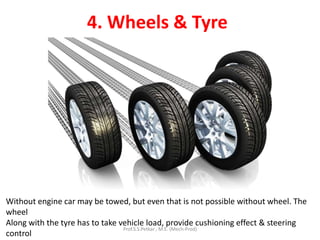
Without engine car may be towed, but even that is not possible without wheel. The
wheel
Along with the tyre has to take vehicle load, provide cushioning effect & steering
control
Prof.S.S.Petkar , M.E. (Mech-Prod)
Basic requirements of wheels and tyres
Prof.S.S.Petkar , M.E. (Mech-Prod)
Types of road Wheels
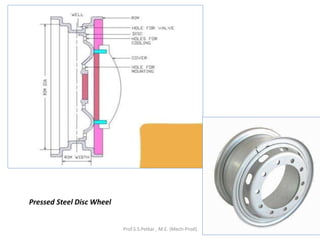
Pressed Steel Disc Wheel :- 90% used, simplicity, robust
construction, lower cost & ease of cleaning
wire wheel :- vintage sports & racing cars, lighter , heat
dissipation is better & can be easily removed
Light Alloy Wheel:- cast & forged (Al & Mg) for wider
rims, low aspect ratio, good heat conductors, good
adhesion & brakes more efficiently than steel.
Prof.S.S.Petkar , M.E. (Mech-Prod)
Pressed Steel Disc Wheel
Prof.S.S.Petkar , M.E. (Mech-Prod)
Pressed Disc Wheel
• It is possible to mount or remove the tire from the wheel
only with the help of a well, otherwise, it is not possible.
• It is possible to pass the tire over the opposite edges of
the rim when the tire bead is resting in the pit.
• The steel disc is used for the operation of spokes. The
wheel is installed together with the tire on the axle by
tightening the nuts on the mounting studs that are
secured to the flange.
• Some holes or grooves are usually provided in the wheel
disc to allow air to enter the inner side of the disc for
better cooling of the brake drum.
• Especially for heavier vehicles such as trucks, buses etc.
which are bulkier and do not fit in the good region.
Therefore, the pit hoops are not used for them.
Prof.S.S.Petkar , M.E. (Mech-Prod)
Advantages of Pressed steel disc wheel:
• Robust construction
• Simplicity
• Ease of cleaning
• Lower manufacturing cost
• Less maintenance
• High production
Applications of Pressed steel disc wheel:
These wheels are used in heavy engines such as
buses and trucks.
It is lighter and heat dissipation will be high
Prof.S.S.Petkar , M.E. (Mech-Prod)
The wire wheel
Prof.S.S.Petkar , M.E. (Mech-Prod)
SPOKES
The wire wheel
• The wire wheel consists of the following parts:
• Steel rim
• Spokes
• Hub
• Steel rim:
This type of wheel is generally used to receive the tire.
• Spokes:
The wire wheel has a separate hub that is attached to the rim
and several spokes of wire are attached to it inside the wheel.
• Hub:
Each spoke is fitted to one end of the hub, while the other
end is pushed through a hole in the wheel rim.
Prof.S.S.Petkar , M.E. (Mech-Prod)
Advantages of the wire wheel:
• This type of wheel can only be used for tube tires.
• Heat dissipation into the environment through rays
installed in the rim.
Disadvantages of the wire wheel:
• Tubeless tires cannot be mounted on wire wheels.
• These wire wheels are difficult to clean.
Wire Wheel Applications:
• This type of wheel was used in the past, but its use is
limited to racing cars and vintage cars.
• Before 5 years from today, the wire wheel will also be
used on bicycles.
• Traditionally, it is also widely used on bicycles
Prof.S.S.Petkar , M.E. (Mech-Prod)
In this type of wheel, the hub, spoke and rim are made of iron. The wire wheel has
a separate hub. Spokes are connected between the hub and rim. Upon this rim,
tyre-tube can be used. These wheels are not used in motor vehicles, but they are
used in motor cycles and also in certain types of sports cars
Prof.S.S.Petkar , M.E. (Mech-Prod)
Light Alloy Cast Wheel or Forged Wheel
Prof.S.S.Petkar , M.E. (Mech-Prod)
Light Alloy Cast Wheel or Forged Wheel
• Cast wheels are used in light duty cars
• Forged wheels are used in heavier vehicle
• It weighs about 50% steel wheel & 70% Al wheel for similar
strength
• These wheels are better heat dissipation property
• Wide rims are possible which improves stability & cornering.
• These wheels have good surface finish & maintain close
tolerance.
• Mg alloys can withstand high fatigue strength, good shock
loading ability.
• Al alloys don’t have high mechanical properties but easy to
cast.
Prof.S.S.Petkar , M.E. (Mech-Prod)
Wheel Balancing
Prof.S.S.Petkar , M.E. (Mech-Prod)
Wheel on Balancer
Prof.S.S.Petkar , M.E. (Mech-Prod)
Rotation for checking balance.
Prof.S.S.Petkar , M.E. (Mech-Prod)
Selection of Weight as per requirement
• Wheel balancing is the process of balancing the
weight of a tire and wheel assembly so that it
travels evenly at high speeds.
• Balancing requires putting a mounted wheel and
tire on a balancer, which centers the wheel and
spins it to determine where the weights should go.
• Every time a wheel is first mounted onto a vehicle
with a new tire, it has to be balanced. The goal is to
make sure the weight is evenly distributed
throughout each of the wheels and tires on a
vehicle.
• This process evens out heavy and light spots in a
wheel, so that it rotates smoothly. If there is even a
slight difference in weight in the wheels, it will
cause enough momentum to create a vibration in
the car
Prof.S.S.Petkar , M.E. (Mech-Prod)
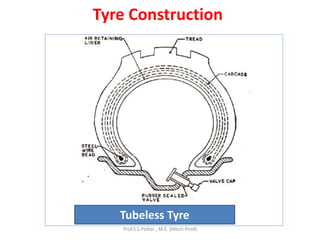
Tyre Construction
TUBE TYRE
Prof.S.S.Petkar , M.E. (Mech-Prod)
TYRE with tube
Tyre Construction
Prof.S.S.Petkar , M.E. (Mech-Prod)
Tubeless Tyre
Function of Tyre
Prof.S.S.Petkar , M.E. (Mech-Prod)
Requirements of Good Tyre
Prof.S.S.Petkar , M.E. (Mech-Prod)
Tyre Construction
Prof.S.S.Petkar , M.E. (Mech-Prod)
Tyre Materials
Prof.S.S.Petkar , M.E. (Mech-Prod)
Tyre Material
• Staple cotton :- carcass in older days
• Rayon:- carcass in older days
• Now Nylon & Teryline is used bcz of strength, elasticcity
• Glass fiber is very strong but special techniques are
required.
• For beads :- bronze plated tensile steel wire is used
Prof.S.S.Petkar , M.E. (Mech-Prod)
Composition by weight
Material Percentage Composition
Synthetic rubber 31
Natural Rubber 18
Bead Wire 4
Carbon black 24
Other chemicals 13
Tyre cord 10
Prof.S.S.Petkar , M.E. (Mech-Prod)
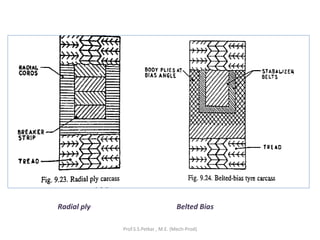
Carcass Type
• Cross ply or Bias Ply
• Radial Ply
• Belted Bias Ply
The tyre is named after the particular type
of carcass
It contains, as this is the main structure
taking the
Stresses while in operation
40 degrees to
tyre axis
Prof.S.S.Petkar , M.E. (Mech-Prod)
Radial ply Belted Bias
Prof.S.S.Petkar , M.E. (Mech-Prod)
Cut sections
Prof.S.S.Petkar , M.E. (Mech-Prod)
Tyre Sizes & Designation
Prof.S.S.Petkar , M.E. (Mech-Prod)
Letter
code
P Q R S T U H V W Y ZR
Speed
Mph
95 100 105 112 118 124 130 149 167 186 Over
149
Speed
kph
150 160 170 180 190 200 210 240 270 300 Over
260
TYRE SPEED RATING
Prof.S.S.Petkar , M.E. (Mech-Prod)
Aspect ratio of a tyre in layman’s term is
denoted by a percentage (nos.) which
hints at the tyre height (or section height),
from bead to the tread, with regards to
the tyre width (or section width).
Aspect ratio is simply identified as a
percentage of the section height divided
by the section width.
Prof.S.S.Petkar , M.E. (Mech-Prod)
Tyre Tread Pattern
Symmetrical Tread Asymmetrical Tread directional Tread
Prof.S.S.Petkar , M.E. (Mech-Prod)
The tread is the part of the tire that makes contact with the surface of the road.
Symmetrical tire tread patterns deliver smooth driving, high directional stability,
and low rolling resistance and Traction
Directional tire tread patterns provide high protection against aquaplaning,
excellent handling on snow and mud, and very good road-holding at high speeds.
Asymmetric tire tread patterns offer excellent handling, high curve stability, and
good grip in wet conditions.
To maintain optimal safety and performance, avoid mixing tire tread patterns
where possible.
Every tire tread has four constituent parts:
Ribs are the raised section of the tread pattern, made up of tread blocks;
Grooves are deep channels which run circumferentially and laterally around the
tire;
Tread blocks are the raised rubber segments that make contact with the road
surface;
Sipes are small, thin slots molded into the tread blocks
Prof.S.S.Petkar , M.E. (Mech-Prod)
Tyre Valve
Prof.S.S.Petkar , M.E. (Mech-Prod)
Tyre Inflation Pressure
Prof.S.S.Petkar , M.E. (Mech-Prod)
Precautions in tyre
• The wheel rim is cleaned to remove dirt, grease, rust and
inspected for cracks
• Check the condition of valve
• The tube is not carelessly pulled by the valve stem
• Tyre beads & rim flange should be lubricated for easy fitting
• The air for inflating should not be moist or contaminated
• Use correct equipment for removing tyre
• Do not use tyre with a tread depth below 1.6 mm. (no
braking in wet condition)
• Check the tyre pressure regularly
• Do not measure tyre pressure after driving or when tyre is
hot, this will give faulty reading.
Prof.S.S.Petkar , M.E. (Mech-Prod)
Tyre Rotation
Prof.S.S.Petkar , M.E. (Mech-Prod)
Types of Tyre wear and their causes
Prof.S.S.Petkar , M.E. (Mech-Prod)
Toe Wear
The toe of your tyre is essential the outer (or inner, depending on how you look at it)
edge of each rib. Since it should, however, be contacting the road just as much as the
other side of the tyre rib, wear on only the toe is usually a large signal that you’re
alignment is off.
The edge will be the thinnest part as a result, so fix the alignment to make the tyre
touching the road evenly.
Camber Wear
Camber wear is a type of tyre wear that typically has one half of the tyre more worn
than the other. It can be a really serious issue when cornering more than anything else
depending on the severity of the turn. It’s a risk in any case and needs to be
monitored closely.
To fix camber wear, again it’s likely down to an alignment solution as this can be the
biggest issue. Always balance.
Center Wear
A much more common type of tyre wear comes from the centre of the tyre becoming
severely worn down rather than the whole tyre equally. This is less common to spot
since the outer edges look fine, so beware of this happening without realising.
To fix this, make sure you’re tyres are not over-inflated. Too much air means the tyres
bulge in the centre more than the outside, meaning the outside doesn’t have as heavy
contact.
Prof.S.S.Petkar , M.E. (Mech-Prod)
Edge Wear
Edgewear on your tyre is essential the opposite of the above. It’s a result of
underinflation meaning the outer edges of the tyres have more contact than the centre,
and this is where all the wear will be.
This again is just as dangerous as not all of your tyre has contact with the road, and
you’re much more likely to lose grip. Always check your tyres regularly to ensure they are
the right pressure for your usage.
Patch Wear
Patch wear is essentially what ti sound slike, and it’s the much rarer case than the rest.
It’s a product of a lack of balance meaning that your tyres are erratically coming into
contact with the road and not at all in other areas, leaving patches of wear against
patches of none.
This type of tyre wear only worsens over time as more wear takes place, so it is always
something to check in on especially recently after changing tyres or wheels. Get the tyres
balanced to repair the issue.
Cup Wear
The last type of tyre wear we’ll look at is cup wear, and this one is one of the easiest to
diagnose but also one of the most serious in relation to the rest of your car. It looks like
erratic patches in the same line of your tyre as demonstrated.
This is caused by serious issues like bent or worn out suspension wearing against your
wheels and making the ‘scalloped’ pattern. To fix it, fix the issue with your suspension
damage and the issue will desist.
Selection of tires under different applications
• Summer Tyre
• Winter Tyre
• All weather tyre:- more complex tread pattern
• Pneumatic:- flexible hollow rubber type
• Semi pneumatic:- hollow tires which are not
pressured
• Solid:- by using solid rubber in cycles
• Cushion tyre:- similar to solid tyre
• Street tyre, mountain bike tyre, off road tyre
Prof.S.S.Petkar , M.E. (Mech-Prod)
Tyre retreating /retreading
Prof.S.S.Petkar , M.E. (Mech-Prod)
Reconditioning a worn tyre to
extend its useful life by adding
new material is called
retreading.
Generally a car tyre is
retreaded only once, whereas
the commercial vehicle tyre
often retreaded twice &
Even thrice.
Process of retreading
• Initial inspection to determine retreading is
required or not.
• Unwanted tread material is removed by buffing,
which provides a profile & s/f texture.
• Secondary inspection including any correction
work.
• Application of new tread, called building process
• Curing and vulcanization is done.
• Final inspection to rule out any defect.
Prof.S.S.Petkar , M.E. (Mech-Prod)
Factors affecting tyre performance.
• Inflation :- Tyre pressure
• Vehicle Maintenance:- wheel alignment
• Manner of driving
• Miscellaneous factors:- heat, road condition,
seasons, position in which tyre is fited
Prof.S.S.Petkar , M.E. (Mech-Prod)

Wheels & Tyre.pptx

  • 1.
    4. Wheels &Tyre Without engine car may be towed, but even that is not possible without wheel. The wheel Along with the tyre has to take vehicle load, provide cushioning effect & steering control Prof.S.S.Petkar , M.E. (Mech-Prod)
  • 2.
    Basic requirements ofwheels and tyres Prof.S.S.Petkar , M.E. (Mech-Prod)
  • 3.
  • 4.
    Types of roadWheels Pressed Steel Disc Wheel :- 90% used, simplicity, robust construction, lower cost & ease of cleaning wire wheel :- vintage sports & racing cars, lighter , heat dissipation is better & can be easily removed Light Alloy Wheel:- cast & forged (Al & Mg) for wider rims, low aspect ratio, good heat conductors, good adhesion & brakes more efficiently than steel. Prof.S.S.Petkar , M.E. (Mech-Prod)
  • 5.
    Pressed Steel DiscWheel Prof.S.S.Petkar , M.E. (Mech-Prod)
  • 6.
    Pressed Disc Wheel •It is possible to mount or remove the tire from the wheel only with the help of a well, otherwise, it is not possible. • It is possible to pass the tire over the opposite edges of the rim when the tire bead is resting in the pit. • The steel disc is used for the operation of spokes. The wheel is installed together with the tire on the axle by tightening the nuts on the mounting studs that are secured to the flange. • Some holes or grooves are usually provided in the wheel disc to allow air to enter the inner side of the disc for better cooling of the brake drum. • Especially for heavier vehicles such as trucks, buses etc. which are bulkier and do not fit in the good region. Therefore, the pit hoops are not used for them. Prof.S.S.Petkar , M.E. (Mech-Prod)
  • 7.
    Advantages of Pressedsteel disc wheel: • Robust construction • Simplicity • Ease of cleaning • Lower manufacturing cost • Less maintenance • High production Applications of Pressed steel disc wheel: These wheels are used in heavy engines such as buses and trucks. It is lighter and heat dissipation will be high Prof.S.S.Petkar , M.E. (Mech-Prod)
  • 8.
    The wire wheel Prof.S.S.Petkar, M.E. (Mech-Prod) SPOKES
  • 9.
    The wire wheel •The wire wheel consists of the following parts: • Steel rim • Spokes • Hub • Steel rim: This type of wheel is generally used to receive the tire. • Spokes: The wire wheel has a separate hub that is attached to the rim and several spokes of wire are attached to it inside the wheel. • Hub: Each spoke is fitted to one end of the hub, while the other end is pushed through a hole in the wheel rim. Prof.S.S.Petkar , M.E. (Mech-Prod)
  • 10.
    Advantages of thewire wheel: • This type of wheel can only be used for tube tires. • Heat dissipation into the environment through rays installed in the rim. Disadvantages of the wire wheel: • Tubeless tires cannot be mounted on wire wheels. • These wire wheels are difficult to clean. Wire Wheel Applications: • This type of wheel was used in the past, but its use is limited to racing cars and vintage cars. • Before 5 years from today, the wire wheel will also be used on bicycles. • Traditionally, it is also widely used on bicycles Prof.S.S.Petkar , M.E. (Mech-Prod)
  • 11.
    In this typeof wheel, the hub, spoke and rim are made of iron. The wire wheel has a separate hub. Spokes are connected between the hub and rim. Upon this rim, tyre-tube can be used. These wheels are not used in motor vehicles, but they are used in motor cycles and also in certain types of sports cars Prof.S.S.Petkar , M.E. (Mech-Prod)
  • 12.
    Light Alloy CastWheel or Forged Wheel Prof.S.S.Petkar , M.E. (Mech-Prod)
  • 13.
    Light Alloy CastWheel or Forged Wheel • Cast wheels are used in light duty cars • Forged wheels are used in heavier vehicle • It weighs about 50% steel wheel & 70% Al wheel for similar strength • These wheels are better heat dissipation property • Wide rims are possible which improves stability & cornering. • These wheels have good surface finish & maintain close tolerance. • Mg alloys can withstand high fatigue strength, good shock loading ability. • Al alloys don’t have high mechanical properties but easy to cast. Prof.S.S.Petkar , M.E. (Mech-Prod)
  • 14.
  • 15.
    Prof.S.S.Petkar , M.E.(Mech-Prod) Wheel on Balancer
  • 16.
    Prof.S.S.Petkar , M.E.(Mech-Prod) Rotation for checking balance.
  • 17.
    Prof.S.S.Petkar , M.E.(Mech-Prod) Selection of Weight as per requirement
  • 18.
    • Wheel balancingis the process of balancing the weight of a tire and wheel assembly so that it travels evenly at high speeds. • Balancing requires putting a mounted wheel and tire on a balancer, which centers the wheel and spins it to determine where the weights should go. • Every time a wheel is first mounted onto a vehicle with a new tire, it has to be balanced. The goal is to make sure the weight is evenly distributed throughout each of the wheels and tires on a vehicle. • This process evens out heavy and light spots in a wheel, so that it rotates smoothly. If there is even a slight difference in weight in the wheels, it will cause enough momentum to create a vibration in the car Prof.S.S.Petkar , M.E. (Mech-Prod)
  • 19.
    Tyre Construction TUBE TYRE Prof.S.S.Petkar, M.E. (Mech-Prod) TYRE with tube
  • 20.
    Tyre Construction Prof.S.S.Petkar ,M.E. (Mech-Prod) Tubeless Tyre
  • 21.
  • 22.
    Requirements of GoodTyre Prof.S.S.Petkar , M.E. (Mech-Prod)
  • 23.
  • 24.
  • 25.
  • 26.
    Tyre Material • Staplecotton :- carcass in older days • Rayon:- carcass in older days • Now Nylon & Teryline is used bcz of strength, elasticcity • Glass fiber is very strong but special techniques are required. • For beads :- bronze plated tensile steel wire is used Prof.S.S.Petkar , M.E. (Mech-Prod)
  • 27.
    Composition by weight MaterialPercentage Composition Synthetic rubber 31 Natural Rubber 18 Bead Wire 4 Carbon black 24 Other chemicals 13 Tyre cord 10 Prof.S.S.Petkar , M.E. (Mech-Prod)
  • 28.
    Carcass Type • Crossply or Bias Ply • Radial Ply • Belted Bias Ply The tyre is named after the particular type of carcass It contains, as this is the main structure taking the Stresses while in operation 40 degrees to tyre axis Prof.S.S.Petkar , M.E. (Mech-Prod)
  • 29.
    Radial ply BeltedBias Prof.S.S.Petkar , M.E. (Mech-Prod)
  • 30.
  • 31.
    Tyre Sizes &Designation Prof.S.S.Petkar , M.E. (Mech-Prod)
  • 32.
    Letter code P Q RS T U H V W Y ZR Speed Mph 95 100 105 112 118 124 130 149 167 186 Over 149 Speed kph 150 160 170 180 190 200 210 240 270 300 Over 260 TYRE SPEED RATING Prof.S.S.Petkar , M.E. (Mech-Prod)
  • 33.
    Aspect ratio ofa tyre in layman’s term is denoted by a percentage (nos.) which hints at the tyre height (or section height), from bead to the tread, with regards to the tyre width (or section width). Aspect ratio is simply identified as a percentage of the section height divided by the section width. Prof.S.S.Petkar , M.E. (Mech-Prod)
  • 34.
    Tyre Tread Pattern SymmetricalTread Asymmetrical Tread directional Tread Prof.S.S.Petkar , M.E. (Mech-Prod)
  • 35.
    The tread isthe part of the tire that makes contact with the surface of the road. Symmetrical tire tread patterns deliver smooth driving, high directional stability, and low rolling resistance and Traction Directional tire tread patterns provide high protection against aquaplaning, excellent handling on snow and mud, and very good road-holding at high speeds. Asymmetric tire tread patterns offer excellent handling, high curve stability, and good grip in wet conditions. To maintain optimal safety and performance, avoid mixing tire tread patterns where possible. Every tire tread has four constituent parts: Ribs are the raised section of the tread pattern, made up of tread blocks; Grooves are deep channels which run circumferentially and laterally around the tire; Tread blocks are the raised rubber segments that make contact with the road surface; Sipes are small, thin slots molded into the tread blocks Prof.S.S.Petkar , M.E. (Mech-Prod)
  • 36.
  • 37.
  • 38.
    Precautions in tyre •The wheel rim is cleaned to remove dirt, grease, rust and inspected for cracks • Check the condition of valve • The tube is not carelessly pulled by the valve stem • Tyre beads & rim flange should be lubricated for easy fitting • The air for inflating should not be moist or contaminated • Use correct equipment for removing tyre • Do not use tyre with a tread depth below 1.6 mm. (no braking in wet condition) • Check the tyre pressure regularly • Do not measure tyre pressure after driving or when tyre is hot, this will give faulty reading. Prof.S.S.Petkar , M.E. (Mech-Prod)
  • 39.
  • 40.
  • 41.
  • 42.
    Types of Tyrewear and their causes Prof.S.S.Petkar , M.E. (Mech-Prod)
  • 43.
    Prof.S.S.Petkar , M.E.(Mech-Prod) Toe Wear The toe of your tyre is essential the outer (or inner, depending on how you look at it) edge of each rib. Since it should, however, be contacting the road just as much as the other side of the tyre rib, wear on only the toe is usually a large signal that you’re alignment is off. The edge will be the thinnest part as a result, so fix the alignment to make the tyre touching the road evenly. Camber Wear Camber wear is a type of tyre wear that typically has one half of the tyre more worn than the other. It can be a really serious issue when cornering more than anything else depending on the severity of the turn. It’s a risk in any case and needs to be monitored closely. To fix camber wear, again it’s likely down to an alignment solution as this can be the biggest issue. Always balance. Center Wear A much more common type of tyre wear comes from the centre of the tyre becoming severely worn down rather than the whole tyre equally. This is less common to spot since the outer edges look fine, so beware of this happening without realising. To fix this, make sure you’re tyres are not over-inflated. Too much air means the tyres bulge in the centre more than the outside, meaning the outside doesn’t have as heavy contact.
  • 44.
    Prof.S.S.Petkar , M.E.(Mech-Prod) Edge Wear Edgewear on your tyre is essential the opposite of the above. It’s a result of underinflation meaning the outer edges of the tyres have more contact than the centre, and this is where all the wear will be. This again is just as dangerous as not all of your tyre has contact with the road, and you’re much more likely to lose grip. Always check your tyres regularly to ensure they are the right pressure for your usage. Patch Wear Patch wear is essentially what ti sound slike, and it’s the much rarer case than the rest. It’s a product of a lack of balance meaning that your tyres are erratically coming into contact with the road and not at all in other areas, leaving patches of wear against patches of none. This type of tyre wear only worsens over time as more wear takes place, so it is always something to check in on especially recently after changing tyres or wheels. Get the tyres balanced to repair the issue. Cup Wear The last type of tyre wear we’ll look at is cup wear, and this one is one of the easiest to diagnose but also one of the most serious in relation to the rest of your car. It looks like erratic patches in the same line of your tyre as demonstrated. This is caused by serious issues like bent or worn out suspension wearing against your wheels and making the ‘scalloped’ pattern. To fix it, fix the issue with your suspension damage and the issue will desist.
  • 45.
    Selection of tiresunder different applications • Summer Tyre • Winter Tyre • All weather tyre:- more complex tread pattern • Pneumatic:- flexible hollow rubber type • Semi pneumatic:- hollow tires which are not pressured • Solid:- by using solid rubber in cycles • Cushion tyre:- similar to solid tyre • Street tyre, mountain bike tyre, off road tyre Prof.S.S.Petkar , M.E. (Mech-Prod)
  • 46.
    Tyre retreating /retreading Prof.S.S.Petkar, M.E. (Mech-Prod) Reconditioning a worn tyre to extend its useful life by adding new material is called retreading. Generally a car tyre is retreaded only once, whereas the commercial vehicle tyre often retreaded twice & Even thrice.
  • 47.
    Process of retreading •Initial inspection to determine retreading is required or not. • Unwanted tread material is removed by buffing, which provides a profile & s/f texture. • Secondary inspection including any correction work. • Application of new tread, called building process • Curing and vulcanization is done. • Final inspection to rule out any defect. Prof.S.S.Petkar , M.E. (Mech-Prod)
  • 48.
    Factors affecting tyreperformance. • Inflation :- Tyre pressure • Vehicle Maintenance:- wheel alignment • Manner of driving • Miscellaneous factors:- heat, road condition, seasons, position in which tyre is fited Prof.S.S.Petkar , M.E. (Mech-Prod)