Diode-Transistor Logic (DTL)


University of Connecticut                      56
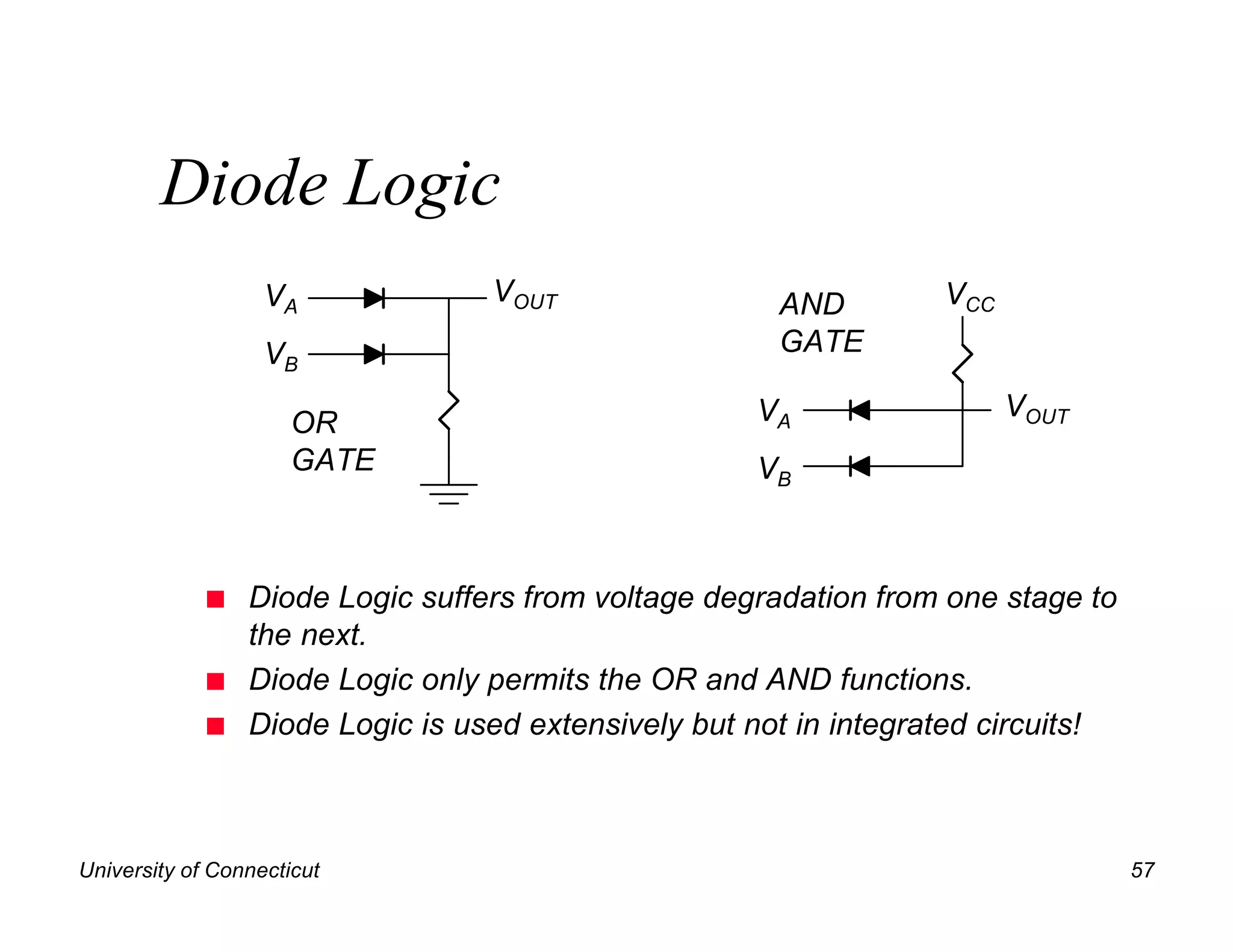
Diode Logic
                   VA             VOUT                 AND         VCC
                   VB                                  GATE

                                                     VA                  VOUT
                      OR
                      GATE                           VB


             n   Diode Logic suffers from voltage degradation from one stage to
                 the next.
             n   Diode Logic only permits the OR and AND functions.
             n   Diode Logic is used extensively but not in integrated circuits!


University of Connecticut                                                          57
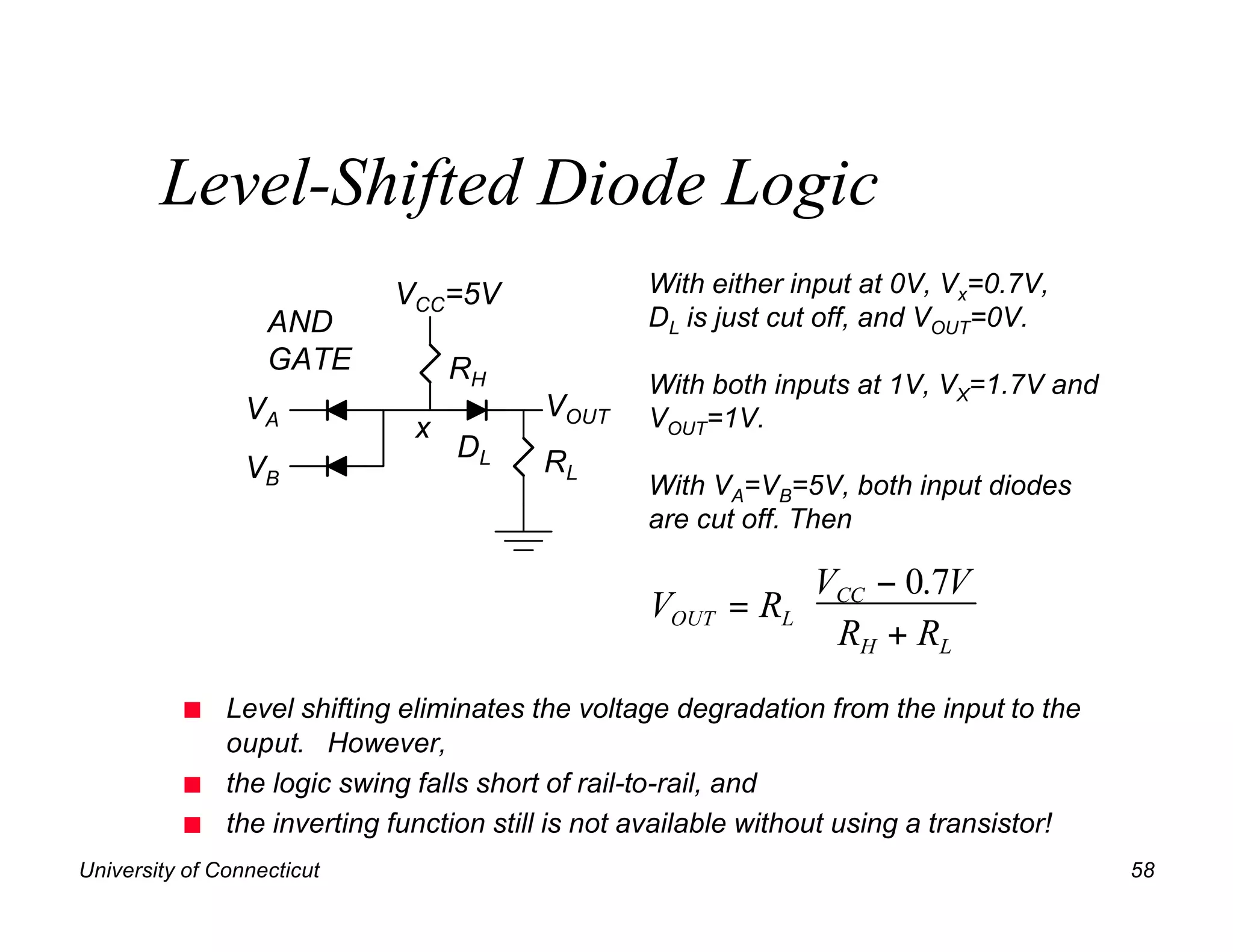
Level-Shifted Diode Logic
                             VCC=5V                With either input at 0V, Vx=0.7V,
                   AND                             DL is just cut off, and VOUT=0V.
                   GATE            RH              With both inputs at 1V, VX=1.7V and
                 VA                       VOUT     VOUT=1V.
                               x
                                   DL     RL
                 VB
                                                   With VA=VB=5V, both input diodes
                                                   are cut off. Then

                                                                VCC − 0.7V 
                                                   VOUT   = RL             
                                                                RH + RL 
          n    Level shifting eliminates the voltage degradation from the input to the
               ouput. However,
          n    the logic swing falls short of rail-to-rail, and
          n    the inverting function still is not available without using a transistor!
University of Connecticut                                                                  58
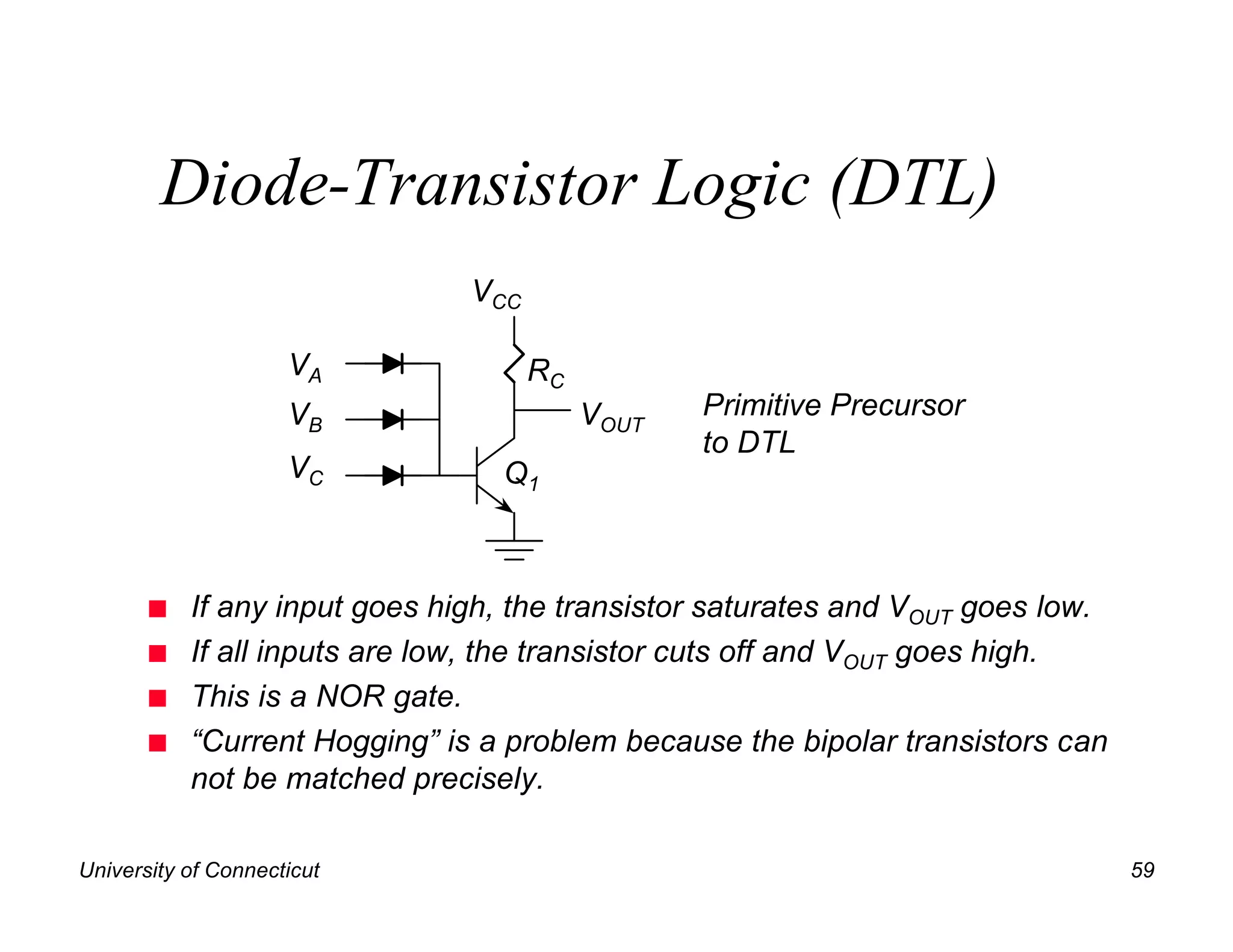
Diode-Transistor Logic (DTL)
                               VCC

                     VA              RC
                     VB                   VOUT   Primitive Precursor
                                                 to DTL
                     VC          Q1


       n   If any input goes high, the transistor saturates and VOUT goes low.
       n   If all inputs are low, the transistor cuts off and VOUT goes high.
       n   This is a NOR gate.
       n   “Current Hogging” is a problem because the bipolar transistors can
           not be matched precisely.

University of Connecticut                                                        59
Diode-Transistor Logic (DTL)
                              VCC

                            RB       RC
                                          VOUT   Improved gate with
                 VA
                                                 reversed diodes.
                 VB                 Q1
                 VC


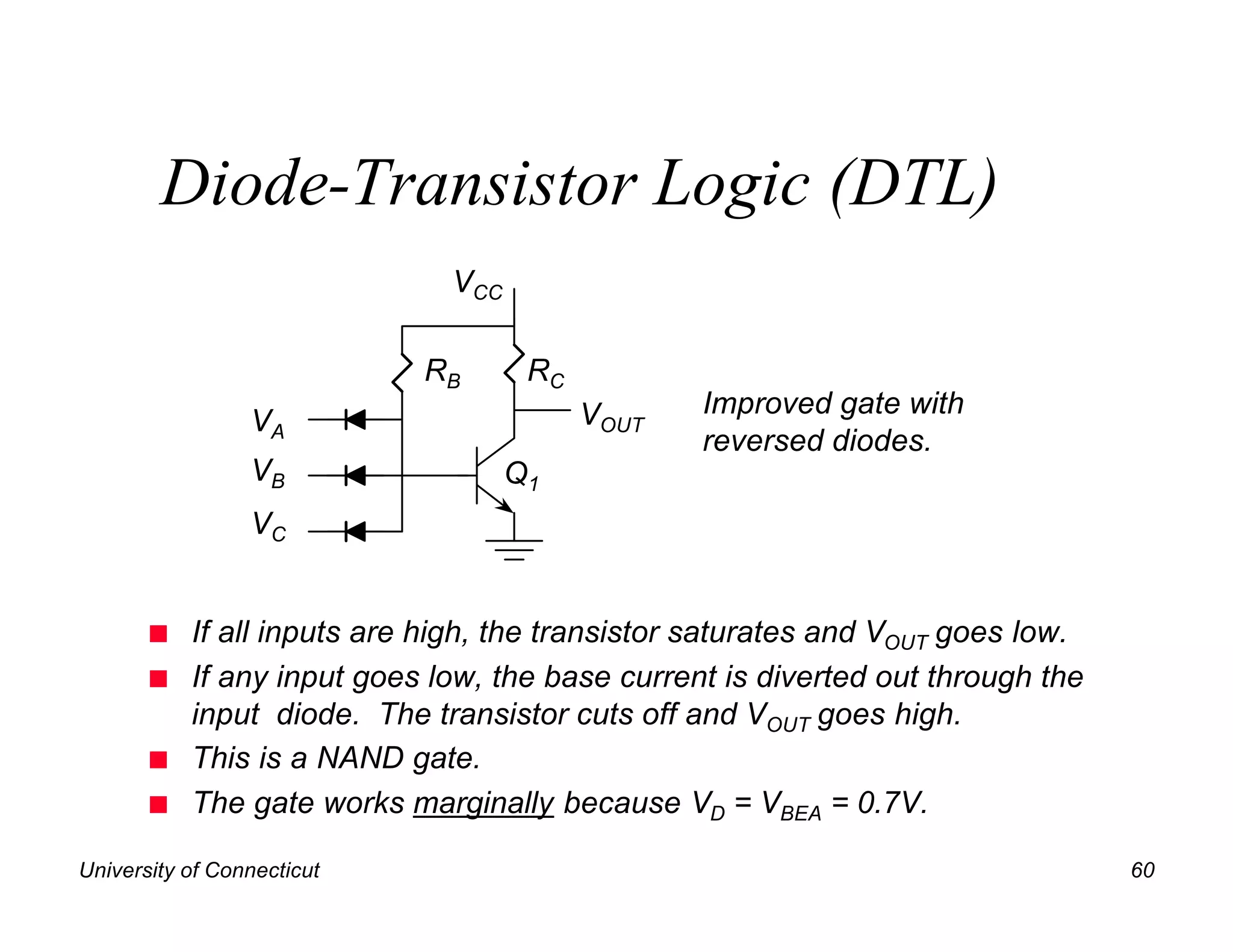
       n   If all inputs are high, the transistor saturates and VOUT goes low.
       n   If any input goes low, the base current is diverted out through the
           input diode. The transistor cuts off and VOUT goes high.
       n   This is a NAND gate.
       n   The gate works marginally because VD = VBEA = 0.7V.

University of Connecticut                                                        60
Diode-Transistor Logic (DTL)
                                     VCC

                              RB            RC               Basic DTL
                   VA        x                   VOUT        NAND gate.
                   VB                      Q1
                   VC                RD


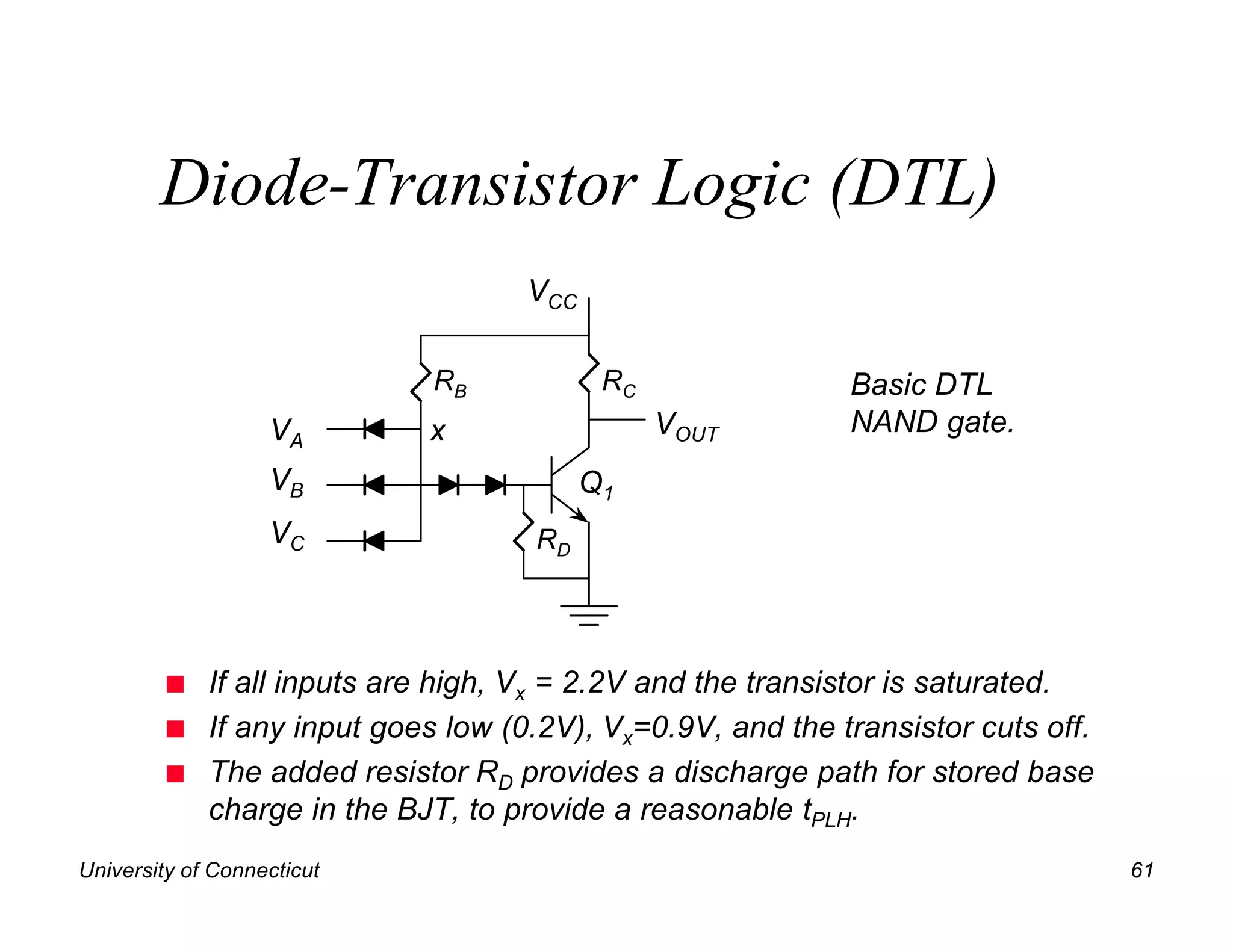
         n   If all inputs are high, Vx = 2.2V and the transistor is saturated.
         n   If any input goes low (0.2V), Vx=0.9V, and the transistor cuts off.
         n   The added resistor RD provides a discharge path for stored base
             charge in the BJT, to provide a reasonable tPLH.
University of Connecticut                                                          61
DTL VTC
                                 VCC                   5
                                                VOUT
                                                       4
                            RB          RC
                                                       3
               VA           x                VOUT
                                                       2
               VB                      Q1
                                                       1
               VC                 RD
                                                       0
                                                           0   1   2   3   4     5
                                                                               VIN
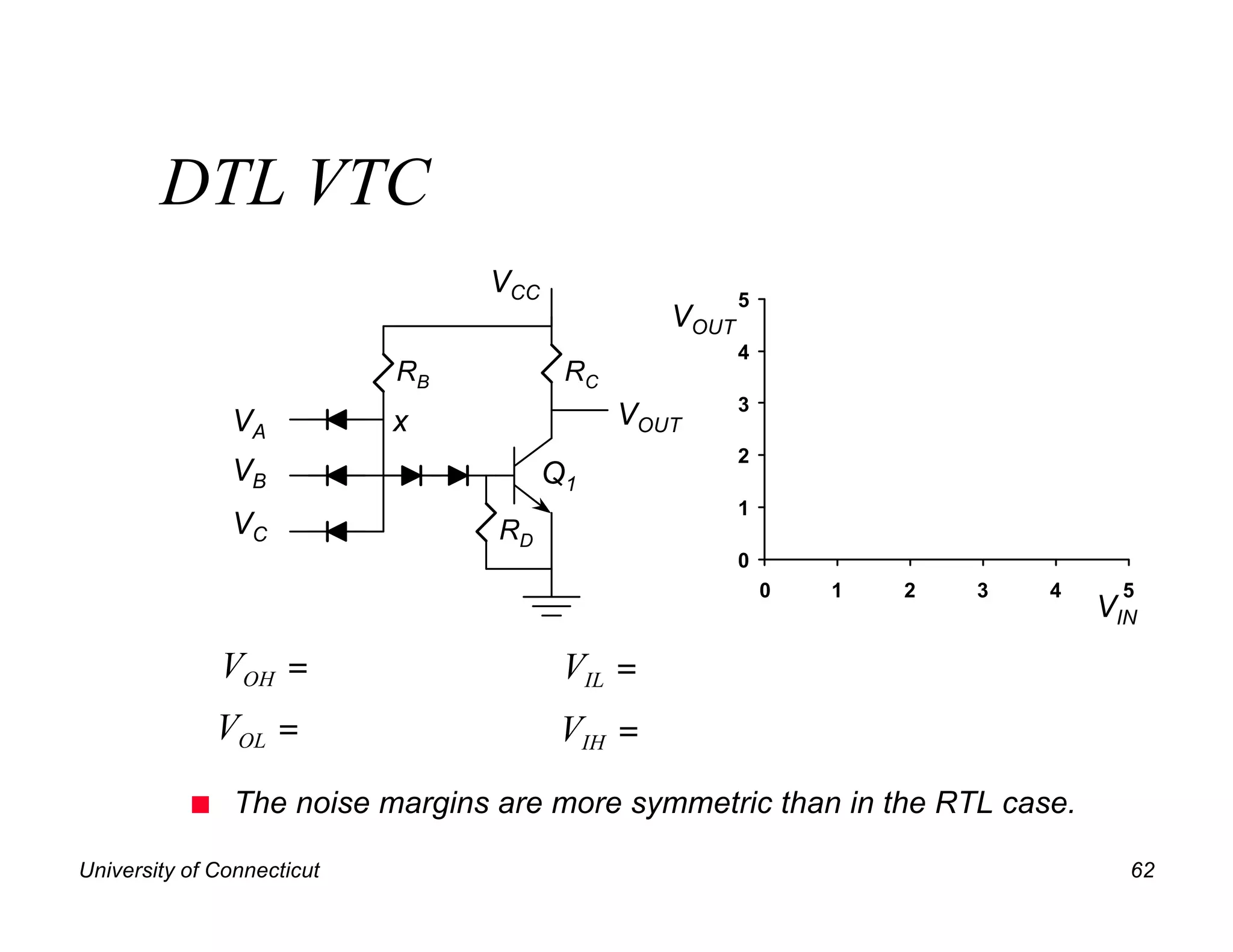
               VOH =                    VIL =
               VOL =                    VIH =
           n    The noise margins are more symmetric than in the RTL case.

University of Connecticut                                                        62
DTL Power Dissipation
                RB=3.4kΩ          VCC
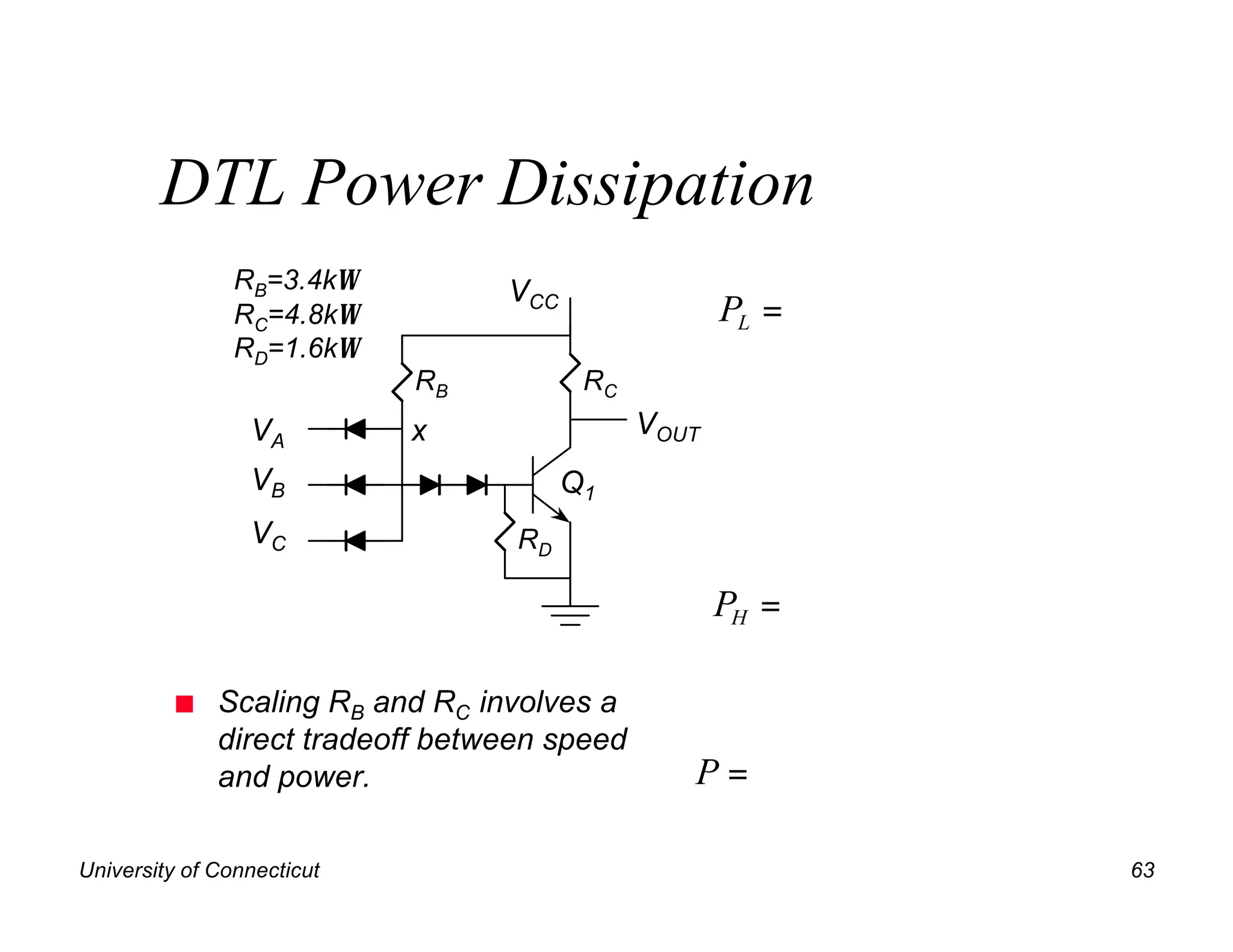
                RC=4.8kΩ                             PL =
                RD=1.6kΩ
                            RB           RC
                 VA         x                 VOUT
                 VB                     Q1
                 VC                RD

                                                     PH =

          n   Scaling RB and RC involves a
              direct tradeoff between speed
              and power.                         P=

University of Connecticut                                   63
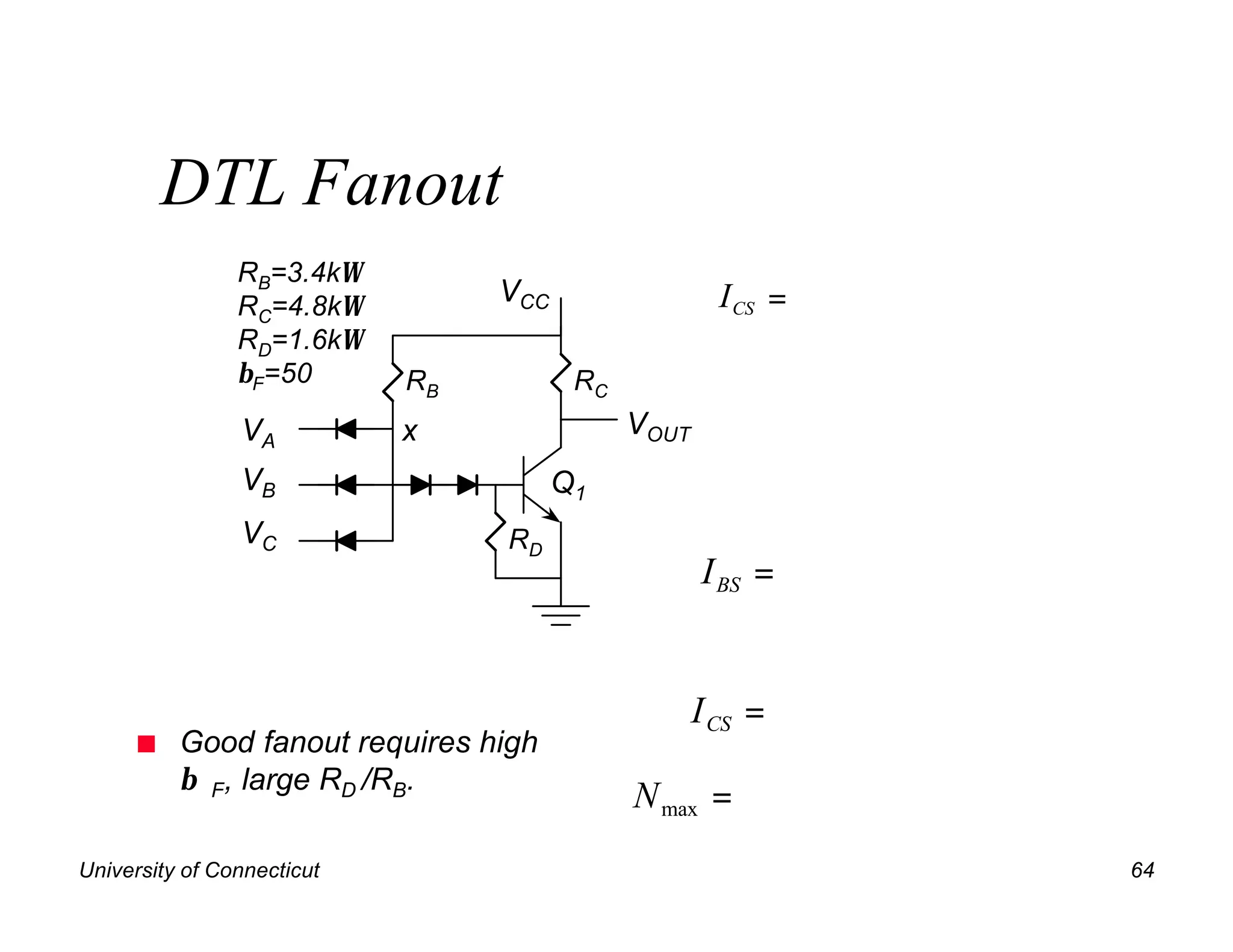
DTL Fanout
                RB=3.4kΩ
                RC=4.8kΩ         VCC                  I CS =
                RD=1.6kΩ
                βF=50       RB          RC
                VA          x                VOUT
                VB                     Q1
                VC               RD
                                                    I BS =


                                                    I CS =
      n   Good fanout requires high
          β F, large RD /RB.
                                             N max =
University of Connecticut                                      64
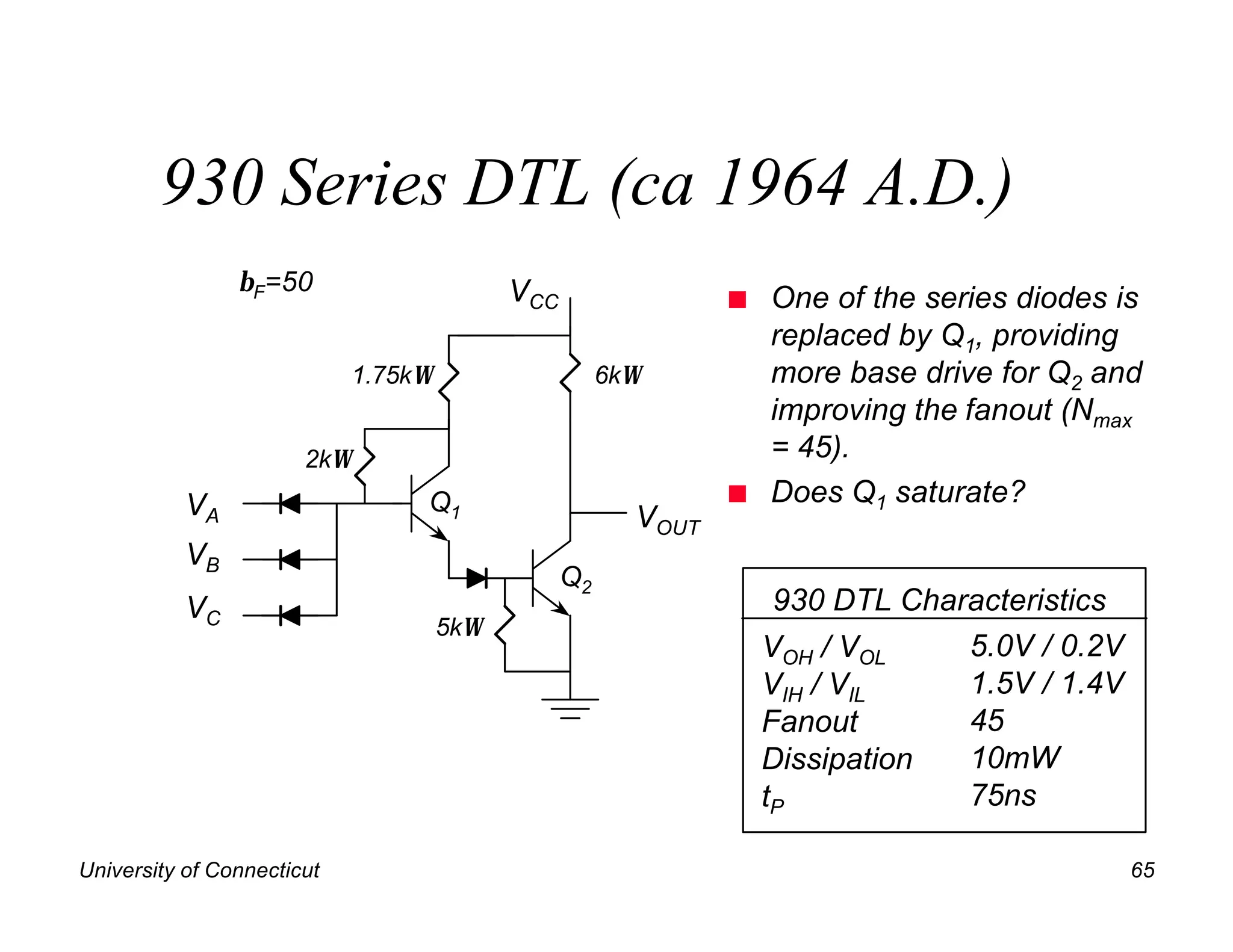
930 Series DTL (ca 1964 A.D.)
                βF=50                       VCC                 n   One of the series diodes is
                                                                    replaced by Q1, providing
                             1.75kΩ                    6kΩ          more base drive for Q2 and
                                                                    improving the fanout (Nmax
                       2kΩ                                          = 45).
           VA                     Q1                            n   Does Q1 saturate?
                                                         VOUT
           VB
                                                  Q2
           VC                                                        930 DTL Characteristics
                                      5kΩ
                                                                    VOH / VOL    5.0V / 0.2V
                                                                    VIH / VIL    1.5V / 1.4V
                                                                    Fanout       45
                                                                    Dissipation  10mW
                                                                    tP           75ns

University of Connecticut                                                                      65
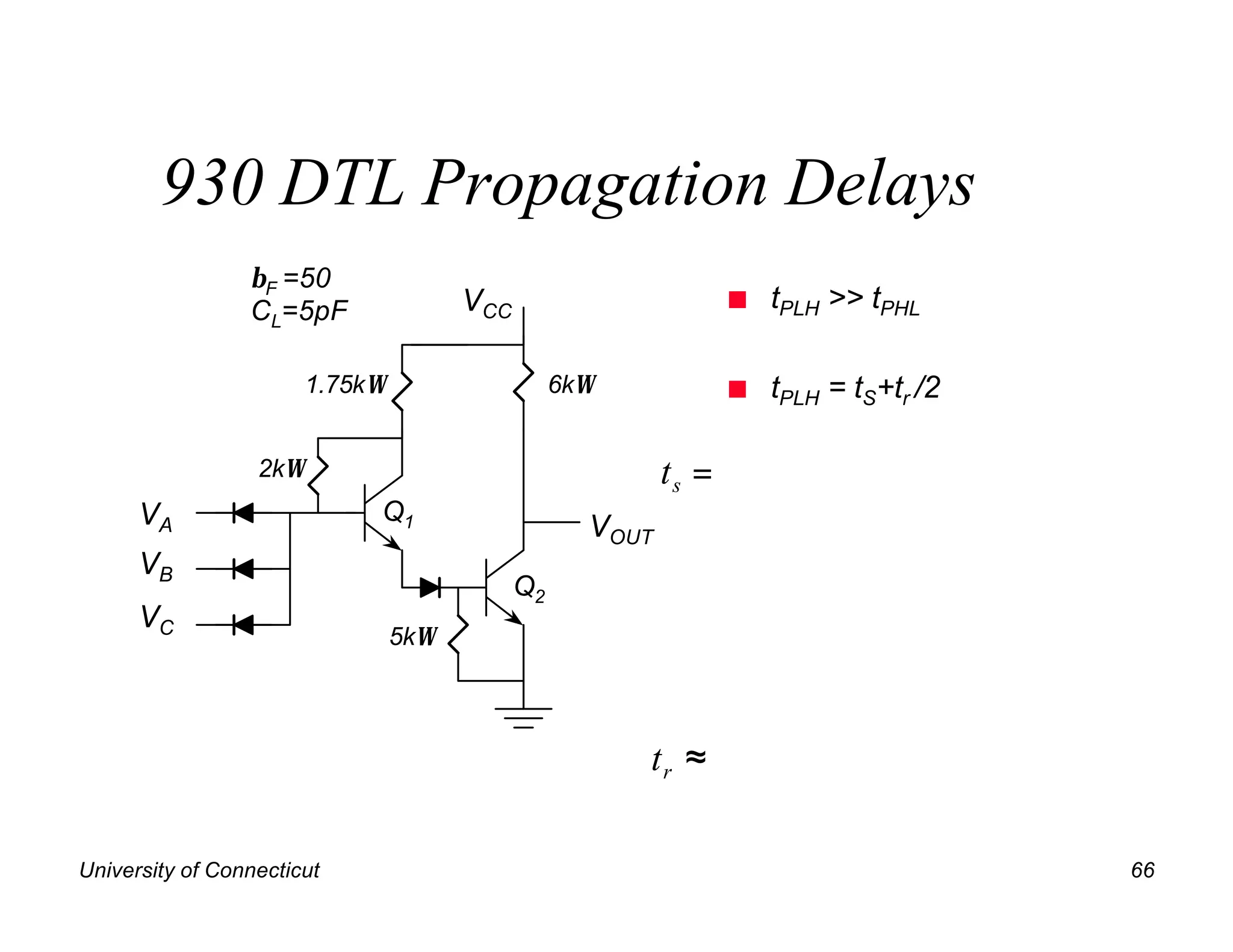
930 DTL Propagation Delays
                 βF =50
                 CL=5pF                VCC                        n   tPLH >> tPHL

                        1.75kΩ                    6kΩ             n   tPLH = tS+tr /2

                  2kΩ                                      ts =
      VA                     Q1
                                                    VOUT
      VB
                                             Q2
      VC
                                 5kΩ


                                                        tr ≈

University of Connecticut                                                               66
Transistor-Transistor
                                Logic (TTL)


University of Connecticut                           67
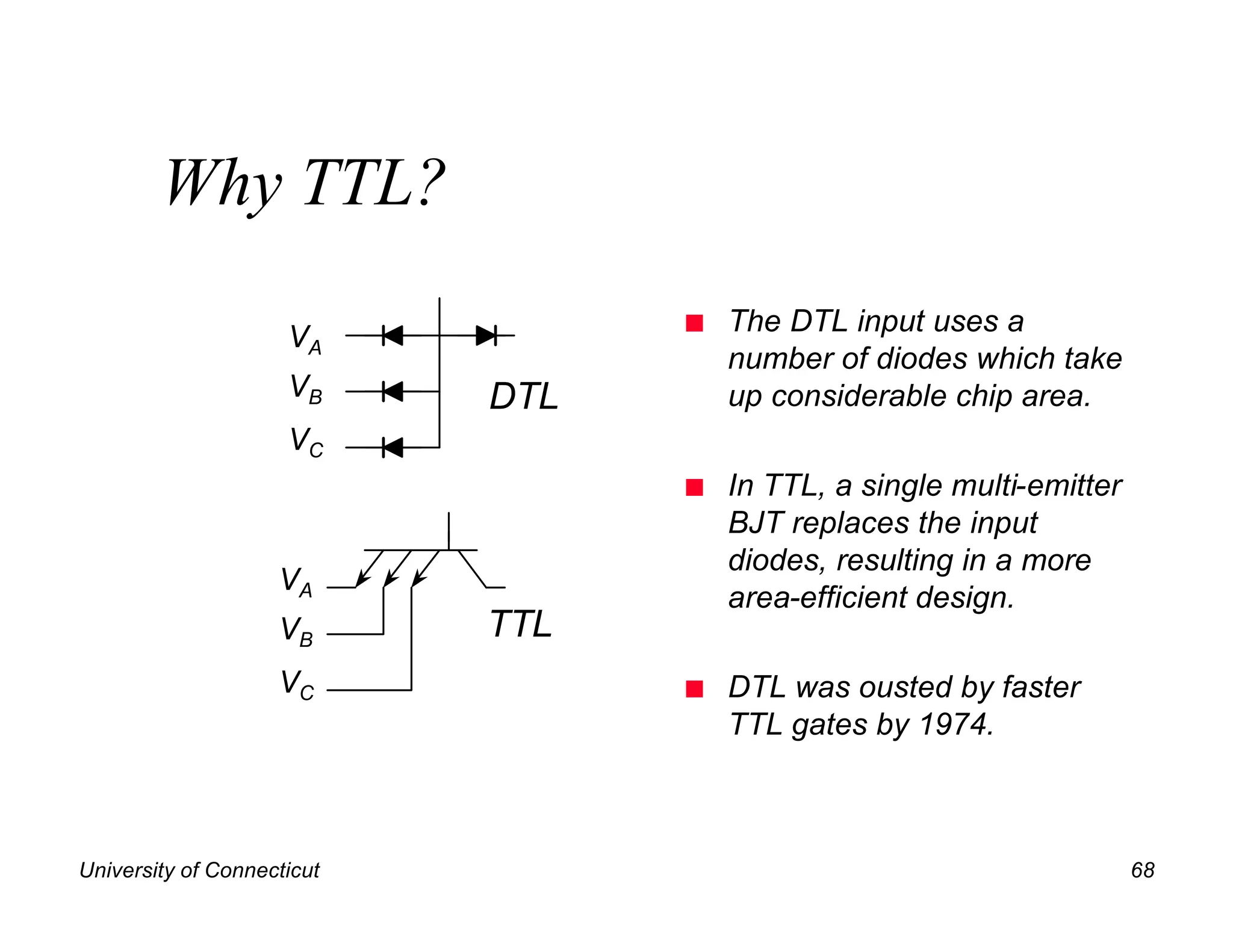
Why TTL?
                                  n   The DTL input uses a
                     VA
                                      number of diodes which take
                     VB     DTL       up considerable chip area.
                     VC
                                  n   In TTL, a single multi-emitter
                                      BJT replaces the input
                                      diodes, resulting in a more
                    VA
                                      area-efficient design.
                    VB      TTL
                    VC            n   DTL was ousted by faster
                                      TTL gates by 1974.


University of Connecticut                                              68
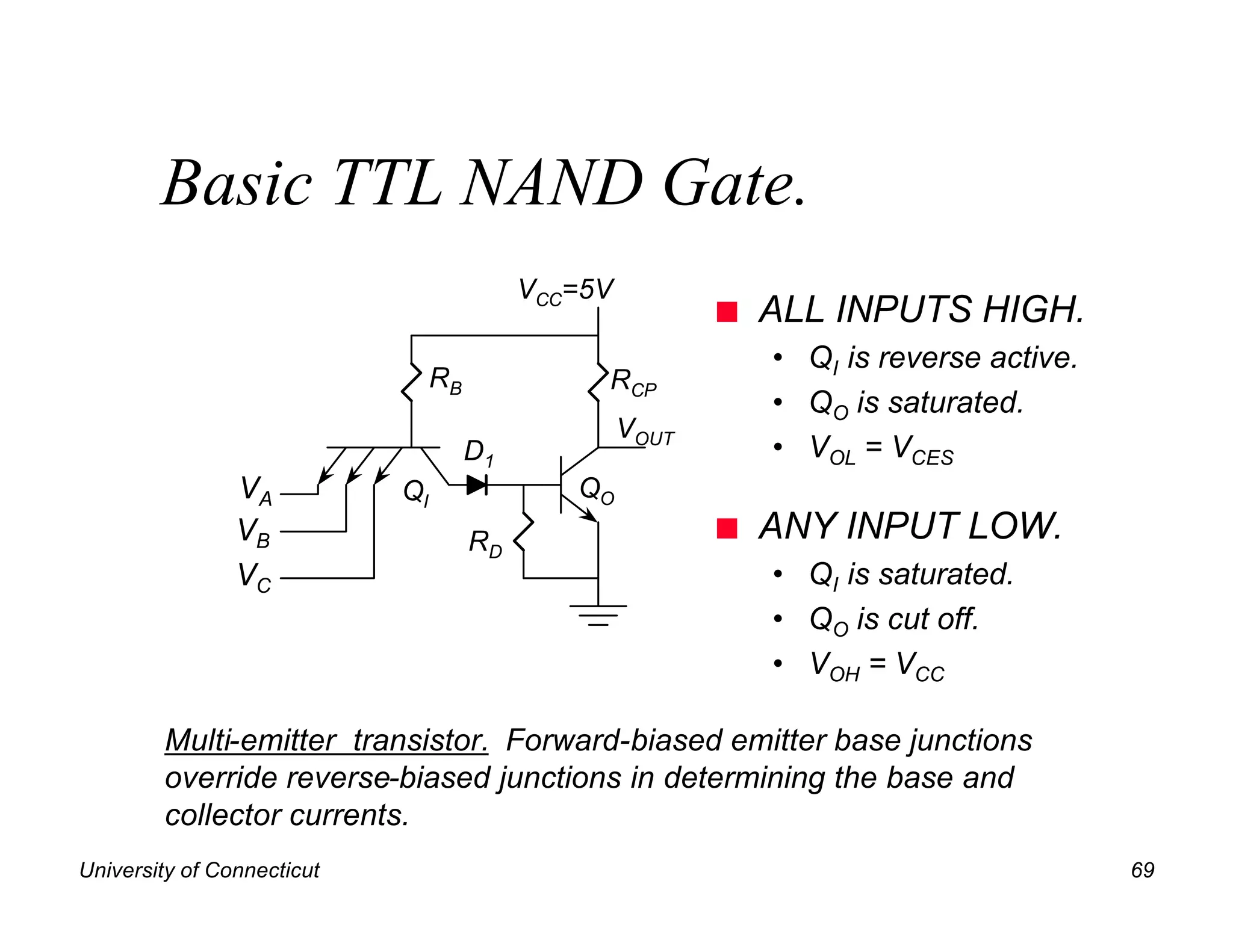
Basic TTL NAND Gate.
                                           VCC=5V
                                                           n   ALL INPUTS HIGH.
                                                               • QI is reverse active.
                                 RB             RCP
                                                               • QO is saturated.
                                                    VOUT
                                      D1                       • VOL = VCES
                VA          QI                QO
                VB                    RD                   n   ANY INPUT LOW.
                VC                                             • QI is saturated.
                                                               • QO is cut off.
                                                               • VOH = VCC

        Multi-emitter transistor. Forward-biased emitter base junctions
        override reverse-biased junctions in determining the base and
        collector currents.
University of Connecticut                                                                69
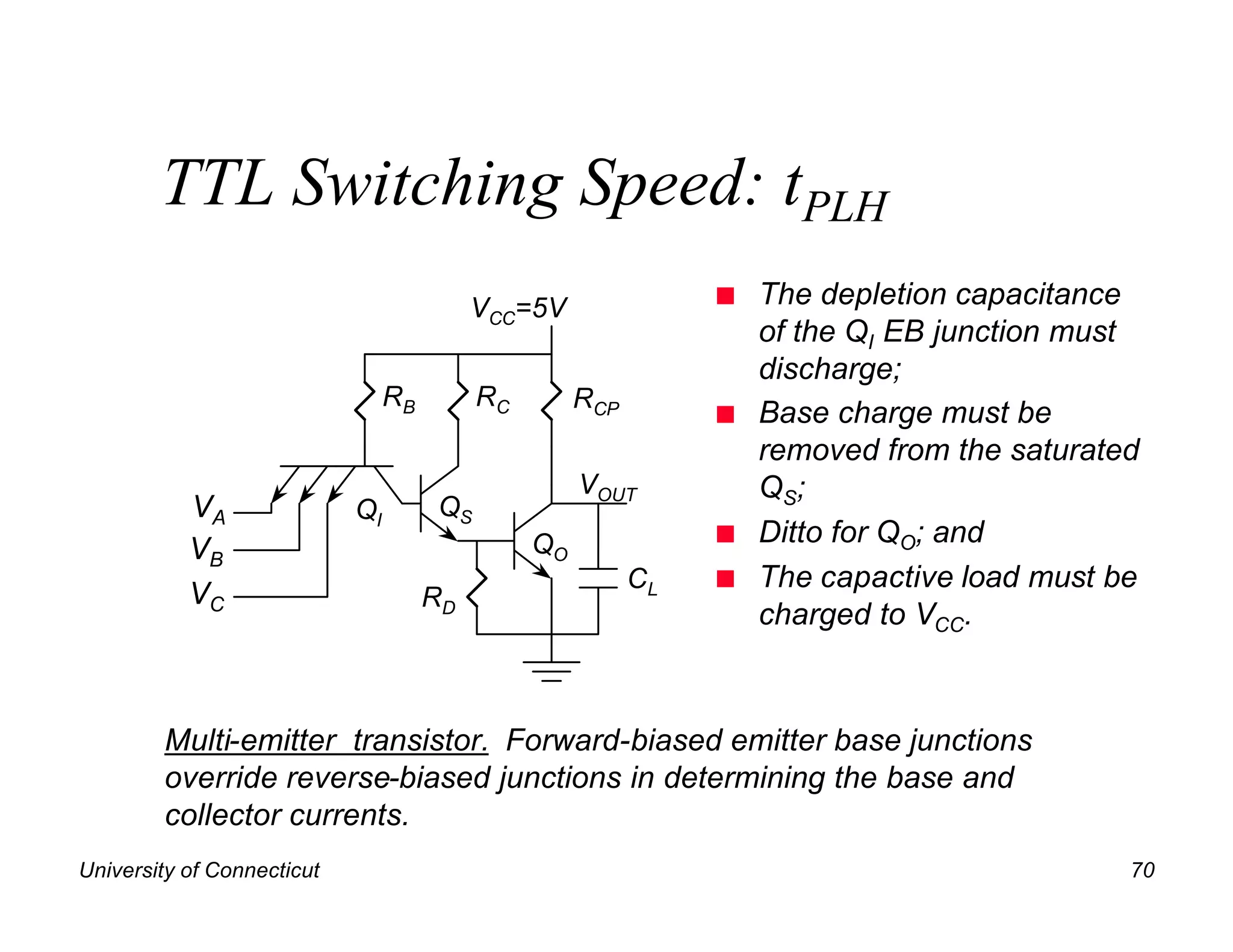
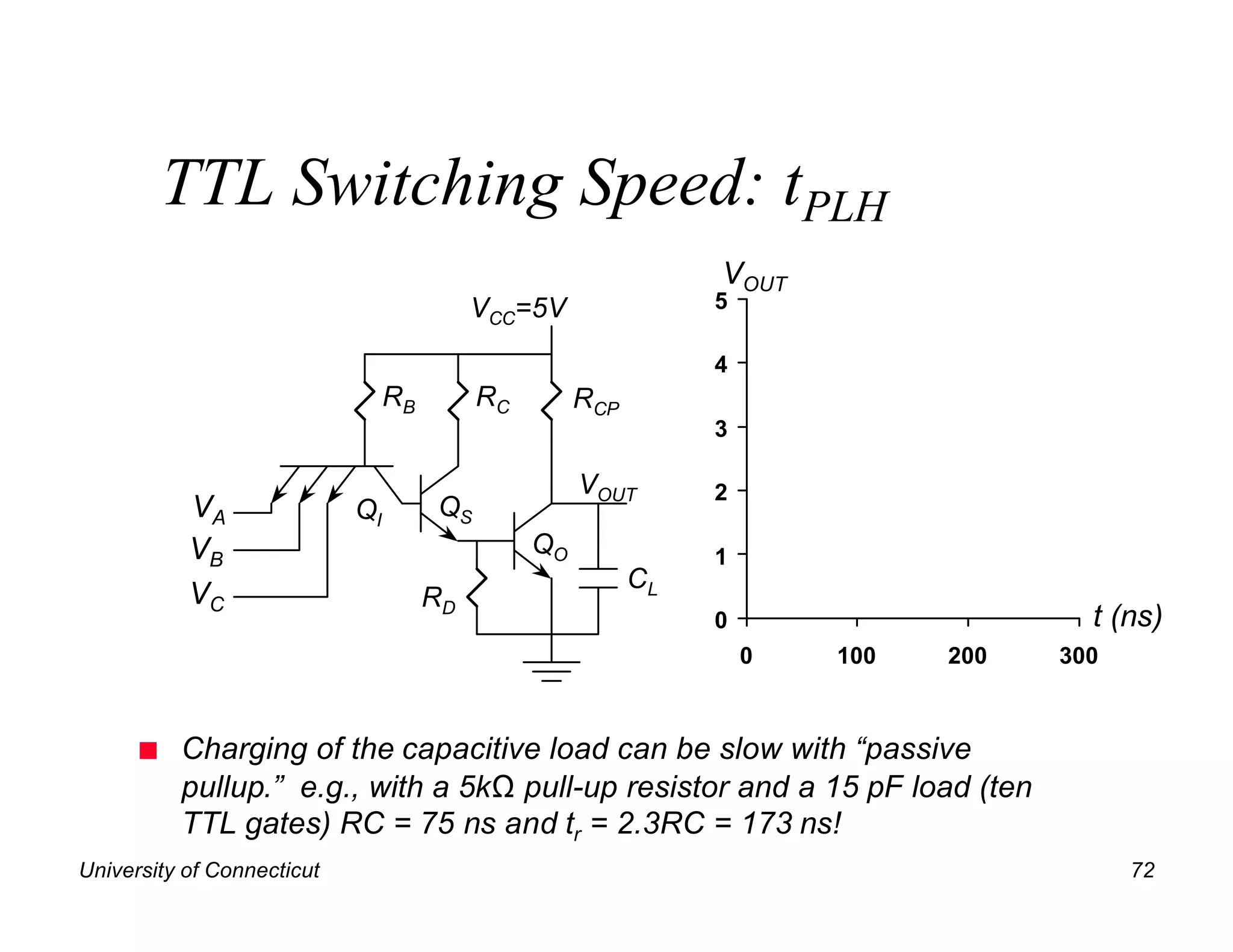
TTL Switching Speed: tPLH
                                           VCC=5V               n   The depletion capacitance
                                                                    of the QI EB junction must
                                                                    discharge;
                                 RB        RC        RCP
                                                                n   Base charge must be
                                                                    removed from the saturated
                                                     VOUT           QS;
           VA               QI        QS
                                                QO              n   Ditto for QO; and
           VB
                                                           CL   n   The capactive load must be
           VC                         RD
                                                                    charged to VCC.


        Multi-emitter transistor. Forward-biased emitter base junctions
        override reverse-biased junctions in determining the base and
        collector currents.
University of Connecticut                                                                    70
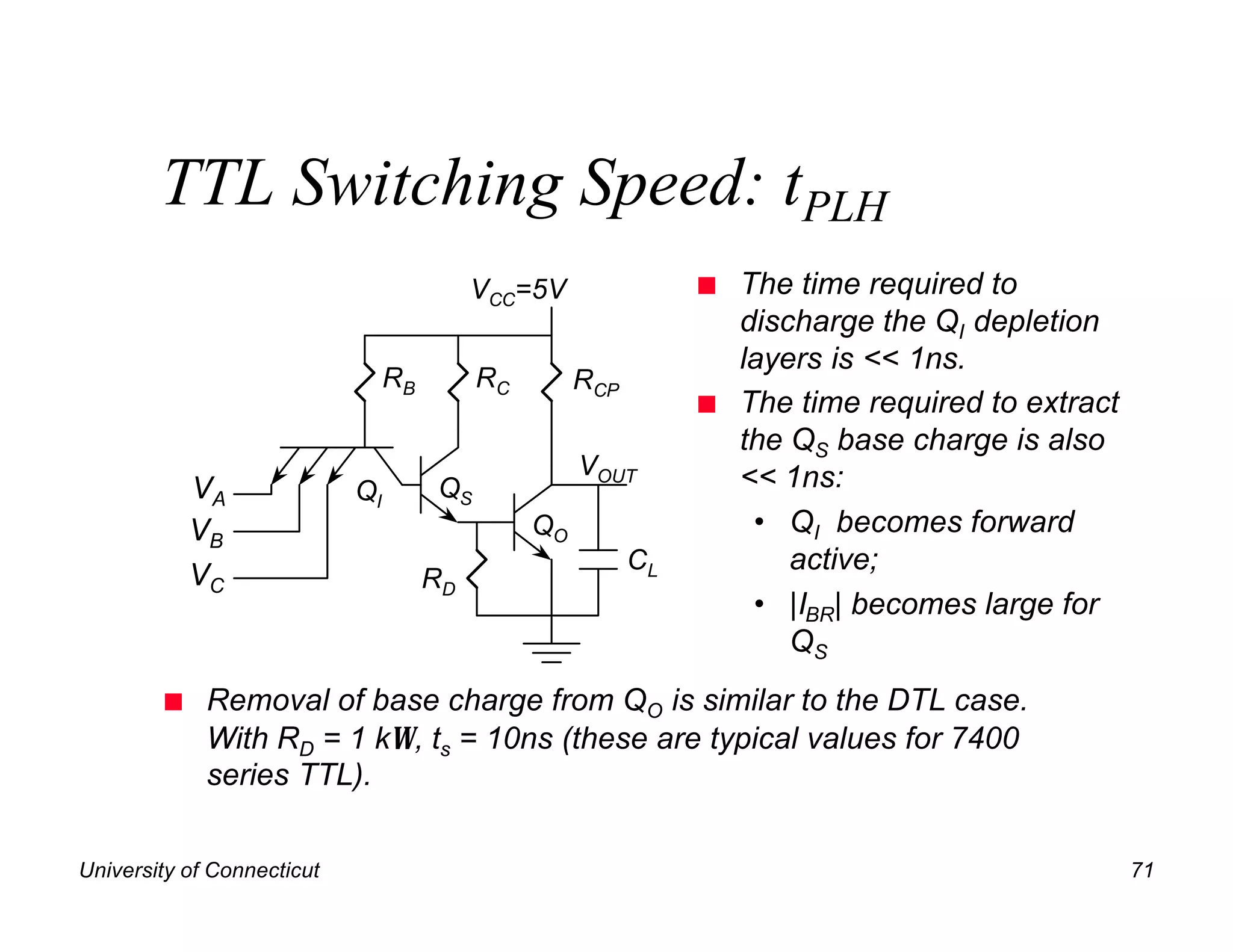
TTL Switching Speed: tPLH
                                           VCC=5V               n   The time required to
                                                                    discharge the QI depletion
                                                                    layers is << 1ns.
                                 RB        RC        RCP
                                                                n   The time required to extract
                                                                    the QS base charge is also
                                                     VOUT           << 1ns:
            VA              QI        QS
            VB                                  QO                   • QI becomes forward
                                                           CL           active;
            VC                        RD
                                                                     • |IBR| becomes large for
                                                                        QS
        n    Removal of base charge from QO is similar to the DTL case.
             With RD = 1 kΩ, ts = 10ns (these are typical values for 7400
             series TTL).

University of Connecticut                                                                          71
TTL Switching Speed: tPLH
                                                                VOUT
                                           VCC=5V               5

                                                                4
                                 RB        RC        RCP
                                                                3

                                                     VOUT       2
           VA               QI        QS
           VB                                   QO              1
                                                           CL
           VC                         RD
                                                                0                     t (ns)
                                                                    0   100   200   300


      n   Charging of the capacitive load can be slow with “passive
          pullup.” e.g., with a 5kΩ pull-up resistor and a 15 pF load (ten
          TTL gates) RC = 75 ns and tr = 2.3RC = 173 ns!
University of Connecticut                                                                 72
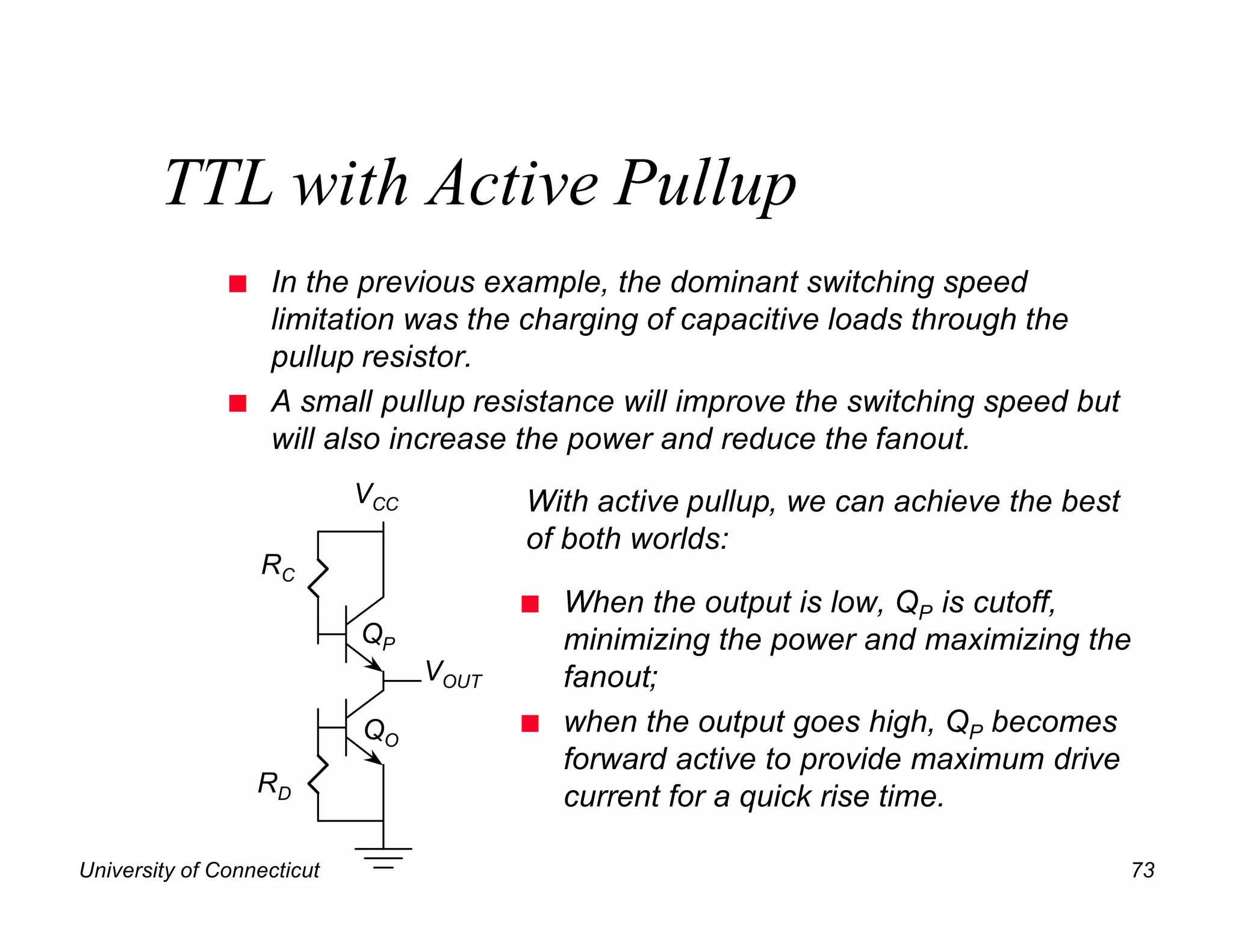
TTL with Active Pullup
               n   In the previous example, the dominant switching speed
                   limitation was the charging of capacitive loads through the
                   pullup resistor.
               n   A small pullup resistance will improve the switching speed but
                   will also increase the power and reduce the fanout.
                            VCC          With active pullup, we can achieve the best
                                         of both worlds:
                   RC
                                         n   When the output is low, QP is cutoff,
                            QP               minimizing the power and maximizing the
                                  VOUT       fanout;
                            QO           n   when the output goes high, QP becomes
                                             forward active to provide maximum drive
                   RD
                                             current for a quick rise time.

University of Connecticut                                                              73
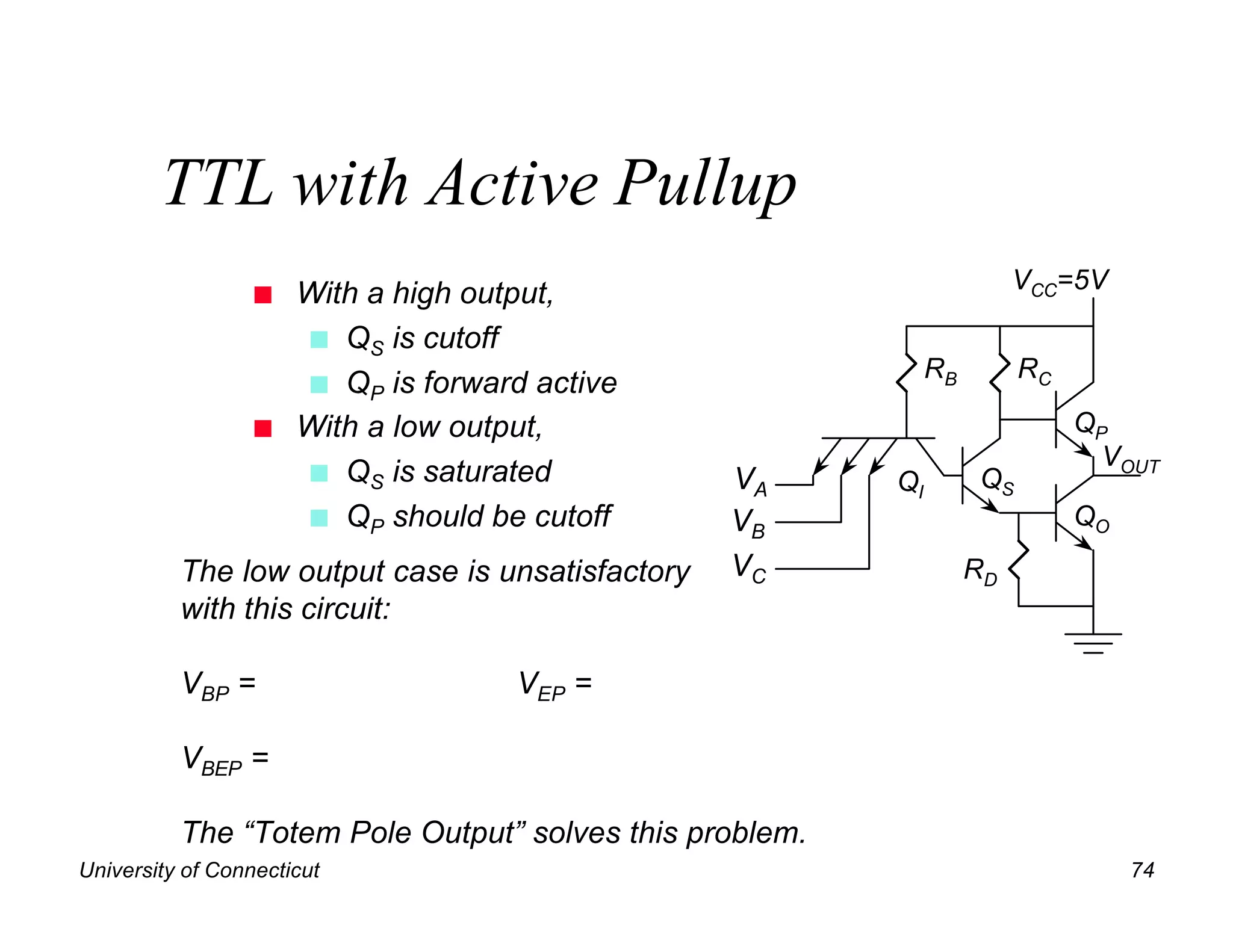
TTL with Active Pullup
                  n   With a high output,                               VCC=5V

                      n QS is cutoff
                                                              RB        RC
                      n QP is forward active
                  n   With a low output,                                     QP
                                                                               VOUT
                      n QS is saturated           VA     QI        QS
                      n QP should be cutoff       VB                         QO

          The low output case is unsatisfactory   VC               RD
          with this circuit:

          VBP =                      VEP =

          VBEP =

          The “Totem Pole Output” solves this problem.
University of Connecticut                                                         74
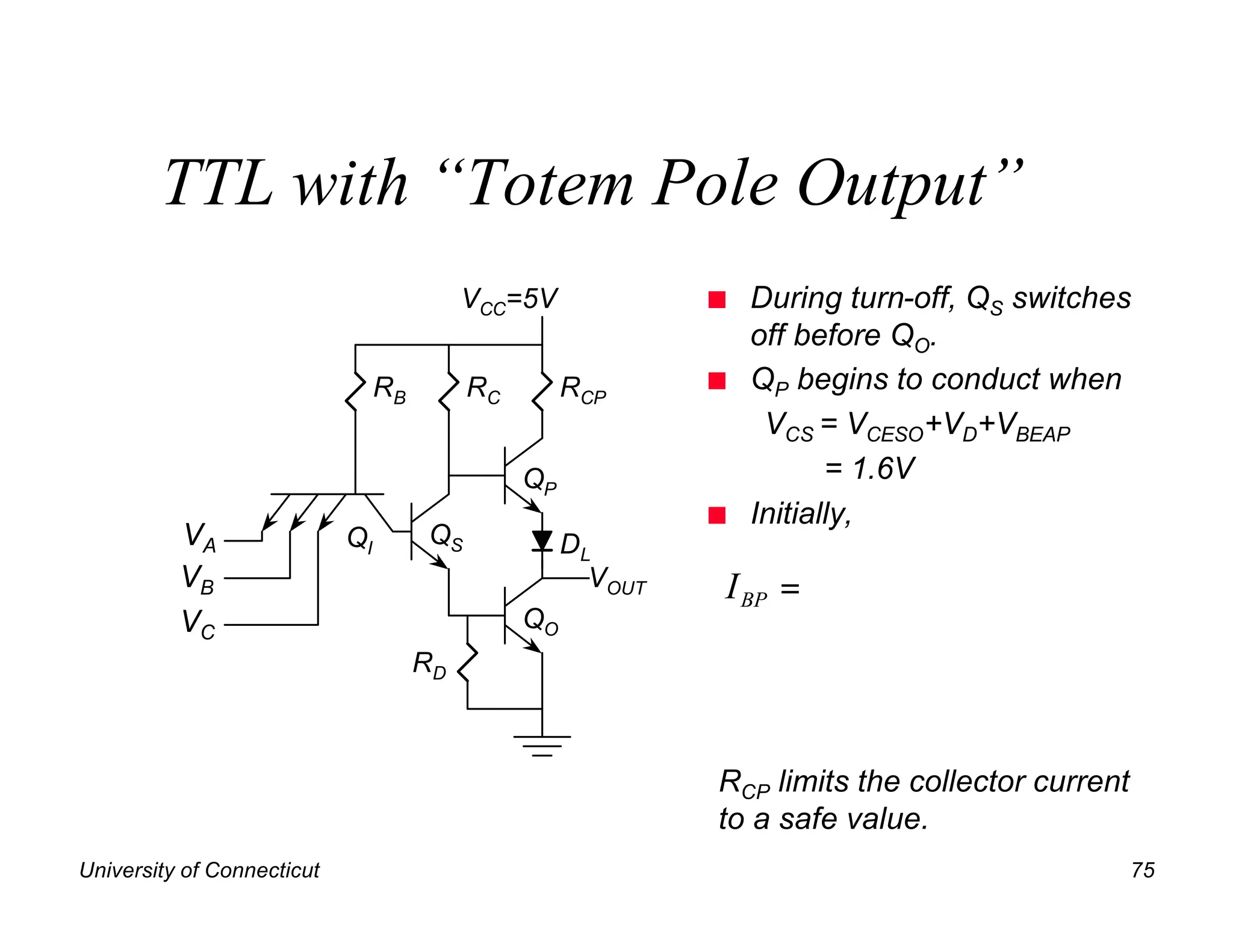
TTL with “Totem Pole Output”
                                           VCC=5V             n   During turn-off, QS switches
                                                                  off before QO.
                                 RB        RC        RCP      n   QP begins to conduct when
                                                                   VCS = VCESO+VD+VBEAP
                                                QP                       = 1.6V
                                                              n   Initially,
          VA                QI        QS             DL
          VB                                           VOUT   I BP =
          VC                                    QO
                                      RD


                                                              RCP limits the collector current
                                                              to a safe value.
University of Connecticut                                                                        75
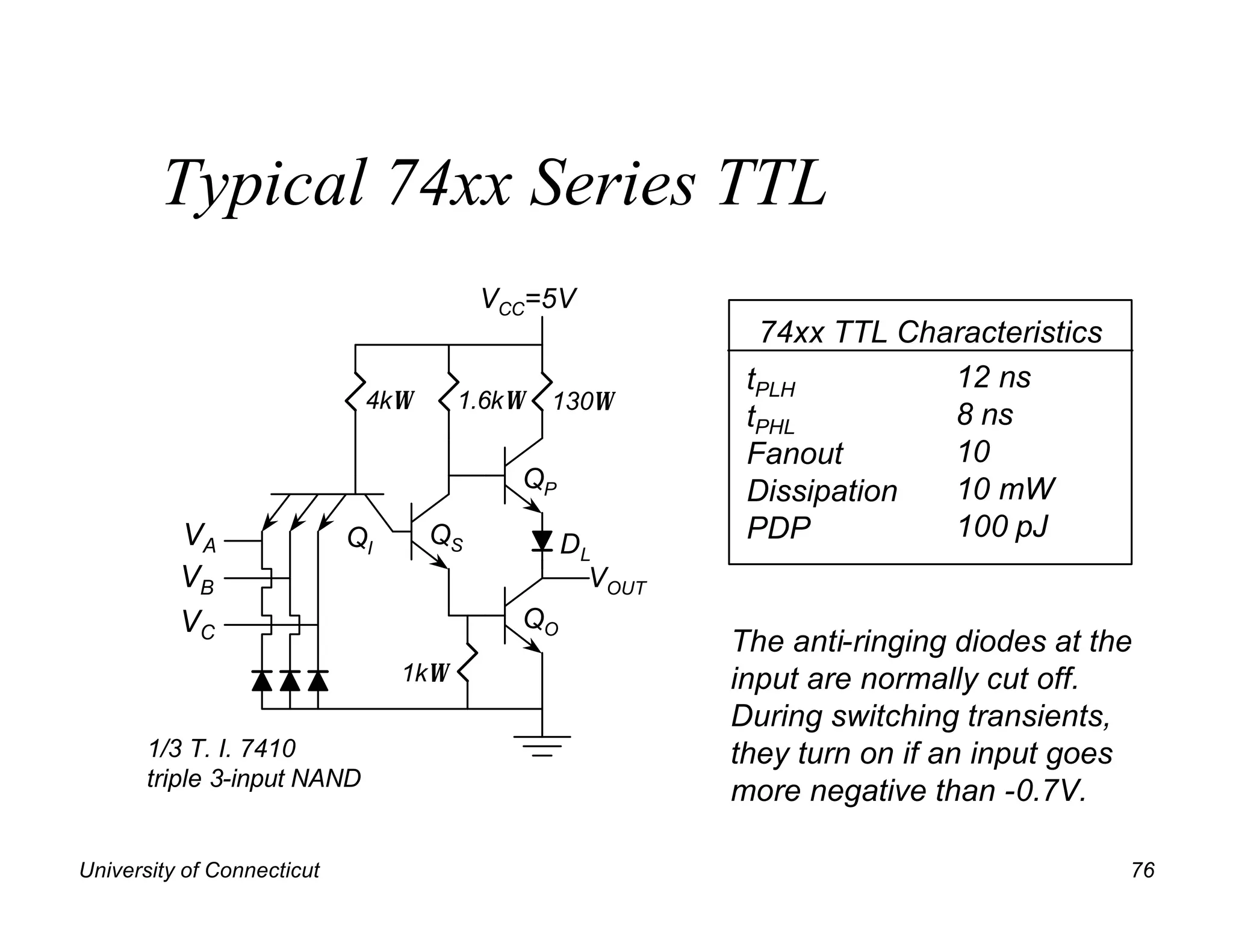
Typical 74xx Series TTL
                                        VCC=5V
                                                           74xx TTL Characteristics
                                                          tPLH         12 ns
                             4kΩ       1.6kΩ   130Ω
                                                          tPHL         8 ns
                                                          Fanout       10
                                           QP             Dissipation  10 mW
          VA                QI     QS                     PDP          100 pJ
                                                DL
          VB                                      VOUT
          VC                               QO
                                                         The anti-ringing diodes at the
                                 1kΩ                     input are normally cut off.
                                                         During switching transients,
       1/3 T. I. 7410                                    they turn on if an input goes
       triple 3-input NAND
                                                         more negative than -0.7V.

University of Connecticut                                                             76
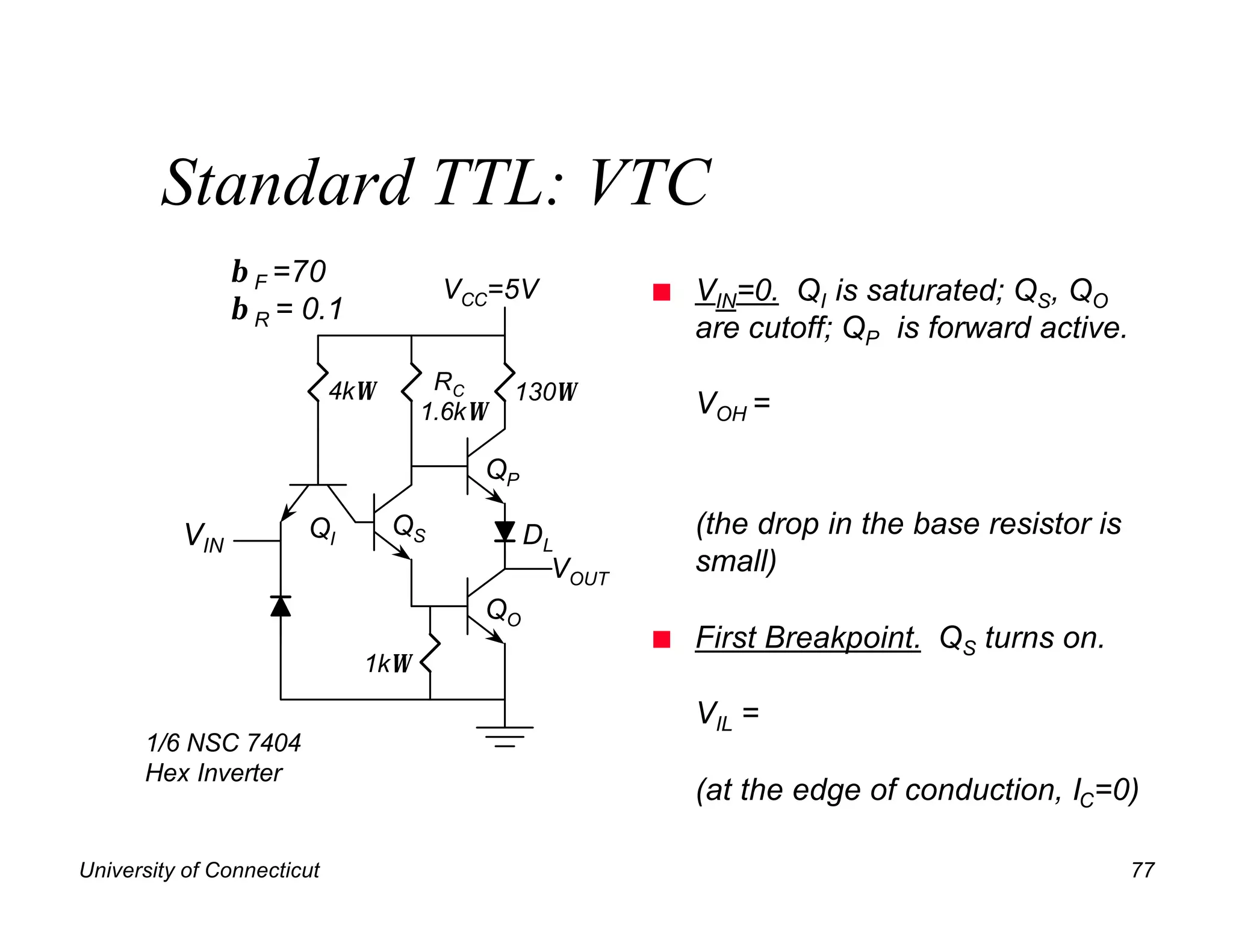
Standard TTL: VTC
                β F =70
                                       VCC=5V          n   VIN=0. QI is saturated; QS, QO
                β R = 0.1
                                                           are cutoff; QP is forward active.

                            4kΩ      RC     130Ω
                                    1.6kΩ                  VOH =

                                         QP

          VIN          QI         QS          DL           (the drop in the base resistor is
                                                VOUT       small)
                                         QO
                                                       n   First Breakpoint. QS turns on.
                              1kΩ

                                                           VIL =
      1/6 NSC 7404
      Hex Inverter
                                                           (at the edge of conduction, IC=0)

University of Connecticut                                                                      77
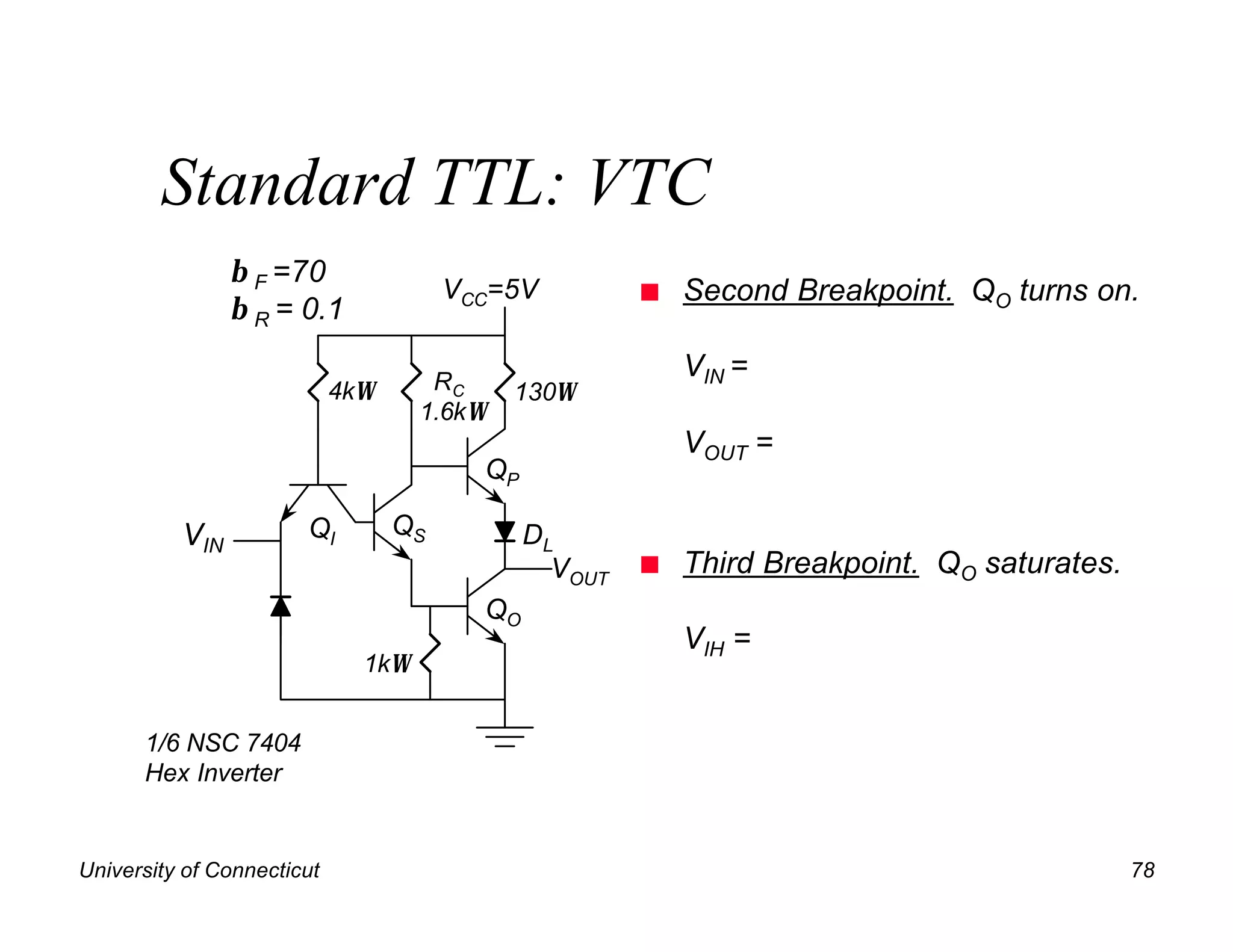
Standard TTL: VTC
                β F =70
                                       VCC=5V          n   Second Breakpoint. QO turns on.
                β R = 0.1

                                     RC
                                                           VIN =
                            4kΩ             130Ω
                                    1.6kΩ
                                                           VOUT =
                                         QP

          VIN          QI         QS          DL
                                                VOUT   n   Third Breakpoint. QO saturates.
                                         QO
                                                           VIH =
                              1kΩ


      1/6 NSC 7404
      Hex Inverter


University of Connecticut                                                                    78
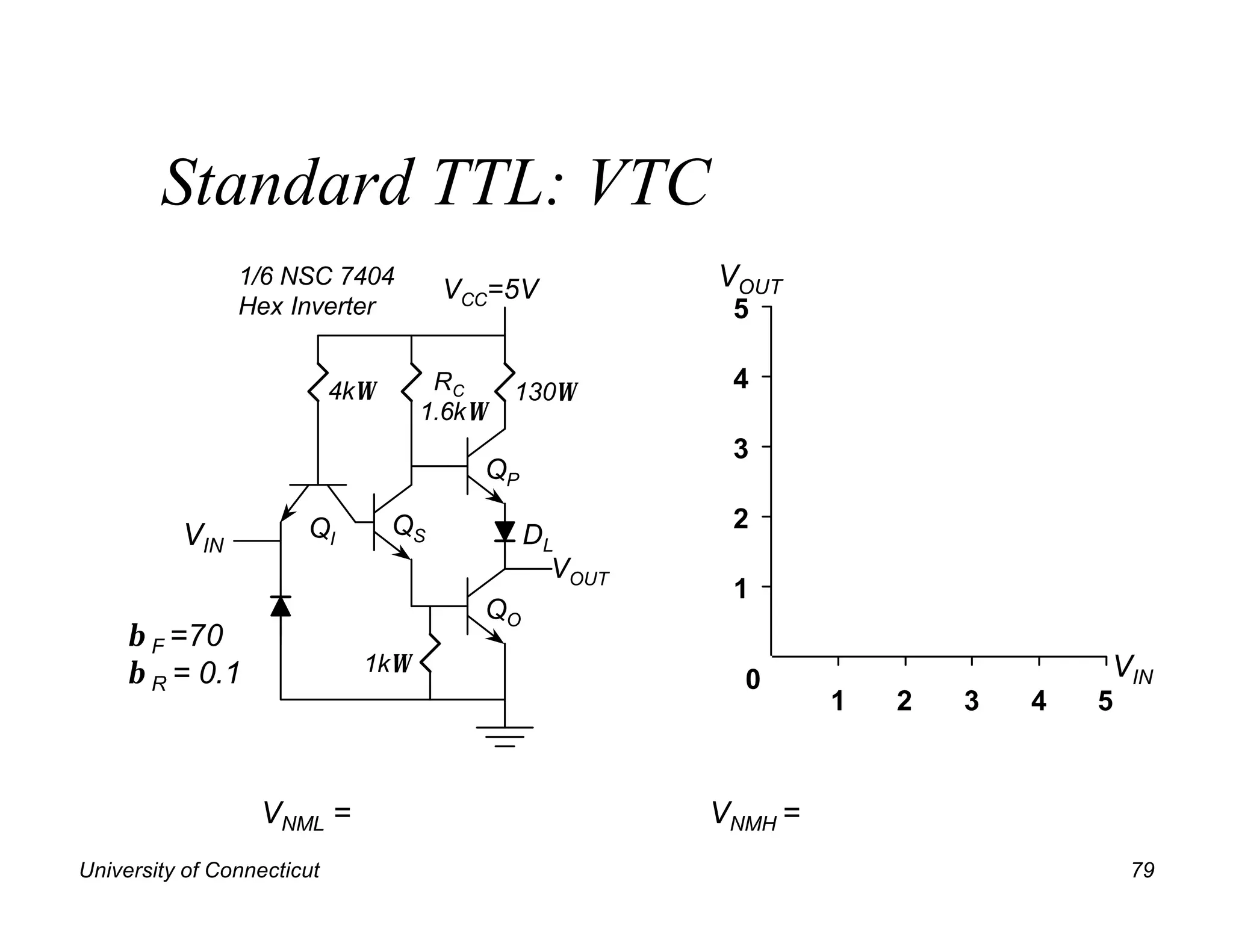
Standard TTL: VTC
                1/6 NSC 7404
                                       VCC=5V          VOUT
                Hex Inverter                            5

                            4kΩ      RC     130Ω        4
                                    1.6kΩ
                                                        3
                                         QP

                       QI         QS                    2
          VIN                                 DL
                                                VOUT
                                                        1
                                         QO
     β F =70
     β R = 0.1                1kΩ
                                                         0                      VIN
                                                                1   2   3   4   5


                  VNML =                               VNMH =
University of Connecticut                                                           79
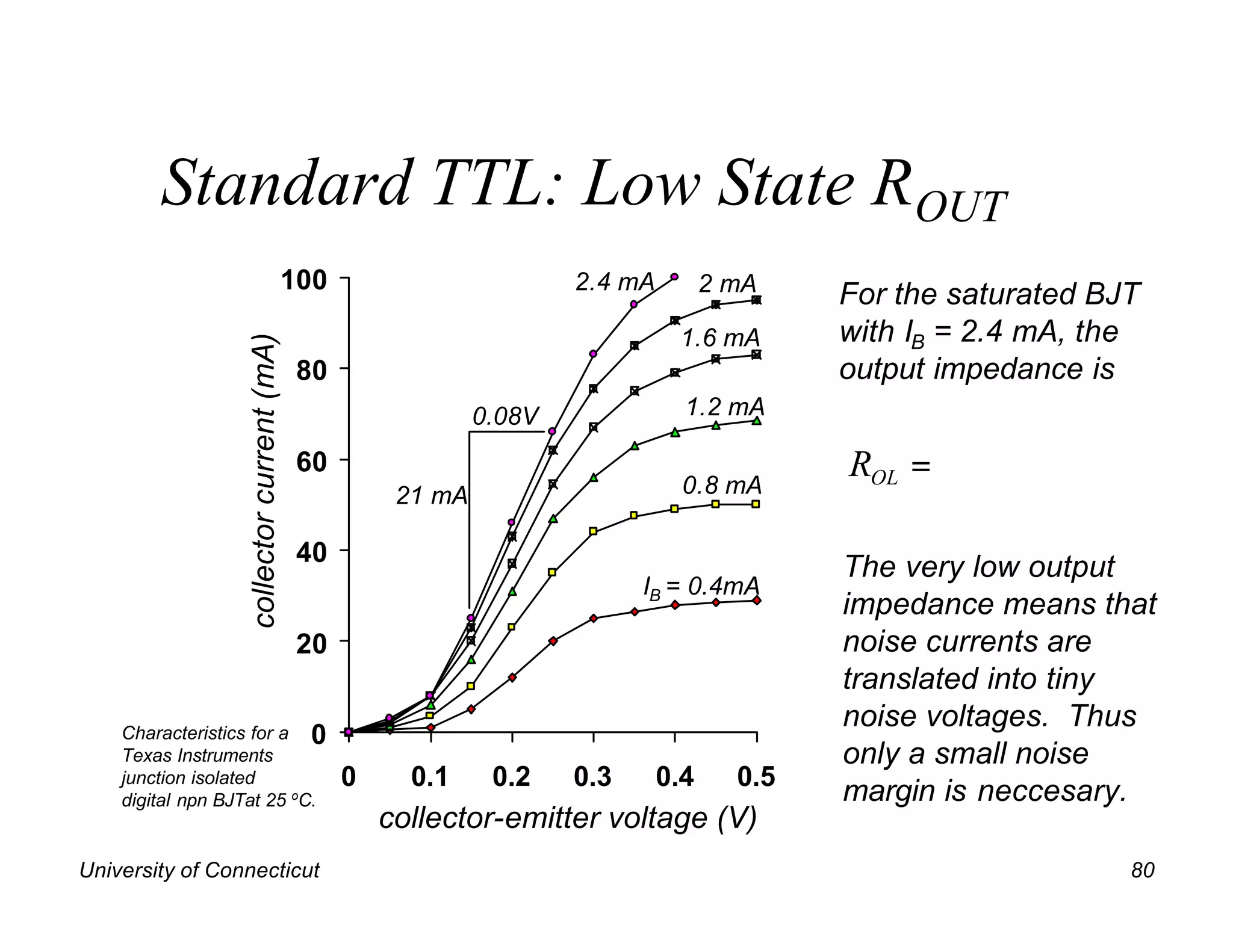
Standard TTL: Low State ROUT
                                            100                        2.4 mA         2 mA    For the saturated BJT
                                                                                 1.6 mA       with IB = 2.4 mA, the
                   collector current (mA)


                                             80                                               output impedance is
                                                               0.08V              1.2 mA

                                             60
                                                                                  0.8 mA
                                                                                              ROL =
                                                       21 mA

                                             40
                                                                                              The very low output
                                                                             IB = 0.4mA
                                                                                              impedance means that
                                             20                                               noise currents are
                                                                                              translated into tiny
    Characteristics for a 0
                                                                                              noise voltages. Thus
    Texas Instruments                                                                         only a small noise
    junction isolated                             0     0.1     0.2    0.3      0.4     0.5
    digital npn BJTat 25 oC.                                                                  margin is neccesary.
                                                      collector-emitter voltage (V)
University of Connecticut                                                                                         80
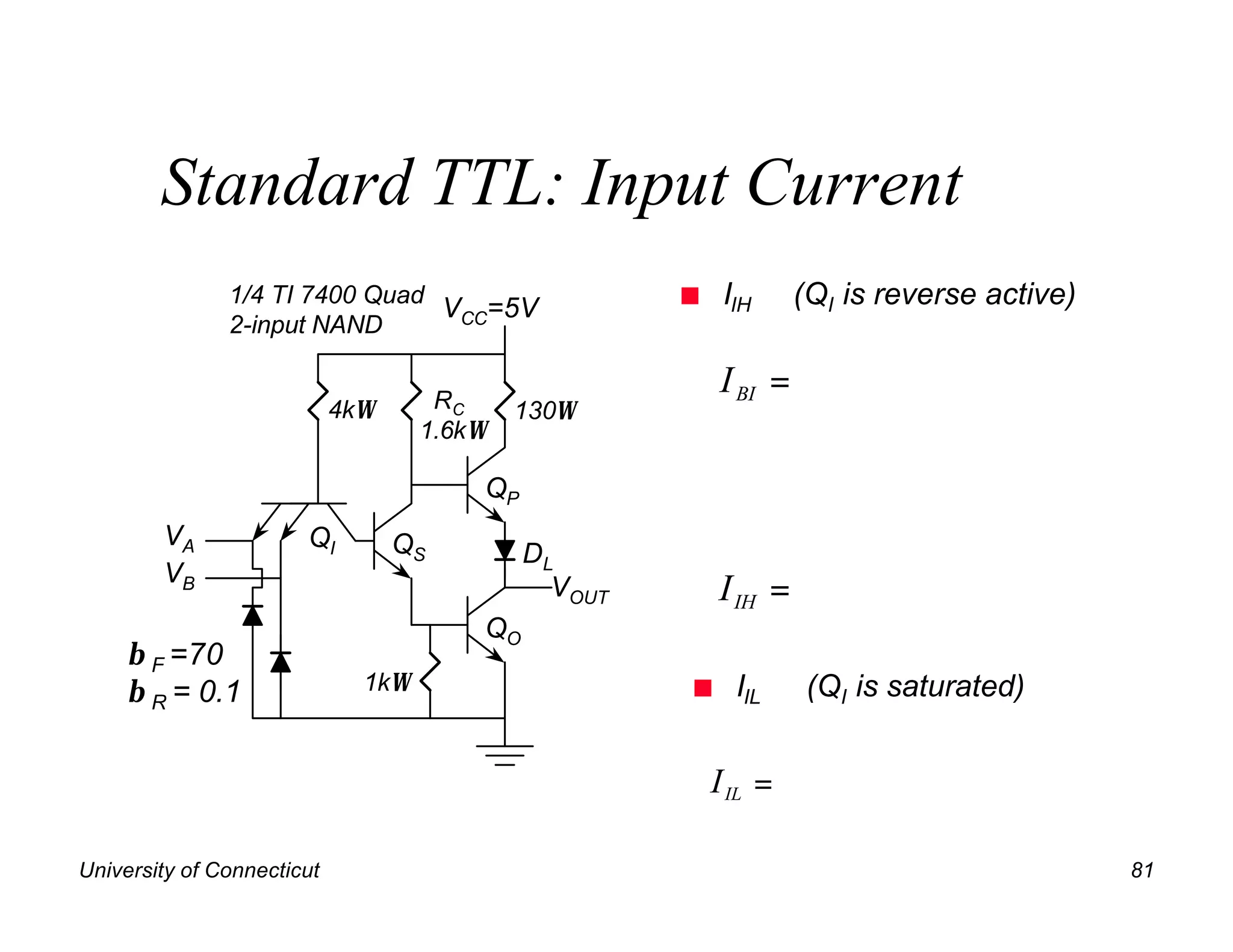
Standard TTL: Input Current
               1/4 TI 7400 Quad
                                VCC=5V                n    IIH     (QI is reverse active)
               2-input NAND

                                     RC
                                                          I BI =
                            4kΩ             130Ω
                                    1.6kΩ

                                        QP
        VA             QI         QS         DL
        VB                                     VOUT       I IH =
                                        QO
     β F =70
     β R = 0.1                1kΩ                     n     IIL     (QI is saturated)


                                                          I IL =

University of Connecticut                                                                   81
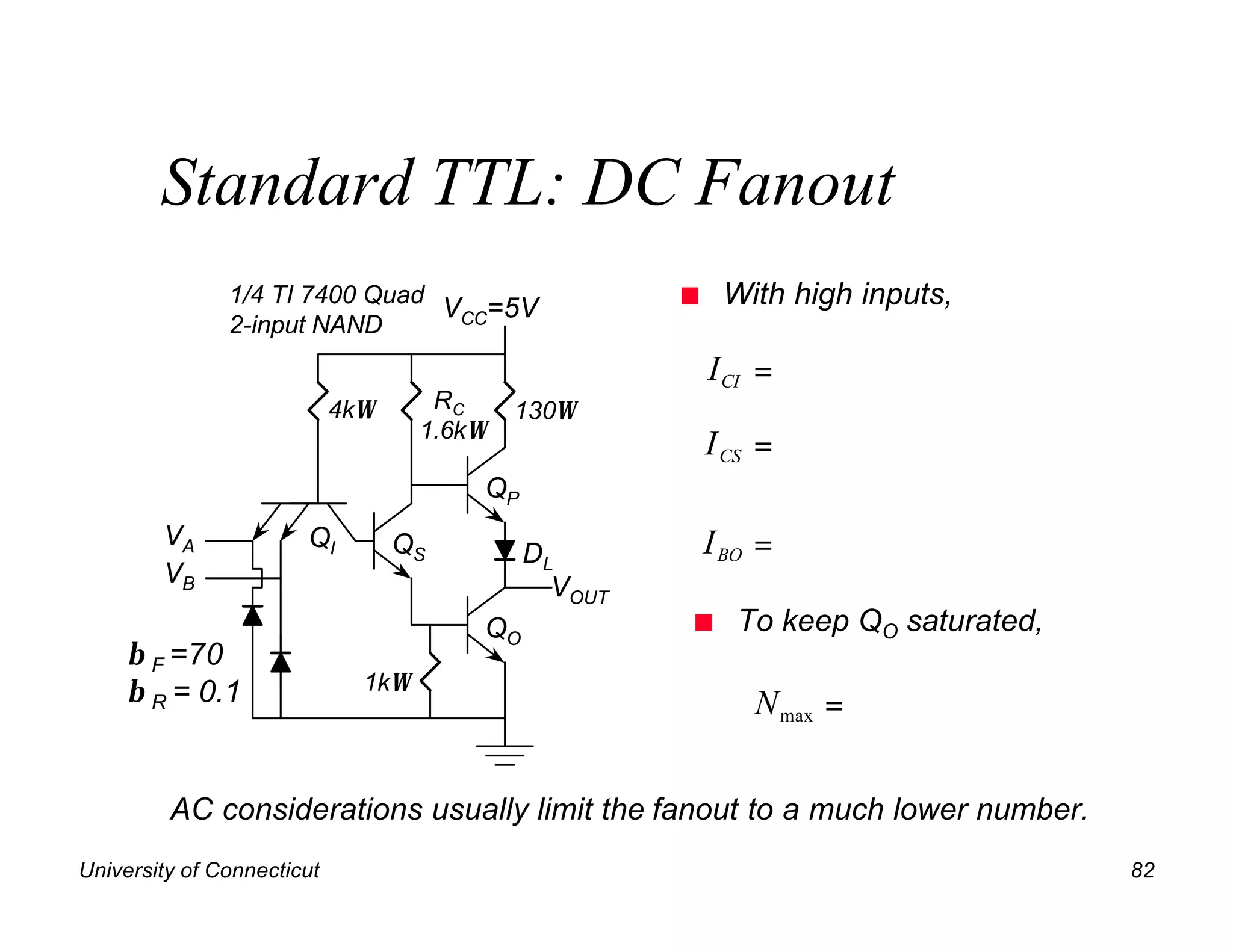
Standard TTL: DC Fanout
               1/4 TI 7400 Quad
                                VCC=5V                n    With high inputs,
               2-input NAND
                                                          I CI =
                            4kΩ      RC     130Ω
                                    1.6kΩ
                                                          I CS =
                                        QP
        VA             QI         QS         DL           I BO =
        VB                                     VOUT
                                        QO            n     To keep QO saturated,
     β F =70
     β R = 0.1                1kΩ
                                                              N max =


         AC considerations usually limit the fanout to a much lower number.
University of Connecticut                                                           82
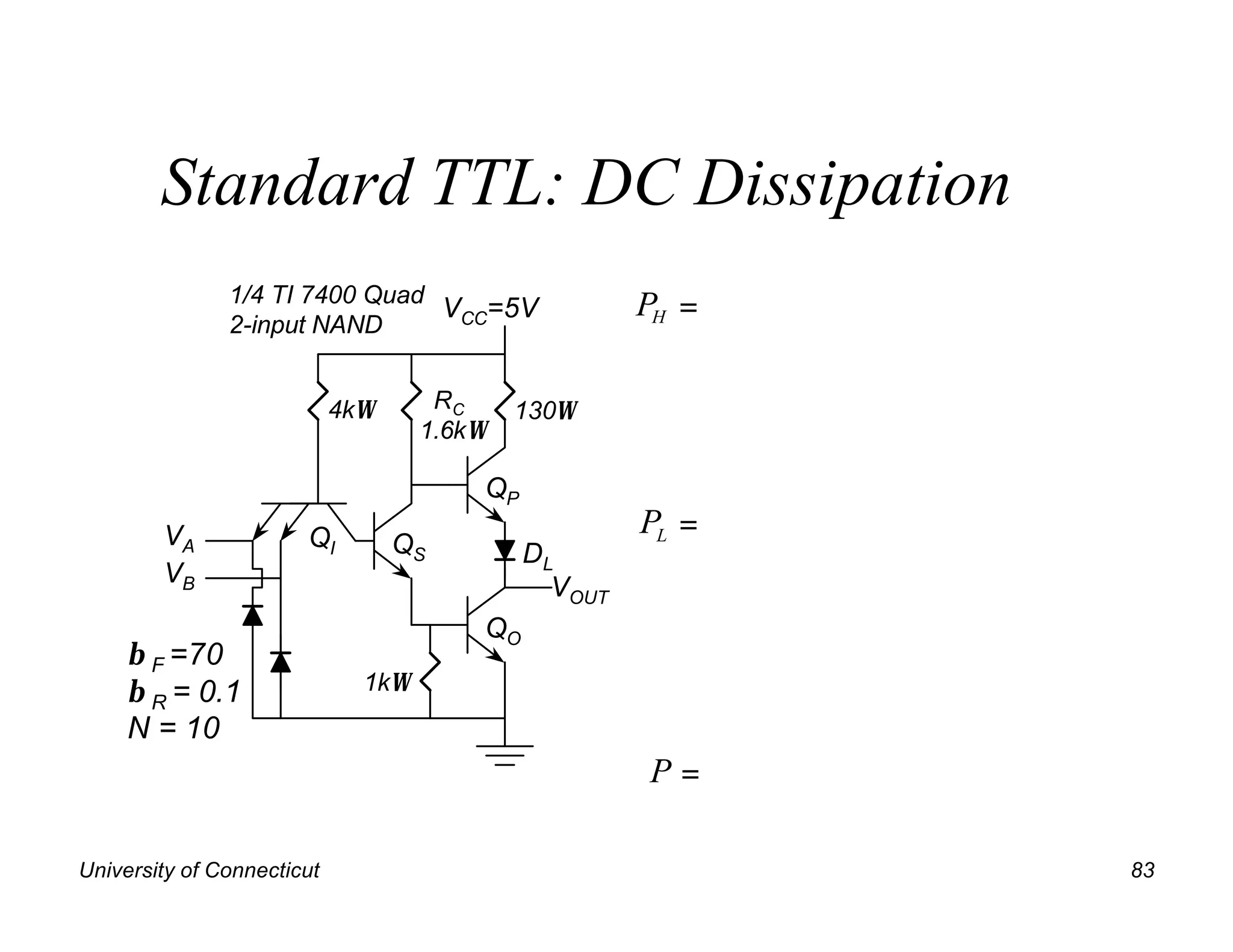
Standard TTL: DC Dissipation
               1/4 TI 7400 Quad
                                VCC=5V                PH =
               2-input NAND


                            4kΩ      RC     130Ω
                                    1.6kΩ

                                        QP
        VA             QI                             PL =
                                  QS         DL
        VB                                     VOUT
                                        QO
     β F =70
     β R = 0.1                1kΩ
     N = 10
                                                      P=

University of Connecticut                                    83
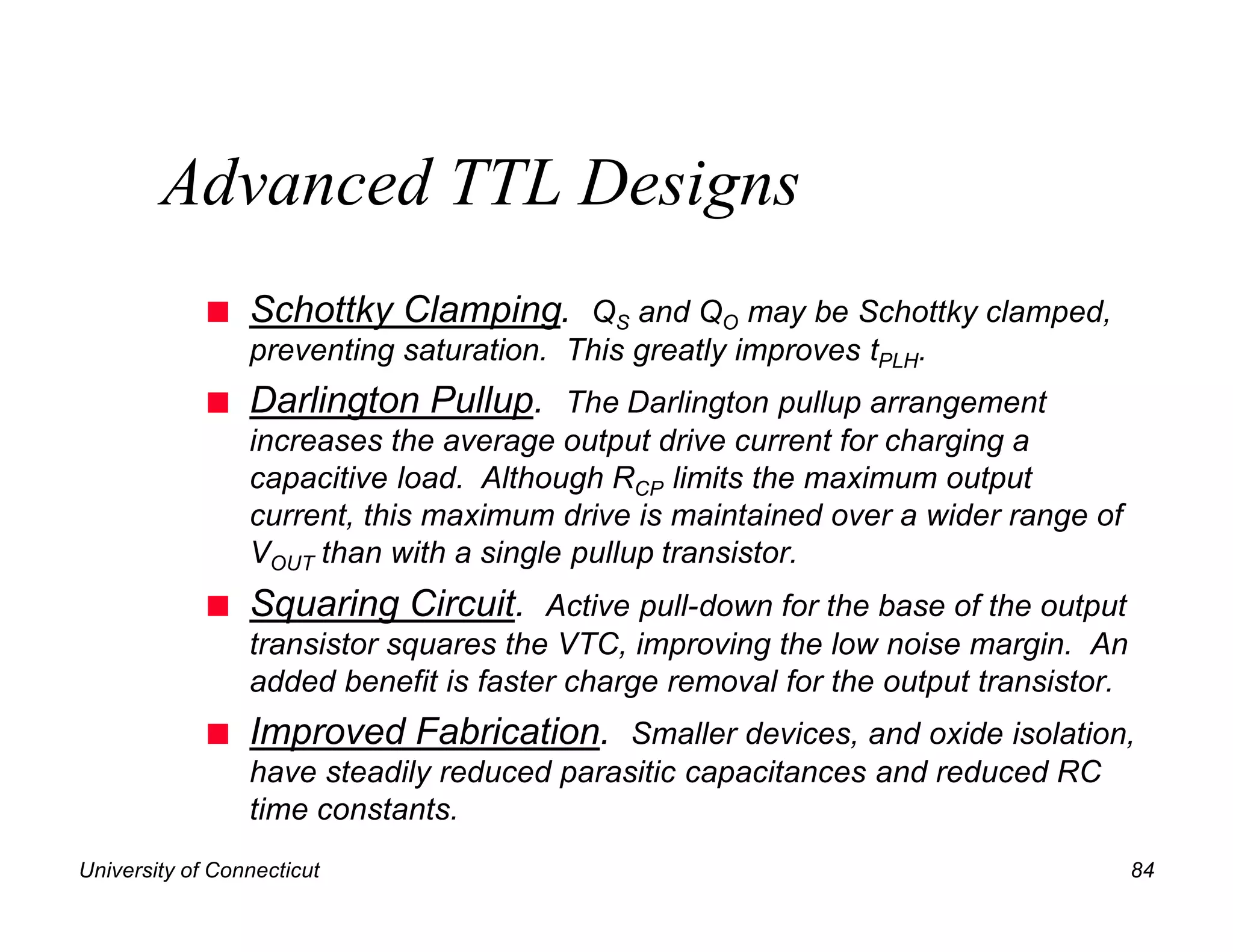
Advanced TTL Designs
             n   Schottky Clamping. QS and QO may be Schottky clamped,
                 preventing saturation. This greatly improves tPLH.
             n   Darlington Pullup. The Darlington pullup arrangement
                 increases the average output drive current for charging a
                 capacitive load. Although RCP limits the maximum output
                 current, this maximum drive is maintained over a wider range of
                 VOUT than with a single pullup transistor.
             n   Squaring Circuit. Active pull-down for the base of the output
                 transistor squares the VTC, improving the low noise margin. An
                 added benefit is faster charge removal for the output transistor.
             n   Improved Fabrication. Smaller devices, and oxide isolation,
                 have steadily reduced parasitic capacitances and reduced RC
                 time constants.
University of Connecticut                                                            84
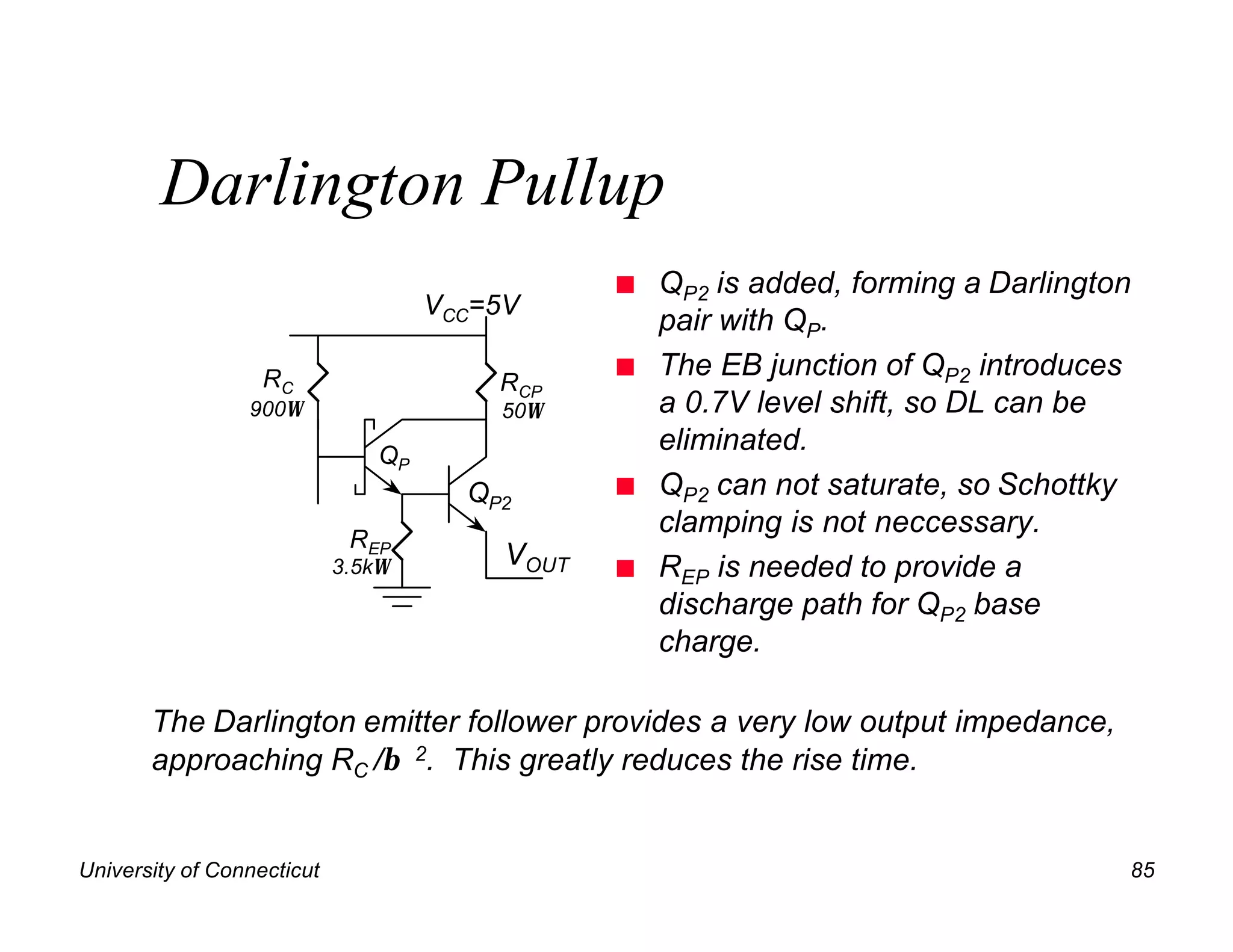
Darlington Pullup
                                                 n   QP2 is added, forming a Darlington
                                     VCC=5V
                                                     pair with QP.
                   RC                            n   The EB junction of QP2 introduces
                                         RCP
                 900Ω                    50Ω         a 0.7V level shift, so DL can be
                                QP
                                                     eliminated.
                                       QP2       n   QP2 can not saturate, so Schottky
                                                     clamping is not neccessary.
                             REP
                            3.5kΩ         VOUT   n   REP is needed to provide a
                                                     discharge path for QP2 base
                                                     charge.

       The Darlington emitter follower provides a very low output impedance,
       approaching RC /β 2. This greatly reduces the rise time.


University of Connecticut                                                             85
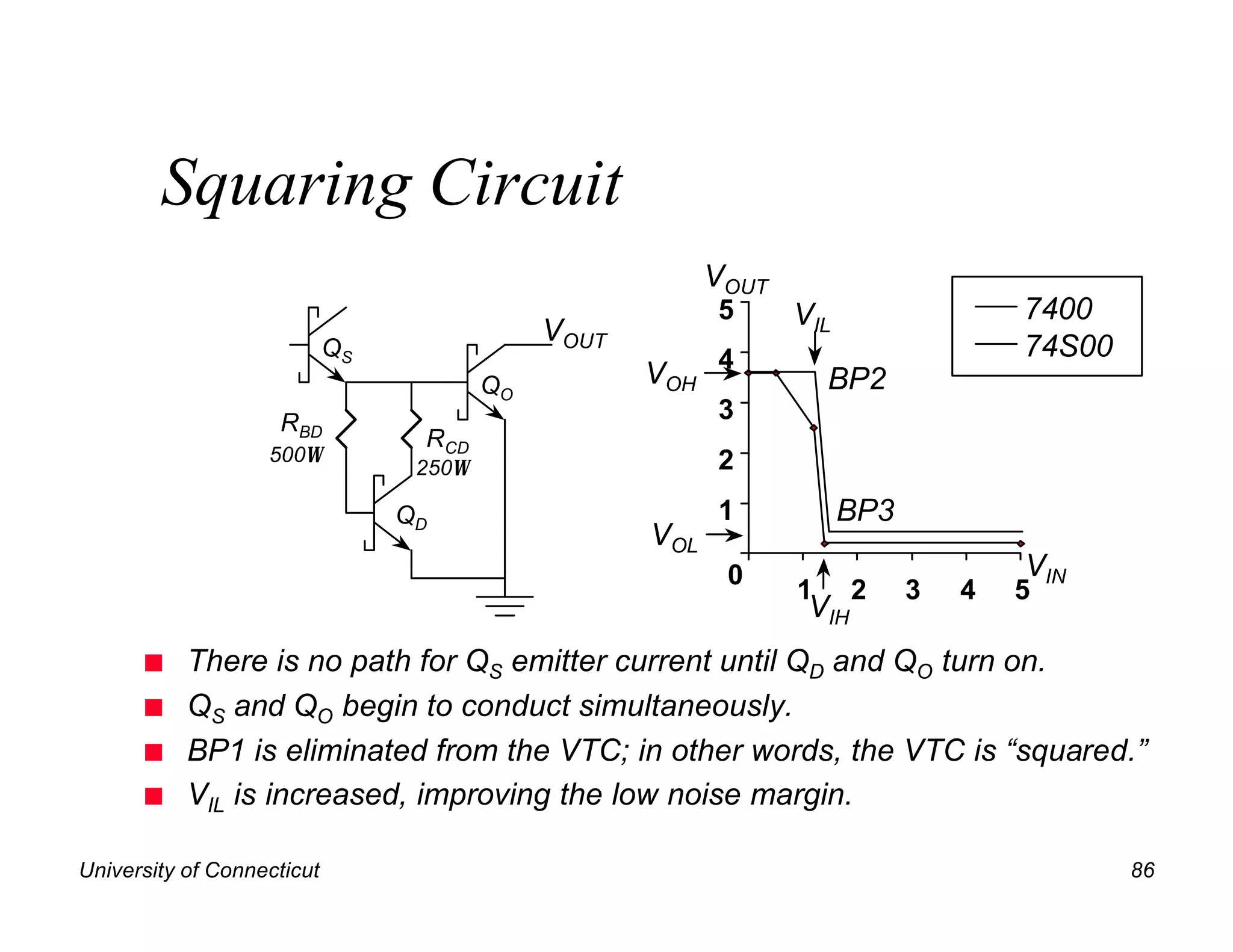
Squaring Circuit
                                                           VOUT
                                                           5      VIL                 7400
                                              VOUT
                            QS                                                        74S00
                                         QO          VOH 4            BP2
                    RBD                                    3
                                  RCD
                   500Ω                                    2
                                  250Ω

                                 QD                        1            BP3
                                                     VOL
                                                            0                         VIN
                                                                  1      2    3   4   5
                                                                   VIH
      n    There is no path for QS emitter current until QD and QO turn on.
      n    QS and QO begin to conduct simultaneously.
      n    BP1 is eliminated from the VTC; in other words, the VTC is “squared.”
      n    VIL is increased, improving the low noise margin.

University of Connecticut                                                                     86
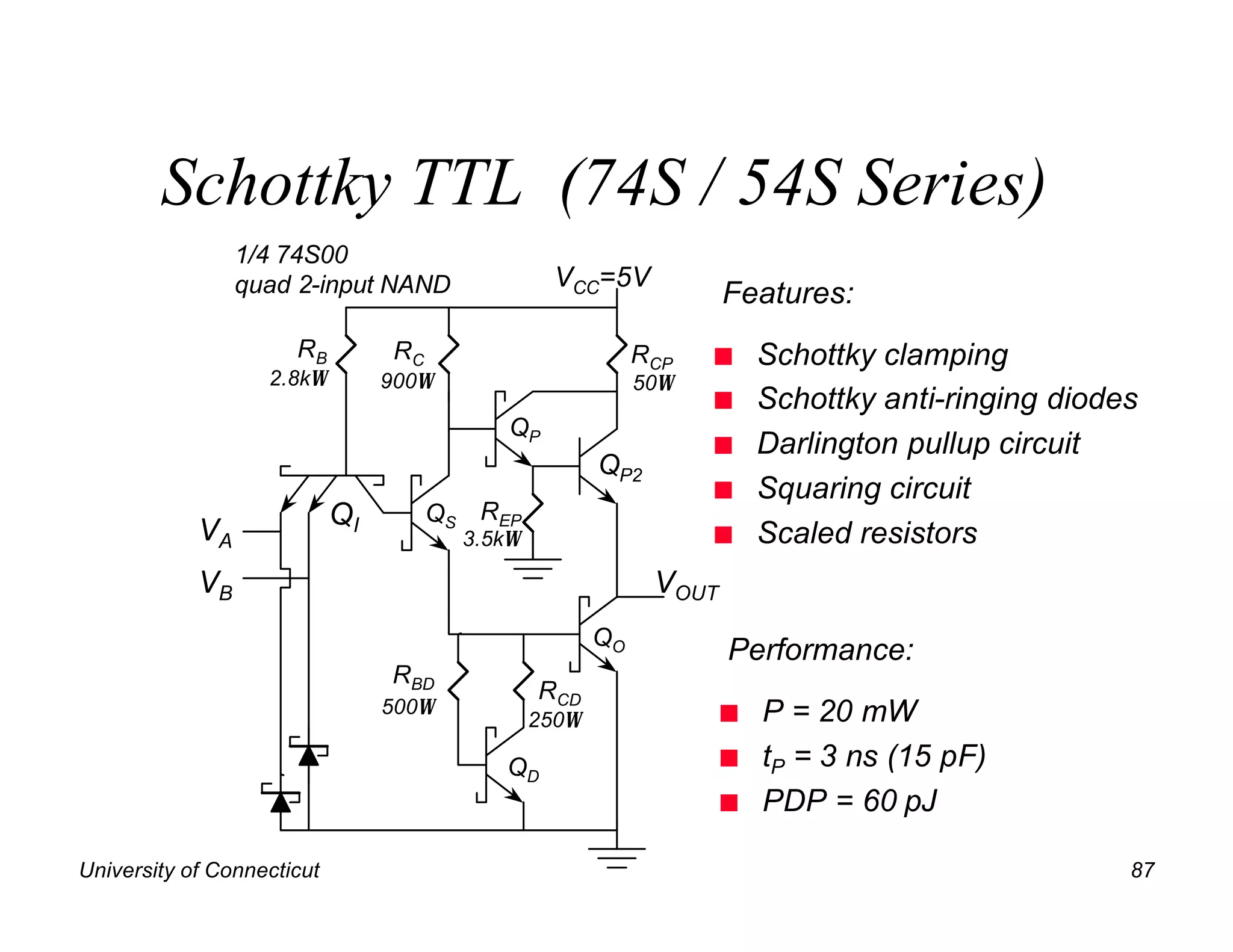
Schottky TTL (74S / 54S Series)
                 1/4 74S00
                 quad 2-input NAND               VCC=5V
                                                                    Features:
                      RB         RC                         RCP   n     Schottky clamping
                   2.8kΩ         900Ω                       50Ω
                                                                  n     Schottky anti-ringing diodes
                                            QP
                                                                  n     Darlington pullup circuit
                                                       QP2
                                                                  n     Squaring circuit
                            QI        QS REP
            VA                          3.5kΩ                     n     Scaled resistors
            VB                                               VOUT
                                                       QO
                                                                    Performance:
                                 RBD
                                                RCD
                                 500Ω                               n   P = 20 mW
                                                250Ω

                                           QD                       n   tP = 3 ns (15 pF)
                                                                    n   PDP = 60 pJ

University of Connecticut                                                                          87

TTL(Transistor Transistor Logic)

  • 1.
  • 2.
    Diode Logic VA VOUT AND VCC VB GATE VA VOUT OR GATE VB n Diode Logic suffers from voltage degradation from one stage to the next. n Diode Logic only permits the OR and AND functions. n Diode Logic is used extensively but not in integrated circuits! University of Connecticut 57
  • 3.
    Level-Shifted Diode Logic VCC=5V With either input at 0V, Vx=0.7V, AND DL is just cut off, and VOUT=0V. GATE RH With both inputs at 1V, VX=1.7V and VA VOUT VOUT=1V. x DL RL VB With VA=VB=5V, both input diodes are cut off. Then  VCC − 0.7V  VOUT = RL    RH + RL  n Level shifting eliminates the voltage degradation from the input to the ouput. However, n the logic swing falls short of rail-to-rail, and n the inverting function still is not available without using a transistor! University of Connecticut 58
  • 4.
    Diode-Transistor Logic (DTL) VCC VA RC VB VOUT Primitive Precursor to DTL VC Q1 n If any input goes high, the transistor saturates and VOUT goes low. n If all inputs are low, the transistor cuts off and VOUT goes high. n This is a NOR gate. n “Current Hogging” is a problem because the bipolar transistors can not be matched precisely. University of Connecticut 59
  • 5.
    Diode-Transistor Logic (DTL) VCC RB RC VOUT Improved gate with VA reversed diodes. VB Q1 VC n If all inputs are high, the transistor saturates and VOUT goes low. n If any input goes low, the base current is diverted out through the input diode. The transistor cuts off and VOUT goes high. n This is a NAND gate. n The gate works marginally because VD = VBEA = 0.7V. University of Connecticut 60
  • 6.
    Diode-Transistor Logic (DTL) VCC RB RC Basic DTL VA x VOUT NAND gate. VB Q1 VC RD n If all inputs are high, Vx = 2.2V and the transistor is saturated. n If any input goes low (0.2V), Vx=0.9V, and the transistor cuts off. n The added resistor RD provides a discharge path for stored base charge in the BJT, to provide a reasonable tPLH. University of Connecticut 61
  • 7.
    DTL VTC VCC 5 VOUT 4 RB RC 3 VA x VOUT 2 VB Q1 1 VC RD 0 0 1 2 3 4 5 VIN VOH = VIL = VOL = VIH = n The noise margins are more symmetric than in the RTL case. University of Connecticut 62
  • 8.
    DTL Power Dissipation RB=3.4kΩ VCC RC=4.8kΩ PL = RD=1.6kΩ RB RC VA x VOUT VB Q1 VC RD PH = n Scaling RB and RC involves a direct tradeoff between speed and power. P= University of Connecticut 63
  • 9.
    DTL Fanout RB=3.4kΩ RC=4.8kΩ VCC I CS = RD=1.6kΩ βF=50 RB RC VA x VOUT VB Q1 VC RD I BS = I CS = n Good fanout requires high β F, large RD /RB. N max = University of Connecticut 64
  • 10.
    930 Series DTL(ca 1964 A.D.) βF=50 VCC n One of the series diodes is replaced by Q1, providing 1.75kΩ 6kΩ more base drive for Q2 and improving the fanout (Nmax 2kΩ = 45). VA Q1 n Does Q1 saturate? VOUT VB Q2 VC 930 DTL Characteristics 5kΩ VOH / VOL 5.0V / 0.2V VIH / VIL 1.5V / 1.4V Fanout 45 Dissipation 10mW tP 75ns University of Connecticut 65
  • 11.
    930 DTL PropagationDelays βF =50 CL=5pF VCC n tPLH >> tPHL 1.75kΩ 6kΩ n tPLH = tS+tr /2 2kΩ ts = VA Q1 VOUT VB Q2 VC 5kΩ tr ≈ University of Connecticut 66
  • 12.
    Transistor-Transistor Logic (TTL) University of Connecticut 67
  • 13.
    Why TTL? n The DTL input uses a VA number of diodes which take VB DTL up considerable chip area. VC n In TTL, a single multi-emitter BJT replaces the input diodes, resulting in a more VA area-efficient design. VB TTL VC n DTL was ousted by faster TTL gates by 1974. University of Connecticut 68
  • 14.
    Basic TTL NANDGate. VCC=5V n ALL INPUTS HIGH. • QI is reverse active. RB RCP • QO is saturated. VOUT D1 • VOL = VCES VA QI QO VB RD n ANY INPUT LOW. VC • QI is saturated. • QO is cut off. • VOH = VCC Multi-emitter transistor. Forward-biased emitter base junctions override reverse-biased junctions in determining the base and collector currents. University of Connecticut 69
  • 15.
    TTL Switching Speed:tPLH VCC=5V n The depletion capacitance of the QI EB junction must discharge; RB RC RCP n Base charge must be removed from the saturated VOUT QS; VA QI QS QO n Ditto for QO; and VB CL n The capactive load must be VC RD charged to VCC. Multi-emitter transistor. Forward-biased emitter base junctions override reverse-biased junctions in determining the base and collector currents. University of Connecticut 70
  • 16.
    TTL Switching Speed:tPLH VCC=5V n The time required to discharge the QI depletion layers is << 1ns. RB RC RCP n The time required to extract the QS base charge is also VOUT << 1ns: VA QI QS VB QO • QI becomes forward CL active; VC RD • |IBR| becomes large for QS n Removal of base charge from QO is similar to the DTL case. With RD = 1 kΩ, ts = 10ns (these are typical values for 7400 series TTL). University of Connecticut 71
  • 17.
    TTL Switching Speed:tPLH VOUT VCC=5V 5 4 RB RC RCP 3 VOUT 2 VA QI QS VB QO 1 CL VC RD 0 t (ns) 0 100 200 300 n Charging of the capacitive load can be slow with “passive pullup.” e.g., with a 5kΩ pull-up resistor and a 15 pF load (ten TTL gates) RC = 75 ns and tr = 2.3RC = 173 ns! University of Connecticut 72
  • 18.
    TTL with ActivePullup n In the previous example, the dominant switching speed limitation was the charging of capacitive loads through the pullup resistor. n A small pullup resistance will improve the switching speed but will also increase the power and reduce the fanout. VCC With active pullup, we can achieve the best of both worlds: RC n When the output is low, QP is cutoff, QP minimizing the power and maximizing the VOUT fanout; QO n when the output goes high, QP becomes forward active to provide maximum drive RD current for a quick rise time. University of Connecticut 73
  • 19.
    TTL with ActivePullup n With a high output, VCC=5V n QS is cutoff RB RC n QP is forward active n With a low output, QP VOUT n QS is saturated VA QI QS n QP should be cutoff VB QO The low output case is unsatisfactory VC RD with this circuit: VBP = VEP = VBEP = The “Totem Pole Output” solves this problem. University of Connecticut 74
  • 20.
    TTL with “TotemPole Output” VCC=5V n During turn-off, QS switches off before QO. RB RC RCP n QP begins to conduct when VCS = VCESO+VD+VBEAP QP = 1.6V n Initially, VA QI QS DL VB VOUT I BP = VC QO RD RCP limits the collector current to a safe value. University of Connecticut 75
  • 21.
    Typical 74xx SeriesTTL VCC=5V 74xx TTL Characteristics tPLH 12 ns 4kΩ 1.6kΩ 130Ω tPHL 8 ns Fanout 10 QP Dissipation 10 mW VA QI QS PDP 100 pJ DL VB VOUT VC QO The anti-ringing diodes at the 1kΩ input are normally cut off. During switching transients, 1/3 T. I. 7410 they turn on if an input goes triple 3-input NAND more negative than -0.7V. University of Connecticut 76
  • 22.
    Standard TTL: VTC β F =70 VCC=5V n VIN=0. QI is saturated; QS, QO β R = 0.1 are cutoff; QP is forward active. 4kΩ RC 130Ω 1.6kΩ VOH = QP VIN QI QS DL (the drop in the base resistor is VOUT small) QO n First Breakpoint. QS turns on. 1kΩ VIL = 1/6 NSC 7404 Hex Inverter (at the edge of conduction, IC=0) University of Connecticut 77
  • 23.
    Standard TTL: VTC β F =70 VCC=5V n Second Breakpoint. QO turns on. β R = 0.1 RC VIN = 4kΩ 130Ω 1.6kΩ VOUT = QP VIN QI QS DL VOUT n Third Breakpoint. QO saturates. QO VIH = 1kΩ 1/6 NSC 7404 Hex Inverter University of Connecticut 78
  • 24.
    Standard TTL: VTC 1/6 NSC 7404 VCC=5V VOUT Hex Inverter 5 4kΩ RC 130Ω 4 1.6kΩ 3 QP QI QS 2 VIN DL VOUT 1 QO β F =70 β R = 0.1 1kΩ 0 VIN 1 2 3 4 5 VNML = VNMH = University of Connecticut 79
  • 25.
    Standard TTL: LowState ROUT 100 2.4 mA 2 mA For the saturated BJT 1.6 mA with IB = 2.4 mA, the collector current (mA) 80 output impedance is 0.08V 1.2 mA 60 0.8 mA ROL = 21 mA 40 The very low output IB = 0.4mA impedance means that 20 noise currents are translated into tiny Characteristics for a 0 noise voltages. Thus Texas Instruments only a small noise junction isolated 0 0.1 0.2 0.3 0.4 0.5 digital npn BJTat 25 oC. margin is neccesary. collector-emitter voltage (V) University of Connecticut 80
  • 26.
    Standard TTL: InputCurrent 1/4 TI 7400 Quad VCC=5V n IIH (QI is reverse active) 2-input NAND RC I BI = 4kΩ 130Ω 1.6kΩ QP VA QI QS DL VB VOUT I IH = QO β F =70 β R = 0.1 1kΩ n IIL (QI is saturated) I IL = University of Connecticut 81
  • 27.
    Standard TTL: DCFanout 1/4 TI 7400 Quad VCC=5V n With high inputs, 2-input NAND I CI = 4kΩ RC 130Ω 1.6kΩ I CS = QP VA QI QS DL I BO = VB VOUT QO n To keep QO saturated, β F =70 β R = 0.1 1kΩ N max = AC considerations usually limit the fanout to a much lower number. University of Connecticut 82
  • 28.
    Standard TTL: DCDissipation 1/4 TI 7400 Quad VCC=5V PH = 2-input NAND 4kΩ RC 130Ω 1.6kΩ QP VA QI PL = QS DL VB VOUT QO β F =70 β R = 0.1 1kΩ N = 10 P= University of Connecticut 83
  • 29.
    Advanced TTL Designs n Schottky Clamping. QS and QO may be Schottky clamped, preventing saturation. This greatly improves tPLH. n Darlington Pullup. The Darlington pullup arrangement increases the average output drive current for charging a capacitive load. Although RCP limits the maximum output current, this maximum drive is maintained over a wider range of VOUT than with a single pullup transistor. n Squaring Circuit. Active pull-down for the base of the output transistor squares the VTC, improving the low noise margin. An added benefit is faster charge removal for the output transistor. n Improved Fabrication. Smaller devices, and oxide isolation, have steadily reduced parasitic capacitances and reduced RC time constants. University of Connecticut 84
  • 30.
    Darlington Pullup n QP2 is added, forming a Darlington VCC=5V pair with QP. RC n The EB junction of QP2 introduces RCP 900Ω 50Ω a 0.7V level shift, so DL can be QP eliminated. QP2 n QP2 can not saturate, so Schottky clamping is not neccessary. REP 3.5kΩ VOUT n REP is needed to provide a discharge path for QP2 base charge. The Darlington emitter follower provides a very low output impedance, approaching RC /β 2. This greatly reduces the rise time. University of Connecticut 85
  • 31.
    Squaring Circuit VOUT 5 VIL 7400 VOUT QS 74S00 QO VOH 4 BP2 RBD 3 RCD 500Ω 2 250Ω QD 1 BP3 VOL 0 VIN 1 2 3 4 5 VIH n There is no path for QS emitter current until QD and QO turn on. n QS and QO begin to conduct simultaneously. n BP1 is eliminated from the VTC; in other words, the VTC is “squared.” n VIL is increased, improving the low noise margin. University of Connecticut 86
  • 32.
    Schottky TTL (74S/ 54S Series) 1/4 74S00 quad 2-input NAND VCC=5V Features: RB RC RCP n Schottky clamping 2.8kΩ 900Ω 50Ω n Schottky anti-ringing diodes QP n Darlington pullup circuit QP2 n Squaring circuit QI QS REP VA 3.5kΩ n Scaled resistors VB VOUT QO Performance: RBD RCD 500Ω n P = 20 mW 250Ω QD n tP = 3 ns (15 pF) n PDP = 60 pJ University of Connecticut 87