Download to read offline
![Introduction to Python 2016
The history of the Python programming language dates
back to the late 1980s.
Python was conceived in the late 1980s and its implementation
was started in December 1989 by Guido van Rossum at CWI in
the Netherlands as a successor to the ABC programming
language capable of exception handling and interfacing with
the Amoeba operating system. An Rossum is Python's principal
author, and his continuing central role in deciding the direction
of Python is reflected in the title given to him by the Python
community, Benevolent Dictator for Life (BDFL).
Python 2.0 was released on October 16, 2000, with many major new features
including, a cycle-detecting garbage collector (in addition to reference counting)
for memory management and support for Unicode. However, the most important
change was to the development process itself, with a shift to a more transparent and
community-backed process. Python 3.0, a major, backwards-incompatible release, was
released on December 3, 2008 after a long period of testing. Many of its major
features have also been back ported to the backwards-compatible Python 2.6 and 2.7.
In February 1991, Van Rossum published the code (labeled version 0.9.0) to
alt.sources. Already present at this stage in development were classes with
inheritance, exception handling, functions, and the core datatypes
of list, dict, str and so on. Also in this initial release was a module system borrowed
from Modula-3; Van Rossum describes the module as "one of Python's major
programming units".]
Python's exception model also resembles Modula-3's, with the
addition of an else clause. In 1994comp.lang.python, the primary discussion forum
for Python, was formed, marking a milestone in the growth of Python's userbase.
Timeline and compatibility
Python 3.0 was released on December 3, 2008.The Python
2.x and Python 3.x series were planned to coexist for several
releases in parallel, with the 2.x series existing largely for
compatibility and with some new features being back ported
from the 3.x series. Python 2.6 was released to coincide with
Python 3.0, and included some features from that release, as
well as a "warnings" mode that highlighted the use of
features that were removed in Python 3.0.Similarly, Python 2.7 coincided with and
included features from Python 3.1 which was released on June 26, 2009. Python 2.7
was the last release in the 2.x series;[
parallel releases ceased as of Python 3.2.](https://image.slidesharecdn.com/92ad9737-addb-4e7b-859b-9e026f411a88-160128180126/85/python-1-1-320.jpg)
![Introduction to Python 2016
The history of the Python programming language dates
back to the late 1980s.
Python was conceived in the late 1980s and its implementation
was started in December 1989 by Guido van Rossum at CWI in
the Netherlands as a successor to the ABC programming
language capable of exception handling and interfacing with
the Amoeba operating system. An Rossum is Python's principal
author, and his continuing central role in deciding the direction
of Python is reflected in the title given to him by the Python
community, Benevolent Dictator for Life (BDFL).
Python 2.0 was released on October 16, 2000, with many major new features
including, a cycle-detecting garbage collector (in addition to reference counting)
for memory management and support for Unicode. However, the most important
change was to the development process itself, with a shift to a more transparent and
community-backed process. Python 3.0, a major, backwards-incompatible release, was
released on December 3, 2008 after a long period of testing. Many of its major
features have also been back ported to the backwards-compatible Python 2.6 and 2.7.
In February 1991, Van Rossum published the code (labeled version 0.9.0) to
alt.sources. Already present at this stage in development were classes with
inheritance, exception handling, functions, and the core datatypes
of list, dict, str and so on. Also in this initial release was a module system borrowed
from Modula-3; Van Rossum describes the module as "one of Python's major
programming units".]
Python's exception model also resembles Modula-3's, with the
addition of an else clause. In 1994comp.lang.python, the primary discussion forum
for Python, was formed, marking a milestone in the growth of Python's userbase.
Timeline and compatibility
Python 3.0 was released on December 3, 2008.The Python
2.x and Python 3.x series were planned to coexist for several
releases in parallel, with the 2.x series existing largely for
compatibility and with some new features being back ported
from the 3.x series. Python 2.6 was released to coincide with
Python 3.0, and included some features from that release, as
well as a "warnings" mode that highlighted the use of
features that were removed in Python 3.0.Similarly, Python 2.7 coincided with and
included features from Python 3.1 which was released on June 26, 2009. Python 2.7
was the last release in the 2.x series;[
parallel releases ceased as of Python 3.2.](https://image.slidesharecdn.com/92ad9737-addb-4e7b-859b-9e026f411a88-160128180126/75/python-1-1-2048.jpg)
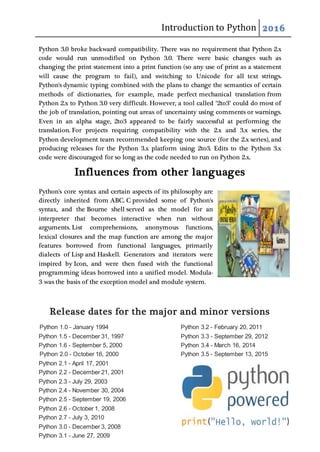

Python was created by Guido van Rossum in 1989 at CWI in the Netherlands as a successor to the ABC language. It was influenced by languages like Modula-3 and C. Major releases include Python 2.0 in 2000 which included a garbage collector and support for Unicode, and Python 3.0 in 2008 which was a major backwards incompatible release.


