Ripple Counter
Modulus (MOD) of a counter
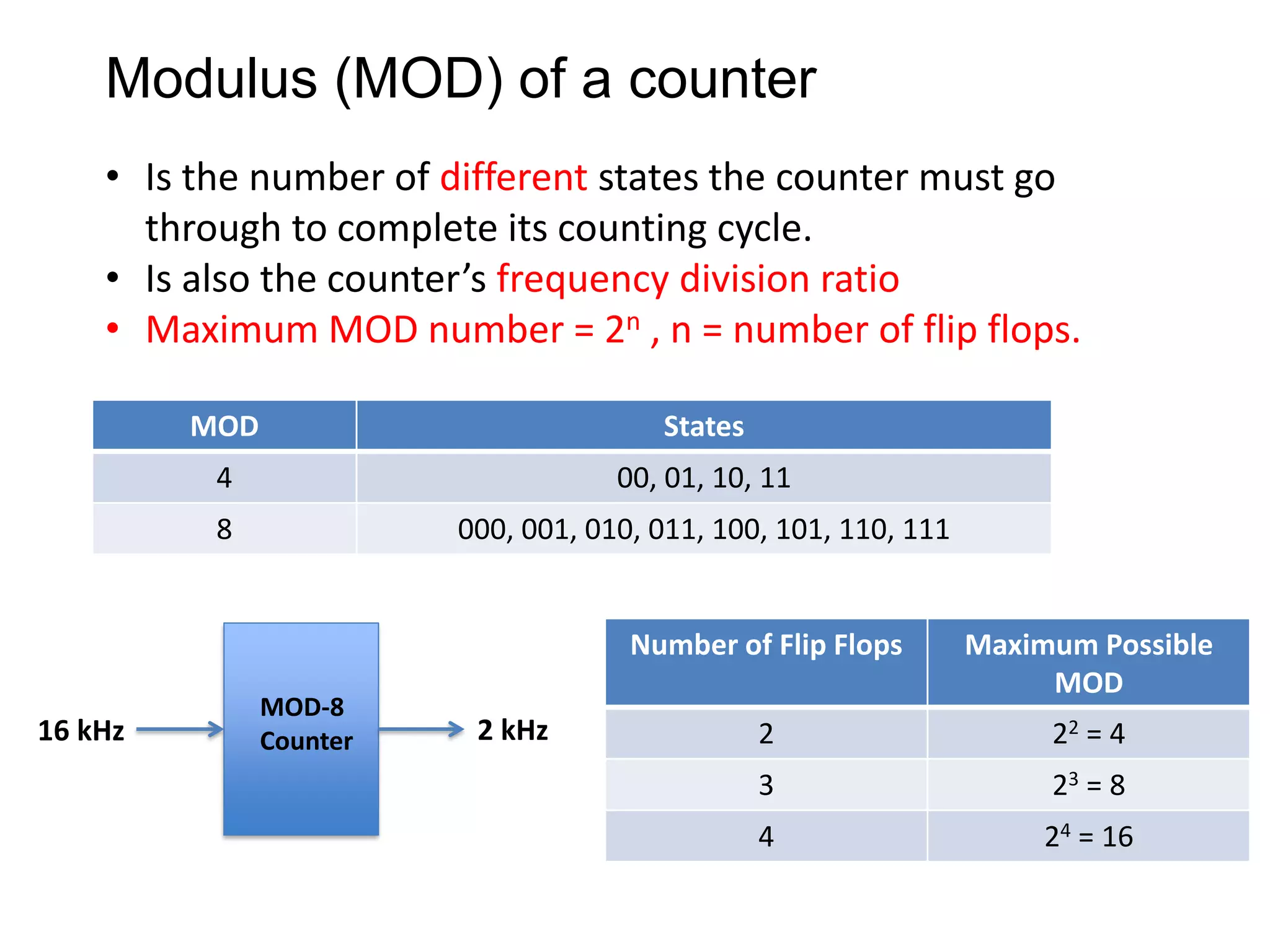
• Is the number of different states the counter must go
through to complete its counting cycle.
• Is also the counter’s frequency division ratio
• Maximum MOD number = 2n , n = number of flip flops.
MOD States
4 00, 01, 10, 11
8 000, 001, 010, 011, 100, 101, 110, 111
MOD-8
Counter16 kHz 2 kHz
Number of Flip Flops Maximum Possible
MOD
2 22 = 4
3 23 = 8
4 24 = 16
State Transition Diagram
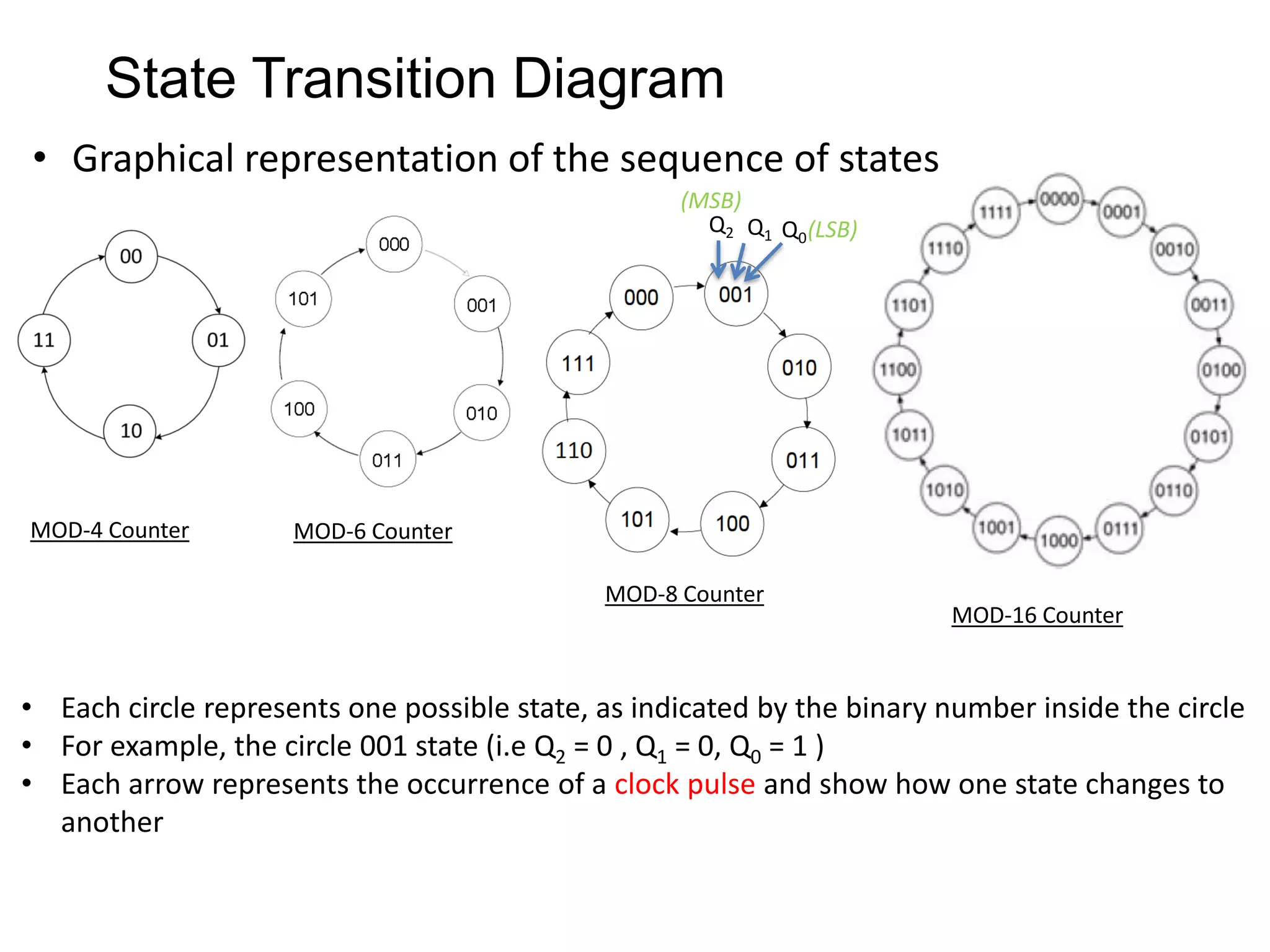
• Graphical representation of the sequence of states
MOD-4 Counter MOD-6 Counter
MOD-8 Counter
• Each circle represents one possible state, as indicated by the binary number inside the circle
• For example, the circle 001 state (i.e Q2 = 0 , Q1 = 0, Q0 = 1 )
• Each arrow represents the occurrence of a clock pulse and show how one state changes to
another
Q0
Q1
Q2 (LSB)
(MSB)
MOD-16 Counter
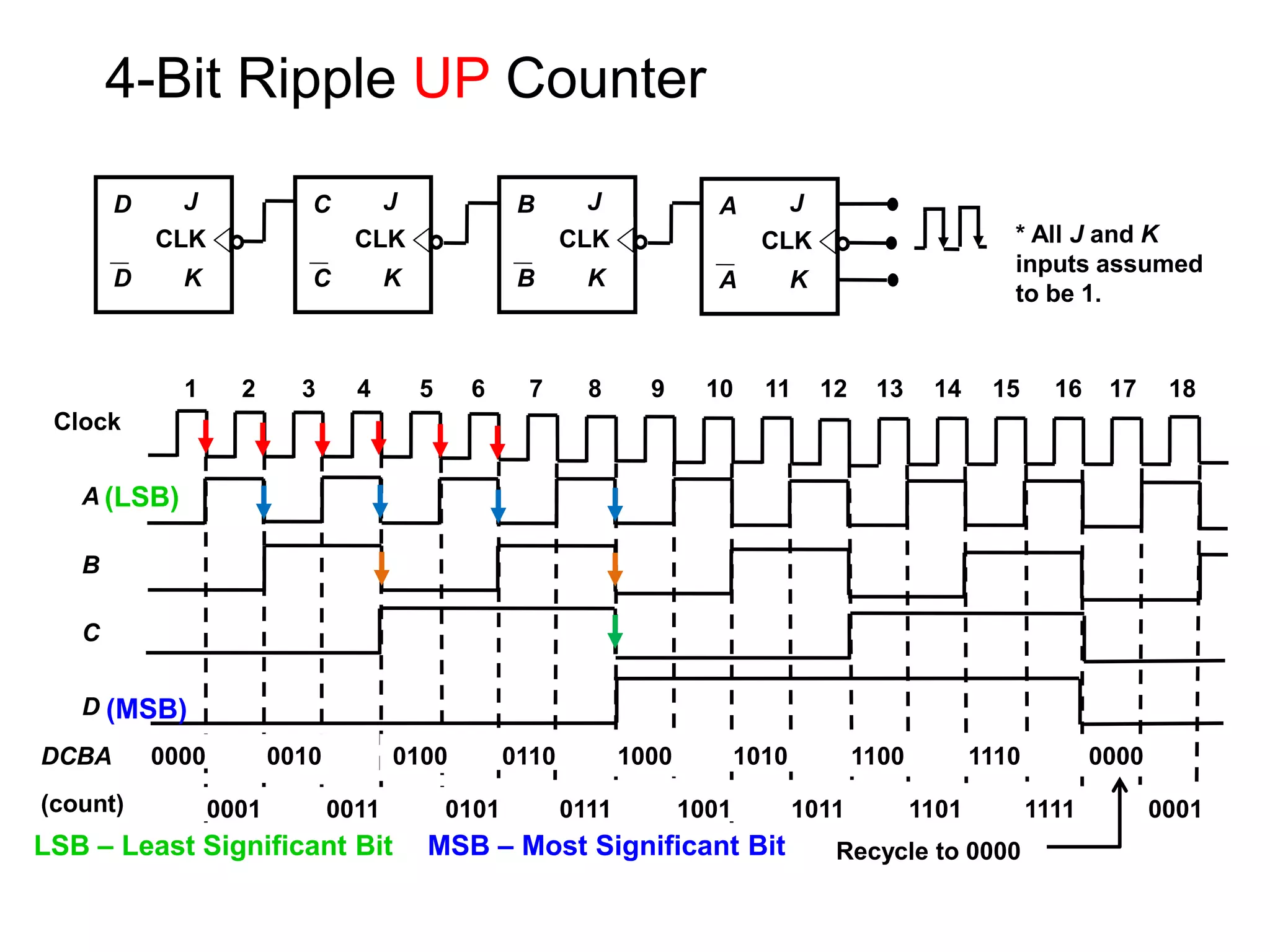
4-Bit Ripple UP Counter
CLK
J
K
A
A
CLK
J
K
B
B
CLK
J
K
C
C
CLK
J
K
D
D
* All J and K
inputs assumed
to be 1.
B
A
Clock
DCBA
(count)
1 2 3 4 5 6 7 8 9 10 11
0000
0001
0010
0011
0100
0101
0110
0111
1000
1001
1010
1011 1101 1111 0001
1100 1110 0000
12 1513 14 16 17 18
C
D
Recycle to 0000
(LSB)
(MSB)
LSB – Least Significant Bit MSB – Most Significant Bit
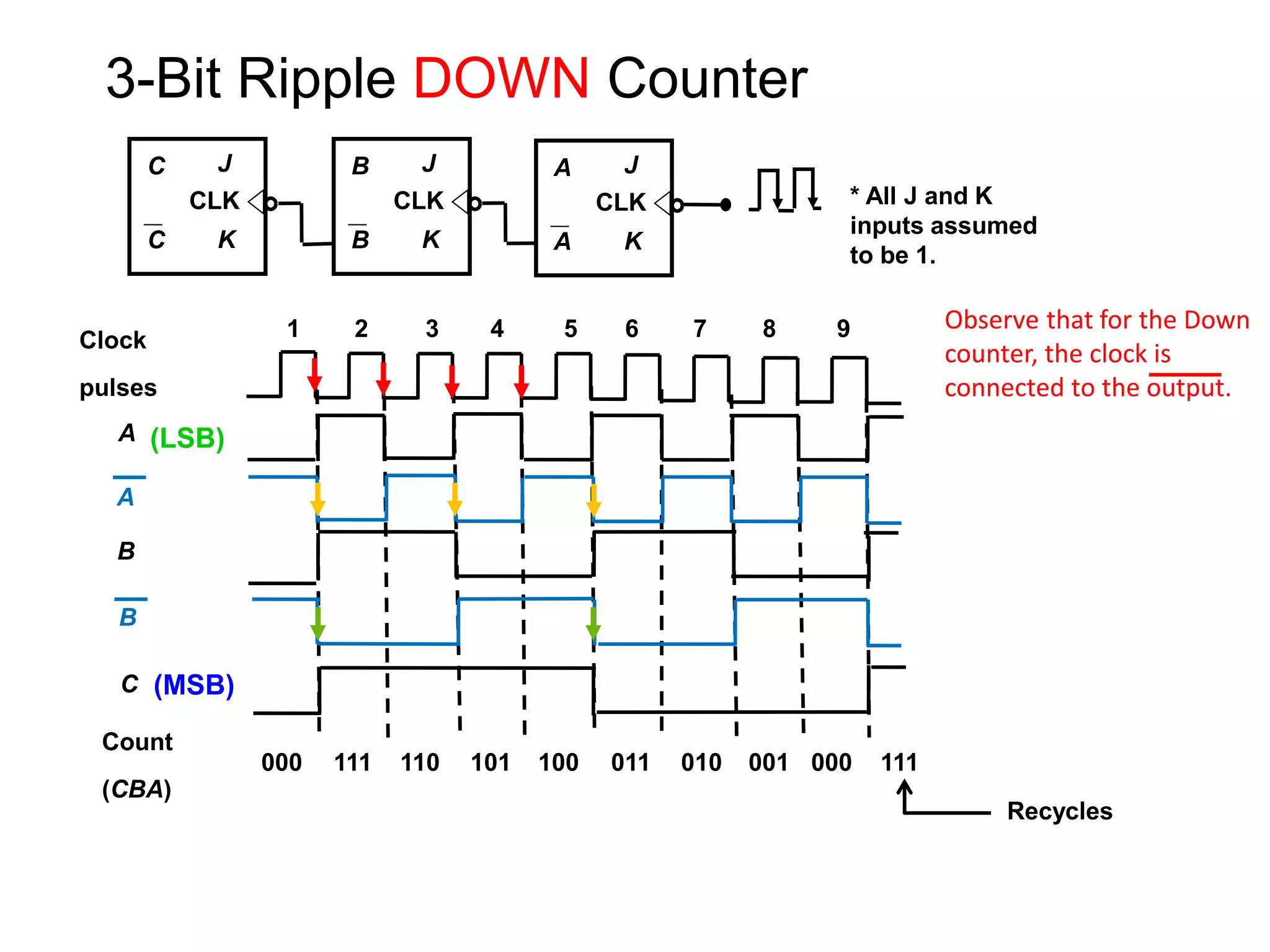
3-Bit Ripple DOWN Counter
CLK
J
K
A
A
CLK
J
K
B
B
CLK
J
K
C
C
* All J and K
inputs assumed
to be 1.
1 2 3 4 5 6 7 8 9Clock
pulses
Count
(CBA)
B
000 001010011100101110111 000 111
Recycles
A (LSB)
C (MSB)
A
B
Observe that for the Down
counter, the clock is
connected to the output.
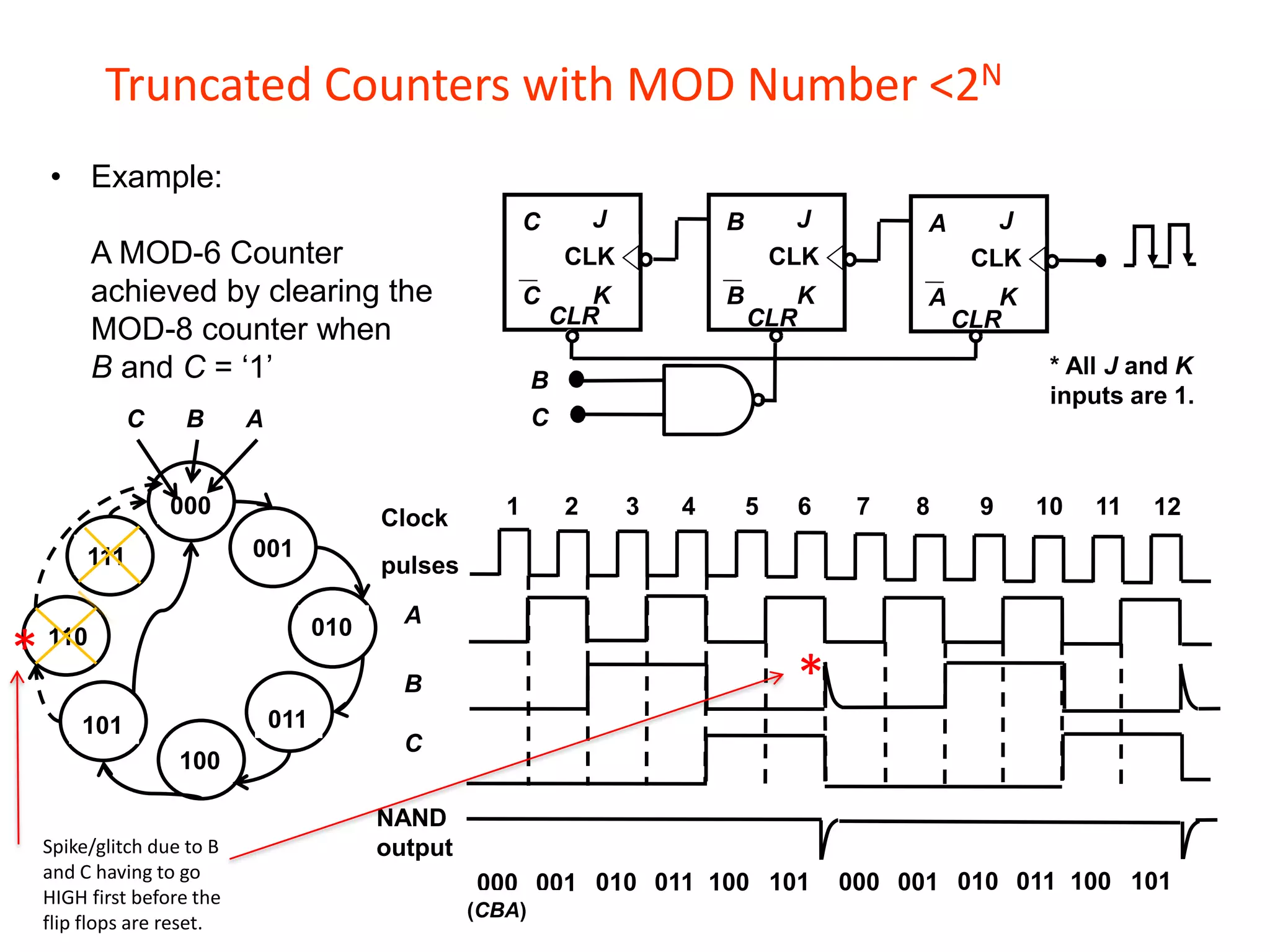
Truncated Counters with MOD Number <2N
• Example:
A MOD-6 Counter
achieved by clearing the
MOD-8 counter when
B and C = ‘1’
CLK
J
K
A
A
CLK
J
K
B
B
CLK
J
K
C
C
* All J and K
inputs are 1.
CLR CLR CLR
B
C
C
B
A
Clock
pulses
NAND
output
1 2 3 4 5 6 7 8 9 10 11 12
C B A
000
100
010110
111 001
011101
* *
000 001 010 011 100 101 000 001 010 011 100 101
(CBA)
Spike/glitch due to B
and C having to go
HIGH first before the
flip flops are reset.
Integrated Circuit Ripple Counters
• 74LS90 – Single Decade Ripple counter
• 74LS92 – Single Divide by Twelve Ripple counter
• 74LS93 – Single 4 bit Ripple Counter
• 74HC390 – Dual Decade Ripple Counters
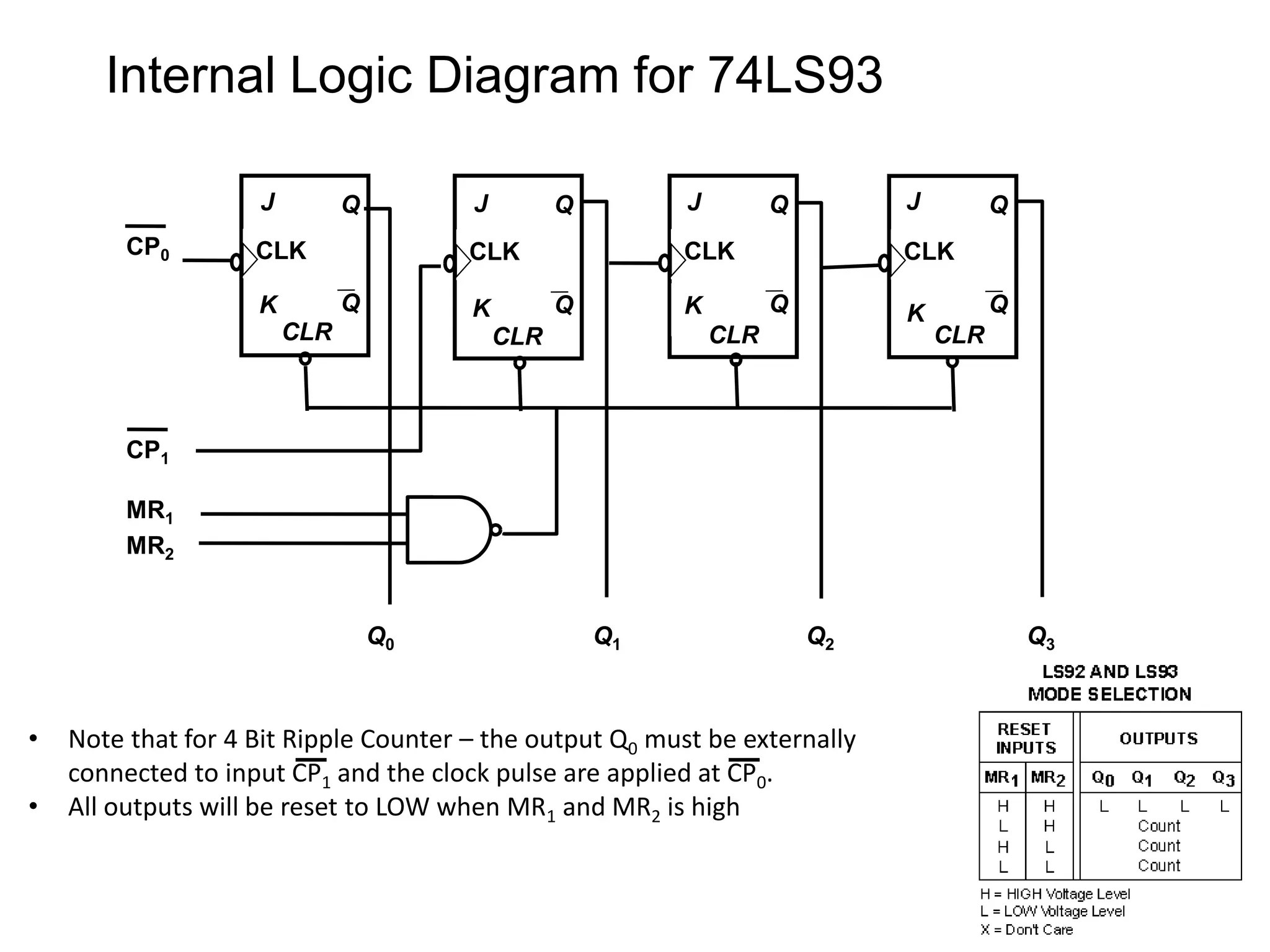
Internal Logic Diagram for 74LS93
CLK
J
K
Q
Q
CLK
J
K
Q
Q
CLK
J
K
Q
Q
CLK
J
K
Q
Q
CP0
CP1
MR1
MR2
Q3Q2Q1Q0
CLR CLR CLR CLR
• Note that for 4 Bit Ripple Counter – the output Q0 must be externally
connected to input CP1 and the clock pulse are applied at CP0.
• All outputs will be reset to LOW when MR1 and MR2 is high
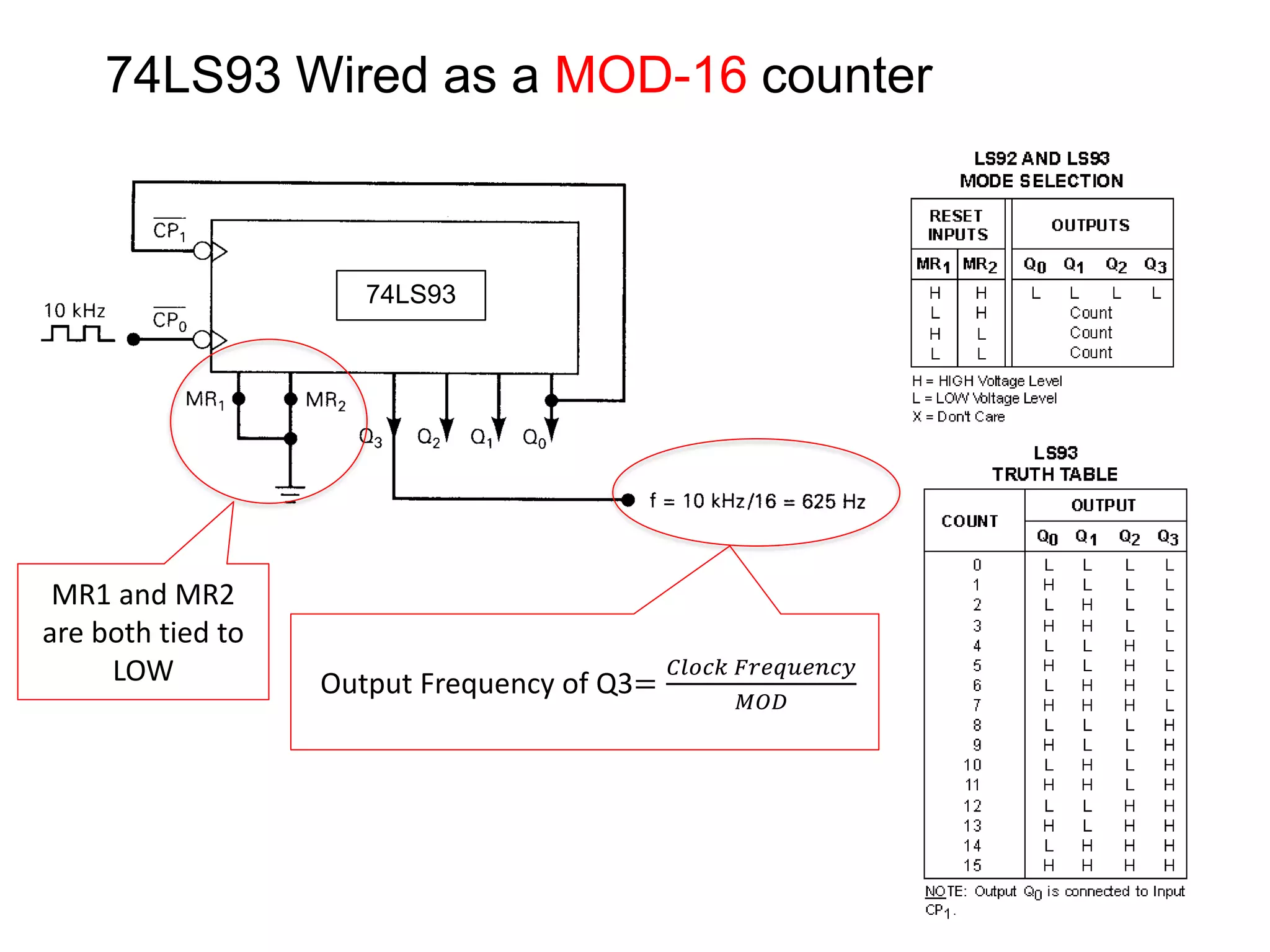
74LS93 Wired as a MOD-16 counter
74LS93
MR1 and MR2
are both tied to
LOW Output Frequency of Q3=
𝐶𝑙𝑜𝑐𝑘 𝐹𝑟𝑒𝑞𝑢𝑒𝑛𝑐𝑦
𝑀𝑂𝐷
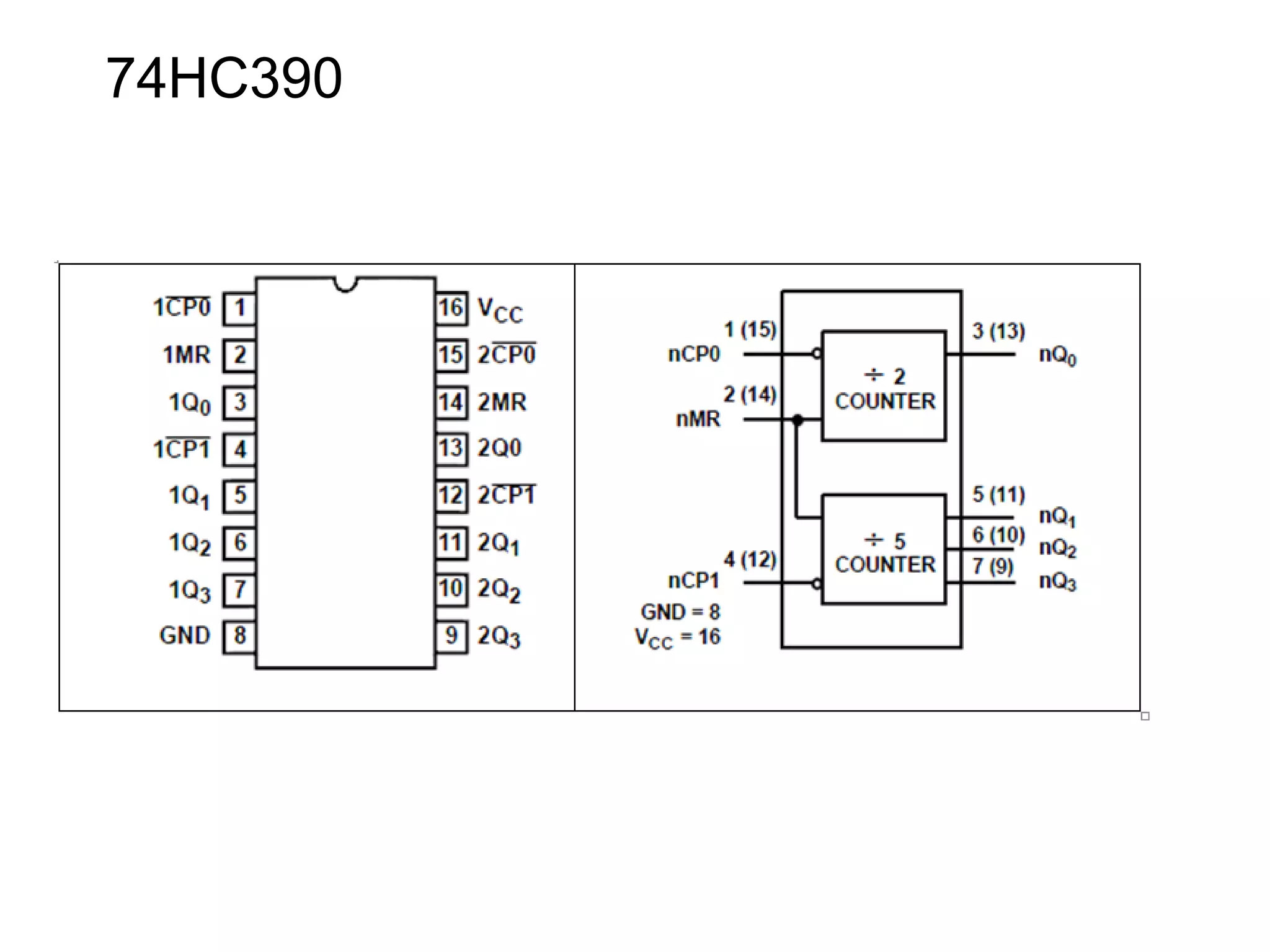
74HC390
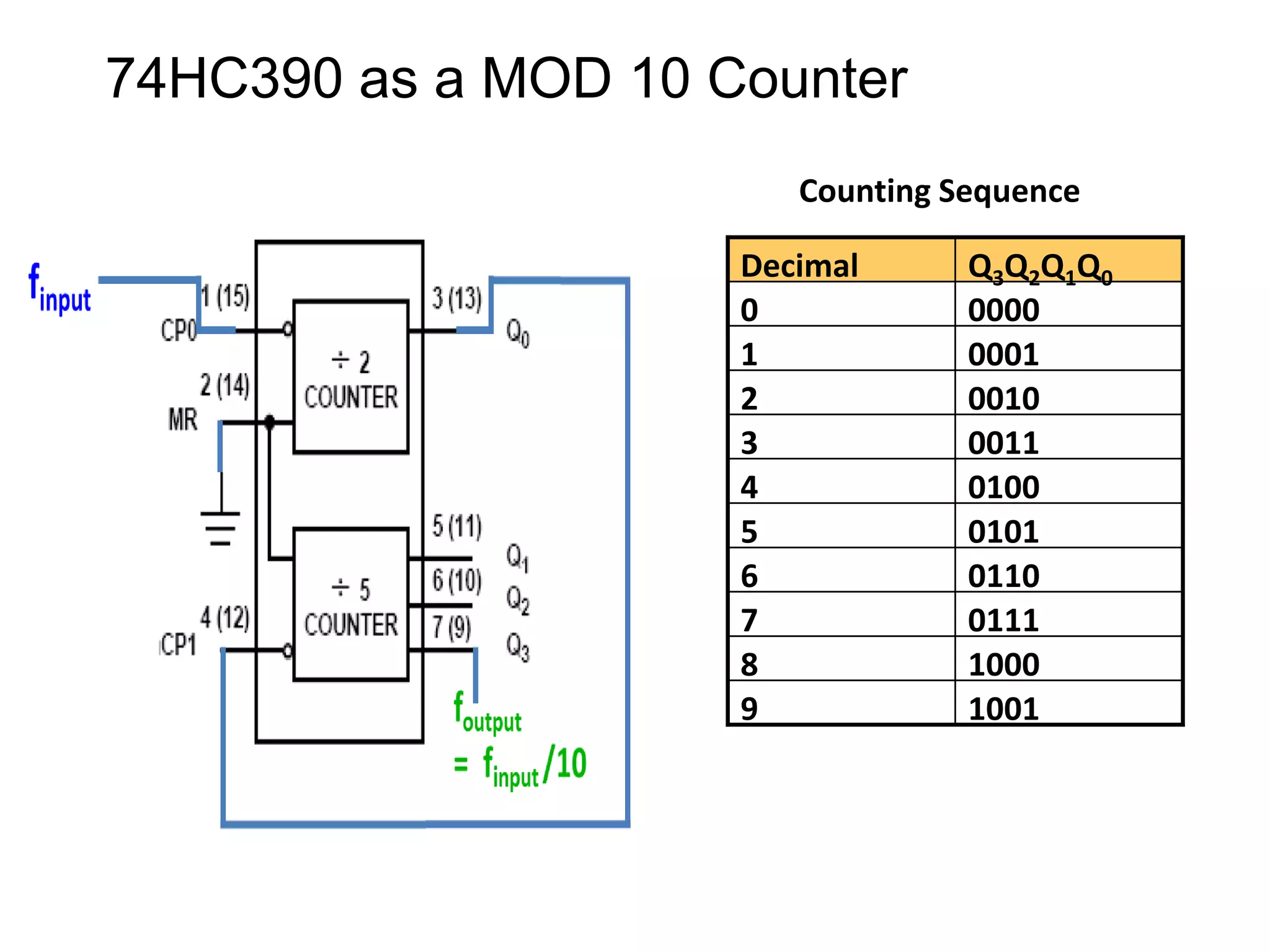
74HC390 as a MOD 10 Counter
10019
10008
01117
01106
01015
01004
00113
00102
00011
00000
Q3Q2Q1Q0Decimal
Counting Sequence
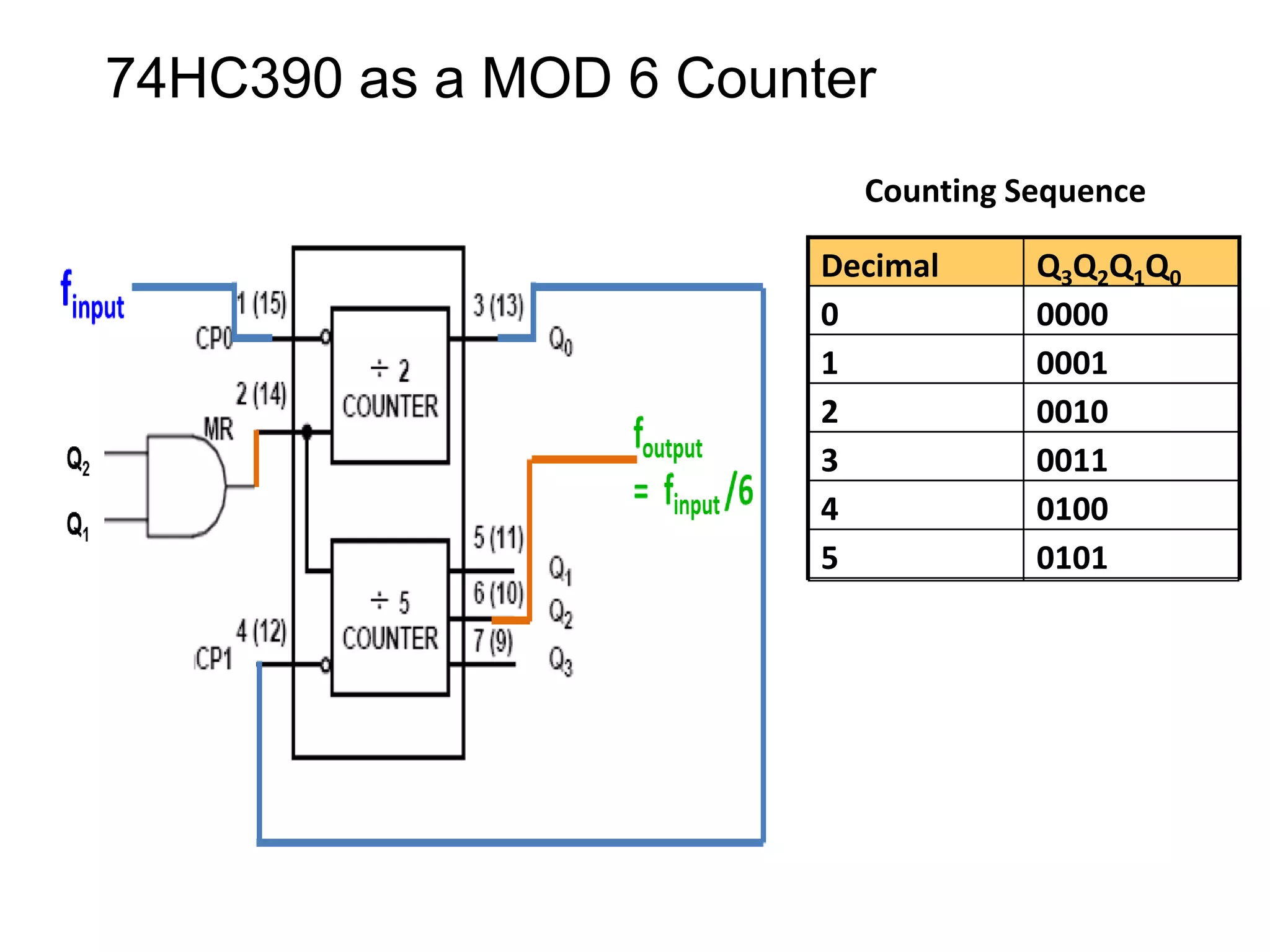
74HC390 as a MOD 6 Counter
01015
01004
00113
00102
00011
00000
Q3Q2Q1Q0Decimal
Counting Sequence
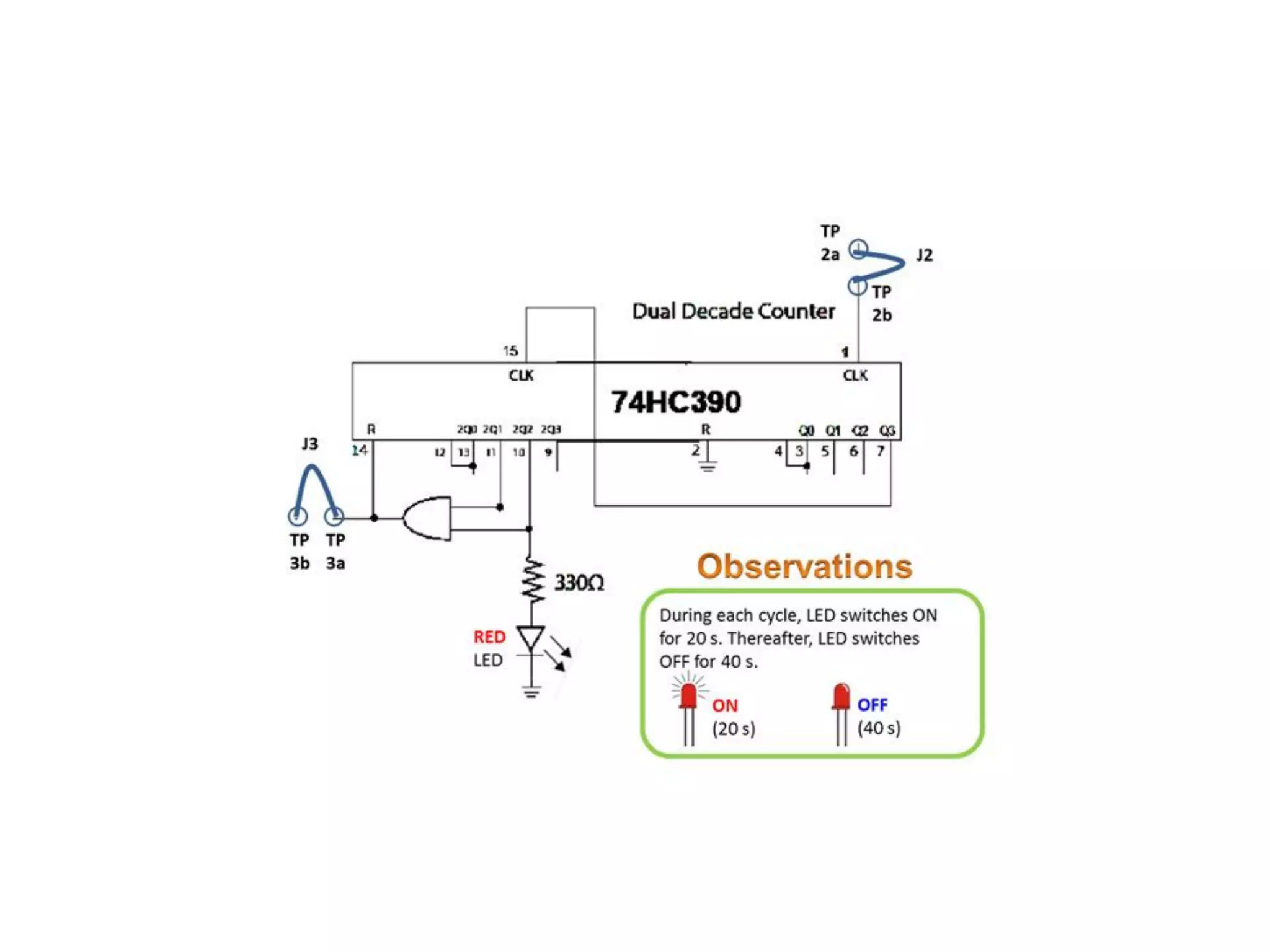
Preparations for Mini Project

Ripple counter

  • 1.
  • 2.
    Modulus (MOD) ofa counter • Is the number of different states the counter must go through to complete its counting cycle. • Is also the counter’s frequency division ratio • Maximum MOD number = 2n , n = number of flip flops. MOD States 4 00, 01, 10, 11 8 000, 001, 010, 011, 100, 101, 110, 111 MOD-8 Counter16 kHz 2 kHz Number of Flip Flops Maximum Possible MOD 2 22 = 4 3 23 = 8 4 24 = 16
  • 3.
    State Transition Diagram •Graphical representation of the sequence of states MOD-4 Counter MOD-6 Counter MOD-8 Counter • Each circle represents one possible state, as indicated by the binary number inside the circle • For example, the circle 001 state (i.e Q2 = 0 , Q1 = 0, Q0 = 1 ) • Each arrow represents the occurrence of a clock pulse and show how one state changes to another Q0 Q1 Q2 (LSB) (MSB) MOD-16 Counter
  • 4.
    4-Bit Ripple UPCounter CLK J K A A CLK J K B B CLK J K C C CLK J K D D * All J and K inputs assumed to be 1. B A Clock DCBA (count) 1 2 3 4 5 6 7 8 9 10 11 0000 0001 0010 0011 0100 0101 0110 0111 1000 1001 1010 1011 1101 1111 0001 1100 1110 0000 12 1513 14 16 17 18 C D Recycle to 0000 (LSB) (MSB) LSB – Least Significant Bit MSB – Most Significant Bit
  • 5.
    3-Bit Ripple DOWNCounter CLK J K A A CLK J K B B CLK J K C C * All J and K inputs assumed to be 1. 1 2 3 4 5 6 7 8 9Clock pulses Count (CBA) B 000 001010011100101110111 000 111 Recycles A (LSB) C (MSB) A B Observe that for the Down counter, the clock is connected to the output.
  • 6.
    Truncated Counters withMOD Number <2N • Example: A MOD-6 Counter achieved by clearing the MOD-8 counter when B and C = ‘1’ CLK J K A A CLK J K B B CLK J K C C * All J and K inputs are 1. CLR CLR CLR B C C B A Clock pulses NAND output 1 2 3 4 5 6 7 8 9 10 11 12 C B A 000 100 010110 111 001 011101 * * 000 001 010 011 100 101 000 001 010 011 100 101 (CBA) Spike/glitch due to B and C having to go HIGH first before the flip flops are reset.
  • 7.
    Integrated Circuit RippleCounters • 74LS90 – Single Decade Ripple counter • 74LS92 – Single Divide by Twelve Ripple counter • 74LS93 – Single 4 bit Ripple Counter • 74HC390 – Dual Decade Ripple Counters
  • 8.
    Internal Logic Diagramfor 74LS93 CLK J K Q Q CLK J K Q Q CLK J K Q Q CLK J K Q Q CP0 CP1 MR1 MR2 Q3Q2Q1Q0 CLR CLR CLR CLR • Note that for 4 Bit Ripple Counter – the output Q0 must be externally connected to input CP1 and the clock pulse are applied at CP0. • All outputs will be reset to LOW when MR1 and MR2 is high
  • 9.
    74LS93 Wired asa MOD-16 counter 74LS93 MR1 and MR2 are both tied to LOW Output Frequency of Q3= 𝐶𝑙𝑜𝑐𝑘 𝐹𝑟𝑒𝑞𝑢𝑒𝑛𝑐𝑦 𝑀𝑂𝐷
  • 10.
  • 11.
    74HC390 as aMOD 10 Counter 10019 10008 01117 01106 01015 01004 00113 00102 00011 00000 Q3Q2Q1Q0Decimal Counting Sequence
  • 12.
    74HC390 as aMOD 6 Counter 01015 01004 00113 00102 00011 00000 Q3Q2Q1Q0Decimal Counting Sequence
  • 14.