By
Mr. C.R.Shinde
Electrical Engineering Department
Matoshri College of Engineering & Research centre, Nashik
203143: Analog And Digital Electronics
Teaching Scheme
Lecture : 03 Hrs/ Week
Practical : 02 Hrs/ Week
Credits
Th: 03
PR:01
Examination Scheme [Marks]
In Sem : 30 Marks
End Sem : 70 Marks
Practical : 50 Marks
Unit 1_Module1 Matoshri College of Engineering & Research Center Nashik 2
Course Objective
1) To use K map for Boolean algebra reduction and design digital
circuit
2) To introduce digital memories and logical families.
3) To construct sequential and combinational circuits using flip
flops and K map
4) To develop the concept of basics of operational Amplifier and
its applications.
5) To design uncontrolled rectifier
Course Outcomes
Upon successful completion of this course, the students will be
able to :-
CO1: Design logical, sequential and combinational digital circuit
using K-Map.
CO2: Demonstrate different digital memories and programmable
logic families.
CO3: Apply and analyze applications of OPAMP in open and closed
loop condition.
CO4: Design uncontrolled rectifier with given specifications
Unit 01 : Design of combinational circuit
M1:-Introductions
M2:- Booleans algebra, De-Morgan theory.
M3:- Karnaugh map: structure for two, three and four Variables, SOP and
POS form reduction of Boolean expressions by K-map.
M4:- Design of combinational circuits using Boolean expression and K-
map.
M5:- encoder, decoder, half and full adder.
Unit 1_Module1 Matoshri College of Engineering & Research Center Nashik 5
Module1:-Introductions
 Introduction to Digital Electronics.
 Introduction to Number System.
 Binary Digits and Logic Levels.
 Introduction to Gray code.
 Binary Digits and Logic Levels.
Unit 1_Module1 Matoshri College of Engineering & Research Center Nashik 6
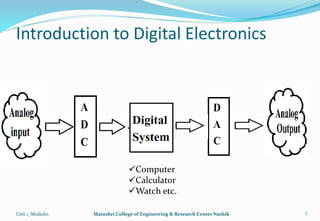
Introduction to Digital Electronics
Unit 1_Module1 Matoshri College of Engineering & Research Center Nashik 7
Computer
Calculator
Watch etc.
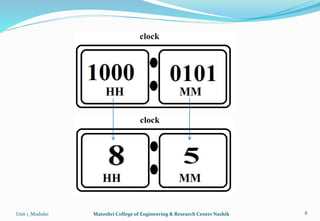
Unit 1_Module1 Matoshri College of Engineering & Research Center Nashik 8
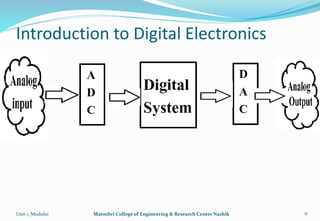
Introduction to Digital Electronics
Unit 1_Module1 Matoshri College of Engineering & Research Center Nashik 9
Unit 1_Module1 Matoshri College of Engineering & Research Center Nashik 10
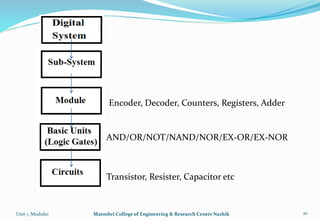
Transistor, Resister, Capacitor etc
AND/OR/NOT/NAND/NOR/EX-OR/EX-NOR
Encoder, Decoder, Counters, Registers, Adder
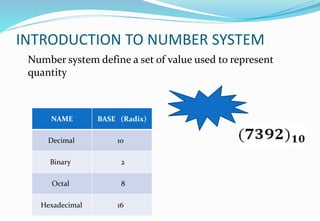
Number system define a set of value used to represent
quantity
NAME BASE (Radix)
Decimal 10
Binary 2
Octal 8
Hexadecimal 16
INTRODUCTION TO NUMBER SYSTEM
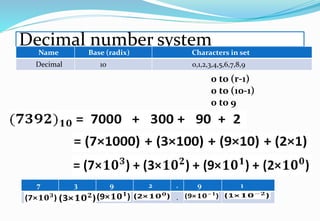
Decimal number system
Name Base (radix) Characters in set
Decimal 10 0,1,2,3,4,5,6,7,8,9
0 to (r-1)
0 to (10-1)
0 to 9
7 3 9 2 . 9 1
.
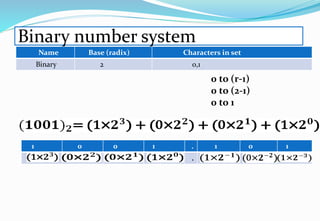
Binary number system
Name Base (radix) Characters in set
Binary 2 0,1
0 to (r-1)
0 to (2-1)
0 to 1
1 0 0 1 . 1 0 1
.
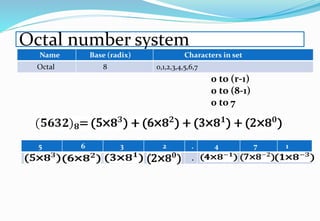
Octal number system
Name Base (radix) Characters in set
Octal 8 0,1,2,3,4,5,6,7
0 to (r-1)
0 to (8-1)
0 to 7
5 6 3 2 . 4 7 1
.
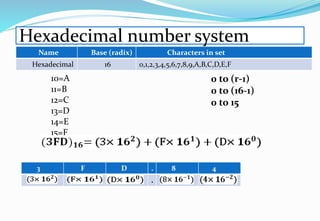
Hexadecimal number system
Name Base (radix) Characters in set
Hexadecimal 16 0,1,2,3,4,5,6,7,8,9,A,B,C,D,E,F
0 to (r-1)
0 to (16-1)
0 to 15
10=A
11=B
12=C
13=D
14=E
15=F
3 F D . 8 4
.
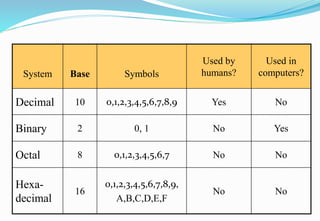
System Base Symbols
Used by
humans?
Used in
computers?
Decimal 10 0,1,2,3,4,5,6,7,8,9 Yes No
Binary 2 0, 1 No Yes
Octal 8 0,1,2,3,4,5,6,7 No No
Hexa-
decimal
16
0,1,2,3,4,5,6,7,8,9,
A,B,C,D,E,F
No No
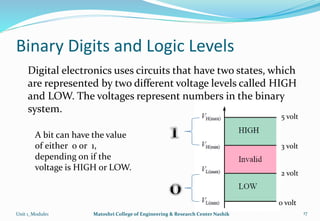
Binary Digits and Logic Levels
Digital electronics uses circuits that have two states, which
are represented by two different voltage levels called HIGH
and LOW. The voltages represent numbers in the binary
system.
Unit 1_Module1 Matoshri College of Engineering & Research Center Nashik 17
A bit can have the value
of either 0 or 1,
depending on if the
voltage is HIGH or LOW.
0 volt
2 volt
3 volt
5 volt
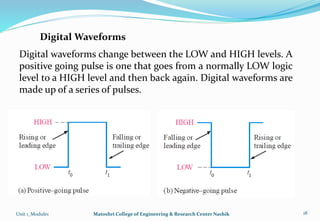
Digital waveforms change between the LOW and HIGH levels. A
positive going pulse is one that goes from a normally LOW logic
level to a HIGH level and then back again. Digital waveforms are
made up of a series of pulses.
Unit 1_Module1 Matoshri College of Engineering & Research Center Nashik 18
Digital Waveforms
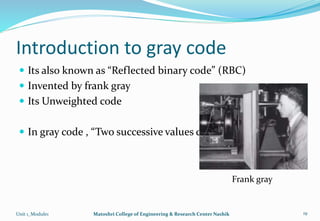
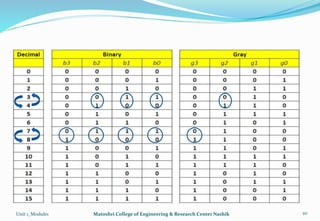
Introduction to gray code
 Its also known as “Reflected binary code” (RBC)
 Invented by frank gray
 Its Unweighted code
 In gray code , “Two successive values differ in only 1 bit”
Unit 1_Module1 Matoshri College of Engineering & Research Center Nashik 19
Frank gray
Unit 1_Module1 Matoshri College of Engineering & Research Center Nashik 20
Unit 1_Module1 Matoshri College of Engineering & Research Center Nashik 21
Logic Gates
Unit 1_Module1 Matoshri College of Engineering & Research Center Nashik 22
It is physical device which performs logical
operation on one /more logical inputs, and
produces single logical output.
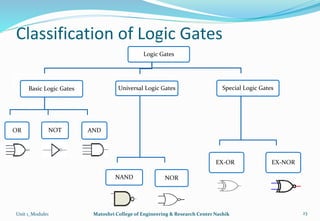
Classification of Logic Gates
Logic Gates
Basic Logic Gates
OR NOT AND
Universal Logic Gates
NAND NOR
Special Logic Gates
EX-OR EX-NOR
Unit 1_Module1 Matoshri College of Engineering & Research Center Nashik 23
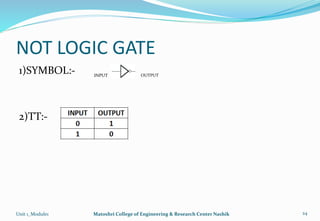
NOT LOGIC GATE
1)SYMBOL:-
2)TT:-
Unit 1_Module1 Matoshri College of Engineering & Research Center Nashik 24
INPUT OUTPUT
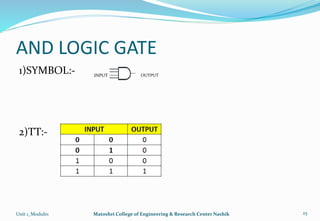
AND LOGIC GATE
1)SYMBOL:-
2)TT:-
Unit 1_Module1 Matoshri College of Engineering & Research Center Nashik 25
INPUT OUTPUT
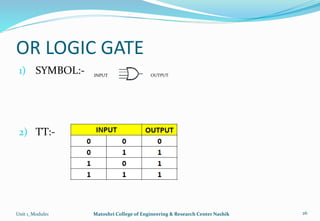
OR LOGIC GATE
1) SYMBOL:-
2) TT:-
Unit 1_Module1 Matoshri College of Engineering & Research Center Nashik 26
INPUT OUTPUT
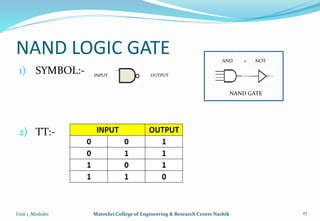
NAND LOGIC GATE
1) SYMBOL:-
2) TT:-
Unit 1_Module1 Matoshri College of Engineering & Research Center Nashik 27
INPUT OUTPUT
AND + NOT
NAND GATE
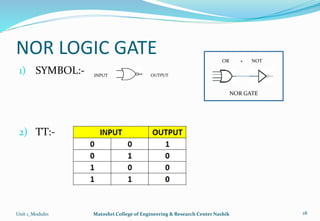
NOR LOGIC GATE
1) SYMBOL:-
2) TT:-
Unit 1_Module1 Matoshri College of Engineering & Research Center Nashik 28
INPUT OUTPUT
OR + NOT
NOR GATE
Module1:-Introductions
 Introduction to Digital Electronics.
 Introduction to Number System.
 Binary Digits and Logic Levels.
 Introduction to Gray code.
 Introduction to Logic Gate.
Unit 1_Module1 Matoshri College of Engineering & Research Center Nashik 29
Module2:-
Booleans algebra,
De-Morgan theory.
Unit 1_Module1 Matoshri College of Engineering & Research Center Nashik 30
Thank you
Mr. C. R. Shinde
Electrical Engineering Department
Matoshri College of Engineering & Research centre, Nashik
If you have any query, ask me anytime on…… … .. . . .
cshinde58@gmail.com
chandrakant.shinde@matoshri.edu.in
9970031353
Unit 1_Module1 Matoshri College of Engineering & Research Center Nashik 31
Unit 1_Module1 Matoshri College of Engineering & Research Center Nashik 32
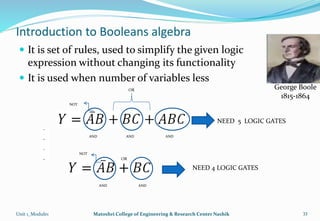
Introduction to Booleans algebra
 It is set of rules, used to simplify the given logic
expression without changing its functionality
 It is used when number of variables less
Unit 1_Module1 Matoshri College of Engineering & Research Center Nashik 33
George Boole
1815-1864
NOT
AND AND AND
OR
NEED 5 LOGIC GATES
NOT
AND AND
OR
NEED 4 LOGIC GATES
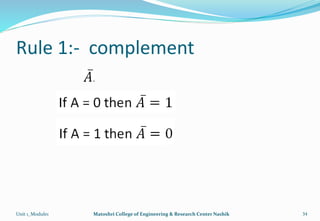
Rule 1:- complement
Unit 1_Module1 Matoshri College of Engineering & Research Center Nashik 34
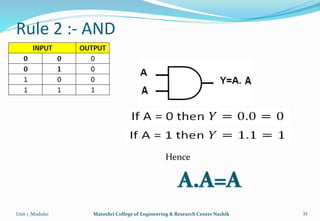
Rule 2 :- AND
Unit 1_Module1 Matoshri College of Engineering & Research Center Nashik 35
Hence
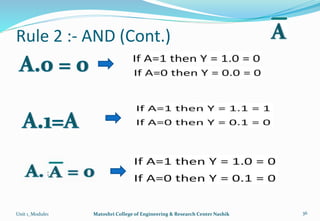
Rule 2 :- AND (Cont.)
Unit 1_Module1 Matoshri College of Engineering & Research Center Nashik 36
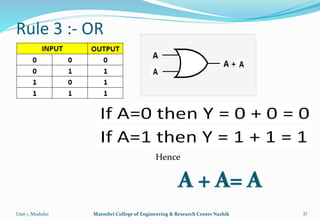
Rule 3 :- OR
Unit 1_Module1 Matoshri College of Engineering & Research Center Nashik 37
Hence
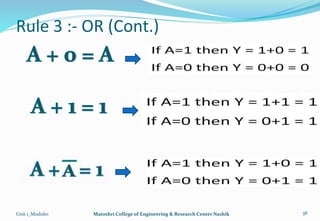
Rule 3 :- OR (Cont.)
Unit 1_Module1 Matoshri College of Engineering & Research Center Nashik 38
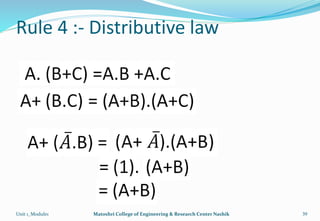
Rule 4 :- Distributive law
Unit 1_Module1 Matoshri College of Engineering & Research Center Nashik 39
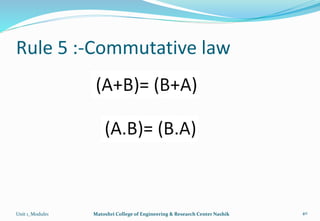
Rule 5 :-Commutative law
Unit 1_Module1 Matoshri College of Engineering & Research Center Nashik 40
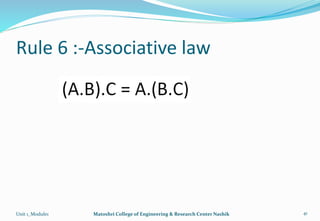
Rule 6 :-Associative law
Unit 1_Module1 Matoshri College of Engineering & Research Center Nashik 41
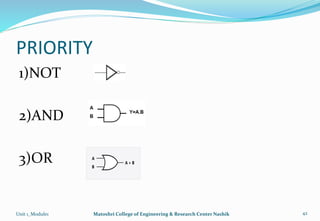
PRIORITY
1)NOT
2)AND
3)OR
Unit 1_Module1 Matoshri College of Engineering & Research Center Nashik 42
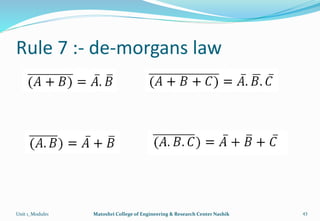
Rule 7 :- de-morgans law
Unit 1_Module1 Matoshri College of Engineering & Research Center Nashik 43
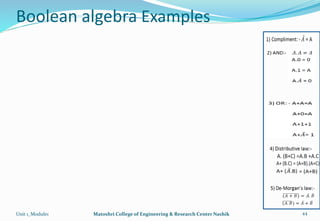
Boolean algebra Examples
Unit 1_Module1 Matoshri College of Engineering & Research Center Nashik 44

module1:Introduction to digital electronics

  • 1.
    By Mr. C.R.Shinde Electrical EngineeringDepartment Matoshri College of Engineering & Research centre, Nashik
  • 2.
    203143: Analog AndDigital Electronics Teaching Scheme Lecture : 03 Hrs/ Week Practical : 02 Hrs/ Week Credits Th: 03 PR:01 Examination Scheme [Marks] In Sem : 30 Marks End Sem : 70 Marks Practical : 50 Marks Unit 1_Module1 Matoshri College of Engineering & Research Center Nashik 2
  • 3.
    Course Objective 1) Touse K map for Boolean algebra reduction and design digital circuit 2) To introduce digital memories and logical families. 3) To construct sequential and combinational circuits using flip flops and K map 4) To develop the concept of basics of operational Amplifier and its applications. 5) To design uncontrolled rectifier
  • 4.
    Course Outcomes Upon successfulcompletion of this course, the students will be able to :- CO1: Design logical, sequential and combinational digital circuit using K-Map. CO2: Demonstrate different digital memories and programmable logic families. CO3: Apply and analyze applications of OPAMP in open and closed loop condition. CO4: Design uncontrolled rectifier with given specifications
  • 5.
    Unit 01 :Design of combinational circuit M1:-Introductions M2:- Booleans algebra, De-Morgan theory. M3:- Karnaugh map: structure for two, three and four Variables, SOP and POS form reduction of Boolean expressions by K-map. M4:- Design of combinational circuits using Boolean expression and K- map. M5:- encoder, decoder, half and full adder. Unit 1_Module1 Matoshri College of Engineering & Research Center Nashik 5
  • 6.
    Module1:-Introductions  Introduction toDigital Electronics.  Introduction to Number System.  Binary Digits and Logic Levels.  Introduction to Gray code.  Binary Digits and Logic Levels. Unit 1_Module1 Matoshri College of Engineering & Research Center Nashik 6
  • 7.
    Introduction to DigitalElectronics Unit 1_Module1 Matoshri College of Engineering & Research Center Nashik 7 Computer Calculator Watch etc.
  • 8.
    Unit 1_Module1 MatoshriCollege of Engineering & Research Center Nashik 8
  • 9.
    Introduction to DigitalElectronics Unit 1_Module1 Matoshri College of Engineering & Research Center Nashik 9
  • 10.
    Unit 1_Module1 MatoshriCollege of Engineering & Research Center Nashik 10 Transistor, Resister, Capacitor etc AND/OR/NOT/NAND/NOR/EX-OR/EX-NOR Encoder, Decoder, Counters, Registers, Adder
  • 11.
    Number system definea set of value used to represent quantity NAME BASE (Radix) Decimal 10 Binary 2 Octal 8 Hexadecimal 16 INTRODUCTION TO NUMBER SYSTEM
  • 12.
    Decimal number system NameBase (radix) Characters in set Decimal 10 0,1,2,3,4,5,6,7,8,9 0 to (r-1) 0 to (10-1) 0 to 9 7 3 9 2 . 9 1 .
  • 13.
    Binary number system NameBase (radix) Characters in set Binary 2 0,1 0 to (r-1) 0 to (2-1) 0 to 1 1 0 0 1 . 1 0 1 .
  • 14.
    Octal number system NameBase (radix) Characters in set Octal 8 0,1,2,3,4,5,6,7 0 to (r-1) 0 to (8-1) 0 to 7 5 6 3 2 . 4 7 1 .
  • 15.
    Hexadecimal number system NameBase (radix) Characters in set Hexadecimal 16 0,1,2,3,4,5,6,7,8,9,A,B,C,D,E,F 0 to (r-1) 0 to (16-1) 0 to 15 10=A 11=B 12=C 13=D 14=E 15=F 3 F D . 8 4 .
  • 16.
    System Base Symbols Usedby humans? Used in computers? Decimal 10 0,1,2,3,4,5,6,7,8,9 Yes No Binary 2 0, 1 No Yes Octal 8 0,1,2,3,4,5,6,7 No No Hexa- decimal 16 0,1,2,3,4,5,6,7,8,9, A,B,C,D,E,F No No
  • 17.
    Binary Digits andLogic Levels Digital electronics uses circuits that have two states, which are represented by two different voltage levels called HIGH and LOW. The voltages represent numbers in the binary system. Unit 1_Module1 Matoshri College of Engineering & Research Center Nashik 17 A bit can have the value of either 0 or 1, depending on if the voltage is HIGH or LOW. 0 volt 2 volt 3 volt 5 volt
  • 18.
    Digital waveforms changebetween the LOW and HIGH levels. A positive going pulse is one that goes from a normally LOW logic level to a HIGH level and then back again. Digital waveforms are made up of a series of pulses. Unit 1_Module1 Matoshri College of Engineering & Research Center Nashik 18 Digital Waveforms
  • 19.
    Introduction to graycode  Its also known as “Reflected binary code” (RBC)  Invented by frank gray  Its Unweighted code  In gray code , “Two successive values differ in only 1 bit” Unit 1_Module1 Matoshri College of Engineering & Research Center Nashik 19 Frank gray
  • 20.
    Unit 1_Module1 MatoshriCollege of Engineering & Research Center Nashik 20
  • 21.
    Unit 1_Module1 MatoshriCollege of Engineering & Research Center Nashik 21
  • 22.
    Logic Gates Unit 1_Module1Matoshri College of Engineering & Research Center Nashik 22 It is physical device which performs logical operation on one /more logical inputs, and produces single logical output.
  • 23.
    Classification of LogicGates Logic Gates Basic Logic Gates OR NOT AND Universal Logic Gates NAND NOR Special Logic Gates EX-OR EX-NOR Unit 1_Module1 Matoshri College of Engineering & Research Center Nashik 23
  • 24.
    NOT LOGIC GATE 1)SYMBOL:- 2)TT:- Unit1_Module1 Matoshri College of Engineering & Research Center Nashik 24 INPUT OUTPUT
  • 25.
    AND LOGIC GATE 1)SYMBOL:- 2)TT:- Unit1_Module1 Matoshri College of Engineering & Research Center Nashik 25 INPUT OUTPUT
  • 26.
    OR LOGIC GATE 1)SYMBOL:- 2) TT:- Unit 1_Module1 Matoshri College of Engineering & Research Center Nashik 26 INPUT OUTPUT
  • 27.
    NAND LOGIC GATE 1)SYMBOL:- 2) TT:- Unit 1_Module1 Matoshri College of Engineering & Research Center Nashik 27 INPUT OUTPUT AND + NOT NAND GATE
  • 28.
    NOR LOGIC GATE 1)SYMBOL:- 2) TT:- Unit 1_Module1 Matoshri College of Engineering & Research Center Nashik 28 INPUT OUTPUT OR + NOT NOR GATE
  • 29.
    Module1:-Introductions  Introduction toDigital Electronics.  Introduction to Number System.  Binary Digits and Logic Levels.  Introduction to Gray code.  Introduction to Logic Gate. Unit 1_Module1 Matoshri College of Engineering & Research Center Nashik 29
  • 30.
    Module2:- Booleans algebra, De-Morgan theory. Unit1_Module1 Matoshri College of Engineering & Research Center Nashik 30
  • 31.
    Thank you Mr. C.R. Shinde Electrical Engineering Department Matoshri College of Engineering & Research centre, Nashik If you have any query, ask me anytime on…… … .. . . . cshinde58@gmail.com chandrakant.shinde@matoshri.edu.in 9970031353 Unit 1_Module1 Matoshri College of Engineering & Research Center Nashik 31
  • 32.
    Unit 1_Module1 MatoshriCollege of Engineering & Research Center Nashik 32
  • 33.
    Introduction to Booleansalgebra  It is set of rules, used to simplify the given logic expression without changing its functionality  It is used when number of variables less Unit 1_Module1 Matoshri College of Engineering & Research Center Nashik 33 George Boole 1815-1864 NOT AND AND AND OR NEED 5 LOGIC GATES NOT AND AND OR NEED 4 LOGIC GATES
  • 34.
    Rule 1:- complement Unit1_Module1 Matoshri College of Engineering & Research Center Nashik 34
  • 35.
    Rule 2 :-AND Unit 1_Module1 Matoshri College of Engineering & Research Center Nashik 35 Hence
  • 36.
    Rule 2 :-AND (Cont.) Unit 1_Module1 Matoshri College of Engineering & Research Center Nashik 36
  • 37.
    Rule 3 :-OR Unit 1_Module1 Matoshri College of Engineering & Research Center Nashik 37 Hence
  • 38.
    Rule 3 :-OR (Cont.) Unit 1_Module1 Matoshri College of Engineering & Research Center Nashik 38
  • 39.
    Rule 4 :-Distributive law Unit 1_Module1 Matoshri College of Engineering & Research Center Nashik 39
  • 40.
    Rule 5 :-Commutativelaw Unit 1_Module1 Matoshri College of Engineering & Research Center Nashik 40
  • 41.
    Rule 6 :-Associativelaw Unit 1_Module1 Matoshri College of Engineering & Research Center Nashik 41
  • 42.
    PRIORITY 1)NOT 2)AND 3)OR Unit 1_Module1 MatoshriCollege of Engineering & Research Center Nashik 42
  • 43.
    Rule 7 :-de-morgans law Unit 1_Module1 Matoshri College of Engineering & Research Center Nashik 43
  • 44.
    Boolean algebra Examples Unit1_Module1 Matoshri College of Engineering & Research Center Nashik 44

Editor's Notes