EET 3350 Digital Systems Design

    Textbook: John Wakerly
        Chapter 8: 8.4


            Counters


                                  1
Counters
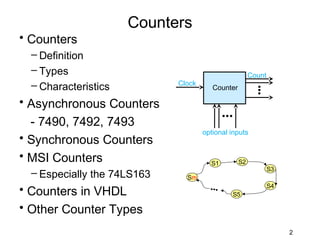
• Counters
  – Definition
  – Types                                              Count
  – Characteristics          Clock
                                        Counter

• Asynchronous Counters
  - 7490, 7492, 7493
                                     optional inputs
• Synchronous Counters
• MSI Counters                         S1         S2
                                                               S3
  – Especially the 74LS163     Sm
                                                               S4
• Counters in VHDL                            S5

• Other Counter Types
                                                                    2
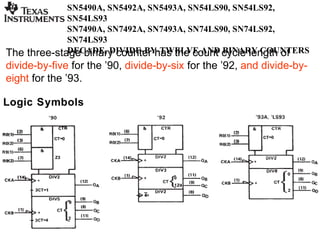
Counters
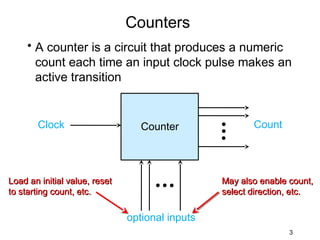
     • A counter is a circuit that produces a numeric
       count each time an input clock pulse makes an
       active transition


       Clock                      Counter               Count


Load an initial value, reset                     May also enable count,
to starting count, etc.                          select direction, etc.

                               optional inputs
                                                                 3
Counter
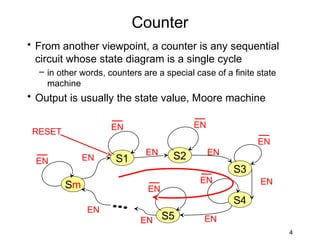
• From another viewpoint, a counter is any sequential
  circuit whose state diagram is a single cycle
  – in other words, counters are a special case of a finite state
    machine
• Output is usually the state value, Moore machine

                     EN                    EN
 RESET
                                                            EN
                              EN     S2         EN
 EN           EN      S1
                                                     S3
                                            EN              EN
         Sm                   EN
                                                     S4
              EN
                            EN S5            EN
                                                                    4
Counters
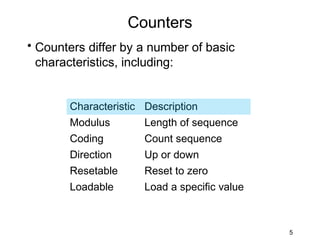
• Counters differ by a number of basic
  characteristics, including:


       Characteristic Description
       Modulus        Length of sequence
       Coding         Count sequence
       Direction      Up or down
       Resetable      Reset to zero
       Loadable       Load a specific value


                                              5
Counters
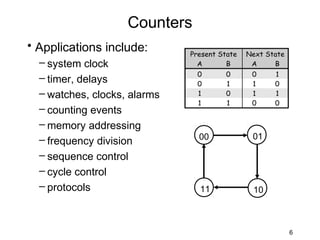
• Applications include:
                              Present State   Next State
  – system clock                A       B      A     B
                                0      0       0     1
  – timer, delays               0      1       1     0
  – watches, clocks, alarms     1      0       1     1
                                1      1       0     0
  – counting events
  – memory addressing
  – frequency division          00             01

  – sequence control
  – cycle control
  – protocols                   11             10


                                                           6
Counter Types
• Asynchronous         • Modulus
 – Ripple                – Binary
• Synchronous            – Decade
 – Clocked               – etc.
                       • Ring
        000            • Johnson
                         – Twisted ring
  101            001
                       • Up/Down
                       • Linear Feedback Shift-
  100            010
                         Register Counter
        011              (LFSR)
                                             7
Counters
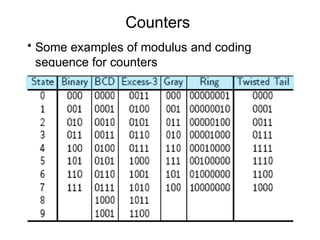
• Some examples of modulus and coding
  sequence for counters


                                        8
Counters
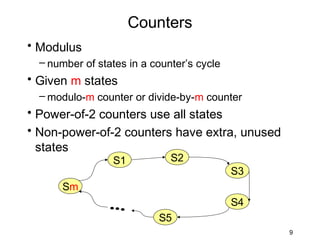
• Modulus
  – number of states in a counter’s cycle
• Given m states
  – modulo-m counter or divide-by-m counter
• Power-of-2 counters use all states
• Non-power-of-2 counters have extra, unused
  states
                 S1           S2
                                            S3
       Sm
                                            S4
                           S5
                                                 9
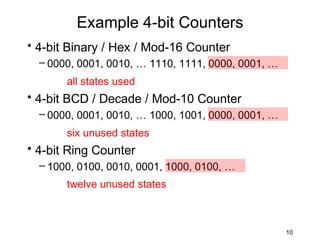
Example 4-bit Counters
• 4-bit Binary / Hex / Mod-16 Counter
  – 0000, 0001, 0010, … 1110, 1111, 0000, 0001, …
       all states used
• 4-bit BCD / Decade / Mod-10 Counter
  – 0000, 0001, 0010, … 1000, 1001, 0000, 0001, …
       six unused states
• 4-bit Ring Counter
  – 1000, 0100, 0010, 0001, 1000, 0100, …
       twelve unused states


                                                    10
Counters
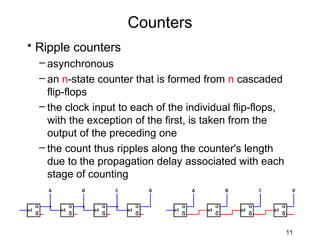
• Ripple counters
  – asynchronous
  – an n-state counter that is formed from n cascaded
    flip-flops
  – the clock input to each of the individual flip-flops,
    with the exception of the first, is taken from the
    output of the preceding one
  – the count thus ripples along the counter's length
    due to the propagation delay associated with each
    stage of counting


                                                            11
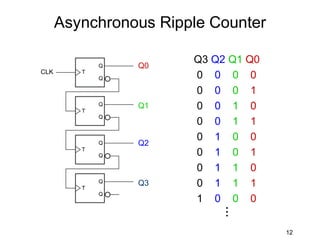
Asynchronous Ripple Counter

                 Q3 Q2 Q1 Q0
          Q0
                 0 0 0 0
                 0 0 0 1
          Q1     0 0 1 0
                 0 0 1 1
                 0 1 0 0
          Q2
                 0 1 0 1
                 0 1 1 0
          Q3     0 1 1 1
                 1 0 0 0
                      .
                      .
                      .
                               12
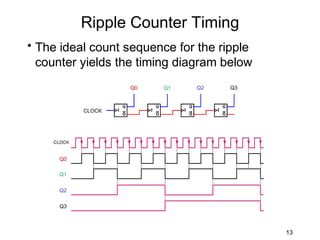
Ripple Counter Timing
• The ideal count sequence for the ripple
  counter yields the timing diagram below
                  Q0    Q1    Q2    Q3


          CLOCK


     Q0

     Q1


     Q2

     Q3


                                            13
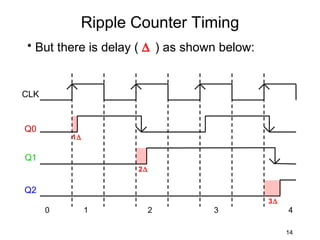
Ripple Counter Timing
• But there is delay ( ∆ ) as shown below:


CLK


Q0
          1∆

Q1
                    2∆


Q2
                                             3∆
      0        1         2        3               4

                                                  14
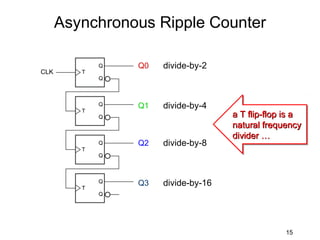
Asynchronous Ripple Counter

          Q0   divide-by-2


          Q1   divide-by-4
                              a T flip-flop is a
                              natural frequency
                              divider …
          Q2   divide-by-8


          Q3   divide-by-16


                                           15
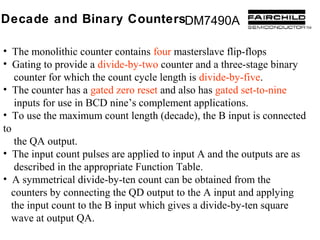
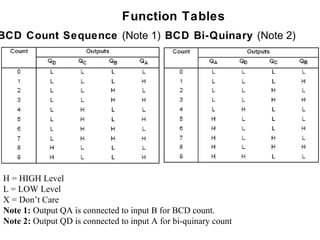
Decade and Binary CountersDM7490A

• The monolithic counter contains four masterslave flip-flops
• Gating to provide a divide-by-two counter and a three-stage binary
   counter for which the count cycle length is divide-by-five.
• The counter has a gated zero reset and also has gated set-to-nine
   inputs for use in BCD nine’s complement applications.
• To use the maximum count length (decade), the B input is connected
to
   the QA output.
• The input count pulses are applied to input A and the outputs are as
   described in the appropriate Function Table.
• A symmetrical divide-by-ten count can be obtained from the
  counters by connecting the QD output to the A input and applying
  the input count to the B input which gives a divide-by-ten square
  wave at output QA.
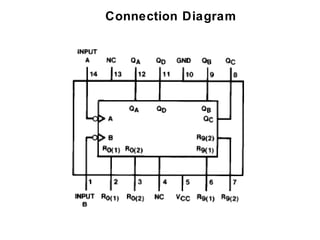
Connection Diagram
Function Tables
BCD Count Sequence (Note 1) BCD Bi-Quinary (Note 2)


H = HIGH Level
L = LOW Level
X = Don’t Care
Note 1: Output QA is connected to input B for BCD count.
Note 2: Output QD is connected to input A for bi-quinary count
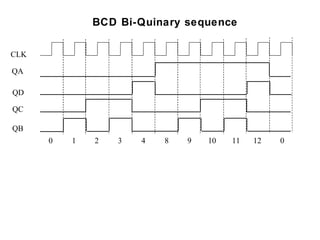
BCD Bi-Quinary sequence

CLK

QA

QD

QC

QB
      0   1   2   3   4   8   9   10   11   12   0
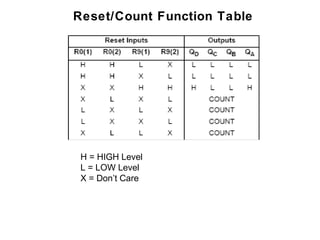
Reset/Count Function Table


 H = HIGH Level
 L = LOW Level
 X = Don’t Care
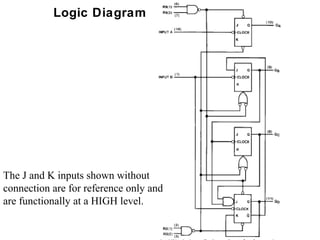
Logic Diagram


The J and K inputs shown without
connection are for reference only and
are functionally at a HIGH level.
SN5490A, SN5492A, SN5493A, SN54LS90, SN54LS92,
             SN54LS93
             SN7490A, SN7492A, SN7493A, SN74LS90, SN74LS92,
             SN74LS93
             DECADE, DIVIDE-BY-TWELVE AND BINARY COUNTERS
The three-stage binary counter has the count cycle length of
divide-by-five for the ’90, divide-by-six for the ’92, and divide-by-
eight for the ’93.

Logic Symbols
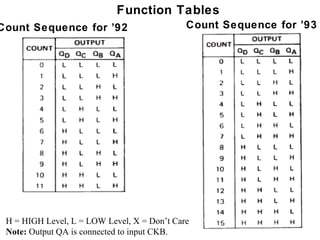
Function Tables
Count Sequence for ’92                       Count Sequence for ’93


 H = HIGH Level, L = LOW Level, X = Don’t Care
 Note: Output QA is connected to input CKB.
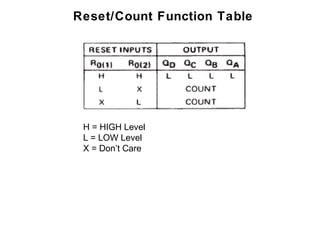
Reset/Count Function Table


 H = HIGH Level
 L = LOW Level
 X = Don’t Care
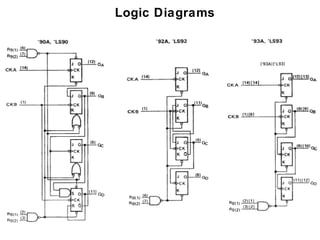
Logic Diagrams
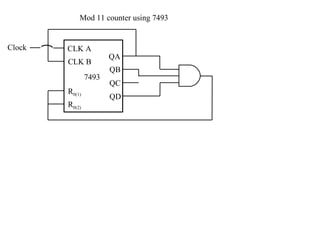
Mod 11 counter using 7493


Clock   CLK A
                       QA
        CLK B
                       QB
                7493
                       QC
        R0(1)
                       QD
        R0(2)
Synchronous Counters
• Asynchronous counters are easy to
  understand, but avoid their use
  – slow, limited by propagation delays
  – error prone


• Characteristics of synchronous counters
  – use a common clock pulse to trigger all flip-flops
    simultaneously
  – have a higher clock speed
  – hardware is more complex but more reliable


                                                         27
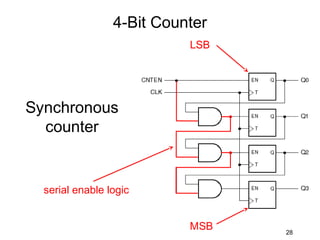
4-Bit Counter
                           LSB


Synchronous
  counter


  serial enable logic


                           MSB   28
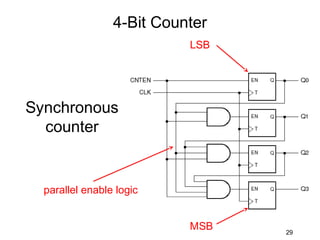
4-Bit Counter
                           LSB


Synchronous
  counter


  parallel enable logic


                           MSB   29
MSI Counters
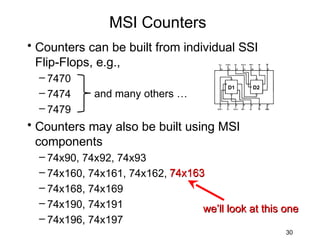
• Counters can be built from individual SSI
  Flip-Flops, e.g.,
  – 7470
                                         D1   D2
  – 7474     and many others …
  – 7479
• Counters may also be built using MSI
  components
  – 74x90, 74x92, 74x93
  – 74x160, 74x161, 74x162, 74x163
  – 74x168, 74x169
  – 74x190, 74x191
                                  we’ll look at this one
  – 74x196, 74x197
                                                     30
MSI Counter
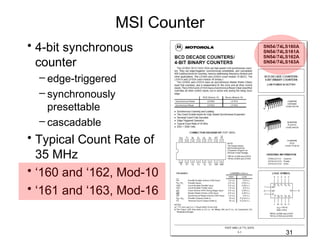
• 4-bit synchronous
  counter
  – edge-triggered
  – synchronously
    presettable
  – cascadable
• Typical Count Rate of
  35 MHz
• ‘160 and ‘162, Mod-10
• ‘161 and ‘163, Mod-16


                               31
MSI Counter
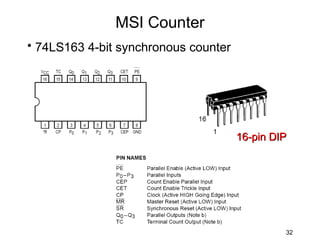
• 74LS163 4-bit synchronous counter


                                      16-pin DIP


                                               32
MSI Counter
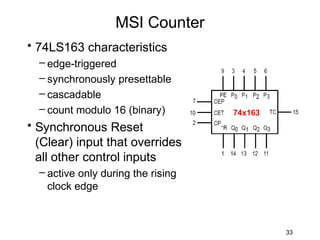
• 74LS163 characteristics
  – edge-triggered
  – synchronously presettable
  – cascadable
  – count modulo 16 (binary)        74x163
• Synchronous Reset
  (Clear) input that overrides
  all other control inputs
  – active only during the rising
    clock edge


                                             33
MSI Counter
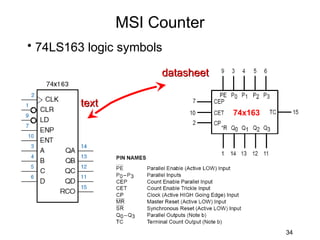
• 74LS163 logic symbols

                      datasheet

         text
                                  74x163


                                           34
MSI Counter
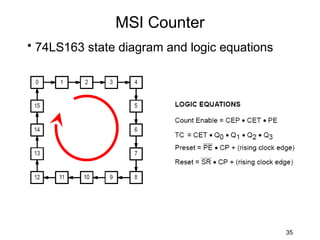
• 74LS163 state diagram and logic equations


                                              35
MSI Counter
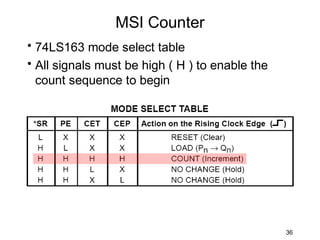
• 74LS163 mode select table
• All signals must be high ( H ) to enable the
  count sequence to begin


                                                 36
MSI Counter
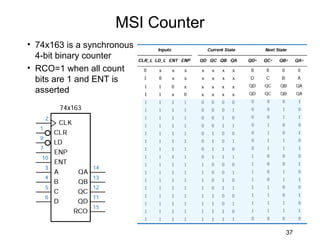
• 74x163 is a synchronous
  4-bit binary counter
• RCO=1 when all count
  bits are 1 and ENT is
  asserted


                                  37
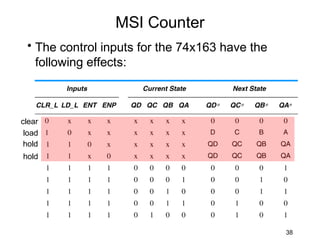
MSI Counter
 • The control inputs for the 74x163 have the
   following effects:


clear
 load
 hold
hold


                                                38
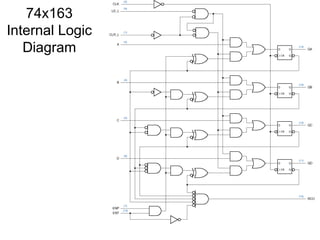
74x163
Internal Logic
   Diagram

Counters

  • 1.
    EET 3350 DigitalSystems Design Textbook: John Wakerly Chapter 8: 8.4 Counters 1
  • 2.
    Counters • Counters – Definition – Types Count – Characteristics Clock Counter • Asynchronous Counters - 7490, 7492, 7493 optional inputs • Synchronous Counters • MSI Counters S1 S2 S3 – Especially the 74LS163 Sm S4 • Counters in VHDL S5 • Other Counter Types 2
  • 3.
    Counters • A counter is a circuit that produces a numeric count each time an input clock pulse makes an active transition Clock Counter Count Load an initial value, reset May also enable count, to starting count, etc. select direction, etc. optional inputs 3
  • 4.
    Counter • From anotherviewpoint, a counter is any sequential circuit whose state diagram is a single cycle – in other words, counters are a special case of a finite state machine • Output is usually the state value, Moore machine EN EN RESET EN EN S2 EN EN EN S1 S3 EN EN Sm EN S4 EN EN S5 EN 4
  • 5.
    Counters • Counters differby a number of basic characteristics, including: Characteristic Description Modulus Length of sequence Coding Count sequence Direction Up or down Resetable Reset to zero Loadable Load a specific value 5
  • 6.
    Counters • Applications include: Present State Next State – system clock A B A B 0 0 0 1 – timer, delays 0 1 1 0 – watches, clocks, alarms 1 0 1 1 1 1 0 0 – counting events – memory addressing – frequency division 00 01 – sequence control – cycle control – protocols 11 10 6
  • 7.
    Counter Types • Asynchronous • Modulus – Ripple – Binary • Synchronous – Decade – Clocked – etc. • Ring 000 • Johnson – Twisted ring 101 001 • Up/Down • Linear Feedback Shift- 100 010 Register Counter 011 (LFSR) 7
  • 8.
    Counters • Some examplesof modulus and coding sequence for counters 8
  • 9.
    Counters • Modulus – number of states in a counter’s cycle • Given m states – modulo-m counter or divide-by-m counter • Power-of-2 counters use all states • Non-power-of-2 counters have extra, unused states S1 S2 S3 Sm S4 S5 9
  • 10.
    Example 4-bit Counters •4-bit Binary / Hex / Mod-16 Counter – 0000, 0001, 0010, … 1110, 1111, 0000, 0001, … all states used • 4-bit BCD / Decade / Mod-10 Counter – 0000, 0001, 0010, … 1000, 1001, 0000, 0001, … six unused states • 4-bit Ring Counter – 1000, 0100, 0010, 0001, 1000, 0100, … twelve unused states 10
  • 11.
    Counters • Ripple counters – asynchronous – an n-state counter that is formed from n cascaded flip-flops – the clock input to each of the individual flip-flops, with the exception of the first, is taken from the output of the preceding one – the count thus ripples along the counter's length due to the propagation delay associated with each stage of counting 11
  • 12.
    Asynchronous Ripple Counter Q3 Q2 Q1 Q0 Q0 0 0 0 0 0 0 0 1 Q1 0 0 1 0 0 0 1 1 0 1 0 0 Q2 0 1 0 1 0 1 1 0 Q3 0 1 1 1 1 0 0 0 . . . 12
  • 13.
    Ripple Counter Timing •The ideal count sequence for the ripple counter yields the timing diagram below Q0 Q1 Q2 Q3 CLOCK Q0 Q1 Q2 Q3 13
  • 14.
    Ripple Counter Timing •But there is delay ( ∆ ) as shown below: CLK Q0 1∆ Q1 2∆ Q2 3∆ 0 1 2 3 4 14
  • 15.
    Asynchronous Ripple Counter Q0 divide-by-2 Q1 divide-by-4 a T flip-flop is a natural frequency divider … Q2 divide-by-8 Q3 divide-by-16 15
  • 16.
    Decade and BinaryCountersDM7490A • The monolithic counter contains four masterslave flip-flops • Gating to provide a divide-by-two counter and a three-stage binary counter for which the count cycle length is divide-by-five. • The counter has a gated zero reset and also has gated set-to-nine inputs for use in BCD nine’s complement applications. • To use the maximum count length (decade), the B input is connected to the QA output. • The input count pulses are applied to input A and the outputs are as described in the appropriate Function Table. • A symmetrical divide-by-ten count can be obtained from the counters by connecting the QD output to the A input and applying the input count to the B input which gives a divide-by-ten square wave at output QA.
  • 17.
  • 18.
    Function Tables BCD CountSequence (Note 1) BCD Bi-Quinary (Note 2) H = HIGH Level L = LOW Level X = Don’t Care Note 1: Output QA is connected to input B for BCD count. Note 2: Output QD is connected to input A for bi-quinary count
  • 19.
  • 20.
    Reset/Count Function Table H = HIGH Level L = LOW Level X = Don’t Care
  • 21.
    Logic Diagram The Jand K inputs shown without connection are for reference only and are functionally at a HIGH level.
  • 22.
    SN5490A, SN5492A, SN5493A,SN54LS90, SN54LS92, SN54LS93 SN7490A, SN7492A, SN7493A, SN74LS90, SN74LS92, SN74LS93 DECADE, DIVIDE-BY-TWELVE AND BINARY COUNTERS The three-stage binary counter has the count cycle length of divide-by-five for the ’90, divide-by-six for the ’92, and divide-by- eight for the ’93. Logic Symbols
  • 23.
    Function Tables Count Sequencefor ’92 Count Sequence for ’93 H = HIGH Level, L = LOW Level, X = Don’t Care Note: Output QA is connected to input CKB.
  • 24.
    Reset/Count Function Table H = HIGH Level L = LOW Level X = Don’t Care
  • 25.
  • 26.
    Mod 11 counterusing 7493 Clock CLK A QA CLK B QB 7493 QC R0(1) QD R0(2)
  • 27.
    Synchronous Counters • Asynchronouscounters are easy to understand, but avoid their use – slow, limited by propagation delays – error prone • Characteristics of synchronous counters – use a common clock pulse to trigger all flip-flops simultaneously – have a higher clock speed – hardware is more complex but more reliable 27
  • 28.
    4-Bit Counter LSB Synchronous counter serial enable logic MSB 28
  • 29.
    4-Bit Counter LSB Synchronous counter parallel enable logic MSB 29
  • 30.
    MSI Counters • Counterscan be built from individual SSI Flip-Flops, e.g., – 7470 D1 D2 – 7474 and many others … – 7479 • Counters may also be built using MSI components – 74x90, 74x92, 74x93 – 74x160, 74x161, 74x162, 74x163 – 74x168, 74x169 – 74x190, 74x191 we’ll look at this one – 74x196, 74x197 30
  • 31.
    MSI Counter • 4-bitsynchronous counter – edge-triggered – synchronously presettable – cascadable • Typical Count Rate of 35 MHz • ‘160 and ‘162, Mod-10 • ‘161 and ‘163, Mod-16 31
  • 32.
    MSI Counter • 74LS1634-bit synchronous counter 16-pin DIP 32
  • 33.
    MSI Counter • 74LS163characteristics – edge-triggered – synchronously presettable – cascadable – count modulo 16 (binary) 74x163 • Synchronous Reset (Clear) input that overrides all other control inputs – active only during the rising clock edge 33
  • 34.
    MSI Counter • 74LS163logic symbols datasheet text 74x163 34
  • 35.
    MSI Counter • 74LS163state diagram and logic equations 35
  • 36.
    MSI Counter • 74LS163mode select table • All signals must be high ( H ) to enable the count sequence to begin 36
  • 37.
    MSI Counter • 74x163is a synchronous 4-bit binary counter • RCO=1 when all count bits are 1 and ENT is asserted 37
  • 38.
    MSI Counter •The control inputs for the 74x163 have the following effects: clear load hold hold 38
  • 39.