Differential amplifier
Mrs.V.SrirengaNachiyar, AP/ECE
Ramco Institute of Technology
Academic Year:2017-2018 (Odd)
Differential amplifier
Amplifier:
An amplifier is a device which accept an
input signal and produces an output signal
proportional to the input.
Differential amplifier:
An amplifier which amplifies the
difference between the two input signals is called
differential amplifier.
Advantages of differential amplifier
• Excellent stability
• High versatility (adapt to many different
situations)
• Immune to noise
• Immune to interference signals
• Used in most of analog circuits ranging from
d.c to high frequency applications.
Basics of Differential amplifier
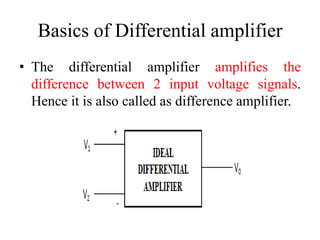
• The differential amplifier amplifies the
difference between 2 input voltage signals.
Hence it is also called as difference amplifier.
Cont…
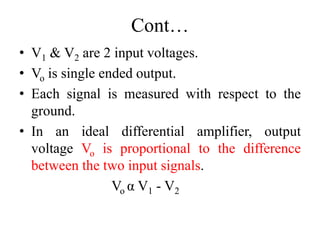
• V1 & V2 are 2 input voltages.
• Vo is single ended output.
• Each signal is measured with respect to the
ground.
• In an ideal differential amplifier, output
voltage Vo is proportional to the difference
between the two input signals.
Vo α V1 - V2
Differential gain (Ad)
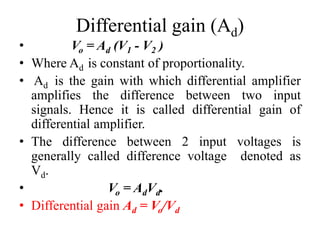
• Vo = Ad (V1 - V2 )
• Where Ad is constant of proportionality.
• Ad is the gain with which differential amplifier
amplifies the difference between two input
signals. Hence it is called differential gain of
differential amplifier.
• The difference between 2 input voltages is
generally called difference voltage denoted as
Vd.
• Vo = AdVd.
• Differential gain Ad = Vo/Vd
Common mode gain (Ac)
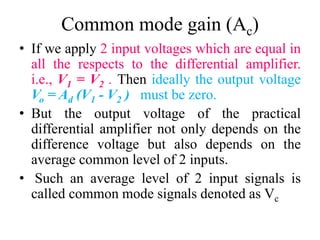
• If we apply 2 input voltages which are equal in
all the respects to the differential amplifier.
i.e., V1 = V2 . Then ideally the output voltage
Vo = Ad (V1 - V2 ) must be zero.
• But the output voltage of the practical
differential amplifier not only depends on the
difference voltage but also depends on the
average common level of 2 inputs.
• Such an average level of 2 input signals is
called common mode signals denoted as Vc
Cont…
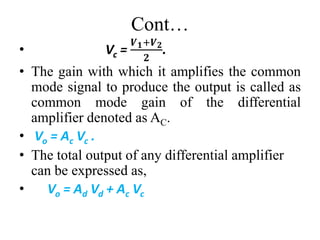
• Vc =
𝑽 𝟏+𝑽 𝟐
𝟐
.
• The gain with which it amplifies the common
mode signal to produce the output is called as
common mode gain of the differential
amplifier denoted as AC.
• Vo = Ac Vc .
• The total output of any differential amplifier
can be expressed as,
• Vo = Ad Vd + Ac Vc
Common mode rejection ratio (CMRR)
• When the same voltage is applied to both the
inputs, the differential amplifier is said to be
operated in a common mode configuration.
• Many disturbance signals, noise signals appear
as a common input signal to both the input
terminals of the differential amplifier.
• The ability of a differential amplifier to reject a
common mode signal is expressed by a ratio
called CMRR.
Cont…
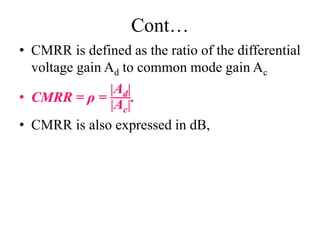
• CMRR is defined as the ratio of the differential
voltage gain Ad to common mode gain Ac
• CMRR = ρ =
Ad
Ac
.
• CMRR is also expressed in dB,
Feature of differential amplifier
• High differential voltage gain.
• Low common mode gain.
• High CMRR
• Two input terminals.
• High input impedance.
• Large bandwidth.
• Low output impedance.
• Low offset voltage and current.
References
• Donald .A. Neamen, Electronic Circuit
Analysis and Design –2nd Edition,Tata Mc
Graw Hill, 2009.
• Adel .S. Sedra, Kenneth C. Smith, “Micro
Electronic Circuits”, 6th Edition, Oxford
University Press, 2010.
• A.P.Godse & U.A. Bakshi,”Electronic
Circuits-I
Differential amplifier

Differential amplifier

  • 1.
    Differential amplifier Mrs.V.SrirengaNachiyar, AP/ECE RamcoInstitute of Technology Academic Year:2017-2018 (Odd)
  • 2.
    Differential amplifier Amplifier: An amplifieris a device which accept an input signal and produces an output signal proportional to the input. Differential amplifier: An amplifier which amplifies the difference between the two input signals is called differential amplifier.
  • 3.
    Advantages of differentialamplifier • Excellent stability • High versatility (adapt to many different situations) • Immune to noise • Immune to interference signals • Used in most of analog circuits ranging from d.c to high frequency applications.
  • 4.
    Basics of Differentialamplifier • The differential amplifier amplifies the difference between 2 input voltage signals. Hence it is also called as difference amplifier.
  • 5.
    Cont… • V1 &V2 are 2 input voltages. • Vo is single ended output. • Each signal is measured with respect to the ground. • In an ideal differential amplifier, output voltage Vo is proportional to the difference between the two input signals. Vo α V1 - V2
  • 6.
    Differential gain (Ad) •Vo = Ad (V1 - V2 ) • Where Ad is constant of proportionality. • Ad is the gain with which differential amplifier amplifies the difference between two input signals. Hence it is called differential gain of differential amplifier. • The difference between 2 input voltages is generally called difference voltage denoted as Vd. • Vo = AdVd. • Differential gain Ad = Vo/Vd
  • 7.
    Common mode gain(Ac) • If we apply 2 input voltages which are equal in all the respects to the differential amplifier. i.e., V1 = V2 . Then ideally the output voltage Vo = Ad (V1 - V2 ) must be zero. • But the output voltage of the practical differential amplifier not only depends on the difference voltage but also depends on the average common level of 2 inputs. • Such an average level of 2 input signals is called common mode signals denoted as Vc
  • 8.
    Cont… • Vc = 𝑽𝟏+𝑽 𝟐 𝟐 . • The gain with which it amplifies the common mode signal to produce the output is called as common mode gain of the differential amplifier denoted as AC. • Vo = Ac Vc . • The total output of any differential amplifier can be expressed as, • Vo = Ad Vd + Ac Vc
  • 9.
    Common mode rejectionratio (CMRR) • When the same voltage is applied to both the inputs, the differential amplifier is said to be operated in a common mode configuration. • Many disturbance signals, noise signals appear as a common input signal to both the input terminals of the differential amplifier. • The ability of a differential amplifier to reject a common mode signal is expressed by a ratio called CMRR.
  • 10.
    Cont… • CMRR isdefined as the ratio of the differential voltage gain Ad to common mode gain Ac • CMRR = ρ = Ad Ac . • CMRR is also expressed in dB,
  • 11.
    Feature of differentialamplifier • High differential voltage gain. • Low common mode gain. • High CMRR • Two input terminals. • High input impedance. • Large bandwidth. • Low output impedance. • Low offset voltage and current.
  • 12.
    References • Donald .A.Neamen, Electronic Circuit Analysis and Design –2nd Edition,Tata Mc Graw Hill, 2009. • Adel .S. Sedra, Kenneth C. Smith, “Micro Electronic Circuits”, 6th Edition, Oxford University Press, 2010. • A.P.Godse & U.A. Bakshi,”Electronic Circuits-I