Dr. C. Saritha
Lecturer in Electronics
SSBN Degree & PG College
ANANTAPUR
   Introduction.
   Characteristics.
   Resistor Transistor Logic.
   Diode Transistor Logic.
   Transistor-Transistor Logic.
   Emitter coupled Logic.
   Fan in : The number of inputs that the gate can
    handle properly with out disturbing the output
    level.

   Fan out : The number of inputs that can driven
    simultaneously by the output with out disturbing
    the output level.

   Noise immunity : Noise immunity is the ability of
    the logic circuit to tolerate the noise voltage.
   Noise Margin : The quantative measure of noise
    immunity is called noise margin.

   Propagation Delay : The propagation delay of gate
    is the average transition delay time for the signal to
    propagate from input to output
     It is measured in nanoseconds

   Threshold Voltage : The voltage at which the
    circuit changes from one state to another state
   Operating Speed : The speed of operation of
    the logic gate is the time that elapses between
    giving input and getting output.

   Power Dissipation : The power dissipation is
    defined as power needed by the logic circuit.
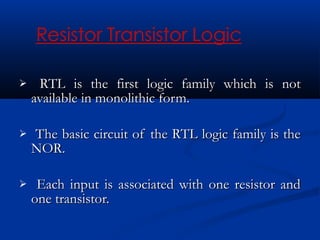
    RTL is the first logic family which is not
    available in monolithic form.

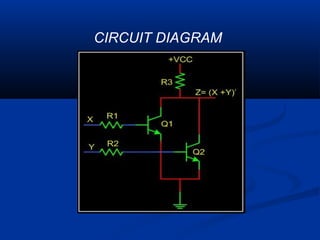
   The basic circuit of the RTL logic family is the
    NOR.

    Each input is associated with one resistor and
    one transistor.
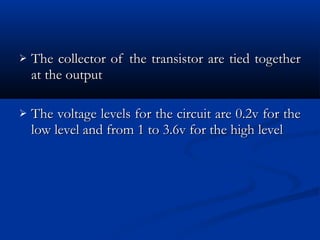
   The collector of the transistor are tied together
    at the output

   The voltage levels for the circuit are 0.2v for the
    low level and from 1 to 3.6v for the high level
CIRCUIT DIAGRAM
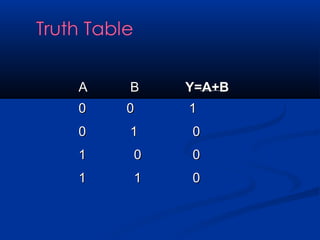
A   B   Y=A+B
0   0   1
0   1   0
1   0   0
1   1   0
Working:

   If any input is high. The corresponding
    transistor is driven into saturation and the
    output goes low, regardless of the states of the
    other transistor.

   If all inputs are low. Then all transistor are in
    cutoff state and the output of the circuit goes
    high.
Characteristics :

   It has a fan-out of 5.
   Propagation delay is 25 ns.
   Power dissipation is 12 mw.
   Noise margin for low signal input is 0.4 v.
   Poor noise immunity.
   Low speed.
   DTL was first commercial available IC logic
    family in 53/73 series.

   The basic circuit in the DTL logic is the NAND
    gate.

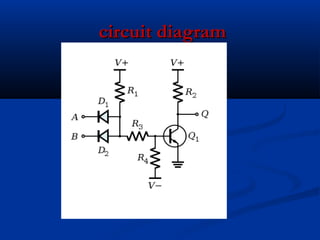
   Each input associated with one diode.

   The diode and resistor form an AND gate.

   The transistor services as a NOR gate
circuit diagram
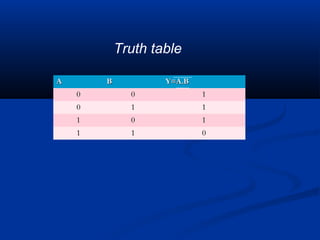
Truth table

A       B           Y=A.B
    0         0             1
    0         1             1
    1         0             1
    1         1             0
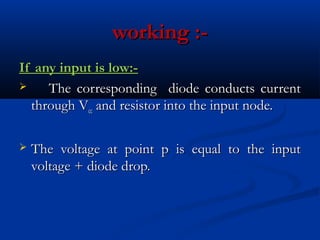
working :-
If any input is low:-
    The corresponding diode conducts current
  through Vcc and resistor into the input node.

   The voltage at point p is equal to the input
    voltage + diode drop.
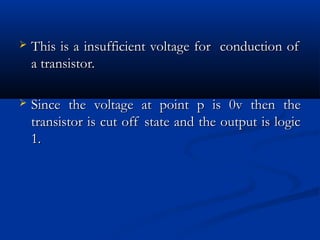
   This is a insufficient voltage for conduction of
    a transistor.

   Since the voltage at point p is 0v then the
    transistor is cut off state and the output is logic
    1.
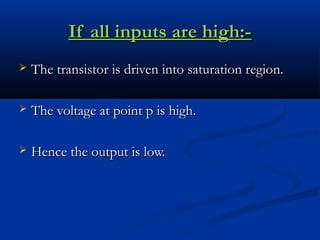
If all inputs are high:-
   The transistor is driven into saturation region.

   The voltage at point p is high.

   Hence the output is low.
characteristics :-

  It has fan-out of 8.
 It has high noise immunity.

 Power dissipation is 12mw.

 Propagation delay is average 30ns.

 Noise margin is about 0.7V.
   It can perform many digital function and have
    achieved the most popularity.

   TTL IC are given the numerical designation as
    5400 and 7400 series

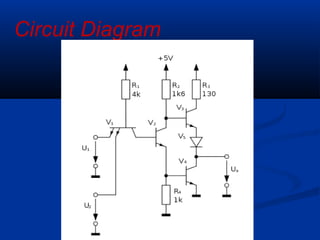
   The basic circuit of TTL with totem pole output
    stage is NAND gate
 TTL uses a multi-miter transistor at the input
  and is fast saturation logic circuit.
 The output transistor Q3 and Q4 form a totem-
  pole connection.

   This extra output stage is known as totem-pole
    stage because three output components Q3 and
    Q4 and Diode are stacked on one another.
   This arrangement will increase the speed the
    speed of operation and also increase output
    current capability.

   The function of diode in this circuit prevent
    both Q3         and Q4 being turned ON
    simultaneously The function of diode in this
    circuit prevent both Q3 and Q4 being turned
    ON simultaneously
Circuit Diagram
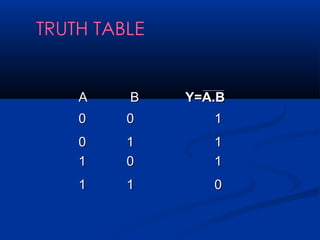
A   B   Y=A.B
0   0      1
0   1      1
1   0      1
1   1      0
Working:-
• A=0,B=0;A=1,B=0;A=0,B=1;
 The emitter base junction of Q1 turns on.


 The collector potential of Q1 falls to 0v,then Q2
  turns off.
 Therefore, at point M we have 0volt i.e., the base
  voltage of Q2 is 0volt.
   So that, Q2 is also turns off.

 But at the same time we have L=+VCC, this
  voltage is applied on the base of Q4
 As a result transistor Q3 is turned ON.

 Therefore, the output voltage is given by
                    V0=+VCC-[Voltage drop in
                         R4+drop in diode ‘D’]
    A=1,B=1;
   When both input are high then emitter          base
    junction of transistor Q1 becomes reverse      bias.
    Hence Q1 is turned off.

   However its collector base junction is forward bias,
    supplying base current to the transistor Q2. Hence
    Q2 turns ON.

   As a result collector potential of Q2 becomes “0”
    volts.
   Now if L=0volt is applied to the base of Q3, it
    is turns off .

   At the same time Q4 is turn ON. Then its
    collector potential nearly equal to 0volts.

   Hence the output is low or logic o.
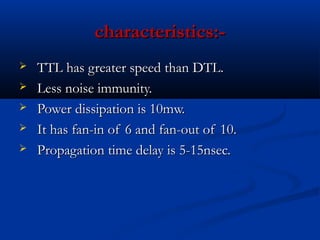
characteristics:-
   TTL has greater speed than DTL.
   Less noise immunity.
   Power dissipation is 10mw.
   It has fan-in of 6 and fan-out of 10.
   Propagation time delay is 5-15nsec.
   ECL is non saturated digital logic family.

   The output of ECL provides OR and NOR
    function.

   Each input is connected to the base of
    transistor.
    The circuit consists of three parts.
    1.differential input amplifier.
    2.Internal temperature and voltage compensated
    bias network.
    3.emittor follower output.

    The emitter output requires a pull down resistor
    for current flow.

    In this logic family we consider the logic 0 as
    -1.6v and logic 1 as -0.8v.
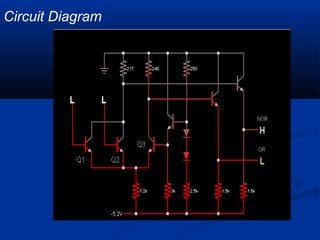
Circuit Diagram
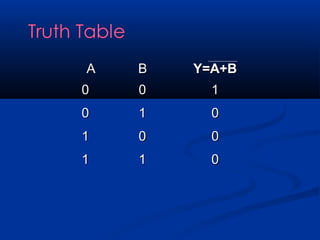
A   B   Y=A+B
0   0     1
0   1     0
1   0     0
1   1     0
working:-
 A=0,B=0;
 If all inputs are at low level(-1.6v),the transistor
  are turn OFF and Q3 conducts .

   Then at point L the potential is 0volts is applied
    to the base of Q5,it is to be turn OFF.

   So, the output of OR gate is logic ‘o’.
   At the same time , the potential at point M= vcc
    is applied to the base of Q6,it is to be turn ON.

   So, the output of NOR is at logic 1.
 A=0,B=0,A=0,B=1,A=1,B=0;
 The corresponding transistor is turned ON and
  Q3is turned OFF.

   Because its voltage needs at least 0.6v to start
    conduction on.

   An input of -0.8v causes the transistor to
    conduct and apply -1.6v on the remaining
    emitters
   Therefore,Q3 is cut off. The voltage in resistor R2
    flows into the base of Q5(L=Vcc) then Q5 is turned
    ON.

   The output is at logic 1.

   At the same time, at point M the voltage is 0v is
    applied to the base of the transistor Q6,it is to be
    turns off. So, the NOR output is logic 0.
Characteristics :-

   Propagation delay is very LOW(<1ns)

   ECL is fastest logic family.

   ECL circuit usually operate with –Ve supplies
    (+Ve terminal is connected to ground).
Logic families

Logic families

  • 1.
    Dr. C. Saritha Lecturerin Electronics SSBN Degree & PG College ANANTAPUR
  • 2.
    Introduction.  Characteristics.  Resistor Transistor Logic.  Diode Transistor Logic.  Transistor-Transistor Logic.  Emitter coupled Logic.
  • 3.
    Fan in : The number of inputs that the gate can handle properly with out disturbing the output level.  Fan out : The number of inputs that can driven simultaneously by the output with out disturbing the output level.  Noise immunity : Noise immunity is the ability of the logic circuit to tolerate the noise voltage.
  • 4.
    Noise Margin : The quantative measure of noise immunity is called noise margin.  Propagation Delay : The propagation delay of gate is the average transition delay time for the signal to propagate from input to output It is measured in nanoseconds  Threshold Voltage : The voltage at which the circuit changes from one state to another state
  • 5.
    Operating Speed : The speed of operation of the logic gate is the time that elapses between giving input and getting output.  Power Dissipation : The power dissipation is defined as power needed by the logic circuit.
  • 6.
    RTL is the first logic family which is not available in monolithic form.  The basic circuit of the RTL logic family is the NOR.  Each input is associated with one resistor and one transistor.
  • 7.
    The collector of the transistor are tied together at the output  The voltage levels for the circuit are 0.2v for the low level and from 1 to 3.6v for the high level
  • 8.
  • 9.
    A B Y=A+B 0 0 1 0 1 0 1 0 0 1 1 0
  • 10.
    Working:  If any input is high. The corresponding transistor is driven into saturation and the output goes low, regardless of the states of the other transistor.  If all inputs are low. Then all transistor are in cutoff state and the output of the circuit goes high.
  • 11.
    Characteristics :  It has a fan-out of 5.  Propagation delay is 25 ns.  Power dissipation is 12 mw.  Noise margin for low signal input is 0.4 v.  Poor noise immunity.  Low speed.
  • 12.
    DTL was first commercial available IC logic family in 53/73 series.  The basic circuit in the DTL logic is the NAND gate.  Each input associated with one diode.  The diode and resistor form an AND gate.  The transistor services as a NOR gate
  • 13.
  • 14.
    Truth table A B Y=A.B 0 0 1 0 1 1 1 0 1 1 1 0
  • 15.
    working :- If anyinput is low:-  The corresponding diode conducts current through Vcc and resistor into the input node.  The voltage at point p is equal to the input voltage + diode drop.
  • 16.
    This is a insufficient voltage for conduction of a transistor.  Since the voltage at point p is 0v then the transistor is cut off state and the output is logic 1.
  • 17.
    If all inputsare high:-  The transistor is driven into saturation region.  The voltage at point p is high.  Hence the output is low.
  • 18.
    characteristics :-  It has fan-out of 8.  It has high noise immunity.  Power dissipation is 12mw.  Propagation delay is average 30ns.  Noise margin is about 0.7V.
  • 19.
    It can perform many digital function and have achieved the most popularity.  TTL IC are given the numerical designation as 5400 and 7400 series  The basic circuit of TTL with totem pole output stage is NAND gate
  • 20.
     TTL usesa multi-miter transistor at the input and is fast saturation logic circuit.  The output transistor Q3 and Q4 form a totem- pole connection.  This extra output stage is known as totem-pole stage because three output components Q3 and Q4 and Diode are stacked on one another.
  • 21.
    This arrangement will increase the speed the speed of operation and also increase output current capability.  The function of diode in this circuit prevent both Q3 and Q4 being turned ON simultaneously The function of diode in this circuit prevent both Q3 and Q4 being turned ON simultaneously
  • 22.
  • 23.
    A B Y=A.B 0 0 1 0 1 1 1 0 1 1 1 0
  • 24.
    Working:- • A=0,B=0;A=1,B=0;A=0,B=1;  Theemitter base junction of Q1 turns on.  The collector potential of Q1 falls to 0v,then Q2 turns off.  Therefore, at point M we have 0volt i.e., the base voltage of Q2 is 0volt.
  • 25.
    So that, Q2 is also turns off.  But at the same time we have L=+VCC, this voltage is applied on the base of Q4  As a result transistor Q3 is turned ON.  Therefore, the output voltage is given by V0=+VCC-[Voltage drop in R4+drop in diode ‘D’]
  • 26.
    A=1,B=1;  When both input are high then emitter base junction of transistor Q1 becomes reverse bias. Hence Q1 is turned off.  However its collector base junction is forward bias, supplying base current to the transistor Q2. Hence Q2 turns ON.  As a result collector potential of Q2 becomes “0” volts.
  • 27.
    Now if L=0volt is applied to the base of Q3, it is turns off .  At the same time Q4 is turn ON. Then its collector potential nearly equal to 0volts.  Hence the output is low or logic o.
  • 28.
    characteristics:-  TTL has greater speed than DTL.  Less noise immunity.  Power dissipation is 10mw.  It has fan-in of 6 and fan-out of 10.  Propagation time delay is 5-15nsec.
  • 29.
    ECL is non saturated digital logic family.  The output of ECL provides OR and NOR function.  Each input is connected to the base of transistor.
  • 30.
    The circuit consists of three parts. 1.differential input amplifier. 2.Internal temperature and voltage compensated bias network. 3.emittor follower output.  The emitter output requires a pull down resistor for current flow.  In this logic family we consider the logic 0 as -1.6v and logic 1 as -0.8v.
  • 31.
  • 32.
    A B Y=A+B 0 0 1 0 1 0 1 0 0 1 1 0
  • 33.
    working:-  A=0,B=0;  Ifall inputs are at low level(-1.6v),the transistor are turn OFF and Q3 conducts .  Then at point L the potential is 0volts is applied to the base of Q5,it is to be turn OFF.  So, the output of OR gate is logic ‘o’.
  • 34.
    At the same time , the potential at point M= vcc is applied to the base of Q6,it is to be turn ON.  So, the output of NOR is at logic 1.
  • 35.
     A=0,B=0,A=0,B=1,A=1,B=0;  Thecorresponding transistor is turned ON and Q3is turned OFF.  Because its voltage needs at least 0.6v to start conduction on.  An input of -0.8v causes the transistor to conduct and apply -1.6v on the remaining emitters
  • 36.
    Therefore,Q3 is cut off. The voltage in resistor R2 flows into the base of Q5(L=Vcc) then Q5 is turned ON.  The output is at logic 1.  At the same time, at point M the voltage is 0v is applied to the base of the transistor Q6,it is to be turns off. So, the NOR output is logic 0.
  • 37.
    Characteristics :-  Propagation delay is very LOW(<1ns)  ECL is fastest logic family.  ECL circuit usually operate with –Ve supplies (+Ve terminal is connected to ground).