Reporters:
Ablanzar, Rachelmae
Enilo, Shaira
Fado, Jeralyn
Ponan, Cristene Joy
Robles, Jaypee
Tuvillara, John Rovee
The Nervous System
Objectives
At the end of the report, the
students are expected to;
• Describe the nervous system
• Describe the structure of a
neuron and how it conducts
electrical impulses
• Distinguish sensory,
interneuron and motor neurons
• Describe the parts and
functions of the brain
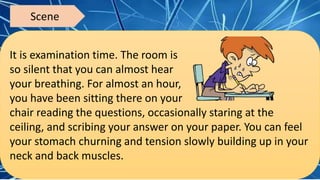
It is examination time. The room is
so silent that you can almost hear
your breathing. For almost an hour,
you have been sitting there on your
chair reading the questions, occasionally staring at the
ceiling, and scribing your answer on your paper. You can feel
your stomach churning and tension slowly building up in your
neck and back muscles.
Scene
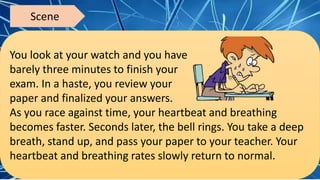
You look at your watch and you have
barely three minutes to finish your
exam. In a haste, you review your
paper and finalized your answers.
As you race against time, your heartbeat and breathing
becomes faster. Seconds later, the bell rings. You take a deep
breath, stand up, and pass your paper to your teacher. Your
heartbeat and breathing rates slowly return to normal.
Scene
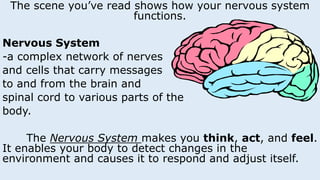
The scene you’ve read shows how your nervous system
functions.
Nervous System
-a complex network of nerves
and cells that carry messages
to and from the brain and
spinal cord to various parts of the
body.
The Nervous System makes you think, act, and feel.
It enables your body to detect changes in the
environment and causes it to respond and adjust itself.
Brain Teaser
If you were running a race, and you passed the
person in 2nd place, what place would you be
in now?
Second
Neuron
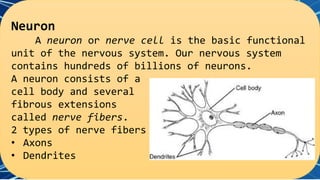
A neuron or nerve cell is the basic functional
unit of the nervous system. Our nervous system
contains hundreds of billions of neurons.
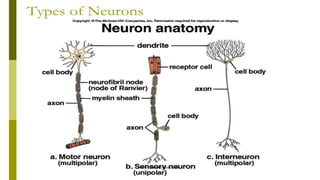
A neuron consists of a
cell body and several
fibrous extensions
called nerve fibers.
2 types of nerve fibers
• Axons
• Dendrites
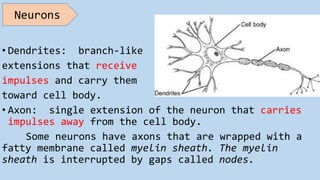
• Dendrites: branch-like
extensions that receive
impulses and carry them
toward cell body.
• Axon: single extension of the neuron that carries
impulses away from the cell body.
Some neurons have axons that are wrapped with a
fatty membrane called myelin sheath. The myelin
sheath is interrupted by gaps called nodes.
Neurons
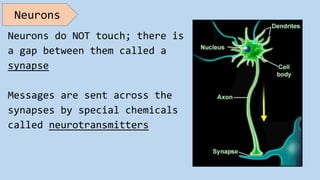
Neurons do NOT touch; there is
a gap between them called a
synapse
Messages are sent across the
synapses by special chemicals
called neurotransmitters
Neurons
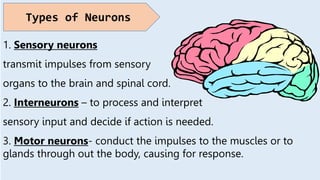
1. Sensory neurons
transmit impulses from sensory
organs to the brain and spinal cord.
2. Interneurons – to process and interpret
sensory input and decide if action is needed.
3. Motor neurons- conduct the impulses to the muscles or to
glands through out the body, causing for response.
Types of Neurons
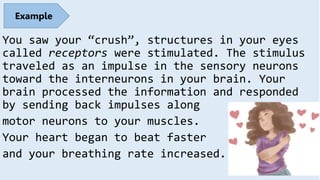
You saw your “crush”, structures in your eyes
called receptors were stimulated. The stimulus
traveled as an impulse in the sensory neurons
toward the interneurons in your brain. Your
brain processed the information and responded
by sending back impulses along
motor neurons to your muscles.
Your heart began to beat faster
and your breathing rate increased.
Example
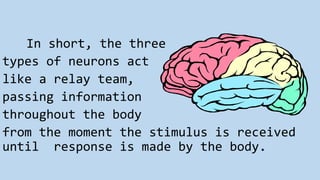
In short, the three
types of neurons act
like a relay team,
passing information
throughout the body
from the moment the stimulus is received
until response is made by the body.
Brain Teaser
A H I M N O T U V W
Which of the letters above does not belong
with the rest?
N It is not a mirror-image of itself
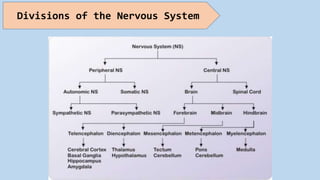
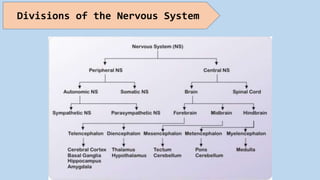
Divisions of the Nervous System
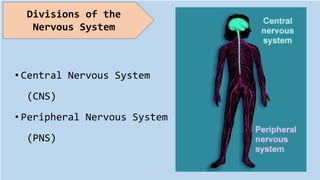
• Central Nervous System
(CNS)
• Peripheral Nervous System
(PNS)
Divisions of the
Nervous System
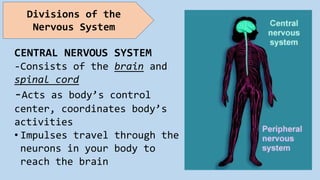
CENTRAL NERVOUS SYSTEM
-Consists of the brain and
spinal cord
-Acts as body’s control
center, coordinates body’s
activities
• Impulses travel through the
neurons in your body to
reach the brain
Divisions of the
Nervous System
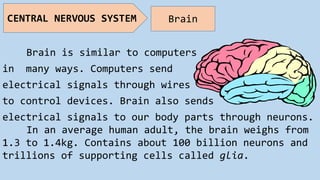
Brain is similar to computers
in many ways. Computers send
electrical signals through wires
to control devices. Brain also sends
electrical signals to our body parts through neurons.
In an average human adult, the brain weighs from
1.3 to 1.4kg. Contains about 100 billion neurons and
trillions of supporting cells called glia.
CENTRAL NERVOUS SYSTEM Brain
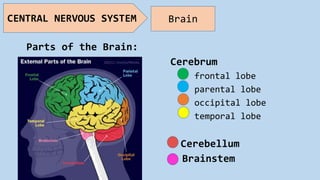
Parts of the Brain:
Cerebrum
frontal lobe
parental lobe
occipital lobe
temporal lobe
Cerebellum
Brainstem
CENTRAL NERVOUS SYSTEM Brain
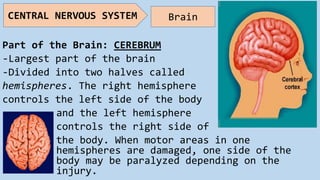
Part of the Brain: CEREBRUM
-Largest part of the brain
-Divided into two halves called
hemispheres. The right hemisphere
controls the left side of the body
and the left hemisphere
controls the right side of
the body. When motor areas in one
hemispheres are damaged, one side of the
body may be paralyzed depending on the
injury.
CENTRAL NERVOUS SYSTEM Brain
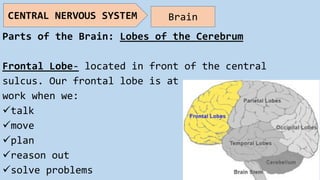
Parts of the Brain: Lobes of the Cerebrum
Frontal Lobe- located in front of the central
sulcus. Our frontal lobe is at
work when we:
talk
move
plan
reason out
solve problems
CENTRAL NERVOUS SYSTEM Brain
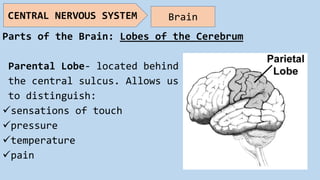
Parts of the Brain: Lobes of the Cerebrum
Parental Lobe- located behind
the central sulcus. Allows us
to distinguish:
sensations of touch
pressure
temperature
pain
CENTRAL NERVOUS SYSTEM Brain
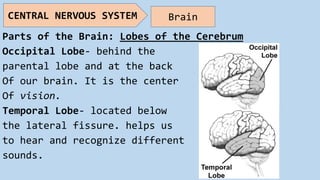
Parts of the Brain: Lobes of the Cerebrum
Occipital Lobe- behind the
parental lobe and at the back
Of our brain. It is the center
Of vision.
Temporal Lobe- located below
the lateral fissure. helps us
to hear and recognize different
sounds.
CENTRAL NERVOUS SYSTEM Brain
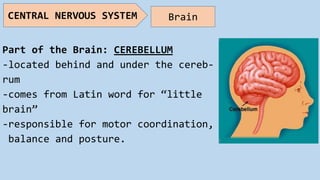
Part of the Brain: CEREBELLUM
-located behind and under the cereb-
rum
-comes from Latin word for “little
brain”
-responsible for motor coordination,
balance and posture.
CENTRAL NERVOUS SYSTEM Brain
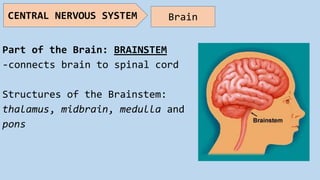
Part of the Brain: BRAINSTEM
-connects brain to spinal cord
Structures of the Brainstem:
thalamus, midbrain, medulla and
pons
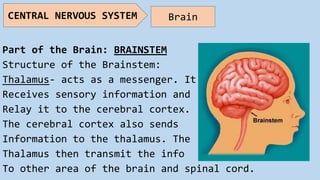
CENTRAL NERVOUS SYSTEM Brain
Part of the Brain: BRAINSTEM
Structure of the Brainstem:
Thalamus- acts as a messenger. It
Receives sensory information and
Relay it to the cerebral cortex.
The cerebral cortex also sends
Information to the thalamus. The
Thalamus then transmit the info
To other area of the brain and spinal cord.
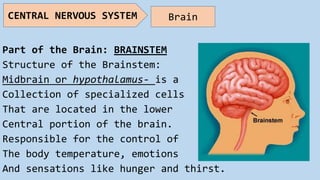
CENTRAL NERVOUS SYSTEM Brain
Part of the Brain: BRAINSTEM
Structure of the Brainstem:
Midbrain or hypothalamus- is a
Collection of specialized cells
That are located in the lower
Central portion of the brain.
Responsible for the control of
The body temperature, emotions
And sensations like hunger and thirst.
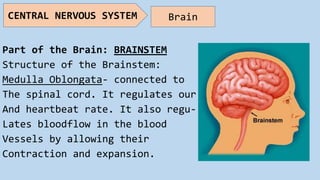
CENTRAL NERVOUS SYSTEM Brain
Part of the Brain: BRAINSTEM
Structure of the Brainstem:
Medulla Oblongata- connected to
The spinal cord. It regulates our
And heartbeat rate. It also regu-
Lates bloodflow in the blood
Vessels by allowing their
Contraction and expansion.
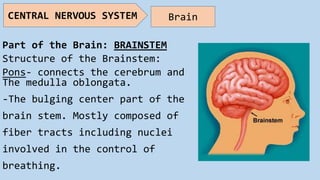
CENTRAL NERVOUS SYSTEM Brain
Part of the Brain: BRAINSTEM
Structure of the Brainstem:
Pons- connects the cerebrum and
The medulla oblongata.
-The bulging center part of the
brain stem. Mostly composed of
fiber tracts including nuclei
involved in the control of
breathing.
CENTRAL NERVOUS SYSTEM Brain
Brain Teaser
There is a town where all the people living
there have unlisted phone numbers. If you
selected 100 names at random from the town’s
phone directory, how many of these people
would have unlisted phone numbers?
0 They would not be in the phone book if
their number was unlisted
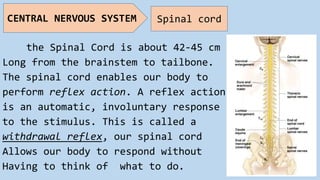
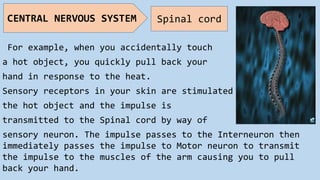
the Spinal Cord is about 42-45 cm
Long from the brainstem to tailbone.
The spinal cord enables our body to
perform reflex action. A reflex action
is an automatic, involuntary response
to the stimulus. This is called a
withdrawal reflex, our spinal cord
Allows our body to respond without
Having to think of what to do.
CENTRAL NERVOUS SYSTEM Spinal cord
BIO- TRIVIA
A nerve impulse can travel up to two
hundred fifty (50) miles per second. One
brain cell can communicate with 25,000
other brain cells.
For example, when you accidentally touch
a hot object, you quickly pull back your
hand in response to the heat.
Sensory receptors in your skin are stimulated by
the hot object and the impulse is
transmitted to the Spinal cord by way of
sensory neuron. The impulse passes to the Interneuron then
immediately passes the impulse to Motor neuron to transmit
the impulse to the muscles of the arm causing you to pull
back your hand.
CENTRAL NERVOUS SYSTEM Spinal cord
Divisions of the Nervous System
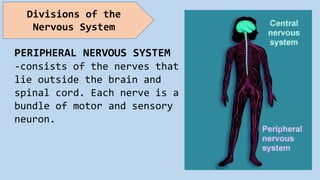
PERIPHERAL NERVOUS SYSTEM
-consists of the nerves that
lie outside the brain and
spinal cord. Each nerve is a
bundle of motor and sensory
neuron.
Divisions of the
Nervous System
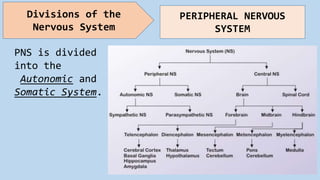
PNS is divided
into the
Autonomic and
Somatic System.
Divisions of the
Nervous System
PERIPHERAL NERVOUS
SYSTEM
Somatic System – consists of the cranial nerves (12
pairs) and spinal nerves (31 pairs) that control
voluntary muscles.
PERIPHERAL NERVOUS SYSTEM Somatic System
Autonomic System- consist of cranial nerves and
spinal nerves that control involuntary muscles.
Autonomic System is sub-divided into:
• Sympathetic System- works during emergency
situations that cause stress and require us to
fight or take flight
• Parasympathetic System- works during nonemergency
situation that allows us to rest and digest.
PERIPHERAL NERVOUS SYSTEM Autonomic System
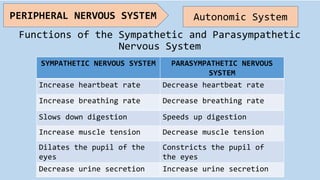
Functions of the Sympathetic and Parasympathetic
Nervous System
PERIPHERAL NERVOUS SYSTEM Autonomic System
SYMPATHETIC NERVOUS SYSTEM PARASYMPATHETIC NERVOUS
SYSTEM
Increase heartbeat rate Decrease heartbeat rate
Increase breathing rate Decrease breathing rate
Slows down digestion Speeds up digestion
Increase muscle tension Decrease muscle tension
Dilates the pupil of the
eyes
Constricts the pupil of
the eyes
Decrease urine secretion Increase urine secretion
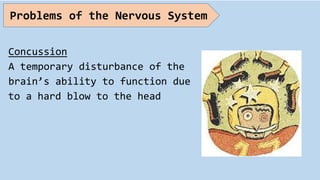
Concussion
A temporary disturbance of the
brain’s ability to function due
to a hard blow to the head
Problems of the Nervous System
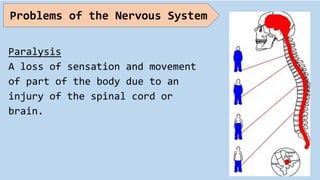
Paralysis
A loss of sensation and movement
of part of the body due to an
injury of the spinal cord or
brain.
Problems of the Nervous System
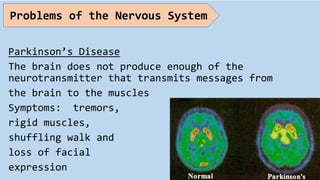
Parkinson’s Disease
The brain does not produce enough of the
neurotransmitter that transmits messages from
the brain to the muscles
Symptoms: tremors,
rigid muscles,
shuffling walk and
loss of facial
expression
Problems of the Nervous System
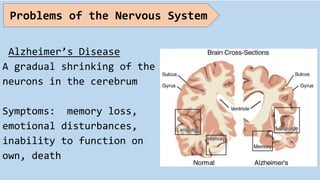
Alzheimer’s Disease
A gradual shrinking of the
neurons in the cerebrum
Symptoms: memory loss,
emotional disturbances,
inability to function on
own, death
Problems of the Nervous System
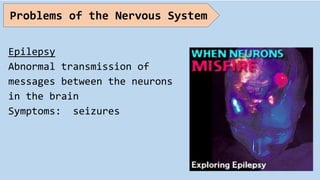
Epilepsy
Abnormal transmission of
messages between the neurons
in the brain
Symptoms: seizures
Problems of the Nervous System

Nervous

  • 1.
    Reporters: Ablanzar, Rachelmae Enilo, Shaira Fado,Jeralyn Ponan, Cristene Joy Robles, Jaypee Tuvillara, John Rovee The Nervous System
  • 2.
    Objectives At the endof the report, the students are expected to; • Describe the nervous system • Describe the structure of a neuron and how it conducts electrical impulses • Distinguish sensory, interneuron and motor neurons • Describe the parts and functions of the brain
  • 3.
    It is examinationtime. The room is so silent that you can almost hear your breathing. For almost an hour, you have been sitting there on your chair reading the questions, occasionally staring at the ceiling, and scribing your answer on your paper. You can feel your stomach churning and tension slowly building up in your neck and back muscles. Scene
  • 4.
    You look atyour watch and you have barely three minutes to finish your exam. In a haste, you review your paper and finalized your answers. As you race against time, your heartbeat and breathing becomes faster. Seconds later, the bell rings. You take a deep breath, stand up, and pass your paper to your teacher. Your heartbeat and breathing rates slowly return to normal. Scene
  • 5.
    The scene you’veread shows how your nervous system functions. Nervous System -a complex network of nerves and cells that carry messages to and from the brain and spinal cord to various parts of the body. The Nervous System makes you think, act, and feel. It enables your body to detect changes in the environment and causes it to respond and adjust itself.
  • 6.
    Brain Teaser If youwere running a race, and you passed the person in 2nd place, what place would you be in now? Second
  • 7.
    Neuron A neuron ornerve cell is the basic functional unit of the nervous system. Our nervous system contains hundreds of billions of neurons. A neuron consists of a cell body and several fibrous extensions called nerve fibers. 2 types of nerve fibers • Axons • Dendrites
  • 8.
    • Dendrites: branch-like extensionsthat receive impulses and carry them toward cell body. • Axon: single extension of the neuron that carries impulses away from the cell body. Some neurons have axons that are wrapped with a fatty membrane called myelin sheath. The myelin sheath is interrupted by gaps called nodes. Neurons
  • 9.
    Neurons do NOTtouch; there is a gap between them called a synapse Messages are sent across the synapses by special chemicals called neurotransmitters Neurons
  • 10.
    1. Sensory neurons transmitimpulses from sensory organs to the brain and spinal cord. 2. Interneurons – to process and interpret sensory input and decide if action is needed. 3. Motor neurons- conduct the impulses to the muscles or to glands through out the body, causing for response. Types of Neurons
  • 12.
    You saw your“crush”, structures in your eyes called receptors were stimulated. The stimulus traveled as an impulse in the sensory neurons toward the interneurons in your brain. Your brain processed the information and responded by sending back impulses along motor neurons to your muscles. Your heart began to beat faster and your breathing rate increased. Example
  • 13.
    In short, thethree types of neurons act like a relay team, passing information throughout the body from the moment the stimulus is received until response is made by the body.
  • 14.
    Brain Teaser A HI M N O T U V W Which of the letters above does not belong with the rest? N It is not a mirror-image of itself
  • 15.
    Divisions of theNervous System
  • 16.
    • Central NervousSystem (CNS) • Peripheral Nervous System (PNS) Divisions of the Nervous System
  • 17.
    CENTRAL NERVOUS SYSTEM -Consistsof the brain and spinal cord -Acts as body’s control center, coordinates body’s activities • Impulses travel through the neurons in your body to reach the brain Divisions of the Nervous System
  • 18.
    Brain is similarto computers in many ways. Computers send electrical signals through wires to control devices. Brain also sends electrical signals to our body parts through neurons. In an average human adult, the brain weighs from 1.3 to 1.4kg. Contains about 100 billion neurons and trillions of supporting cells called glia. CENTRAL NERVOUS SYSTEM Brain
  • 19.
    Parts of theBrain: Cerebrum frontal lobe parental lobe occipital lobe temporal lobe Cerebellum Brainstem CENTRAL NERVOUS SYSTEM Brain
  • 20.
    Part of theBrain: CEREBRUM -Largest part of the brain -Divided into two halves called hemispheres. The right hemisphere controls the left side of the body and the left hemisphere controls the right side of the body. When motor areas in one hemispheres are damaged, one side of the body may be paralyzed depending on the injury. CENTRAL NERVOUS SYSTEM Brain
  • 21.
    Parts of theBrain: Lobes of the Cerebrum Frontal Lobe- located in front of the central sulcus. Our frontal lobe is at work when we: talk move plan reason out solve problems CENTRAL NERVOUS SYSTEM Brain
  • 22.
    Parts of theBrain: Lobes of the Cerebrum Parental Lobe- located behind the central sulcus. Allows us to distinguish: sensations of touch pressure temperature pain CENTRAL NERVOUS SYSTEM Brain
  • 23.
    Parts of theBrain: Lobes of the Cerebrum Occipital Lobe- behind the parental lobe and at the back Of our brain. It is the center Of vision. Temporal Lobe- located below the lateral fissure. helps us to hear and recognize different sounds. CENTRAL NERVOUS SYSTEM Brain
  • 24.
    Part of theBrain: CEREBELLUM -located behind and under the cereb- rum -comes from Latin word for “little brain” -responsible for motor coordination, balance and posture. CENTRAL NERVOUS SYSTEM Brain
  • 25.
    Part of theBrain: BRAINSTEM -connects brain to spinal cord Structures of the Brainstem: thalamus, midbrain, medulla and pons CENTRAL NERVOUS SYSTEM Brain
  • 26.
    Part of theBrain: BRAINSTEM Structure of the Brainstem: Thalamus- acts as a messenger. It Receives sensory information and Relay it to the cerebral cortex. The cerebral cortex also sends Information to the thalamus. The Thalamus then transmit the info To other area of the brain and spinal cord. CENTRAL NERVOUS SYSTEM Brain
  • 27.
    Part of theBrain: BRAINSTEM Structure of the Brainstem: Midbrain or hypothalamus- is a Collection of specialized cells That are located in the lower Central portion of the brain. Responsible for the control of The body temperature, emotions And sensations like hunger and thirst. CENTRAL NERVOUS SYSTEM Brain
  • 28.
    Part of theBrain: BRAINSTEM Structure of the Brainstem: Medulla Oblongata- connected to The spinal cord. It regulates our And heartbeat rate. It also regu- Lates bloodflow in the blood Vessels by allowing their Contraction and expansion. CENTRAL NERVOUS SYSTEM Brain
  • 29.
    Part of theBrain: BRAINSTEM Structure of the Brainstem: Pons- connects the cerebrum and The medulla oblongata. -The bulging center part of the brain stem. Mostly composed of fiber tracts including nuclei involved in the control of breathing. CENTRAL NERVOUS SYSTEM Brain
  • 30.
    Brain Teaser There isa town where all the people living there have unlisted phone numbers. If you selected 100 names at random from the town’s phone directory, how many of these people would have unlisted phone numbers? 0 They would not be in the phone book if their number was unlisted
  • 31.
    the Spinal Cordis about 42-45 cm Long from the brainstem to tailbone. The spinal cord enables our body to perform reflex action. A reflex action is an automatic, involuntary response to the stimulus. This is called a withdrawal reflex, our spinal cord Allows our body to respond without Having to think of what to do. CENTRAL NERVOUS SYSTEM Spinal cord
  • 32.
    CENTRAL NERVOUS SYSTEMSpinal cord BIO- TRIVIA A nerve impulse can travel up to two hundred fifty (50) miles per second. One brain cell can communicate with 25,000 other brain cells.
  • 33.
    For example, whenyou accidentally touch a hot object, you quickly pull back your hand in response to the heat. Sensory receptors in your skin are stimulated by the hot object and the impulse is transmitted to the Spinal cord by way of sensory neuron. The impulse passes to the Interneuron then immediately passes the impulse to Motor neuron to transmit the impulse to the muscles of the arm causing you to pull back your hand. CENTRAL NERVOUS SYSTEM Spinal cord
  • 34.
    Divisions of theNervous System
  • 35.
    PERIPHERAL NERVOUS SYSTEM -consistsof the nerves that lie outside the brain and spinal cord. Each nerve is a bundle of motor and sensory neuron. Divisions of the Nervous System
  • 36.
    PNS is divided intothe Autonomic and Somatic System. Divisions of the Nervous System PERIPHERAL NERVOUS SYSTEM
  • 37.
    Somatic System –consists of the cranial nerves (12 pairs) and spinal nerves (31 pairs) that control voluntary muscles. PERIPHERAL NERVOUS SYSTEM Somatic System
  • 38.
    Autonomic System- consistof cranial nerves and spinal nerves that control involuntary muscles. Autonomic System is sub-divided into: • Sympathetic System- works during emergency situations that cause stress and require us to fight or take flight • Parasympathetic System- works during nonemergency situation that allows us to rest and digest. PERIPHERAL NERVOUS SYSTEM Autonomic System
  • 39.
    Functions of theSympathetic and Parasympathetic Nervous System PERIPHERAL NERVOUS SYSTEM Autonomic System SYMPATHETIC NERVOUS SYSTEM PARASYMPATHETIC NERVOUS SYSTEM Increase heartbeat rate Decrease heartbeat rate Increase breathing rate Decrease breathing rate Slows down digestion Speeds up digestion Increase muscle tension Decrease muscle tension Dilates the pupil of the eyes Constricts the pupil of the eyes Decrease urine secretion Increase urine secretion
  • 40.
    Concussion A temporary disturbanceof the brain’s ability to function due to a hard blow to the head Problems of the Nervous System
  • 41.
    Paralysis A loss ofsensation and movement of part of the body due to an injury of the spinal cord or brain. Problems of the Nervous System
  • 42.
    Parkinson’s Disease The braindoes not produce enough of the neurotransmitter that transmits messages from the brain to the muscles Symptoms: tremors, rigid muscles, shuffling walk and loss of facial expression Problems of the Nervous System
  • 43.
    Alzheimer’s Disease A gradualshrinking of the neurons in the cerebrum Symptoms: memory loss, emotional disturbances, inability to function on own, death Problems of the Nervous System
  • 44.
    Epilepsy Abnormal transmission of messagesbetween the neurons in the brain Symptoms: seizures Problems of the Nervous System