Control &
Coordination
The

Nervous System

Neurons
Central

Nervous System

Brain
•Spinal Cord
•

Peripheral

The

Senses

Nervous System
OO BODY

A collection of systems

SYSTEM

Several organs working together;
each system has one major role

ORGAN

A distinct body part that carries
out one or more main functions

TISSUE

A group of similar cells that
carry out a specialized job

CELL
ORGANELLE

The basic building block of all
living things, plant or animal
Specialized structures inside a
cell that have specific functions
Helps the body adjust to
changes in your environment
Stimulus
Any change inside or
outside your body that
brings about a response

Homeostasis
Regulation of steady
conditions inside the
body
Neurons
Building blocks of the nervous system
100 billion neurons in your brain alone
30,000 on a pinhead

They communicate with each other
thousands of times a second.
Bundles of neurons make up nerves


Central Nervous System =
Brain + Spinal Cord



Peripheral Nervous System =
Nerves to rest of body
3 Types of Nerve Cells
Sensory Neurons
Receive information form a sensory receptor
and send impulses to the CNS

Interneurons
Relay impulses from sensory neurons to
motor neurons

Motor Neurons
Carry impulse from the CNS to muscles and
glands through out the body
Parts of a
Neuron
3 MAIN PARTS
 Dendrites - receive
messages from other
neurons
 Cell Body – nucleus is
found here
 Axon - sends messages
to other neurons
Dendrites

Parts of a
Neuron

Cell Body

Axon
Space between each neuron
Neurotransmitters are the messengers that
travel across each synapse
They are chemical signals that neurons use to
talk to each other, which is what makes your
brain work. They help determine how you feel,
think and act.
Neurotransmitters
 Serotonin - involved in mood (such as helping you

to feel happy), sleep, mental health, blood pressure
and heartbeat.
 Dopamine - important in helping to regulate
physical movement, pleasure, and thought.
 Missing in patients with Parkinson's Disease.
Neurotransmitters
• Acetylcholine - involved in regulating
muscles, memory, mood, sleep, and
organs (like the heart).
– Lowered amounts associated with
Alzheimer’s Disease
Central Nervous System
(C.N.S.)
Cerebrum
 Largest part of the brain
 Interprets impulses from
the senses
Responsible for:
 thinking and learning
 creativity
 five senses
 memory and emotion
 problem-solving
 decisions
Cerebellum
 Coordinates voluntary
muscle movement
 Helps maintain balance
 When a ball is thrown to
you, the cerebellum
coordinates the proper
response to prevent injury
Brainstem
 Controls involuntary
actions
 Connects the brain to the
spinal cord
 Regulates heart rate,
breathing, swallowing,
blinking, and more
Made up of:
the midbrain
Pons
medulla
 Made up of bundles of
neurons
 Carries impulses to and
from the brain
 Together, the brain and
spinal cord make up the
Central Nervous System
(C.N.S.)
Fun fact:
 The spinal cord is about
45 cm long in men and 43
cm long in women.
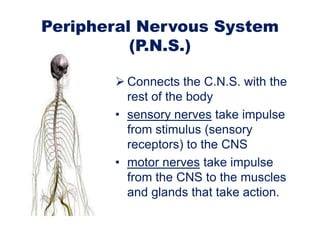
Peripheral Nervous System
(P.N.S.)
 Connects the C.N.S. with the
rest of the body
• sensory nerves take impulse
from stimulus (sensory
receptors) to the CNS
• motor nerves take impulse
from the CNS to the muscles
and glands that take action.
Reflex
 REFLEX
An involuntary, automatic response to a stimulus
controlled by the spinal cord
 Like when the doctor uses the rubber mallet on

your tendon below your knee
 Movement when someone unexpectedly throws
something at you
Reflex Arc
When the body receives a painful stimulus (stepping
on a nail, touching a hot surface, etc), the body
responds super-fast.

Path of reflex arc:
STIMULUS sensory receptor sensory nerve
spinal cord (interneuron) motor nerve
muscle RESPONSE
An impulse continues up to the brain to be interpreted by
the cerebrum, BUT, meanwhile the affected area has
already produced a response!
Senses
Vision
Sensory Receptors
Rods sense brightness
Cones sense color
The retina, in the back of your eye, has cells that
are sensitive to light. They connect directly to your
brain.
Senses
Hearing
 Sound waves make your
eardrum vibrate.
 Small bones in your ear
vibrate (hammer, anvil,
stirrup)
 Vibrations go through the
snail-like cochlea, which
turns them into nerve
impulses to your brain.
Taste
 10,000 taste buds in your
mouth
 Your tongue picks up four
types of taste:
•
•
•
•

sweet
sour
bitter
salty

 Sweet and salty are least
sensitive
 Bitter ones are most
sensitive

Senses
Senses
Smell
 Odor particles drift into your nose
 Stimulate sensory receptors –
olfactory cells – in nasal passages
 Sensory receptors send impulses
to your brain to be interpreted.
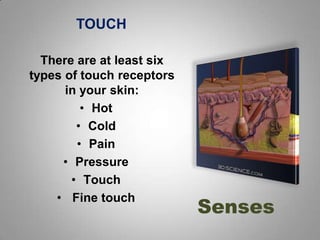
TOUCH
There are at least six
types of touch receptors
in your skin:
• Hot
• Cold
• Pain
• Pressure
• Touch
• Fine touch

Senses
Control and coordination, Brain and its functions

Control and coordination, Brain and its functions

  • 1.
  • 2.
    The Nervous System Neurons Central Nervous System Brain •SpinalCord • Peripheral The Senses Nervous System
  • 3.
    OO BODY A collectionof systems SYSTEM Several organs working together; each system has one major role ORGAN A distinct body part that carries out one or more main functions TISSUE A group of similar cells that carry out a specialized job CELL ORGANELLE The basic building block of all living things, plant or animal Specialized structures inside a cell that have specific functions
  • 4.
    Helps the bodyadjust to changes in your environment
  • 5.
    Stimulus Any change insideor outside your body that brings about a response Homeostasis Regulation of steady conditions inside the body
  • 6.
    Neurons Building blocks ofthe nervous system 100 billion neurons in your brain alone 30,000 on a pinhead They communicate with each other thousands of times a second. Bundles of neurons make up nerves
  • 7.
     Central Nervous System= Brain + Spinal Cord  Peripheral Nervous System = Nerves to rest of body
  • 8.
    3 Types ofNerve Cells Sensory Neurons Receive information form a sensory receptor and send impulses to the CNS Interneurons Relay impulses from sensory neurons to motor neurons Motor Neurons Carry impulse from the CNS to muscles and glands through out the body
  • 9.
    Parts of a Neuron 3MAIN PARTS  Dendrites - receive messages from other neurons  Cell Body – nucleus is found here  Axon - sends messages to other neurons
  • 10.
  • 12.
    Space between eachneuron Neurotransmitters are the messengers that travel across each synapse They are chemical signals that neurons use to talk to each other, which is what makes your brain work. They help determine how you feel, think and act.
  • 13.
    Neurotransmitters  Serotonin -involved in mood (such as helping you to feel happy), sleep, mental health, blood pressure and heartbeat.  Dopamine - important in helping to regulate physical movement, pleasure, and thought.  Missing in patients with Parkinson's Disease.
  • 14.
    Neurotransmitters • Acetylcholine -involved in regulating muscles, memory, mood, sleep, and organs (like the heart). – Lowered amounts associated with Alzheimer’s Disease
  • 15.
  • 16.
    Cerebrum  Largest partof the brain  Interprets impulses from the senses Responsible for:  thinking and learning  creativity  five senses  memory and emotion  problem-solving  decisions
  • 17.
    Cerebellum  Coordinates voluntary musclemovement  Helps maintain balance  When a ball is thrown to you, the cerebellum coordinates the proper response to prevent injury
  • 18.
    Brainstem  Controls involuntary actions Connects the brain to the spinal cord  Regulates heart rate, breathing, swallowing, blinking, and more Made up of: the midbrain Pons medulla
  • 19.
     Made upof bundles of neurons  Carries impulses to and from the brain  Together, the brain and spinal cord make up the Central Nervous System (C.N.S.) Fun fact:  The spinal cord is about 45 cm long in men and 43 cm long in women.
  • 20.
    Peripheral Nervous System (P.N.S.) Connects the C.N.S. with the rest of the body • sensory nerves take impulse from stimulus (sensory receptors) to the CNS • motor nerves take impulse from the CNS to the muscles and glands that take action.
  • 21.
    Reflex  REFLEX An involuntary,automatic response to a stimulus controlled by the spinal cord  Like when the doctor uses the rubber mallet on your tendon below your knee  Movement when someone unexpectedly throws something at you
  • 22.
    Reflex Arc When thebody receives a painful stimulus (stepping on a nail, touching a hot surface, etc), the body responds super-fast. Path of reflex arc: STIMULUS sensory receptor sensory nerve spinal cord (interneuron) motor nerve muscle RESPONSE An impulse continues up to the brain to be interpreted by the cerebrum, BUT, meanwhile the affected area has already produced a response!
  • 23.
    Senses Vision Sensory Receptors Rods sensebrightness Cones sense color The retina, in the back of your eye, has cells that are sensitive to light. They connect directly to your brain.
  • 24.
    Senses Hearing  Sound wavesmake your eardrum vibrate.  Small bones in your ear vibrate (hammer, anvil, stirrup)  Vibrations go through the snail-like cochlea, which turns them into nerve impulses to your brain.
  • 25.
    Taste  10,000 tastebuds in your mouth  Your tongue picks up four types of taste: • • • • sweet sour bitter salty  Sweet and salty are least sensitive  Bitter ones are most sensitive Senses
  • 26.
    Senses Smell  Odor particlesdrift into your nose  Stimulate sensory receptors – olfactory cells – in nasal passages  Sensory receptors send impulses to your brain to be interpreted.
  • 27.
    TOUCH There are atleast six types of touch receptors in your skin: • Hot • Cold • Pain • Pressure • Touch • Fine touch Senses