The Nervous System
Objectives
• To differentiate sensory division from motor
division.
• To learn the two divisions of nervous system.
• To compare and contrast sympathetic and
parasympathetic nervous system.
• To learn different types of neurons.
Basic Functions of the
Nervous System
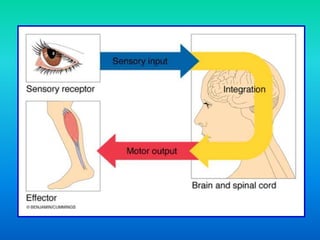
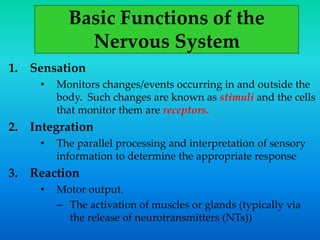
1. Sensation
• Monitors changes/events occurring in and outside the
body. Such changes are known as stimuli and the cells
that monitor them are receptors.
2. Integration
• The parallel processing and interpretation of sensory
information to determine the appropriate response
3. Reaction
• Motor output.
– The activation of muscles or glands (typically via
the release of neurotransmitters (NTs))
Nervous vs. Endocrine System
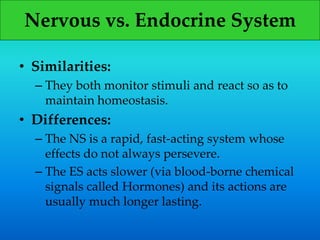
• Similarities:
– They both monitor stimuli and react so as to
maintain homeostasis.
• Differences:
– The NS is a rapid, fast-acting system whose
effects do not always persevere.
– The ES acts slower (via blood-borne chemical
signals called Hormones) and its actions are
usually much longer lasting.
Organization of the
Nervous System
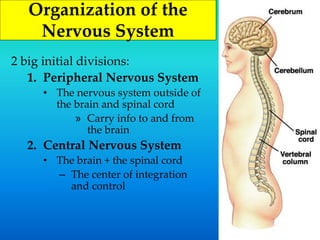
2 big initial divisions:
1. Peripheral Nervous System
• The nervous system outside of
the brain and spinal cord
» Carry info to and from
the brain
2. Central Nervous System
• The brain + the spinal cord
– The center of integration
and control
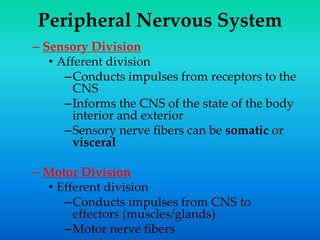
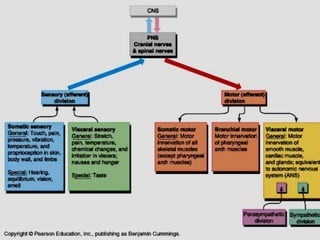
Peripheral Nervous System
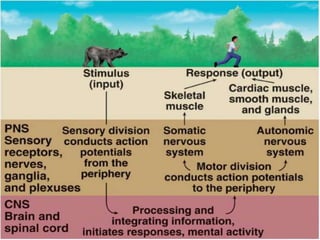
– Sensory Division
• Afferent division
–Conducts impulses from receptors to the
CNS
–Informs the CNS of the state of the body
interior and exterior
–Sensory nerve fibers can be somatic or
visceral
– Motor Division
• Efferent division
–Conducts impulses from CNS to
effectors (muscles/glands)
–Motor nerve fibers
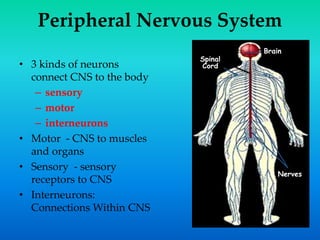
Peripheral Nervous System
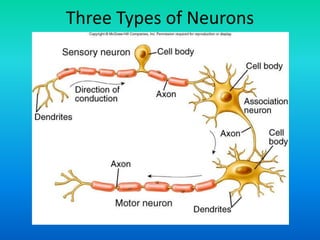
• 3 kinds of neurons
connect CNS to the body
– sensory
– motor
– interneurons
• Motor - CNS to muscles
and organs
• Sensory - sensory
receptors to CNS
• Interneurons:
Connections Within CNS
Spinal
Cord
Brain
Nerves
Three Types of Neurons
Motor Efferent Division
• Can be divided further:
– Somatic nervous system
• VOLUNTARY (generally)
• Somatic nerve fibers that conduct impulses from
the CNS to skeletal muscles
– Autonomic nervous system
• INVOLUNTARY (generally)
• Conducts impulses from the CNS to smooth
muscle, cardiac muscle, and glands.
Assignment
Peripheral Nervous System
Autonomic
- sympathetic
- parasympathetic
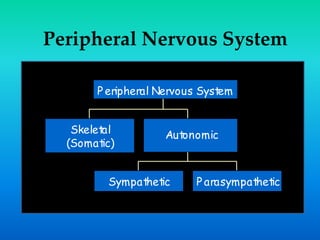
Peripheral Nervous System
Skeletal
(Somatic)
Sympathetic P arasympathetic
Autonomic
P eripheral Nervous System
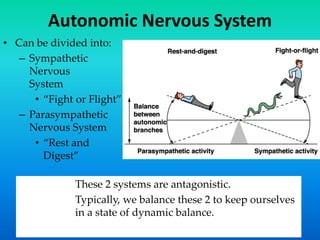
Autonomic Nervous System
• Can be divided into:
– Sympathetic
Nervous
System
• “Fight or Flight”
– Parasympathetic
Nervous System
• “Rest and
Digest”
These 2 systems are antagonistic.
Typically, we balance these 2 to keep ourselves
in a state of dynamic balance.
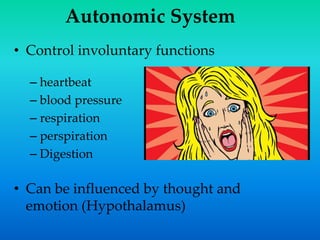
Autonomic System
• Control involuntary functions
– heartbeat
– blood pressure
– respiration
– perspiration
– Digestion
• Can be influenced by thought and
emotion (Hypothalamus)
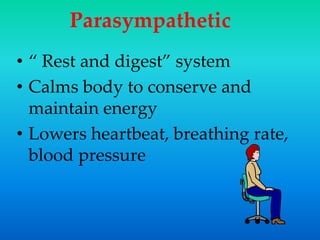
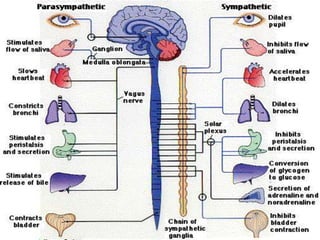
Parasympathetic
• “ Rest and digest” system
• Calms body to conserve and
maintain energy
• Lowers heartbeat, breathing rate,
blood pressure
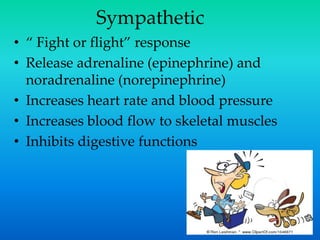
Sympathetic
• “ Fight or flight” response
• Release adrenaline (epinephrine) and
noradrenaline (norepinephrine)
• Increases heart rate and blood pressure
• Increases blood flow to skeletal muscles
• Inhibits digestive functions
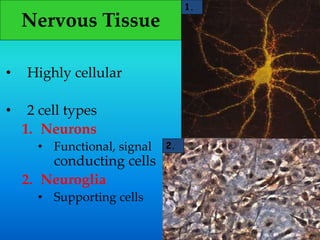
Nervous Tissue
• Highly cellular
• 2 cell types
1. Neurons
• Functional, signal
conducting cells
2. Neuroglia
• Supporting cells
1.
2.
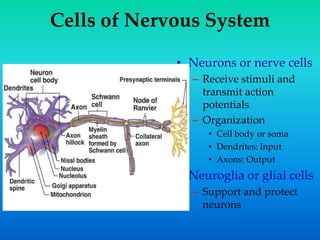
Cells of Nervous System
• Neurons or nerve cells
– Receive stimuli and
transmit action
potentials
– Organization
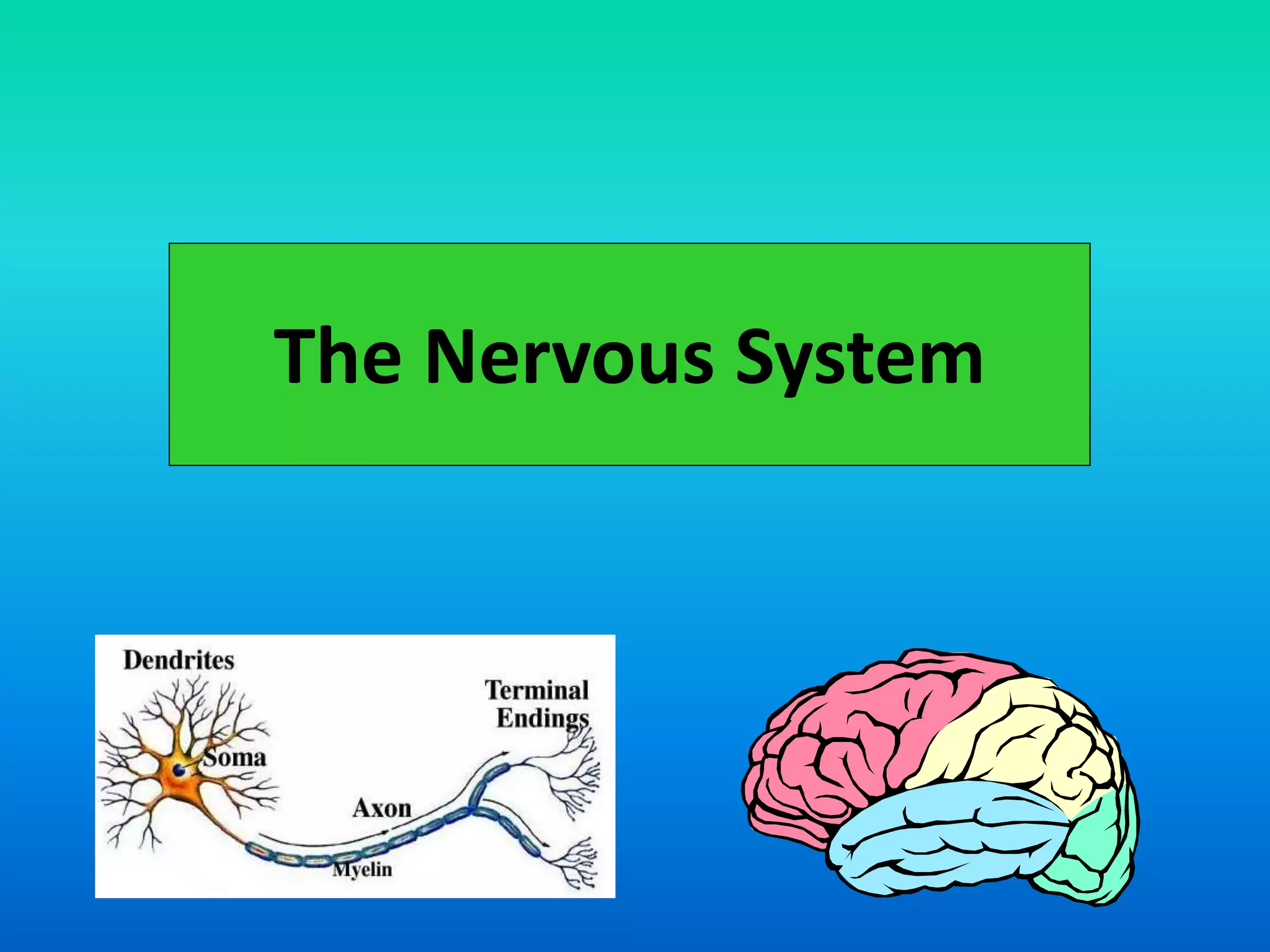
• Cell body or soma
• Dendrites: Input
• Axons: Output
• Neuroglia or glial cells
– Support and protect
neurons
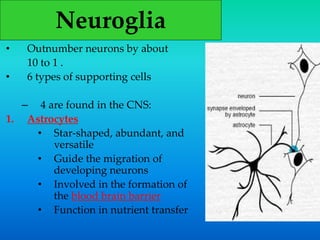
Neuroglia
• Outnumber neurons by about
10 to 1 .
• 6 types of supporting cells
– 4 are found in the CNS:
1. Astrocytes
• Star-shaped, abundant, and
versatile
• Guide the migration of
developing neurons
• Involved in the formation of
the blood brain barrier
• Function in nutrient transfer
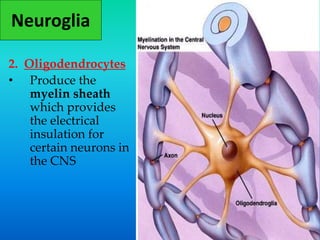
Neuroglia
2. Oligodendrocytes
• Produce the
myelin sheath
which provides
the electrical
insulation for
certain neurons in
the CNS
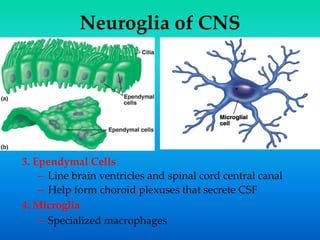
Neuroglia of CNS
3. Ependymal Cells
– Line brain ventricles and spinal cord central canal
– Help form choroid plexuses that secrete CSF
4. Microglia
– Specialized macrophages
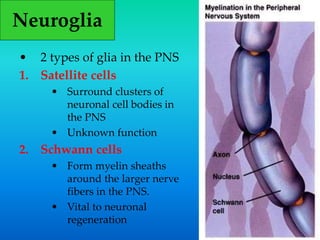
• 2 types of glia in the PNS
1. Satellite cells
• Surround clusters of
neuronal cell bodies in
the PNS
• Unknown function
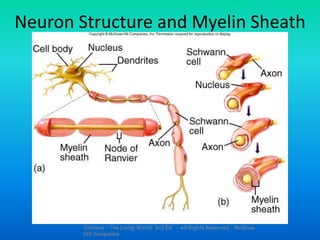
2. Schwann cells
• Form myelin sheaths
around the larger nerve
fibers in the PNS.
• Vital to neuronal
regeneration
Neuroglia
Johnson - The Living World: 3rd Ed. - All Rights Reserved - McGraw
Hill Companies
Neuron Structure and Myelin Sheath
Formation
Assignment:
Central Nervous System
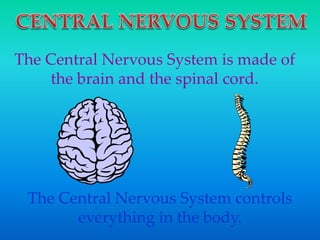
The Central Nervous System is made of
the brain and the spinal cord.
The Central Nervous System controls
everything in the body.
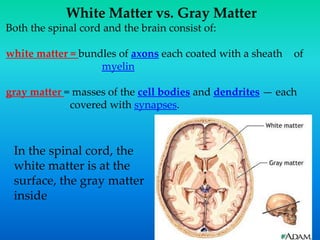
White Matter vs. Gray Matter
Both the spinal cord and the brain consist of:
white matter = bundles of axons each coated with a sheath of
myelin
gray matter = masses of the cell bodies and dendrites — each
covered with synapses.
In the spinal cord, the
white matter is at the
surface, the gray matter
inside
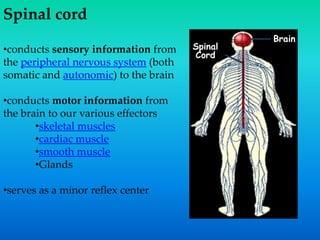
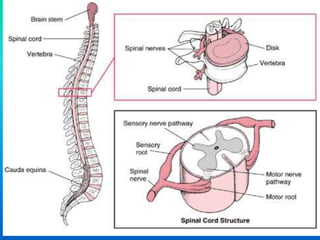
Spinal cord
•conducts sensory information from
the peripheral nervous system (both
somatic and autonomic) to the brain
•conducts motor information from
the brain to our various effectors
•skeletal muscles
•cardiac muscle
•smooth muscle
•Glands
•serves as a minor reflex center
Spinal
Cord
Brain
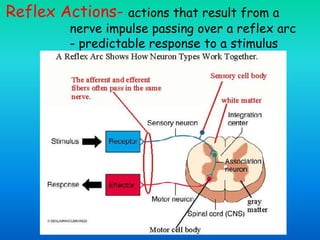
Reflex Actions- actions that result from a
nerve impulse passing over a reflex arc
- predictable response to a stimulus
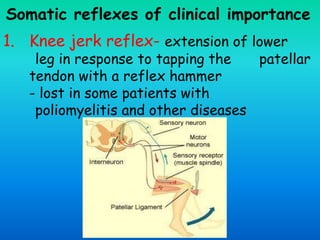
Somatic reflexes of clinical importance
1. Knee jerk reflex- extension of lower
leg in response to tapping the patellar
tendon with a reflex hammer
- lost in some patients with
poliomyelitis and other diseases
Effects:
1. Stretches the quadriceps muscles
2. Stimulates muscle spindles
3. Inhibits hamstring
+knee jerk- provides evidence that sensory and motor
connections between muscle and sipnal cord are
intact
Hypoactive-knee jerk
-due to peripheral nerve damage
-absent in those with chronic diabetes and
neurosyphilis and during coma
-hyperactive in polio and stroke patients
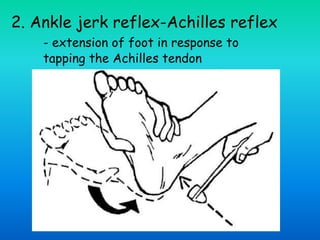
2. Ankle jerk reflex-Achilles reflex
- extension of foot in response to
tapping the Achilles tendon
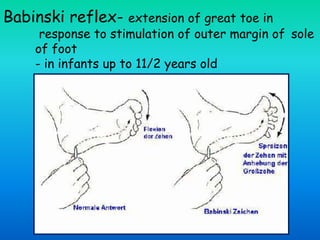
Babinski reflex- extension of great toe in
response to stimulation of outer margin of sole
of foot
- in infants up to 11/2 years old
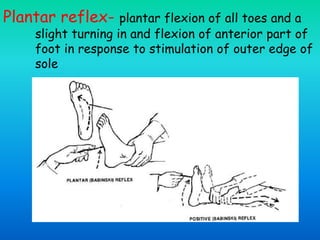
Plantar reflex- plantar flexion of all toes and a
slight turning in and flexion of anterior part of
foot in response to stimulation of outer edge of
sole
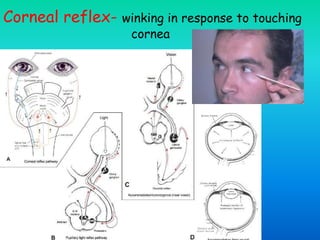
Corneal reflex- winking in response to touching
cornea
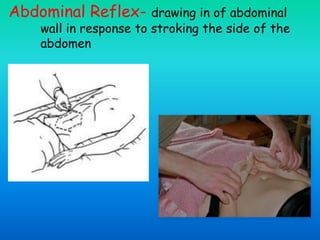
Abdominal Reflex- drawing in of abdominal
wall in response to stroking the side of the
abdomen
Assignment:
Brain
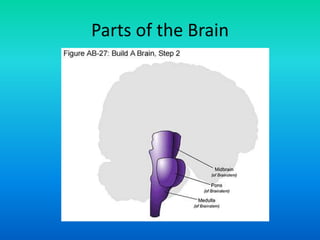
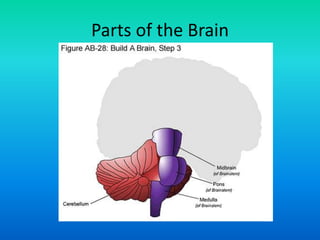
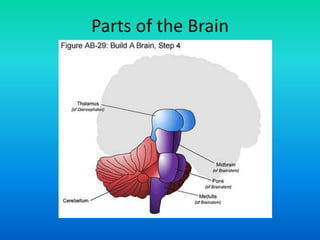
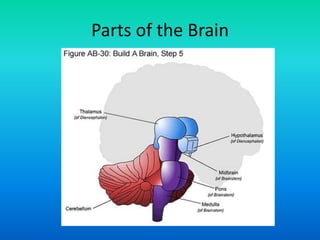
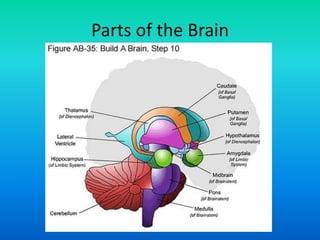
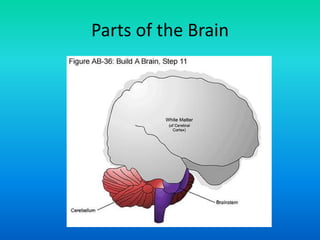
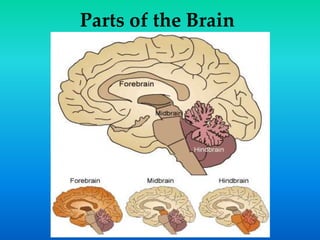
Parts of the Brain
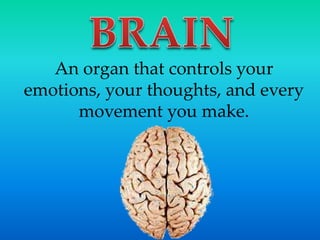
An organ that controls your
emotions, your thoughts, and every
movement you make.
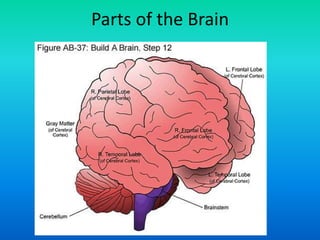
Parts of the Brain
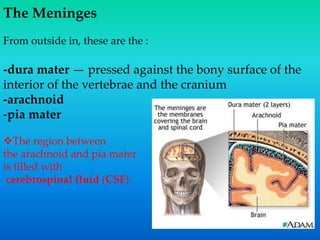
The Meninges
From outside in, these are the :
-dura mater — pressed against the bony surface of the
interior of the vertebrae and the cranium
-arachnoid
-pia mater
The region between
the arachnoid and pia mater
is filled with
cerebrospinal fluid (CSF).
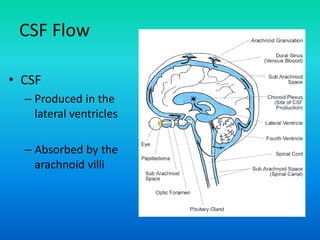
CSF Flow
• CSF
– Produced in the
lateral ventricles
– Absorbed by the
arachnoid villi
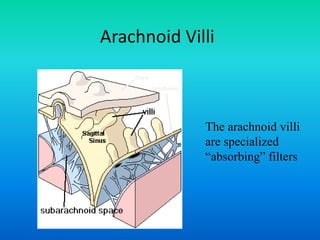
Arachnoid Villi
Arachnoid
Dura
The arachnoid villi
are specialized
“absorbing” filters
Brain Support
• Bone
– Face Attachment
– Holds CSF and Supports Meninges
• Meninges
– Main brain support
– Suspends, Compartmentalizes, and Coats
• Cerebrospinal Fluid
– In a bony container, allows dissipation of
sudden shocks (forces)
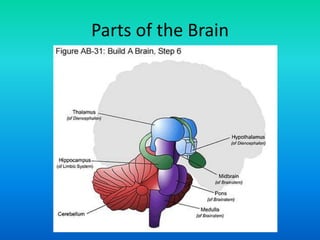
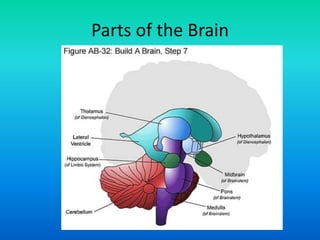
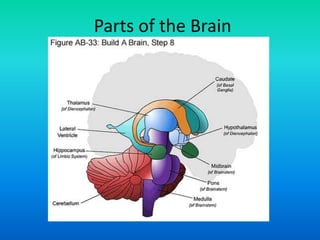
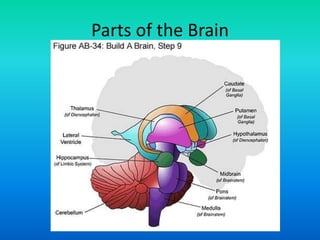
Parts of the Brain
Parts of the Brain
Parts of the Brain
Parts of the Brain
Parts of the Brain
Parts of the Brain
Parts of the Brain
Parts of the Brain
Parts of the Brain
Parts of the Brain
Parts of the Brain
Assignment:
Brain Stem
Cerebellum
Diencephalon
Prosencephalon
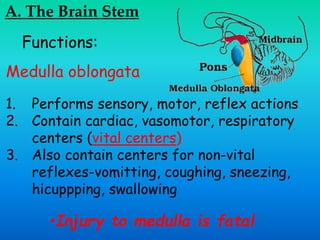
A. The Brain Stem
Functions:
Medulla oblongata
1. Performs sensory, motor, reflex actions
2. Contain cardiac, vasomotor, respiratory
centers (vital centers)
3. Also contain centers for non-vital
reflexes-vomitting, coughing, sneezing,
hicuppping, swallowing
•Injury to medulla is fatal
Medulla oblongata
Nerve impulses arising here rhythmically stimulate
the intercostal muscles and diaphragm — making
breathing possible.
•regulate heartbeat
•regulate the diameter of arterioles thus adjusting
blood flow.
The neurons controlling breathing have mu (µ)
receptors, the receptors to which opiates, like heroin,
bind. This accounts for the suppressive effect of opiates on
breathing. Destruction of the medulla causes instant
death
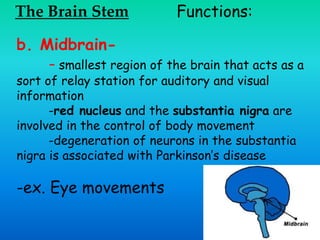
The Brain Stem Functions:
b. Midbrain-
- smallest region of the brain that acts as a
sort of relay station for auditory and visual
information
-red nucleus and the substantia nigra are
involved in the control of body movement
-degeneration of neurons in the substantia
nigra is associated with Parkinson’s disease
-ex. Eye movements
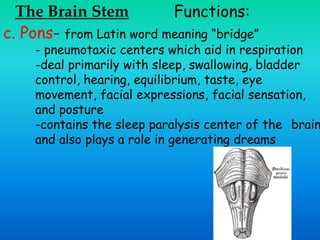
The Brain Stem Functions:
c. Pons- from Latin word meaning “bridge”
- pneumotaxic centers which aid in respiration
-deal primarily with sleep, swallowing, bladder
control, hearing, equilibrium, taste, eye
movement, facial expressions, facial sensation,
and posture
-contains the sleep paralysis center of the brain
and also plays a role in generating dreams
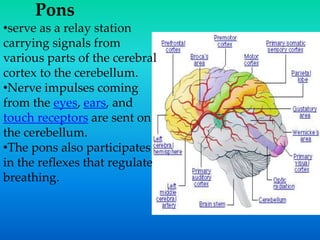
Pons
•serve as a relay station
carrying signals from
various parts of the cerebral
cortex to the cerebellum.
•Nerve impulses coming
from the eyes, ears, and
touch receptors are sent on
the cerebellum.
•The pons also participates
in the reflexes that regulate
breathing.
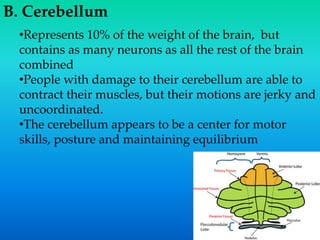
•Represents 10% of the weight of the brain, but
contains as many neurons as all the rest of the brain
combined
•People with damage to their cerebellum are able to
contract their muscles, but their motions are jerky and
uncoordinated.
•The cerebellum appears to be a center for motor
skills, posture and maintaining equilibrium
B. Cerebellum
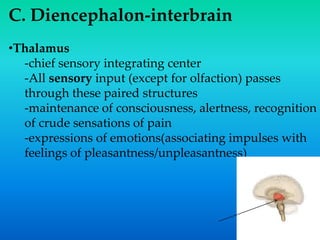
C. Diencephalon-interbrain
•Thalamus
-chief sensory integrating center
-All sensory input (except for olfaction) passes
through these paired structures
-maintenance of consciousness, alertness, recognition
of crude sensations of pain
-expressions of emotions(associating impulses with
feelings of pleasantness/unpleasantness)
Hypothalamus
- regulator/coordinator of autonomic
activities
•Damage to the hypothalamus is quickly fatal
as the normal homeostasis of body
temperature, blood chemistry, etc. goes out of
control.
• Posterior lobe of the pituitary.
Receives vasopressin (ADH) and oxytocin
from the hypothalamus and releases them
into the blood.
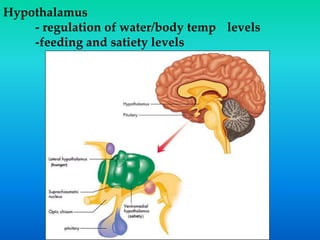
Hypothalamus
- regulation of water/body temp levels
-feeding and satiety levels
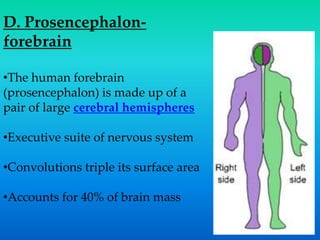
D. Prosencephalon-
forebrain
•The human forebrain
(prosencephalon) is made up of a
pair of large cerebral hemispheres
•Executive suite of nervous system
•Convolutions triple its surface area
•Accounts for 40% of brain mass
Assignment:
Functions of Cerebral Hemisphere
Association Areas
General Interpretation Areas
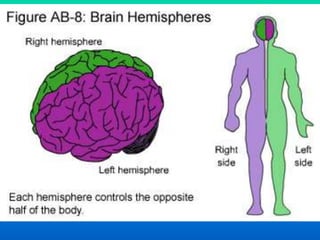
Right and Left Hemisphere
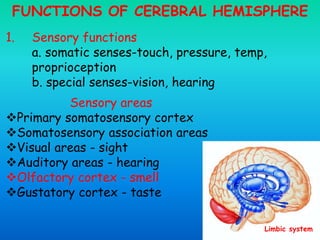
FUNCTIONS OF CEREBRAL HEMISPHERE
1. Sensory functions
a. somatic senses-touch, pressure, temp,
proprioception
b. special senses-vision, hearing
Sensory areas
Primary somatosensory cortex
Somatosensory association areas
Visual areas - sight
Auditory areas - hearing
Olfactory cortex - smell
Gustatory cortex - taste
Limbic system
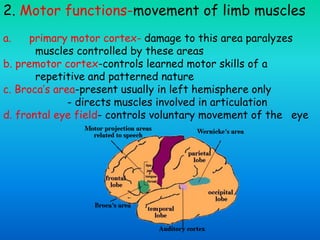
2. Motor functions-movement of limb muscles
a. primary motor cortex- damage to this area paralyzes
muscles controlled by these areas
b. premotor cortex-controls learned motor skills of a
repetitive and patterned nature
c. Broca’s area-present usually in left hemisphere only
- directs muscles involved in articulation
d. frontal eye field- controls voluntary movement of the eye
a. consciousness- state of awareness of one’s
environment and other beings
- depends on excitation of cortical neurons by impulses
from reticular activating system
b. language- ability to speak/write words and to
understand spoken/written words
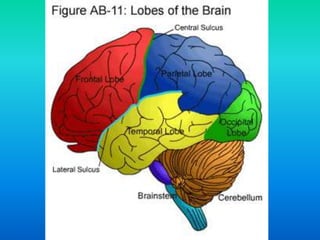
speech centers- frontal, parietal, temporal lobes
c. emotions- limbic system and cerebrum
-anger, fear, sexual feelings, sorrow etc
d. memory- for storing, retrieving information
-in temporal, parietal and occipital lobes
3. Integrative function
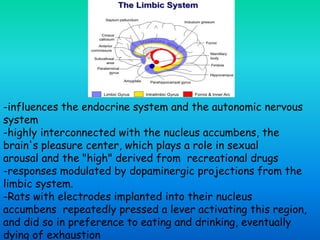
-influences the endocrine system and the autonomic nervous
system
-highly interconnected with the nucleus accumbens, the
brain's pleasure center, which plays a role in sexual
arousal and the "high" derived from recreational drugs
-responses modulated by dopaminergic projections from the
limbic system.
-Rats with electrodes implanted into their nucleus
accumbens repeatedly pressed a lever activating this region,
and did so in preference to eating and drinking, eventually
dying of exhaustion
1. ASSOCIATION AREAS-communicate with
primary sensory areas and with motor cortex to analyze,
recognize and act on sensory inputs
1. pre-frontal area- anterior portion of frontal lobes;
most complicated region
- involved with intellect, cognition and
personality
- abstract ideas, judgment, reason, persistence,
planning, concern for others and conscience
-develops slowly in children
-heavily dependent on +/- feedback from social
environment
-closely-linked to limbic system
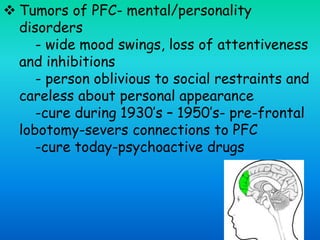
 Tumors of PFC- mental/personality
disorders
- wide mood swings, loss of attentiveness
and inhibitions
- person oblivious to social restraints and
careless about personal appearance
-cure during 1930’s – 1950’s- pre-frontal
lobotomy-severs connections to PFC
-cure today-psychoactive drugs
2. GENERAL INTERPRETATION AREA-
gnostic or ‘knowing’
-in one area usually left hemisphere
-receives inputs from sensory association areas
and integrates all incoming signals into a single
thought or understanding of the situation
- sends this assessment to PFC which adds
emotional overtones and decides on appropriate
response
-injury to gnostic area-one becomes an imbecile
bec one’s ability to interpret the entire situation is
lost
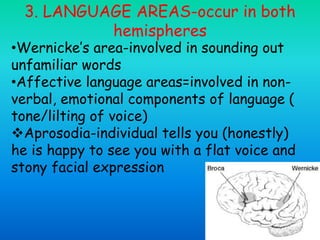
3. LANGUAGE AREAS-occur in both
hemispheres
•Wernicke’s area-involved in sounding out
unfamiliar words
•Affective language areas=involved in non-
verbal, emotional components of language (
tone/lilting of voice)
Aprosodia-individual tells you (honestly)
he is happy to see you with a flat voice and
stony facial expression
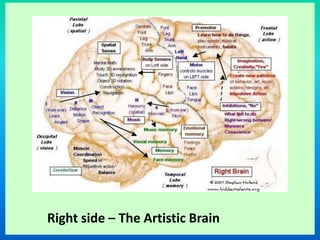
LATERALIZATION OF CORTICAL
FUNCTIONING
-‘split-brain concept’
-‘division of labor’
-Each hemisphere has unique abilities not shared by
the other
•Cerebral dominance-
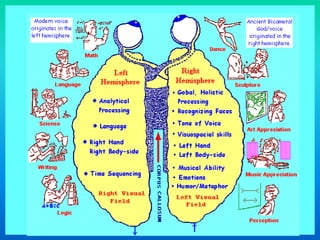
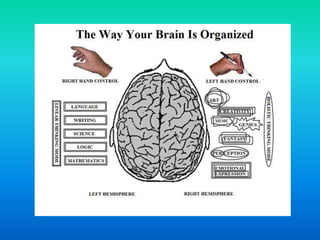
Left- dominant for language, math, logic
Right- visual/spatial skills, intuition, emotion and
appreciation of art and music
- the poetic, creative and insightful side of our
nature far better at recognizing faces
- right-dominant people are generally left-
handed and more often male
90% of individuals with left-cerebral
dominance are right-handed.
10%-roles of hemispheres are reversed or
they share functions equally
Results in cerebral confusion and learning
disabilities
Ambidexterity-mutuality of brain control
Dyslexia-due to lack of cerebral dominance
-people reverse order of letters or
syllables in words or words in sentences
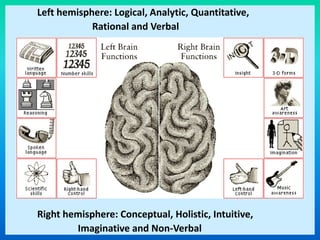
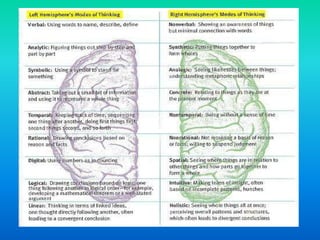
Left hemisphere: Logical, Analytic, Quantitative,
Rational and Verbal
Right hemisphere: Conceptual, Holistic, Intuitive,
Imaginative and Non-Verbal
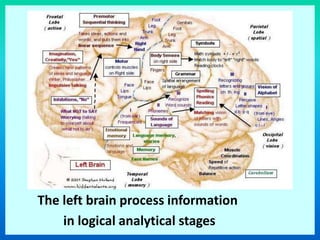
The left brain process information
in logical analytical stages
Right side – The Artistic Brain
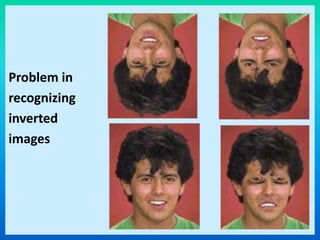
Are both smiling figures?
Problem in
recognizing
inverted
images
Are both smiling figures ?
Assignment
Disorders of the CNS
Disorders of the PNS
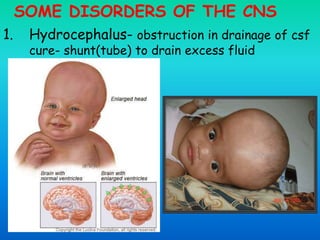
SOME DISORDERS OF THE CNS
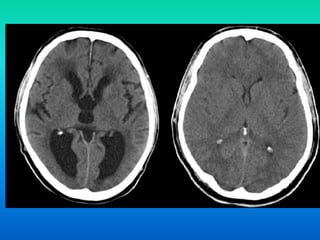
1. Hydrocephalus- obstruction in drainage of csf
cure- shunt(tube) to drain excess fluid
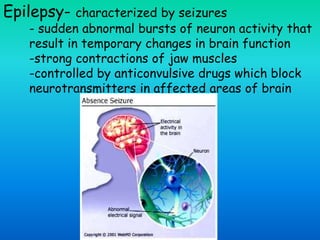
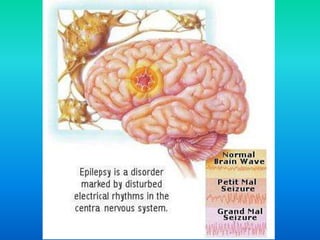
Epilepsy- characterized by seizures
- sudden abnormal bursts of neuron activity that
result in temporary changes in brain function
-strong contractions of jaw muscles
-controlled by anticonvulsive drugs which block
neurotransmitters in affected areas of brain
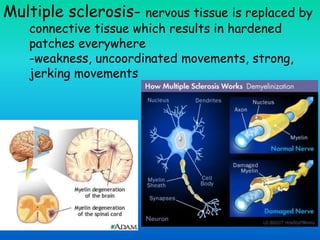
Multiple sclerosis- nervous tissue is replaced by
connective tissue which results in hardened
patches everywhere
-weakness, uncoordinated movements, strong,
jerking movements
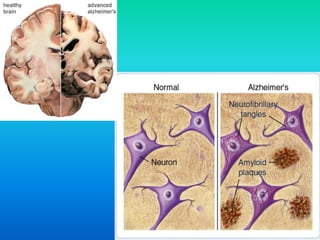
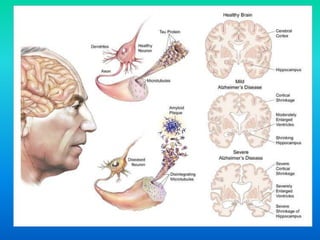
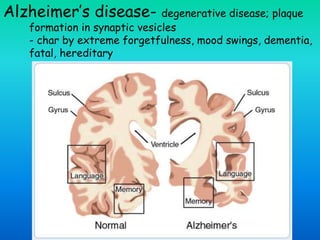
Alzheimer’s disease- degenerative disease; plaque
formation in synaptic vesicles
- char by extreme forgetfulness, mood swings, dementia,
fatal, hereditary
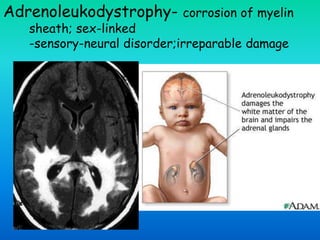
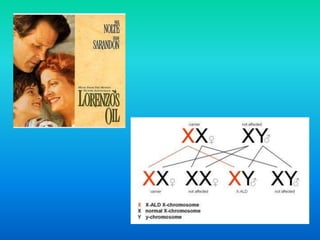
Adrenoleukodystrophy- corrosion of myelin
sheath; sex-linked
-sensory-neural disorder;irreparable damage
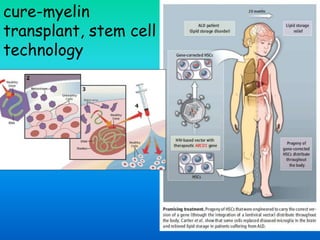
cure-myelin
transplant, stem cell
technology
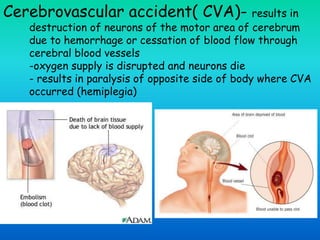
Cerebrovascular accident( CVA)- results in
destruction of neurons of the motor area of cerebrum
due to hemorrhage or cessation of blood flow through
cerebral blood vessels
-oxygen supply is disrupted and neurons die
- results in paralysis of opposite side of body where CVA
occurred (hemiplegia)
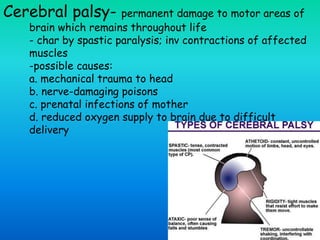
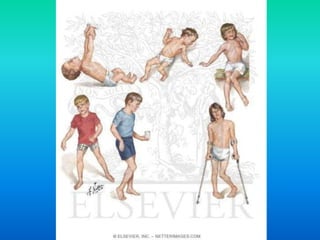
Cerebral palsy- permanent damage to motor areas of
brain which remains throughout life
- char by spastic paralysis; inv contractions of affected
muscles
-possible causes:
a. mechanical trauma to head
b. nerve-damaging poisons
c. prenatal infections of mother
d. reduced oxygen supply to brain due to difficult
delivery
End
Status-----nganga
Ion Movements in a Neuron
• K+
– [K+] higher inside cell than outside
– Attracted to fixed anions inside cell
– High membrane permeability
– Flows slowly out of cell
• Na+
– [Na+] higher outside cell than inside
– Attracted to fixed anions inside cell
– Low membrane permeability
– Flows slowly into cell
Resting Potentials
• Resting potential
– Typical membrane potential for
cells
– Depends on concentration
gradients and membrane
permeabilities for different ions
involved
– -65 to -85 mV
– [Na+] and [K+] inside the cell are
maintained using Na+/K+ pumps
ICF (-)ECF (+)
Na/K pump
Neuronal Physiology
Graded Potentials
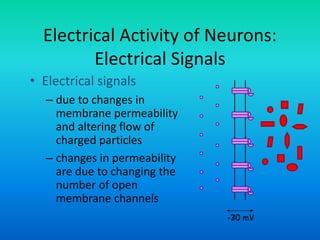
Electrical Activity of Neurons:
Electrical Signals
• Electrical signals
– due to changes in
membrane permeability
and altering flow of
charged particles
– changes in permeability
are due to changing the
number of open
membrane channels
-70 mV-30 mV
Membrane Proteins Involved in
Electrical Signals
• Non-gated ion channels (leak channels)
– always open
– specific for a particular ion
• Gated Ion channels
– open only under particular conditions (stimulus)
– voltage-gated, ligand-gated, stress-gated
• Ion pumps
– active (require ATP)
– maintain ion gradients
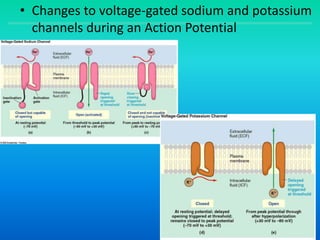
• Changes to voltage-gated sodium and potassium
channels during an Action Potential
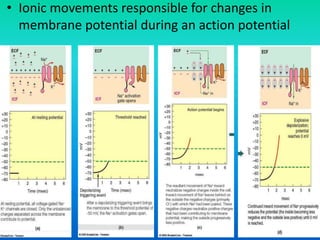
• Ionic movements responsible for changes in
membrane potential during an action potential
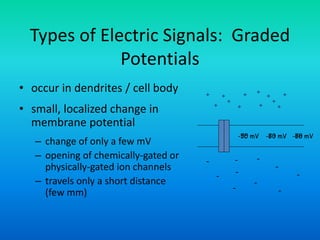
Types of Electric Signals: Graded
Potentials
• occur in dendrites / cell body
• small, localized change in
membrane potential
– change of only a few mV
– opening of chemically-gated or
physically-gated ion channels
– travels only a short distance
(few mm)
+
+
+
++
+
-
-
-
- -
-
-
+
+
+
++
+
-
-
-
-70 mV -70 mV -70 mV-55 mV -63 mV -68 mV
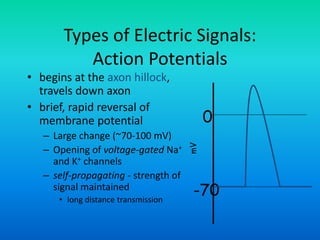
Types of Electric Signals:
Action Potentials
• begins at the axon hillock,
travels down axon
• brief, rapid reversal of
membrane potential
– Large change (~70-100 mV)
– Opening of voltage-gated Na+
and K+ channels
– self-propagating - strength of
signal maintained
• long distance transmission
mV
0
-70
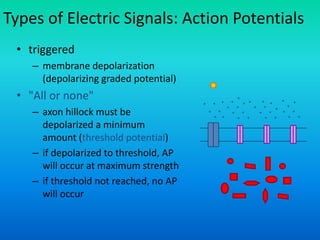
Types of Electric Signals: Action Potentials
• triggered
– membrane depolarization
(depolarizing graded potential)
• "All or none"
– axon hillock must be
depolarized a minimum
amount (threshold potential)
– if depolarized to threshold, AP
will occur at maximum strength
– if threshold not reached, no AP
will occur
+
+
+
+
+
+
+
+
+
+
+ +
+
+
+
+
+
+
+
+
+
+
+
+
+
+
+
+
+
+
+
+ +
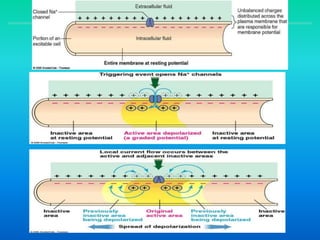
• Triggering event (graded potential) causes membrane to
depolarize
• slow increase until threshold is reached
Action Potential:Depolarization
mV
0
-70
+30
threshold
• voltage-gated Na+ channels open
– Na+ enters cell → further depolarization → more channels open → further
depolarization
• membrane reverses polarity (+30 mV)
• K+ channels close
• [Na+] and [K+] restored by the Na+-K+ pump
• K+ rushes out of the cell
– membrane potential restored
• Na+ channels close
• Delayed opening of voltage-gated K+ channels
Action Potential: Repolarization
Action Potential Propagation:
Myelinated Axons
• myelin - lipid insulator
–membranes of certain glial cells
• Nodes of Ranvier contain lots of Na+ channels
• Saltatory conduction
–signals “jump” from one node to the next
–AP conduction speed 50-100x
• Vertebrates tend to have more myelinated
axons than invertebrates
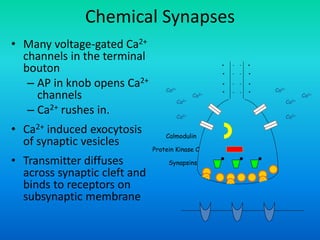
Chemical Synapses
• Many voltage-gated Ca2+
channels in the terminal
bouton
– AP in knob opens Ca2+
channels
– Ca2+ rushes in.
• Ca2+ induced exocytosis
of synaptic vesicles
• Transmitter diffuses
across synaptic cleft and
binds to receptors on
subsynaptic membrane
Ca2+
Ca2+
Ca2+
Ca2+
Ca2+
Ca2+
Ca2+
Ca2+
Calmodulin
Protein Kinase C
Synapsins
+
+
+
+
+
+
+
+ --
--
--
--
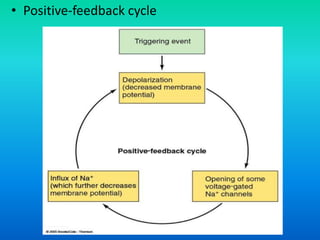
• Positive-feedback cycle
Johnson - The Living World: 3rd Ed. - All Rights Reserved - McGraw
Hill Companies
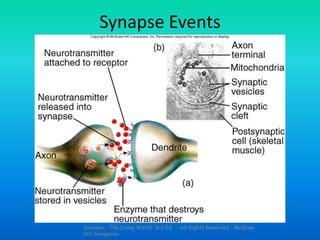
Synapse Events
Drug Addiction
• When a cell is exposed to a chemical signal for a
prolonged period, it tends to lose ability to
respond with its original intensity.
– If receptor proteins within synapses are exposed to
high levels of neurotransmitter molecules for
prolonged periods, the nerve cell often responds by
inserting fewer receptor proteins into the membrane.
Drug Addiction
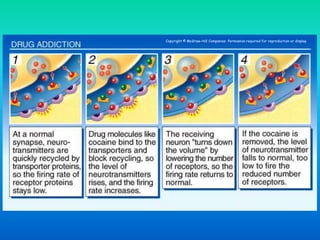
• Cocaine
– Neuromodulator (prolongs transmission of signal
across synapse) that causes large amounts of
neurotransmitters to remain in synapses for long
periods of time.
• Transmit pleasure messages using the
neurotransmitter dopamine.
–Nerve cells may eventually lower the number of
receptor proteins on surface.
Copyright © McGraw-Hill Companies Permission required for reproduction or display

6. nervous system

  • 1.
  • 2.
    Objectives • To differentiatesensory division from motor division. • To learn the two divisions of nervous system. • To compare and contrast sympathetic and parasympathetic nervous system. • To learn different types of neurons.
  • 5.
    Basic Functions ofthe Nervous System 1. Sensation • Monitors changes/events occurring in and outside the body. Such changes are known as stimuli and the cells that monitor them are receptors. 2. Integration • The parallel processing and interpretation of sensory information to determine the appropriate response 3. Reaction • Motor output. – The activation of muscles or glands (typically via the release of neurotransmitters (NTs))
  • 6.
    Nervous vs. EndocrineSystem • Similarities: – They both monitor stimuli and react so as to maintain homeostasis. • Differences: – The NS is a rapid, fast-acting system whose effects do not always persevere. – The ES acts slower (via blood-borne chemical signals called Hormones) and its actions are usually much longer lasting.
  • 7.
    Organization of the NervousSystem 2 big initial divisions: 1. Peripheral Nervous System • The nervous system outside of the brain and spinal cord » Carry info to and from the brain 2. Central Nervous System • The brain + the spinal cord – The center of integration and control
  • 8.
    Peripheral Nervous System –Sensory Division • Afferent division –Conducts impulses from receptors to the CNS –Informs the CNS of the state of the body interior and exterior –Sensory nerve fibers can be somatic or visceral – Motor Division • Efferent division –Conducts impulses from CNS to effectors (muscles/glands) –Motor nerve fibers
  • 9.
    Peripheral Nervous System •3 kinds of neurons connect CNS to the body – sensory – motor – interneurons • Motor - CNS to muscles and organs • Sensory - sensory receptors to CNS • Interneurons: Connections Within CNS Spinal Cord Brain Nerves
  • 10.
  • 11.
    Motor Efferent Division •Can be divided further: – Somatic nervous system • VOLUNTARY (generally) • Somatic nerve fibers that conduct impulses from the CNS to skeletal muscles – Autonomic nervous system • INVOLUNTARY (generally) • Conducts impulses from the CNS to smooth muscle, cardiac muscle, and glands.
  • 12.
  • 13.
    Peripheral Nervous System Skeletal (Somatic) SympatheticP arasympathetic Autonomic P eripheral Nervous System
  • 14.
    Autonomic Nervous System •Can be divided into: – Sympathetic Nervous System • “Fight or Flight” – Parasympathetic Nervous System • “Rest and Digest” These 2 systems are antagonistic. Typically, we balance these 2 to keep ourselves in a state of dynamic balance.
  • 15.
    Autonomic System • Controlinvoluntary functions – heartbeat – blood pressure – respiration – perspiration – Digestion • Can be influenced by thought and emotion (Hypothalamus)
  • 16.
    Parasympathetic • “ Restand digest” system • Calms body to conserve and maintain energy • Lowers heartbeat, breathing rate, blood pressure
  • 17.
    Sympathetic • “ Fightor flight” response • Release adrenaline (epinephrine) and noradrenaline (norepinephrine) • Increases heart rate and blood pressure • Increases blood flow to skeletal muscles • Inhibits digestive functions
  • 20.
    Nervous Tissue • Highlycellular • 2 cell types 1. Neurons • Functional, signal conducting cells 2. Neuroglia • Supporting cells 1. 2.
  • 21.
    Cells of NervousSystem • Neurons or nerve cells – Receive stimuli and transmit action potentials – Organization • Cell body or soma • Dendrites: Input • Axons: Output • Neuroglia or glial cells – Support and protect neurons
  • 22.
    Neuroglia • Outnumber neuronsby about 10 to 1 . • 6 types of supporting cells – 4 are found in the CNS: 1. Astrocytes • Star-shaped, abundant, and versatile • Guide the migration of developing neurons • Involved in the formation of the blood brain barrier • Function in nutrient transfer
  • 23.
    Neuroglia 2. Oligodendrocytes • Producethe myelin sheath which provides the electrical insulation for certain neurons in the CNS
  • 24.
    Neuroglia of CNS 3.Ependymal Cells – Line brain ventricles and spinal cord central canal – Help form choroid plexuses that secrete CSF 4. Microglia – Specialized macrophages
  • 25.
    • 2 typesof glia in the PNS 1. Satellite cells • Surround clusters of neuronal cell bodies in the PNS • Unknown function 2. Schwann cells • Form myelin sheaths around the larger nerve fibers in the PNS. • Vital to neuronal regeneration Neuroglia
  • 26.
    Johnson - TheLiving World: 3rd Ed. - All Rights Reserved - McGraw Hill Companies Neuron Structure and Myelin Sheath Formation
  • 27.
  • 28.
    The Central NervousSystem is made of the brain and the spinal cord. The Central Nervous System controls everything in the body.
  • 29.
    White Matter vs.Gray Matter Both the spinal cord and the brain consist of: white matter = bundles of axons each coated with a sheath of myelin gray matter = masses of the cell bodies and dendrites — each covered with synapses. In the spinal cord, the white matter is at the surface, the gray matter inside
  • 30.
    Spinal cord •conducts sensoryinformation from the peripheral nervous system (both somatic and autonomic) to the brain •conducts motor information from the brain to our various effectors •skeletal muscles •cardiac muscle •smooth muscle •Glands •serves as a minor reflex center Spinal Cord Brain
  • 32.
    Reflex Actions- actionsthat result from a nerve impulse passing over a reflex arc - predictable response to a stimulus
  • 33.
    Somatic reflexes ofclinical importance 1. Knee jerk reflex- extension of lower leg in response to tapping the patellar tendon with a reflex hammer - lost in some patients with poliomyelitis and other diseases
  • 34.
    Effects: 1. Stretches thequadriceps muscles 2. Stimulates muscle spindles 3. Inhibits hamstring +knee jerk- provides evidence that sensory and motor connections between muscle and sipnal cord are intact Hypoactive-knee jerk -due to peripheral nerve damage -absent in those with chronic diabetes and neurosyphilis and during coma -hyperactive in polio and stroke patients
  • 35.
    2. Ankle jerkreflex-Achilles reflex - extension of foot in response to tapping the Achilles tendon
  • 36.
    Babinski reflex- extensionof great toe in response to stimulation of outer margin of sole of foot - in infants up to 11/2 years old
  • 37.
    Plantar reflex- plantarflexion of all toes and a slight turning in and flexion of anterior part of foot in response to stimulation of outer edge of sole
  • 38.
    Corneal reflex- winkingin response to touching cornea
  • 39.
    Abdominal Reflex- drawingin of abdominal wall in response to stroking the side of the abdomen
  • 40.
  • 41.
    An organ thatcontrols your emotions, your thoughts, and every movement you make.
  • 42.
  • 43.
    The Meninges From outsidein, these are the : -dura mater — pressed against the bony surface of the interior of the vertebrae and the cranium -arachnoid -pia mater The region between the arachnoid and pia mater is filled with cerebrospinal fluid (CSF).
  • 44.
    CSF Flow • CSF –Produced in the lateral ventricles – Absorbed by the arachnoid villi
  • 45.
    Arachnoid Villi Arachnoid Dura The arachnoidvilli are specialized “absorbing” filters
  • 46.
    Brain Support • Bone –Face Attachment – Holds CSF and Supports Meninges • Meninges – Main brain support – Suspends, Compartmentalizes, and Coats • Cerebrospinal Fluid – In a bony container, allows dissipation of sudden shocks (forces)
  • 47.
  • 48.
  • 49.
  • 50.
  • 51.
  • 52.
  • 53.
  • 54.
  • 55.
  • 56.
  • 57.
  • 58.
  • 59.
    A. The BrainStem Functions: Medulla oblongata 1. Performs sensory, motor, reflex actions 2. Contain cardiac, vasomotor, respiratory centers (vital centers) 3. Also contain centers for non-vital reflexes-vomitting, coughing, sneezing, hicuppping, swallowing •Injury to medulla is fatal
  • 60.
    Medulla oblongata Nerve impulsesarising here rhythmically stimulate the intercostal muscles and diaphragm — making breathing possible. •regulate heartbeat •regulate the diameter of arterioles thus adjusting blood flow. The neurons controlling breathing have mu (µ) receptors, the receptors to which opiates, like heroin, bind. This accounts for the suppressive effect of opiates on breathing. Destruction of the medulla causes instant death
  • 61.
    The Brain StemFunctions: b. Midbrain- - smallest region of the brain that acts as a sort of relay station for auditory and visual information -red nucleus and the substantia nigra are involved in the control of body movement -degeneration of neurons in the substantia nigra is associated with Parkinson’s disease -ex. Eye movements
  • 62.
    The Brain StemFunctions: c. Pons- from Latin word meaning “bridge” - pneumotaxic centers which aid in respiration -deal primarily with sleep, swallowing, bladder control, hearing, equilibrium, taste, eye movement, facial expressions, facial sensation, and posture -contains the sleep paralysis center of the brain and also plays a role in generating dreams
  • 63.
    Pons •serve as arelay station carrying signals from various parts of the cerebral cortex to the cerebellum. •Nerve impulses coming from the eyes, ears, and touch receptors are sent on the cerebellum. •The pons also participates in the reflexes that regulate breathing.
  • 64.
    •Represents 10% ofthe weight of the brain, but contains as many neurons as all the rest of the brain combined •People with damage to their cerebellum are able to contract their muscles, but their motions are jerky and uncoordinated. •The cerebellum appears to be a center for motor skills, posture and maintaining equilibrium B. Cerebellum
  • 65.
    C. Diencephalon-interbrain •Thalamus -chief sensoryintegrating center -All sensory input (except for olfaction) passes through these paired structures -maintenance of consciousness, alertness, recognition of crude sensations of pain -expressions of emotions(associating impulses with feelings of pleasantness/unpleasantness)
  • 66.
    Hypothalamus - regulator/coordinator ofautonomic activities •Damage to the hypothalamus is quickly fatal as the normal homeostasis of body temperature, blood chemistry, etc. goes out of control. • Posterior lobe of the pituitary. Receives vasopressin (ADH) and oxytocin from the hypothalamus and releases them into the blood.
  • 67.
    Hypothalamus - regulation ofwater/body temp levels -feeding and satiety levels
  • 68.
    D. Prosencephalon- forebrain •The humanforebrain (prosencephalon) is made up of a pair of large cerebral hemispheres •Executive suite of nervous system •Convolutions triple its surface area •Accounts for 40% of brain mass
  • 71.
    Assignment: Functions of CerebralHemisphere Association Areas General Interpretation Areas Right and Left Hemisphere
  • 72.
    FUNCTIONS OF CEREBRALHEMISPHERE 1. Sensory functions a. somatic senses-touch, pressure, temp, proprioception b. special senses-vision, hearing Sensory areas Primary somatosensory cortex Somatosensory association areas Visual areas - sight Auditory areas - hearing Olfactory cortex - smell Gustatory cortex - taste Limbic system
  • 73.
    2. Motor functions-movementof limb muscles a. primary motor cortex- damage to this area paralyzes muscles controlled by these areas b. premotor cortex-controls learned motor skills of a repetitive and patterned nature c. Broca’s area-present usually in left hemisphere only - directs muscles involved in articulation d. frontal eye field- controls voluntary movement of the eye
  • 74.
    a. consciousness- stateof awareness of one’s environment and other beings - depends on excitation of cortical neurons by impulses from reticular activating system b. language- ability to speak/write words and to understand spoken/written words speech centers- frontal, parietal, temporal lobes c. emotions- limbic system and cerebrum -anger, fear, sexual feelings, sorrow etc d. memory- for storing, retrieving information -in temporal, parietal and occipital lobes 3. Integrative function
  • 75.
    -influences the endocrinesystem and the autonomic nervous system -highly interconnected with the nucleus accumbens, the brain's pleasure center, which plays a role in sexual arousal and the "high" derived from recreational drugs -responses modulated by dopaminergic projections from the limbic system. -Rats with electrodes implanted into their nucleus accumbens repeatedly pressed a lever activating this region, and did so in preference to eating and drinking, eventually dying of exhaustion
  • 76.
    1. ASSOCIATION AREAS-communicatewith primary sensory areas and with motor cortex to analyze, recognize and act on sensory inputs 1. pre-frontal area- anterior portion of frontal lobes; most complicated region - involved with intellect, cognition and personality - abstract ideas, judgment, reason, persistence, planning, concern for others and conscience -develops slowly in children -heavily dependent on +/- feedback from social environment -closely-linked to limbic system
  • 77.
     Tumors ofPFC- mental/personality disorders - wide mood swings, loss of attentiveness and inhibitions - person oblivious to social restraints and careless about personal appearance -cure during 1930’s – 1950’s- pre-frontal lobotomy-severs connections to PFC -cure today-psychoactive drugs
  • 78.
    2. GENERAL INTERPRETATIONAREA- gnostic or ‘knowing’ -in one area usually left hemisphere -receives inputs from sensory association areas and integrates all incoming signals into a single thought or understanding of the situation - sends this assessment to PFC which adds emotional overtones and decides on appropriate response -injury to gnostic area-one becomes an imbecile bec one’s ability to interpret the entire situation is lost
  • 79.
    3. LANGUAGE AREAS-occurin both hemispheres •Wernicke’s area-involved in sounding out unfamiliar words •Affective language areas=involved in non- verbal, emotional components of language ( tone/lilting of voice) Aprosodia-individual tells you (honestly) he is happy to see you with a flat voice and stony facial expression
  • 80.
    LATERALIZATION OF CORTICAL FUNCTIONING -‘split-brainconcept’ -‘division of labor’ -Each hemisphere has unique abilities not shared by the other •Cerebral dominance- Left- dominant for language, math, logic Right- visual/spatial skills, intuition, emotion and appreciation of art and music - the poetic, creative and insightful side of our nature far better at recognizing faces - right-dominant people are generally left- handed and more often male
  • 81.
    90% of individualswith left-cerebral dominance are right-handed. 10%-roles of hemispheres are reversed or they share functions equally Results in cerebral confusion and learning disabilities Ambidexterity-mutuality of brain control Dyslexia-due to lack of cerebral dominance -people reverse order of letters or syllables in words or words in sentences
  • 82.
    Left hemisphere: Logical,Analytic, Quantitative, Rational and Verbal Right hemisphere: Conceptual, Holistic, Intuitive, Imaginative and Non-Verbal
  • 86.
    The left brainprocess information in logical analytical stages
  • 87.
    Right side –The Artistic Brain
  • 88.
  • 89.
  • 90.
  • 92.
    Assignment Disorders of theCNS Disorders of the PNS
  • 93.
    SOME DISORDERS OFTHE CNS 1. Hydrocephalus- obstruction in drainage of csf cure- shunt(tube) to drain excess fluid
  • 95.
    Epilepsy- characterized byseizures - sudden abnormal bursts of neuron activity that result in temporary changes in brain function -strong contractions of jaw muscles -controlled by anticonvulsive drugs which block neurotransmitters in affected areas of brain
  • 97.
    Multiple sclerosis- nervoustissue is replaced by connective tissue which results in hardened patches everywhere -weakness, uncoordinated movements, strong, jerking movements
  • 98.
    Alzheimer’s disease- degenerativedisease; plaque formation in synaptic vesicles - char by extreme forgetfulness, mood swings, dementia, fatal, hereditary
  • 101.
    Adrenoleukodystrophy- corrosion ofmyelin sheath; sex-linked -sensory-neural disorder;irreparable damage
  • 103.
  • 104.
    Cerebrovascular accident( CVA)-results in destruction of neurons of the motor area of cerebrum due to hemorrhage or cessation of blood flow through cerebral blood vessels -oxygen supply is disrupted and neurons die - results in paralysis of opposite side of body where CVA occurred (hemiplegia)
  • 105.
    Cerebral palsy- permanentdamage to motor areas of brain which remains throughout life - char by spastic paralysis; inv contractions of affected muscles -possible causes: a. mechanical trauma to head b. nerve-damaging poisons c. prenatal infections of mother d. reduced oxygen supply to brain due to difficult delivery
  • 107.
  • 108.
    Ion Movements ina Neuron • K+ – [K+] higher inside cell than outside – Attracted to fixed anions inside cell – High membrane permeability – Flows slowly out of cell • Na+ – [Na+] higher outside cell than inside – Attracted to fixed anions inside cell – Low membrane permeability – Flows slowly into cell
  • 109.
    Resting Potentials • Restingpotential – Typical membrane potential for cells – Depends on concentration gradients and membrane permeabilities for different ions involved – -65 to -85 mV – [Na+] and [K+] inside the cell are maintained using Na+/K+ pumps ICF (-)ECF (+) Na/K pump
  • 110.
  • 111.
    Electrical Activity ofNeurons: Electrical Signals • Electrical signals – due to changes in membrane permeability and altering flow of charged particles – changes in permeability are due to changing the number of open membrane channels -70 mV-30 mV
  • 112.
    Membrane Proteins Involvedin Electrical Signals • Non-gated ion channels (leak channels) – always open – specific for a particular ion • Gated Ion channels – open only under particular conditions (stimulus) – voltage-gated, ligand-gated, stress-gated • Ion pumps – active (require ATP) – maintain ion gradients
  • 113.
    • Changes tovoltage-gated sodium and potassium channels during an Action Potential
  • 114.
    • Ionic movementsresponsible for changes in membrane potential during an action potential
  • 115.
    Types of ElectricSignals: Graded Potentials • occur in dendrites / cell body • small, localized change in membrane potential – change of only a few mV – opening of chemically-gated or physically-gated ion channels – travels only a short distance (few mm) + + + ++ + - - - - - - - + + + ++ + - - - -70 mV -70 mV -70 mV-55 mV -63 mV -68 mV
  • 116.
    Types of ElectricSignals: Action Potentials • begins at the axon hillock, travels down axon • brief, rapid reversal of membrane potential – Large change (~70-100 mV) – Opening of voltage-gated Na+ and K+ channels – self-propagating - strength of signal maintained • long distance transmission mV 0 -70
  • 117.
    Types of ElectricSignals: Action Potentials • triggered – membrane depolarization (depolarizing graded potential) • "All or none" – axon hillock must be depolarized a minimum amount (threshold potential) – if depolarized to threshold, AP will occur at maximum strength – if threshold not reached, no AP will occur + + + + + + + + + + + + + + + + + + + + + + + + + + + + + + + + +
  • 118.
    • Triggering event(graded potential) causes membrane to depolarize • slow increase until threshold is reached Action Potential:Depolarization
  • 119.
    mV 0 -70 +30 threshold • voltage-gated Na+channels open – Na+ enters cell → further depolarization → more channels open → further depolarization • membrane reverses polarity (+30 mV) • K+ channels close • [Na+] and [K+] restored by the Na+-K+ pump • K+ rushes out of the cell – membrane potential restored • Na+ channels close • Delayed opening of voltage-gated K+ channels Action Potential: Repolarization
  • 120.
    Action Potential Propagation: MyelinatedAxons • myelin - lipid insulator –membranes of certain glial cells • Nodes of Ranvier contain lots of Na+ channels • Saltatory conduction –signals “jump” from one node to the next –AP conduction speed 50-100x • Vertebrates tend to have more myelinated axons than invertebrates
  • 121.
    Chemical Synapses • Manyvoltage-gated Ca2+ channels in the terminal bouton – AP in knob opens Ca2+ channels – Ca2+ rushes in. • Ca2+ induced exocytosis of synaptic vesicles • Transmitter diffuses across synaptic cleft and binds to receptors on subsynaptic membrane Ca2+ Ca2+ Ca2+ Ca2+ Ca2+ Ca2+ Ca2+ Ca2+ Calmodulin Protein Kinase C Synapsins + + + + + + + + -- -- -- --
  • 122.
  • 123.
    Johnson - TheLiving World: 3rd Ed. - All Rights Reserved - McGraw Hill Companies Synapse Events
  • 124.
    Drug Addiction • Whena cell is exposed to a chemical signal for a prolonged period, it tends to lose ability to respond with its original intensity. – If receptor proteins within synapses are exposed to high levels of neurotransmitter molecules for prolonged periods, the nerve cell often responds by inserting fewer receptor proteins into the membrane.
  • 125.
    Drug Addiction • Cocaine –Neuromodulator (prolongs transmission of signal across synapse) that causes large amounts of neurotransmitters to remain in synapses for long periods of time. • Transmit pleasure messages using the neurotransmitter dopamine. –Nerve cells may eventually lower the number of receptor proteins on surface.
  • 126.
    Copyright © McGraw-HillCompanies Permission required for reproduction or display