The Immune System
&
Viral Specificity
Answer the following questions using your textbook:
Miller & Levine p. 969 -972 or Nelson p. 201 – 204.
1. What is a pathogen?
2. Name the system that defends the body against pathogens?
3. Explain the non-specific response and the specific response of
the body.
4. COPY: Primary line of defense = skin mucous, membranes,
tears, digestive enzymes non – specific response
Secondary line of defense=phagocytic white blood cells (engulf
foreign bodies (viruses, bacteria..) non-specific response
Tertiary line of defense = lymphocytes – white blood cells that
produce antibodies (active immunity)specific response
5. What are interferons?
6. A) What is an antigen?
B) What is an antibody?
A pathogen is
anything that causes a
disease
The immune system is
our bodies’ way of
defending itself
against pathogens.
The immune system can be divided into
2 parts:
Non-specific response (AKA INNATE
immune system)

body’s first line of defense against
disease. Tries to prevent you from
getting sick in the first place.
Specific response (AKA ACQUIRED
immune system)

if pathogen gets by 1st
line of defense.

there are specific antibodies made that
will recognize a virus & prevent it from
infecting the host.
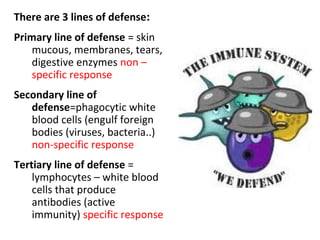
There are 3 lines of defense:
Primary line of defense = skin
mucous, membranes, tears,
digestive enzymes non –
specific response
Secondary line of
defense=phagocytic white
blood cells (engulf foreign
bodies (viruses, bacteria..)
non-specific response
Tertiary line of defense =
lymphocytes – white blood
cells that produce
antibodies (active
immunity) specific response
The Immune System Explained
https://www.youtube.com/watch?
v=zQGOcOUBi6s
Innate Virus-Specific Immune
Responses
Small proteins called INTERFERONS are
produced by virus-infected cells
and released as part of the INNATE
(non-specific) response. Interferons
act as chemical messengers help
other cells resist viral infection
(when released from a virus
infected cell).
Interferons INTERFERE with viral
infection!
Acquired Virus-Specific Immune
Responses
• Targets specific viral
proteins
• Takes longer to
develop but
produces 'memory'
• Involves antibody
production by B cells,
cytotoxic T cells and
natral killer (NK) cells
Antibodies Explained...
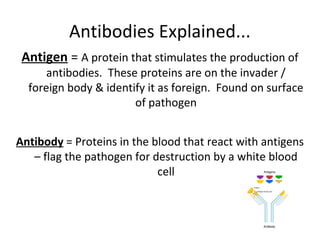
Antigen = A protein that stimulates the production of
antibodies. These proteins are on the invader /
foreign body & identify it as foreign. Found on surface
of pathogen
Antibody = Proteins in the blood that react with antigens
– flag the pathogen for destruction by a white blood
cell
Viral Specificity
• Viruses only infect specific
hosts. Ex: only plants, only
animals, only fungus or only
bacteria.
• Some are very specific in that
they infect a particular
species such as only humans,
only peach tree etc…
• Some may only infect certain
cells of the body Ex. Influenza
infects lung cells
Host Range: the number of different species a
virus can infect
• Narrow host range =
infects only 1-3 species.
– Ex. Human cold virus
• Broad host range =
infects many different
species
– Ex. Rabies – infects
mammals & birds
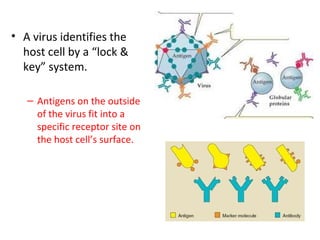
• A virus identifies the
host cell by a “lock &
key” system.
– Antigens on the outside
of the virus fit into a
specific receptor site on
the host cell’s surface.
AIDS •HIV can be
transmitted sexually,
through contact with
contaminated blood,
tissue, or needles,
and from mother to
child during birth or
breast-feeding.
•Full-blown symptoms
of AIDS may not
develop for more than
10 years after
infection.
CHICKEN POX
•Infects most children worldwide by
the age of 10.
•Transmitted in airborne droplets
exhaled from an infected person.
•The virus causes a low fever and a
rash of fluid-filled blisters that begin
as red spots covering most of the
body and the inside of the mouth.
•The disease is dangerous to newborns, to
people first infected in adulthood, and to those
in whom the virus remains dormant in nerve
cells, erupting as the more painful and
sometimes chronic (shingles) later in life.
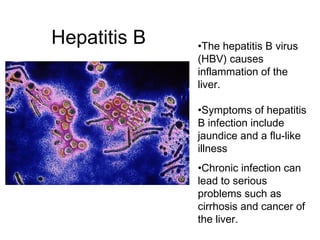
Hepatitis B •The hepatitis B virus
(HBV) causes
inflammation of the
liver.
•Symptoms of hepatitis
B infection include
jaundice and a flu-like
illness
•Chronic infection can
lead to serious
problems such as
cirrhosis and cancer of
the liver.
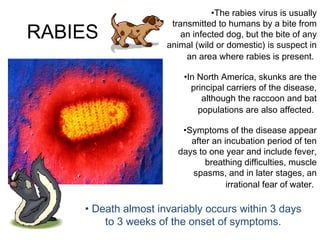
RABIES
•The rabies virus is usually
transmitted to humans by a bite from
an infected dog, but the bite of any
animal (wild or domestic) is suspect in
an area where rabies is present.
•In North America, skunks are the
principal carriers of the disease,
although the raccoon and bat
populations are also affected.
•Symptoms of the disease appear
after an incubation period of ten
days to one year and include fever,
breathing difficulties, muscle
spasms, and in later stages, an
irrational fear of water.
• Death almost invariably occurs within 3 days
to 3 weeks of the onset of symptoms.
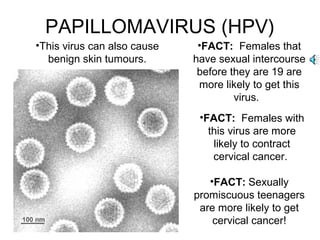
PAPILLOMAVIRUS (HPV)
•FACT: Females that
have sexual intercourse
before they are 19 are
more likely to get this
virus.
•FACT: Females with
this virus are more
likely to contract
cervical cancer.
•FACT: Sexually
promiscuous teenagers
are more likely to get
cervical cancer!
•This virus can also cause
benign skin tumours.
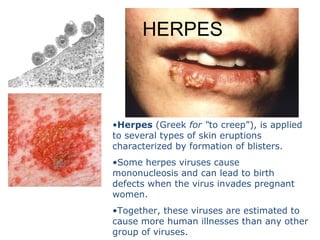
•Herpes (Greek for “to creep”), is applied 
to several types of skin eruptions 
characterized by formation of blisters.
•Some herpes viruses cause   
mononucleosis and can lead to birth 
defects when the virus invades pregnant 
women. 
•Together, these viruses are estimated to 
cause more human illnesses than any other 
group of viruses.
HERPES
The Ebola Virus Explained
https://www.youtube.com/watch?
v=sRv19gkZ4E0
The immune system & viral specificity

The immune system & viral specificity

  • 1.
  • 2.
    Answer the followingquestions using your textbook: Miller & Levine p. 969 -972 or Nelson p. 201 – 204. 1. What is a pathogen? 2. Name the system that defends the body against pathogens? 3. Explain the non-specific response and the specific response of the body. 4. COPY: Primary line of defense = skin mucous, membranes, tears, digestive enzymes non – specific response Secondary line of defense=phagocytic white blood cells (engulf foreign bodies (viruses, bacteria..) non-specific response Tertiary line of defense = lymphocytes – white blood cells that produce antibodies (active immunity)specific response 5. What are interferons? 6. A) What is an antigen? B) What is an antibody?
  • 3.
    A pathogen is anythingthat causes a disease The immune system is our bodies’ way of defending itself against pathogens.
  • 4.
    The immune systemcan be divided into 2 parts: Non-specific response (AKA INNATE immune system)  body’s first line of defense against disease. Tries to prevent you from getting sick in the first place. Specific response (AKA ACQUIRED immune system)  if pathogen gets by 1st line of defense.  there are specific antibodies made that will recognize a virus & prevent it from infecting the host.
  • 5.
    There are 3lines of defense: Primary line of defense = skin mucous, membranes, tears, digestive enzymes non – specific response Secondary line of defense=phagocytic white blood cells (engulf foreign bodies (viruses, bacteria..) non-specific response Tertiary line of defense = lymphocytes – white blood cells that produce antibodies (active immunity) specific response
  • 6.
    The Immune SystemExplained https://www.youtube.com/watch? v=zQGOcOUBi6s
  • 7.
    Innate Virus-Specific Immune Responses Smallproteins called INTERFERONS are produced by virus-infected cells and released as part of the INNATE (non-specific) response. Interferons act as chemical messengers help other cells resist viral infection (when released from a virus infected cell). Interferons INTERFERE with viral infection!
  • 8.
    Acquired Virus-Specific Immune Responses •Targets specific viral proteins • Takes longer to develop but produces 'memory' • Involves antibody production by B cells, cytotoxic T cells and natral killer (NK) cells
  • 9.
    Antibodies Explained... Antigen =A protein that stimulates the production of antibodies. These proteins are on the invader / foreign body & identify it as foreign. Found on surface of pathogen Antibody = Proteins in the blood that react with antigens – flag the pathogen for destruction by a white blood cell
  • 10.
    Viral Specificity • Virusesonly infect specific hosts. Ex: only plants, only animals, only fungus or only bacteria. • Some are very specific in that they infect a particular species such as only humans, only peach tree etc… • Some may only infect certain cells of the body Ex. Influenza infects lung cells
  • 11.
    Host Range: thenumber of different species a virus can infect • Narrow host range = infects only 1-3 species. – Ex. Human cold virus • Broad host range = infects many different species – Ex. Rabies – infects mammals & birds
  • 12.
    • A virusidentifies the host cell by a “lock & key” system. – Antigens on the outside of the virus fit into a specific receptor site on the host cell’s surface.
  • 13.
    AIDS •HIV canbe transmitted sexually, through contact with contaminated blood, tissue, or needles, and from mother to child during birth or breast-feeding. •Full-blown symptoms of AIDS may not develop for more than 10 years after infection.
  • 14.
    CHICKEN POX •Infects mostchildren worldwide by the age of 10. •Transmitted in airborne droplets exhaled from an infected person. •The virus causes a low fever and a rash of fluid-filled blisters that begin as red spots covering most of the body and the inside of the mouth. •The disease is dangerous to newborns, to people first infected in adulthood, and to those in whom the virus remains dormant in nerve cells, erupting as the more painful and sometimes chronic (shingles) later in life.
  • 15.
    Hepatitis B •Thehepatitis B virus (HBV) causes inflammation of the liver. •Symptoms of hepatitis B infection include jaundice and a flu-like illness •Chronic infection can lead to serious problems such as cirrhosis and cancer of the liver.
  • 16.
    RABIES •The rabies virusis usually transmitted to humans by a bite from an infected dog, but the bite of any animal (wild or domestic) is suspect in an area where rabies is present. •In North America, skunks are the principal carriers of the disease, although the raccoon and bat populations are also affected. •Symptoms of the disease appear after an incubation period of ten days to one year and include fever, breathing difficulties, muscle spasms, and in later stages, an irrational fear of water. • Death almost invariably occurs within 3 days to 3 weeks of the onset of symptoms.
  • 17.
    PAPILLOMAVIRUS (HPV) •FACT: Femalesthat have sexual intercourse before they are 19 are more likely to get this virus. •FACT: Females with this virus are more likely to contract cervical cancer. •FACT: Sexually promiscuous teenagers are more likely to get cervical cancer! •This virus can also cause benign skin tumours.
  • 18.
  • 19.
    The Ebola VirusExplained https://www.youtube.com/watch? v=sRv19gkZ4E0