
Theories of Viral Evolution
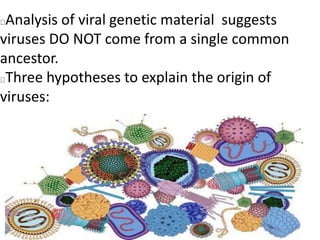
Analysis of viral genetic material suggests
viruses DO NOT come from a single common
ancestor.
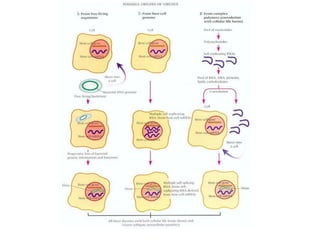
Three hypotheses to explain the origin of
viruses:
1. Devolution (Regression) Hypothesis
•Viral ancestors were cellular organisms similar
to bacteria.
•Evolved into obligate parasites
•Parasites lost cellular components as it was
more efficient to reproduce without.
•
2. Escapist (Progressive) Hypothesis
•Genetic material from a free living (non-parasitic)
cell “escaped” wrapped in protein coat
•Explains viral-host specificity (viruses are able to
attack and take over host because they came from
them)
3. Self-Replication (Co-evolution)
Hypothesis
•Particles with the ability to self-replicate
evolved alongside the cells
•As new cell types evolved, new viruses that
could target that cell evolved (co-evolution)
viral evolution 2016

viral evolution 2016

  • 1.
  • 2.
    Analysis of viralgenetic material suggests viruses DO NOT come from a single common ancestor. Three hypotheses to explain the origin of viruses:
  • 3.
    1. Devolution (Regression)Hypothesis •Viral ancestors were cellular organisms similar to bacteria. •Evolved into obligate parasites •Parasites lost cellular components as it was more efficient to reproduce without. •
  • 4.
    2. Escapist (Progressive)Hypothesis •Genetic material from a free living (non-parasitic) cell “escaped” wrapped in protein coat •Explains viral-host specificity (viruses are able to attack and take over host because they came from them)
  • 5.
    3. Self-Replication (Co-evolution) Hypothesis •Particleswith the ability to self-replicate evolved alongside the cells •As new cell types evolved, new viruses that could target that cell evolved (co-evolution)