THE IMMUNE SYSTEM
               Students should be able to:
Describe the role of the blood in defending the body
Explain how the principles of immunization are used to
control communicable disease
T E R M IN O L O G Y
• A N T I B I O T I C S : A drug used to treat infections
  caused by bacteria and other microorganisms
  (inhibits growth or destroys).
  e.g. penicillin, streptomycin, tetracycline

• A N T I G E N : A toxin or other foreign substance
  that induces an immune response in the body, esp.
  the production of antibodies.

• A N T I B O D Y : A blood protein produced in
  response to and counteracting a specific antigen
• I M M U N I T Y : The ability to resist a particular toxin
  by the action of specific antibodies.

• I M M U N I Z A T I O N : the act of making immune
  (especially by inoculation, i.e. taking a vaccine as a
  precaution against contracting a disease).

• V A C C I N E : A substance used to stimulate the
  production of antibodies and provide immunity against
  one or several diseases, prepared from the causative
  agent of a disease, its products, or a synthetic
  substitute, treated to act as an antigen without
  inducing the disease.
FIRST LINE OF DEFENSE
• Goal: to stop pathogens from entering the body
 Skin – acts as a barrier to invasion
 Sweat – has chemicals which can kill different
  pathogens.
 Tears - have lysozyme which has powerful
  digestive abilities that render antigens harmless.
 Saliva – also has lysozyme.
 Mucus - can trap pathogens, which are then
  sneezed, coughed, washed away, or destroyed
  by chemicals.
 Stomach Acid – destroys pathogens
SECOND LINE OF DEFENSE
• If a pathogen is able to get past the body's first
  line of defense, and an infection starts, the body
  can rely on it's second line of defense.

• First there is a non-specific response
  (phagocytosis) followed by an INFLAMMATORY
  RESPONSE.
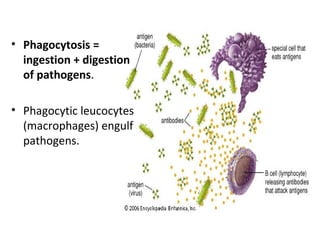
• Phagocytosis =
  ingestion + digestion
  of pathogens.

• Phagocytic leucocytes
  (macrophages) engulf
  pathogens.
Inflammation causes:
ii.Redness - due to capillary dilation resulting in
   increased blood flow
iii.Heat - due to capillary dilation resulting in
   increased blood flow
iv.Swelling – due to passage of plasma from the
   blood stream into the damaged tissue
v. Pain – due mainly to tissue destruction and, to
   a lesser extent, swelling.
THIRD LINE OF DEFENSE
• Sometimes the second line of defense is still not enough
  and the pathogen is then heading for the body's last line
  of defense, the immune system.

• The immune system recognizes, attacks, destroys, and
  remembers each pathogen that enters the body. It does
  this by making specialized cells and antibodies that
  render the pathogens harmless.

• Unlike the first line and second line defense the immune
  system differentiates among pathogens.

• For each type of pathogen, the immune system produces
  cells that are specific for that particular pathogen.
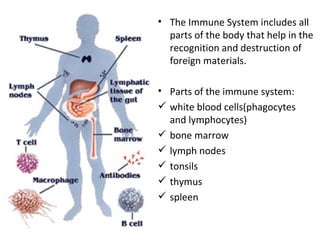
• The Immune System includes all
  parts of the body that help in the
  recognition and destruction of
  foreign materials.

• Parts of the immune system:
 white blood cells(phagocytes
  and lymphocytes)
 bone marrow
 lymph nodes
 tonsils
 thymus
 spleen
TYPES OF IMMUNITY
        P A S S IV E                          A C T IV E

•   Source: It is developed         •   Source: It is developed by
    when ready-made                     an individual’s own cells in
    antibodies are inoculated           response to an infection or
    from outside.                       a vaccine.
•   Side effects: It may cause      •   Side effects: It has no side
    reaction.                           effects.
•   Period of relief: It provides   •   Period of relief: It provides
    immediate relief.                   relief only after long
•   Period of effectiveness: It         period.
    is short lived                  •   Period of effectiveness: It
                                        is long lasting.
• The natural passive immunity occurs,
  when the maternal IgG type
  antibodies is passed to the foetus
  through the placenta. It is very much
  helpful in the initial 6 months of the
  infant’s life when the immune system
  is still developing.

• In the artificial passive immunity, we
  are introducing immunoglobulin or
  pre formed animal based antibodies
  (antiserum) to a non immune person.
  This can be used, following exposure,
  to a pathogen.
• It is named as naturally
  acquired active immunity
  because, the person develops
  the full fledged infection to the
  organism and later finds himself
  resistant to that organism.

• In the artificial acquired active
  immunity, the patient is
  introduced with an organism
  (usually attenuated) along with
  substances to activate the
  immune response.
DISEASES OF THE IMMUNE
         SYSTEM
• HAY FEVER: is your immune system's response
        FEVER
  to foreign material in the air you breathe.
• Hay fever usually refers to allergies to outdoor,
  airborne materials such as pollens and molds.
• A particular kind of antibody, IgE is released
  causing very sensitive reaction to the allergens.
• Histamine is produced resulting sneezing,
  difficulty breathing, runny nose.
• Antihistamines and inhalers relieve symptoms.
• ASTHMA: is a disorder that causes the airways
  ASTHMA
  of the lungs to swell and narrow, leading to
  wheezing, shortness of breath, chest
  tightness, and coughing.

Immunity

  • 1.
    THE IMMUNE SYSTEM Students should be able to: Describe the role of the blood in defending the body Explain how the principles of immunization are used to control communicable disease
  • 2.
    T E RM IN O L O G Y • A N T I B I O T I C S : A drug used to treat infections caused by bacteria and other microorganisms (inhibits growth or destroys). e.g. penicillin, streptomycin, tetracycline • A N T I G E N : A toxin or other foreign substance that induces an immune response in the body, esp. the production of antibodies. • A N T I B O D Y : A blood protein produced in response to and counteracting a specific antigen
  • 3.
    • I MM U N I T Y : The ability to resist a particular toxin by the action of specific antibodies. • I M M U N I Z A T I O N : the act of making immune (especially by inoculation, i.e. taking a vaccine as a precaution against contracting a disease). • V A C C I N E : A substance used to stimulate the production of antibodies and provide immunity against one or several diseases, prepared from the causative agent of a disease, its products, or a synthetic substitute, treated to act as an antigen without inducing the disease.
  • 4.
    FIRST LINE OFDEFENSE • Goal: to stop pathogens from entering the body  Skin – acts as a barrier to invasion  Sweat – has chemicals which can kill different pathogens.  Tears - have lysozyme which has powerful digestive abilities that render antigens harmless.  Saliva – also has lysozyme.  Mucus - can trap pathogens, which are then sneezed, coughed, washed away, or destroyed by chemicals.  Stomach Acid – destroys pathogens
  • 5.
    SECOND LINE OFDEFENSE • If a pathogen is able to get past the body's first line of defense, and an infection starts, the body can rely on it's second line of defense. • First there is a non-specific response (phagocytosis) followed by an INFLAMMATORY RESPONSE.
  • 6.
    • Phagocytosis = ingestion + digestion of pathogens. • Phagocytic leucocytes (macrophages) engulf pathogens.
  • 7.
    Inflammation causes: ii.Redness -due to capillary dilation resulting in increased blood flow iii.Heat - due to capillary dilation resulting in increased blood flow iv.Swelling – due to passage of plasma from the blood stream into the damaged tissue v. Pain – due mainly to tissue destruction and, to a lesser extent, swelling.
  • 9.
    THIRD LINE OFDEFENSE • Sometimes the second line of defense is still not enough and the pathogen is then heading for the body's last line of defense, the immune system. • The immune system recognizes, attacks, destroys, and remembers each pathogen that enters the body. It does this by making specialized cells and antibodies that render the pathogens harmless. • Unlike the first line and second line defense the immune system differentiates among pathogens. • For each type of pathogen, the immune system produces cells that are specific for that particular pathogen.
  • 10.
    • The ImmuneSystem includes all parts of the body that help in the recognition and destruction of foreign materials. • Parts of the immune system:  white blood cells(phagocytes and lymphocytes)  bone marrow  lymph nodes  tonsils  thymus  spleen
  • 11.
    TYPES OF IMMUNITY P A S S IV E A C T IV E • Source: It is developed • Source: It is developed by when ready-made an individual’s own cells in antibodies are inoculated response to an infection or from outside. a vaccine. • Side effects: It may cause • Side effects: It has no side reaction. effects. • Period of relief: It provides • Period of relief: It provides immediate relief. relief only after long • Period of effectiveness: It period. is short lived • Period of effectiveness: It is long lasting.
  • 12.
    • The naturalpassive immunity occurs, when the maternal IgG type antibodies is passed to the foetus through the placenta. It is very much helpful in the initial 6 months of the infant’s life when the immune system is still developing. • In the artificial passive immunity, we are introducing immunoglobulin or pre formed animal based antibodies (antiserum) to a non immune person. This can be used, following exposure, to a pathogen.
  • 13.
    • It isnamed as naturally acquired active immunity because, the person develops the full fledged infection to the organism and later finds himself resistant to that organism. • In the artificial acquired active immunity, the patient is introduced with an organism (usually attenuated) along with substances to activate the immune response.
  • 14.
    DISEASES OF THEIMMUNE SYSTEM • HAY FEVER: is your immune system's response FEVER to foreign material in the air you breathe. • Hay fever usually refers to allergies to outdoor, airborne materials such as pollens and molds. • A particular kind of antibody, IgE is released causing very sensitive reaction to the allergens. • Histamine is produced resulting sneezing, difficulty breathing, runny nose. • Antihistamines and inhalers relieve symptoms.
  • 15.
    • ASTHMA: isa disorder that causes the airways ASTHMA of the lungs to swell and narrow, leading to wheezing, shortness of breath, chest tightness, and coughing.

Editor's Notes

  • #14 http://www.differencebetween.com/difference-between-active-and-vs-passive-immunity/