IMMUNITY BY- SANCHIT
DHANKHAR
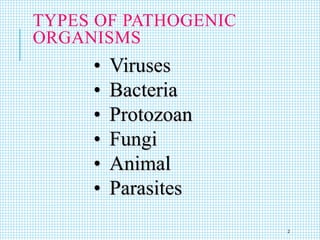
TYPES OF PATHOGENIC
ORGANISMS
• Viruses
• Bacteria
• Protozoan
• Fungi
• Animal
• Parasites
2
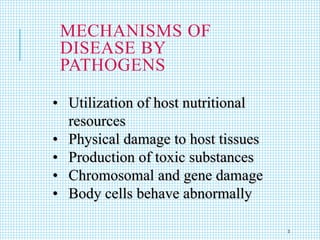
MECHANISMS OF
DISEASE BY
PATHOGENS
• Utilization of host nutritional
resources
• Physical damage to host tissues
• Production of toxic substances
• Chromosomal and gene damage
• Body cells behave abnormally
3
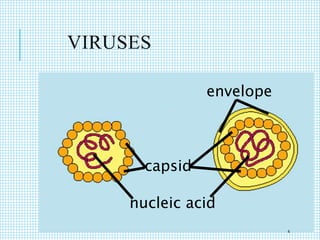
VIRUSES
nucleic acid
capsid
envelope
4
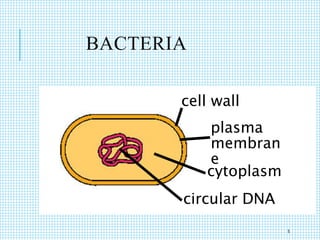
BACTERIA
cell wall
plasma
membran
e
cytoplasm
circular DNA
5
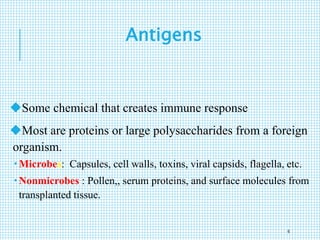
Antigens
Some chemical that creates immune response
Most are proteins or large polysaccharides from a foreign
organism.
 Microbes: Capsules, cell walls, toxins, viral capsids, flagella, etc.
 Nonmicrobes : Pollen,, serum proteins, and surface molecules from
transplanted tissue.
6
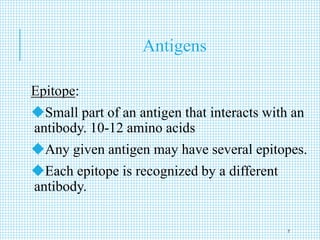
Antigens
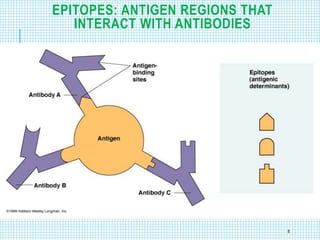
Epitope:
Small part of an antigen that interacts with an
antibody. 10-12 amino acids
Any given antigen may have several epitopes.
Each epitope is recognized by a different
antibody.
7
EPITOPES: ANTIGEN REGIONS THAT
INTERACT WITH ANTIBODIES
8
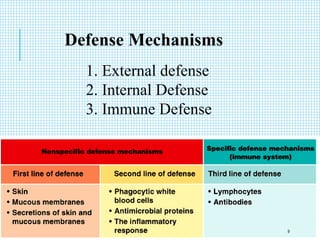
Defense Mechanisms
1. External defense
2. Internal Defense
3. Immune Defense
9
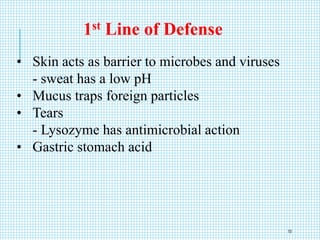
• Skin acts as barrier to microbes and viruses
- sweat has a low pH
• Mucus traps foreign particles
• Tears
- Lysozyme has antimicrobial action
• Gastric stomach acid
1st Line of Defense
10
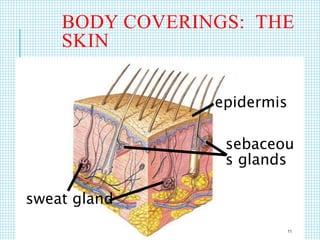
BODY COVERINGS: THE
SKIN
sebaceou
s glands
sweat gland
epidermis
11
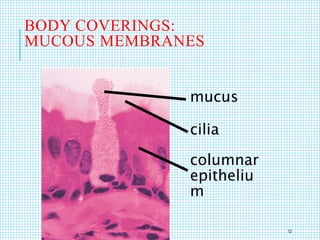
BODY COVERINGS:
MUCOUS MEMBRANES
mucus
cilia
columnar
epitheliu
m
12
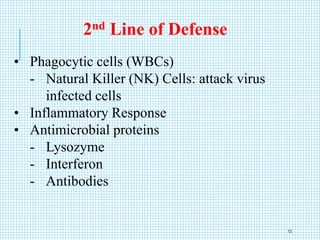
• Phagocytic cells (WBCs)
- Natural Killer (NK) Cells: attack virus
infected cells
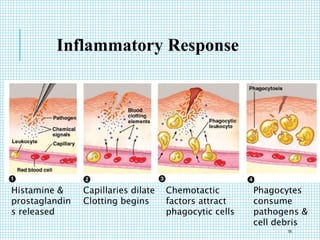
• Inflammatory Response
• Antimicrobial proteins
- Lysozyme
- Interferon
- Antibodies
2nd Line of Defense
13
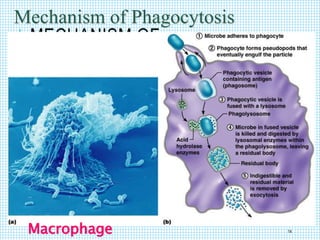
MECHANISM OF
PHAGOCYTOSIS
Mechanism of Phagocytosis
Macrophage 14
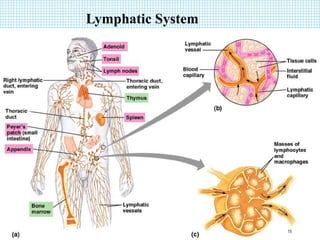
Lymphatic System
15
Inflammatory Response
Histamine &
prostaglandin
s released
Capillaries dilate
Clotting begins
Chemotactic
factors attract
phagocytic cells
Phagocytes
consume
pathogens &
cell debris
16
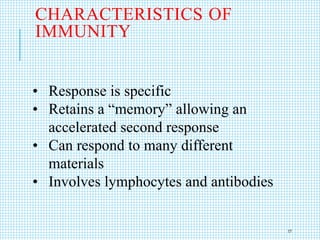
CHARACTERISTICS OF
IMMUNITY
• Response is specific
• Retains a “memory” allowing an
accelerated second response
• Can respond to many different
materials
• Involves lymphocytes and antibodies
17
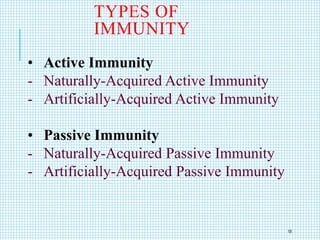
TYPES OF
IMMUNITY
• Active Immunity
- Naturally-Acquired Active Immunity
- Artificially-Acquired Active Immunity
• Passive Immunity
- Naturally-Acquired Passive Immunity
- Artificially-Acquired Passive Immunity
18
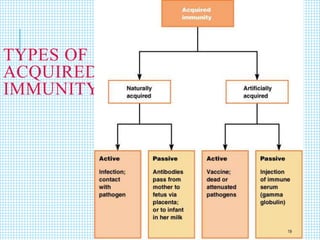
TYPES OF
ACQUIRED
IMMUNITY
19
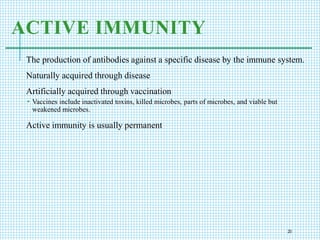
ACTIVE IMMUNITY
The production of antibodies against a specific disease by the immune system.
Naturally acquired through disease
Artificially acquired through vaccination
 Vaccines include inactivated toxins, killed microbes, parts of microbes, and viable but
weakened microbes.
Active immunity is usually permanent
20
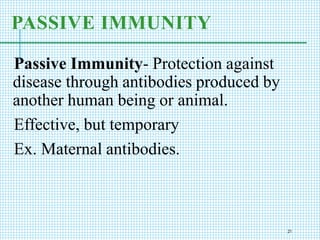
PASSIVE IMMUNITY
Passive Immunity- Protection against
disease through antibodies produced by
another human being or animal.
Effective, but temporary
Ex. Maternal antibodies.
21
Passive immunity can be transferred artificially by injecting antibodies from an
animal that is already immune to a disease into another animal.
22
IMMUNE SYSTEM RESPONSE TO
ANTIGENS
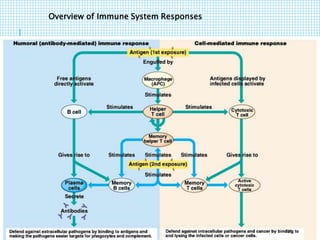
Humoral Immunity
• Involves antibodies (secreted from B
cells) dissolved in the blood plasma.
• Demonstrated as a immune response
using only the blood serum.
• Defense against bacteria, bacterial
toxins, & viruses.
23
Cell-Mediated Immunity
• Involves the activities of specific white
blood cells (T cells).
• Defense against cancer cells, virus-
infected cells, fungi, animal parasites, &
foreign cells from transplants.
IMMUNE SYSTEM RESPONSE TO
ANTIGENS
24
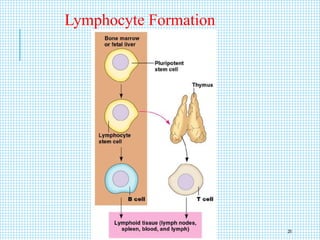
Lymphocyte Formation
25
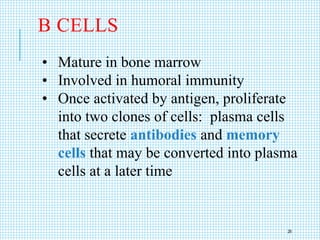
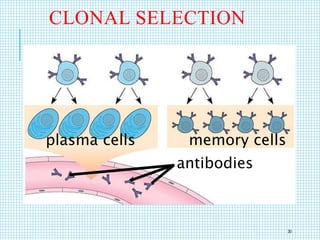
B CELLS
• Mature in bone marrow
• Involved in humoral immunity
• Once activated by antigen, proliferate
into two clones of cells: plasma cells
that secrete antibodies and memory
cells that may be converted into plasma
cells at a later time
26
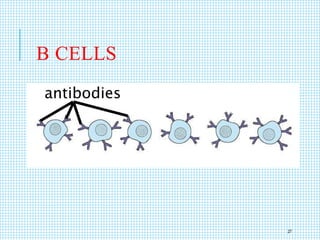
B CELLS
antibodies
27
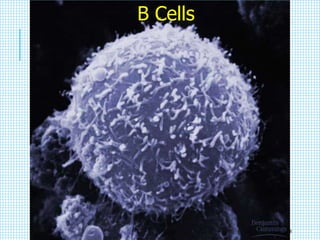
B Cells
28
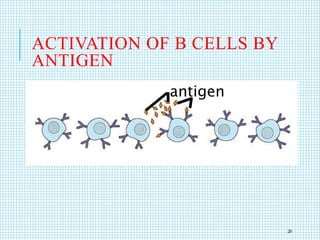
ACTIVATION OF B CELLS BY
ANTIGEN
antigen
29
CLONAL SELECTION
plasma cells memory cells
antibodies
30
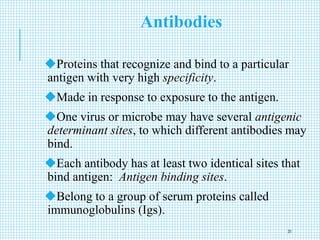
Antibodies
Proteins that recognize and bind to a particular
antigen with very high specificity.
Made in response to exposure to the antigen.
One virus or microbe may have several antigenic
determinant sites, to which different antibodies may
bind.
Each antibody has at least two identical sites that
bind antigen: Antigen binding sites.
Belong to a group of serum proteins called
immunoglobulins (Igs).
31
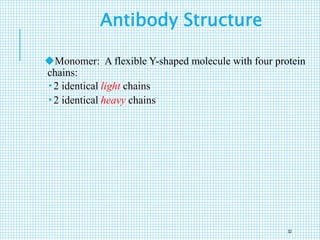
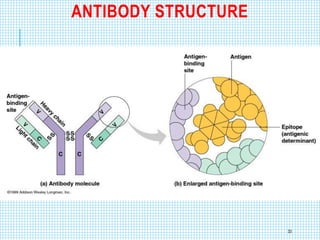
Antibody Structure
Monomer: A flexible Y-shaped molecule with four protein
chains:
 2 identical light chains
 2 identical heavy chains
32
ANTIBODY STRUCTURE
33
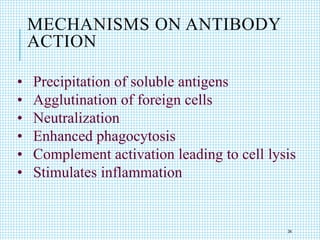
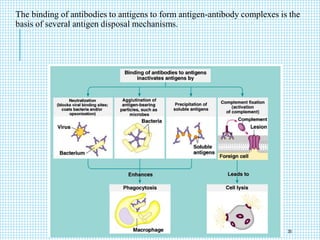
MECHANISMS ON ANTIBODY
ACTION
• Precipitation of soluble antigens
• Agglutination of foreign cells
• Neutralization
• Enhanced phagocytosis
• Complement activation leading to cell lysis
• Stimulates inflammation
34
The binding of antibodies to antigens to form antigen-antibody complexes is the
basis of several antigen disposal mechanisms.
35
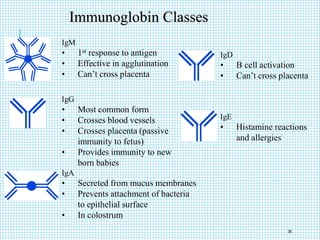
Immunoglobin Classes
IgM
• 1st response to antigen
• Effective in agglutination
• Can’t cross placenta
IgG
• Most common form
• Crosses blood vessels
• Crosses placenta (passive
immunity to fetus)
• Provides immunity to new
born babies
IgA
• Secreted from mucus membranes
• Prevents attachment of bacteria
to epithelial surface
• In colostrum
IgD
• B cell activation
• Can’t cross placenta
IgE
• Histamine reactions
and allergies
36
Overview of Immune System Responses
37
T CELLS
• Mature in thymus
• Involved in cell-mediated immunity
• Activated when another cell presents
antigen to them
• Several types of T cells: cytoxic T cells,
helper T cells, suppressor T cells, and
memory T cells
38
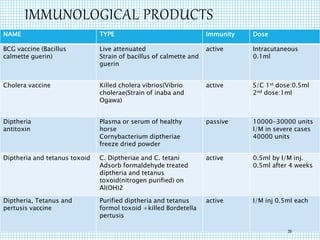
IMMUNOLOGICAL PRODUCTS
NAME TYPE Immunity Dose
BCG vaccine (Bacillus
calmette guerin)
Live attenuated
Strain of bacillus of calmette and
guerin
active Intracutaneous
0.1ml
Cholera vaccine Killed cholera vibrios(Vibrio
cholerae(Strain of inaba and
Ogawa)
active S/C 1st dose:0.5ml
2nd dose:1ml
Diptheria
antitoxin
Plasma or serum of healthy
horse
Cornybacterium diptheriae
freeze dried powder
passive 10000-30000 units
I/M in severe cases
40000 units
Diptheria and tetanus toxoid C. Diptheriae and C. tetani
Adsorb formaldehyde treated
diptheria and tetanus
toxoid(nitrogen purified) on
Al(OH)2
active 0.5ml by I/M inj.
0.5ml after 4 weeks
Diptheria, Tetanus and
pertusis vaccine
Purified diptheria and tetanus
formol toxoid +killed Bordetella
pertusis
active I/M inj 0.5ml each
39
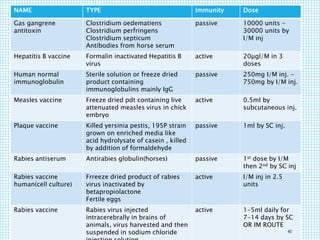
NAME TYPE Immunity Dose
Gas gangrene
antitoxin
Clostridium oedematiens
Clostridium perfringens
Clostridium septicum
Antibodies from horse serum
passive 10000 units -
30000 units by
I/M inj
Hepatitis B vaccine Formalin inactivated Hepatitis B
virus
active 20µgl/M in 3
doses
Human normal
immunoglobulin
Sterile solution or freeze dried
product containing
immunoglobulins mainly IgG
passive 250mg I/M inj. -
750mg by I/M inj.
Measles vaccine Freeze dried pdt containing live
attenuated measles virus in chick
embryo
active 0.5ml by
subcutaneous inj.
Plaque vaccine Killed yersinia pestis, 195P strain
grown on enriched media like
acid hydrolysate of casein , killed
by addition of formaldehyde
passive 1ml by SC inj.
Rabies antiserum Antirabies globulin(horses) passive 1st dose by I/M
then 2nd by SC inj
Rabies vaccine
human(cell culture)
Frreeze dried product of rabies
virus inactivated by
betapropiolactone
Fertile eggs
active I/M inj in 2.5
units
Rabies vaccine Rabies virus injected
intracerebrally in brains of
animals, virus harvested and then
suspended in sodium chloride
active 1-5ml daily for
7-14 days by SC
OR IM ROUTE
40
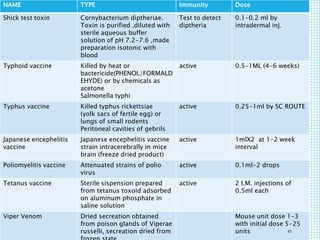
NAME TYPE Immunity Dose
Shick test toxin Cornybacterium diptheriae.
Toxin is purified ,diluted with
sterile aqueous buffer
solution of pH 7.2-7.6 ,made
preparation isotonic with
blood
Test to detect
diptheria
0.1-0.2 ml by
intradermal inj.
Typhoid vaccine Killed by heat or
bactericide(PHENOL/FORMALD
EHYDE) or by chemicals as
acetone
Salmonella typhi
active 0.5-1ML (4-6 weeks)
Typhus vaccine Killed typhus rickettsiae
(yolk sacs of fertile egg) or
lungs of small rodents
Peritoneal cavities of gebrils
active 0.25-1ml by SC ROUTE
Japanese encephelitis
vaccine
Japanese encephelitis vaccine
strain intracerebrally in mice
brain (freeze dried product)
active 1mlX2 at 1-2 week
interval
Poliomyelitis vaccine Attenuated strains of polio
virus
active 0.1ml-2 drops
Tetanus vaccine Sterile sispension prepared
from tetanus toxoid adsorbed
on aluminum phosphate in
saline solution
active 2 I.M. injections of
0.5ml each
Viper Venom Dried secreation obtained
from poison glands of Viperae
russelli, secreation dried from
Mouse unit dose 1-3
with initial dose 5-25
units 41
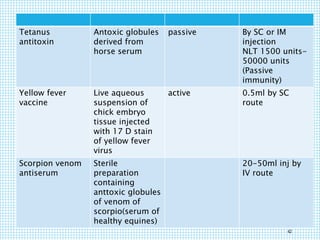
Tetanus
antitoxin
Antoxic globules
derived from
horse serum
passive By SC or IM
injection
NLT 1500 units-
50000 units
(Passive
immunity)
Yellow fever
vaccine
Live aqueous
suspension of
chick embryo
tissue injected
with 17 D stain
of yellow fever
virus
active 0.5ml by SC
route
Scorpion venom
antiserum
Sterile
preparation
containing
anttoxic globules
of venom of
scorpio(serum of
healthy equines)
20-50ml inj by
IV route
42
THANKYOU
43

Immunity- Pharmaceutical Microbiology

  • 1.
  • 2.
    TYPES OF PATHOGENIC ORGANISMS •Viruses • Bacteria • Protozoan • Fungi • Animal • Parasites 2
  • 3.
    MECHANISMS OF DISEASE BY PATHOGENS •Utilization of host nutritional resources • Physical damage to host tissues • Production of toxic substances • Chromosomal and gene damage • Body cells behave abnormally 3
  • 4.
  • 5.
  • 6.
    Antigens Some chemical thatcreates immune response Most are proteins or large polysaccharides from a foreign organism.  Microbes: Capsules, cell walls, toxins, viral capsids, flagella, etc.  Nonmicrobes : Pollen,, serum proteins, and surface molecules from transplanted tissue. 6
  • 7.
    Antigens Epitope: Small part ofan antigen that interacts with an antibody. 10-12 amino acids Any given antigen may have several epitopes. Each epitope is recognized by a different antibody. 7
  • 8.
    EPITOPES: ANTIGEN REGIONSTHAT INTERACT WITH ANTIBODIES 8
  • 9.
    Defense Mechanisms 1. Externaldefense 2. Internal Defense 3. Immune Defense 9
  • 10.
    • Skin actsas barrier to microbes and viruses - sweat has a low pH • Mucus traps foreign particles • Tears - Lysozyme has antimicrobial action • Gastric stomach acid 1st Line of Defense 10
  • 11.
    BODY COVERINGS: THE SKIN sebaceou sglands sweat gland epidermis 11
  • 12.
  • 13.
    • Phagocytic cells(WBCs) - Natural Killer (NK) Cells: attack virus infected cells • Inflammatory Response • Antimicrobial proteins - Lysozyme - Interferon - Antibodies 2nd Line of Defense 13
  • 14.
    MECHANISM OF PHAGOCYTOSIS Mechanism ofPhagocytosis Macrophage 14
  • 15.
  • 16.
    Inflammatory Response Histamine & prostaglandin sreleased Capillaries dilate Clotting begins Chemotactic factors attract phagocytic cells Phagocytes consume pathogens & cell debris 16
  • 17.
    CHARACTERISTICS OF IMMUNITY • Responseis specific • Retains a “memory” allowing an accelerated second response • Can respond to many different materials • Involves lymphocytes and antibodies 17
  • 18.
    TYPES OF IMMUNITY • ActiveImmunity - Naturally-Acquired Active Immunity - Artificially-Acquired Active Immunity • Passive Immunity - Naturally-Acquired Passive Immunity - Artificially-Acquired Passive Immunity 18
  • 19.
  • 20.
    ACTIVE IMMUNITY The productionof antibodies against a specific disease by the immune system. Naturally acquired through disease Artificially acquired through vaccination  Vaccines include inactivated toxins, killed microbes, parts of microbes, and viable but weakened microbes. Active immunity is usually permanent 20
  • 21.
    PASSIVE IMMUNITY Passive Immunity-Protection against disease through antibodies produced by another human being or animal. Effective, but temporary Ex. Maternal antibodies. 21
  • 22.
    Passive immunity canbe transferred artificially by injecting antibodies from an animal that is already immune to a disease into another animal. 22
  • 23.
    IMMUNE SYSTEM RESPONSETO ANTIGENS Humoral Immunity • Involves antibodies (secreted from B cells) dissolved in the blood plasma. • Demonstrated as a immune response using only the blood serum. • Defense against bacteria, bacterial toxins, & viruses. 23
  • 24.
    Cell-Mediated Immunity • Involvesthe activities of specific white blood cells (T cells). • Defense against cancer cells, virus- infected cells, fungi, animal parasites, & foreign cells from transplants. IMMUNE SYSTEM RESPONSE TO ANTIGENS 24
  • 25.
  • 26.
    B CELLS • Maturein bone marrow • Involved in humoral immunity • Once activated by antigen, proliferate into two clones of cells: plasma cells that secrete antibodies and memory cells that may be converted into plasma cells at a later time 26
  • 27.
  • 28.
  • 29.
    ACTIVATION OF BCELLS BY ANTIGEN antigen 29
  • 30.
    CLONAL SELECTION plasma cellsmemory cells antibodies 30
  • 31.
    Antibodies Proteins that recognizeand bind to a particular antigen with very high specificity. Made in response to exposure to the antigen. One virus or microbe may have several antigenic determinant sites, to which different antibodies may bind. Each antibody has at least two identical sites that bind antigen: Antigen binding sites. Belong to a group of serum proteins called immunoglobulins (Igs). 31
  • 32.
    Antibody Structure Monomer: Aflexible Y-shaped molecule with four protein chains:  2 identical light chains  2 identical heavy chains 32
  • 33.
  • 34.
    MECHANISMS ON ANTIBODY ACTION •Precipitation of soluble antigens • Agglutination of foreign cells • Neutralization • Enhanced phagocytosis • Complement activation leading to cell lysis • Stimulates inflammation 34
  • 35.
    The binding ofantibodies to antigens to form antigen-antibody complexes is the basis of several antigen disposal mechanisms. 35
  • 36.
    Immunoglobin Classes IgM • 1stresponse to antigen • Effective in agglutination • Can’t cross placenta IgG • Most common form • Crosses blood vessels • Crosses placenta (passive immunity to fetus) • Provides immunity to new born babies IgA • Secreted from mucus membranes • Prevents attachment of bacteria to epithelial surface • In colostrum IgD • B cell activation • Can’t cross placenta IgE • Histamine reactions and allergies 36
  • 37.
    Overview of ImmuneSystem Responses 37
  • 38.
    T CELLS • Maturein thymus • Involved in cell-mediated immunity • Activated when another cell presents antigen to them • Several types of T cells: cytoxic T cells, helper T cells, suppressor T cells, and memory T cells 38
  • 39.
    IMMUNOLOGICAL PRODUCTS NAME TYPEImmunity Dose BCG vaccine (Bacillus calmette guerin) Live attenuated Strain of bacillus of calmette and guerin active Intracutaneous 0.1ml Cholera vaccine Killed cholera vibrios(Vibrio cholerae(Strain of inaba and Ogawa) active S/C 1st dose:0.5ml 2nd dose:1ml Diptheria antitoxin Plasma or serum of healthy horse Cornybacterium diptheriae freeze dried powder passive 10000-30000 units I/M in severe cases 40000 units Diptheria and tetanus toxoid C. Diptheriae and C. tetani Adsorb formaldehyde treated diptheria and tetanus toxoid(nitrogen purified) on Al(OH)2 active 0.5ml by I/M inj. 0.5ml after 4 weeks Diptheria, Tetanus and pertusis vaccine Purified diptheria and tetanus formol toxoid +killed Bordetella pertusis active I/M inj 0.5ml each 39
  • 40.
    NAME TYPE ImmunityDose Gas gangrene antitoxin Clostridium oedematiens Clostridium perfringens Clostridium septicum Antibodies from horse serum passive 10000 units - 30000 units by I/M inj Hepatitis B vaccine Formalin inactivated Hepatitis B virus active 20µgl/M in 3 doses Human normal immunoglobulin Sterile solution or freeze dried product containing immunoglobulins mainly IgG passive 250mg I/M inj. - 750mg by I/M inj. Measles vaccine Freeze dried pdt containing live attenuated measles virus in chick embryo active 0.5ml by subcutaneous inj. Plaque vaccine Killed yersinia pestis, 195P strain grown on enriched media like acid hydrolysate of casein , killed by addition of formaldehyde passive 1ml by SC inj. Rabies antiserum Antirabies globulin(horses) passive 1st dose by I/M then 2nd by SC inj Rabies vaccine human(cell culture) Frreeze dried product of rabies virus inactivated by betapropiolactone Fertile eggs active I/M inj in 2.5 units Rabies vaccine Rabies virus injected intracerebrally in brains of animals, virus harvested and then suspended in sodium chloride active 1-5ml daily for 7-14 days by SC OR IM ROUTE 40
  • 41.
    NAME TYPE ImmunityDose Shick test toxin Cornybacterium diptheriae. Toxin is purified ,diluted with sterile aqueous buffer solution of pH 7.2-7.6 ,made preparation isotonic with blood Test to detect diptheria 0.1-0.2 ml by intradermal inj. Typhoid vaccine Killed by heat or bactericide(PHENOL/FORMALD EHYDE) or by chemicals as acetone Salmonella typhi active 0.5-1ML (4-6 weeks) Typhus vaccine Killed typhus rickettsiae (yolk sacs of fertile egg) or lungs of small rodents Peritoneal cavities of gebrils active 0.25-1ml by SC ROUTE Japanese encephelitis vaccine Japanese encephelitis vaccine strain intracerebrally in mice brain (freeze dried product) active 1mlX2 at 1-2 week interval Poliomyelitis vaccine Attenuated strains of polio virus active 0.1ml-2 drops Tetanus vaccine Sterile sispension prepared from tetanus toxoid adsorbed on aluminum phosphate in saline solution active 2 I.M. injections of 0.5ml each Viper Venom Dried secreation obtained from poison glands of Viperae russelli, secreation dried from Mouse unit dose 1-3 with initial dose 5-25 units 41
  • 42.
    Tetanus antitoxin Antoxic globules derived from horseserum passive By SC or IM injection NLT 1500 units- 50000 units (Passive immunity) Yellow fever vaccine Live aqueous suspension of chick embryo tissue injected with 17 D stain of yellow fever virus active 0.5ml by SC route Scorpion venom antiserum Sterile preparation containing anttoxic globules of venom of scorpio(serum of healthy equines) 20-50ml inj by IV route 42
  • 43.