ARTHROPOD CLASSIFICATION
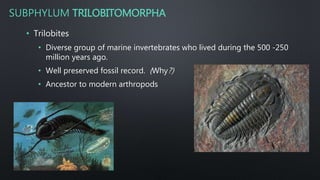
SUBPHYLUM TRILOBITOMORPHA
• Trilobites
• Diverse group of marine invertebrates who lived during the 500 -250
million years ago.
• Well preserved fossil record. (Why?)
• Ancestor to modern arthropods
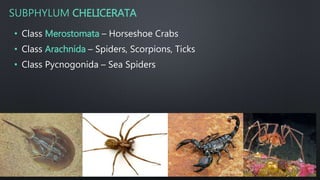
SUBPHYLUM CHELICERATA
• Class Merostomata – Horseshoe Crabs
• Class Arachnida – Spiders, Scorpions, Ticks
• Class Pycnogonida – Sea Spiders
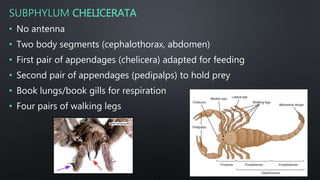
SUBPHYLUM CHELICERATA
• No antenna
• Two body segments (cephalothorax, abdomen)
• First pair of appendages (chelicera) adapted for feeding
• Second pair of appendages (pedipalps) to hold prey
• Book lungs/book gills for respiration
• Four pairs of walking legs
SUBPHYLUM MANDIBULATA
• Class Myriapoda
• Order Chilopoda (Centipedes)
• Order Diplopoda (Millipedes)
• Class Insecta
• Subclass Apterygota (Wingless Insects)
• Subclass Pterygota (Winged Insects)
• Class Crustacea
• Subclass Malacostraca (Crabs, Lobsters, Shrimp, Woodbugs)
• Subclass Cirripedia (Barnacles)
• Subclasses Ostracoda, Copepod (Planktonic Crustaceans)
SUBPHYLUM MANDIBULATA
• Head appendages are modified as mandibles for chewing or grinding.
• Class Myriapoda
• Order Chilopoda (Centipedes)
• One pair of walking legs per segment
• Flat body, fast moving
• Some poisonous
• Carnivores
• Order Diplopoda (Millipedes)
• Two pairs of walking legs per segment
• Round body, slow movers
• Herbivores
SUBPHYLUM MANDIBULATA
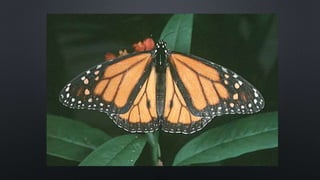
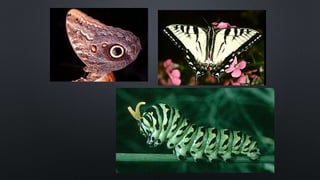
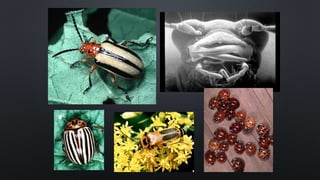
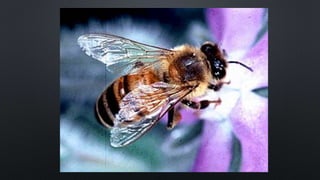
• Class Insecta
• Three pairs of walking legs (uniramous)on thorax
• One pair or antenna
• Three body segments
• May have wings (only flying invertebrates)
MOSQUITO
SUBPHYLUM MANDIBULATA
• Class Myriapoda
• Order Chilopoda (Centipedes)
• Order Diplopoda (Millipedes)
• Class Insecta
• Subclass Apterygota (Wingless Insects)
• Subclass Pterygota (Winged Insects)
• Class Crustacea
• Subclass Malacostraca (Crabs, Lobsters, Shrimp, Woodbugs)
• Subclass Cirripedia (Barnacles)
• Subclasses Ostracoda, Copepod (Planktonic Crustaceans)
SUBPHYLUM MANDIBULATA
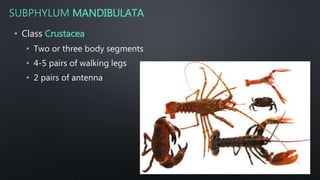
• Class Crustacea
• Two or three body segments
• 4-5 pairs of walking legs
• 2 pairs of antenna
BARNACLES

Arthropod classification

  • 1.
  • 2.
    SUBPHYLUM TRILOBITOMORPHA • Trilobites •Diverse group of marine invertebrates who lived during the 500 -250 million years ago. • Well preserved fossil record. (Why?) • Ancestor to modern arthropods
  • 3.
    SUBPHYLUM CHELICERATA • ClassMerostomata – Horseshoe Crabs • Class Arachnida – Spiders, Scorpions, Ticks • Class Pycnogonida – Sea Spiders
  • 4.
    SUBPHYLUM CHELICERATA • Noantenna • Two body segments (cephalothorax, abdomen) • First pair of appendages (chelicera) adapted for feeding • Second pair of appendages (pedipalps) to hold prey • Book lungs/book gills for respiration • Four pairs of walking legs
  • 5.
    SUBPHYLUM MANDIBULATA • ClassMyriapoda • Order Chilopoda (Centipedes) • Order Diplopoda (Millipedes) • Class Insecta • Subclass Apterygota (Wingless Insects) • Subclass Pterygota (Winged Insects) • Class Crustacea • Subclass Malacostraca (Crabs, Lobsters, Shrimp, Woodbugs) • Subclass Cirripedia (Barnacles) • Subclasses Ostracoda, Copepod (Planktonic Crustaceans)
  • 6.
    SUBPHYLUM MANDIBULATA • Headappendages are modified as mandibles for chewing or grinding. • Class Myriapoda • Order Chilopoda (Centipedes) • One pair of walking legs per segment • Flat body, fast moving • Some poisonous • Carnivores • Order Diplopoda (Millipedes) • Two pairs of walking legs per segment • Round body, slow movers • Herbivores
  • 7.
    SUBPHYLUM MANDIBULATA • ClassInsecta • Three pairs of walking legs (uniramous)on thorax • One pair or antenna • Three body segments • May have wings (only flying invertebrates)
  • 11.
  • 18.
    SUBPHYLUM MANDIBULATA • ClassMyriapoda • Order Chilopoda (Centipedes) • Order Diplopoda (Millipedes) • Class Insecta • Subclass Apterygota (Wingless Insects) • Subclass Pterygota (Winged Insects) • Class Crustacea • Subclass Malacostraca (Crabs, Lobsters, Shrimp, Woodbugs) • Subclass Cirripedia (Barnacles) • Subclasses Ostracoda, Copepod (Planktonic Crustaceans)
  • 19.
    SUBPHYLUM MANDIBULATA • ClassCrustacea • Two or three body segments • 4-5 pairs of walking legs • 2 pairs of antenna
  • 20.