Lesson Overview

Fighting Infectious Disease

Lesson Overview
35.3 Fighting
Infectious Disease
Lesson Overview

Fighting Infectious Disease

THINK ABOUT IT
More than 200 years ago, English physician Edward Jenner noted that
milkmaids who contracted a mild disease called cowpox didn’t develop
smallpox.
At the time, smallpox was a widespread disease that killed many people.
Could people be protected from smallpox by deliberately infecting them
with cowpox?
Lesson Overview

Fighting Infectious Disease

Acquired Immunity
How do vaccines and externally produced antibodies fight disease?
Lesson Overview

Fighting Infectious Disease

Acquired Immunity
How do vaccines and externally produced antibodies fight disease?
A vaccine stimulates the immune system with an antigen. The immune
system produces memory B cells and memory T cells that quicken and
strengthen the body’s response to repeated infection.
Antibodies produced against a pathogen by other individuals or animals
can be used to produce temporary immunity.
Lesson Overview

Fighting Infectious Disease

Acquired Immunity
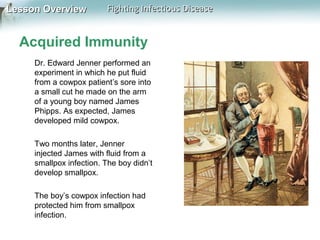
Dr. Edward Jenner performed an
experiment in which he put fluid
from a cowpox patient’s sore into
a small cut he made on the arm
of a young boy named James
Phipps. As expected, James
developed mild cowpox.
Two months later, Jenner
injected James with fluid from a
smallpox infection. The boy didn’t
develop smallpox.
The boy’s cowpox infection had
protected him from smallpox
infection.
Lesson Overview

Fighting Infectious Disease

Acquired Immunity
The injection of a weakened form of a pathogen, or of a similar but less
dangerous pathogen, to produce immunity is known as a vaccination.
The term comes from the Latin word vacca, meaning “cow,” as a reminder
of Jenner’s work.
Lesson Overview

Fighting Infectious Disease

Active Immunity
Active immunity may develop as a result of natural exposure to an
antigen (fighting an infection) or from deliberate exposure to the antigen
(through a vaccine).
Vaccination stimulates the immune system with an antigen.
The immune system produces memory B cells and memory T cells that
quicken and strengthen the body’s response to repeated infection.
Lesson Overview

Fighting Infectious Disease

Passive Immunity
Antibodies produced against a pathogen by other individuals or animals
can be used to produce temporary immunity. If externally produced
antibodies are introduced into a person’s blood, the result is passive
immunity.
Passive immunity lasts only a short time because the immune system
eventually destroys the foreign antibodies.
Lesson Overview

Fighting Infectious Disease

Passive Immunity
Passive immunity can occur naturally or by deliberate exposure.
Natural passive immunity occurs when antibodies are passed from a
pregnant woman to her fetus (across the placenta), or to an infant
through breast milk.
For some diseases, antibodies from humans or animals can be injected
into an individual.
For example, people who have been bitten by rabid animals are injected
with antibodies for the rabies virus.
Lesson Overview

Fighting Infectious Disease

Public Health and Medications
How do public health measures and medications fight disease?
Lesson Overview

Fighting Infectious Disease

Public Health and Medications
How do public health measures and medications fight disease?
Public health measures help prevent disease by monitoring and regulating
food and water supplies, promoting vaccination, and promoting ways that
avoid infection.
Antibiotics can kill bacteria, and some antiviral medications can slow down
viral activity.
Lesson Overview

Fighting Infectious Disease

Public Health and Medications
In 1900, more than 30 percent of deaths in the United States were
caused by infectious disease.
In 2005, less than 5 percent of deaths were caused by infectious
disease.
Two factors that contributed to this change are public health measures
and the development of medications.
Lesson Overview

Fighting Infectious Disease

Public Health Measures
In 1854, Dr. John Snow learned, through interviewing residents
and mapping, that the source of a London cholera outbreak was
a water pump. This is a major event in the history of public
health.
The field of public health offers services and advice that help
provide healthy conditions.
Lesson Overview

Fighting Infectious Disease

Public Health Measures
Promoting childhood vaccinations and providing clean drinking water
are two important public health measures that have greatly reduced the
spread of infectious disease.
Lesson Overview

Fighting Infectious Disease

Medications
Medications, such as antibiotics and antiviral drugs, are other weapons
that can fight pathogens.
An antibiotic is a compound that kills bacteria without harming its host.
In 1928, Alexander Fleming noticed that a mold, Penicillium notatum,
seemed to produce something that inhibited bacterial growth. Research
determined that this “something” was a compound Fleming named
penicillin.
Researchers learned to mass-produce penicillin just in time for it to save
thousands of World War II soldiers.
Lesson Overview

Fighting Infectious Disease

Medications
Antibiotics have no effect on viruses.
However, antiviral drugs have been developed to fight certain viral
infections.
These drugs generally inhibit the ability of viruses to invade cells or to
multiply once inside cells.
Lesson Overview

Fighting Infectious Disease

New and Re-Emerging Diseases
Why have patterns of infectious diseases changed?
Lesson Overview

Fighting Infectious Disease

New and Re-Emerging Diseases
Why have patterns of infectious diseases changed?
Two major reasons for the emergence of new diseases are the ongoing
merging of human and animal habitats and the increase in the exotic
animal trade.
Misuse of medications has led to the re-emergence of diseases that many
people thought were under control.
Lesson Overview

Fighting Infectious Disease

New and Re-Emerging Diseases
By 1980, many people thought that medicine had conquered infectious
disease.
Vaccination and other public health measures had wiped out polio in the
United States and had eliminated smallpox globally.
Antibiotics seemed to have bacterial diseases under control.
Some exotic diseases remained in the tropics, but researchers were
confident that epidemics would soon be history.
Lesson Overview

Fighting Infectious Disease

New and Re-Emerging Diseases
In recent decades, a host of new diseases have appeared, including
AIDS, SARS, hantavirus, monkeypox, West Nile virus, Ebola, and
avian influenza (“bird flu”).
Other diseases that people thought were under control are reemerging as a threat and spreading to new areas.
Lesson Overview

Fighting Infectious Disease

Changing Interactions With Animals
Pathogens are also evolving in ways that enable them to infect different
hosts.
As people clear new areas of land and as environments change, people
come in contact with different pathogens.
Lesson Overview

Fighting Infectious Disease

Changing Interactions With Animals
Exotic animal trade, for pets and food, has also given pathogens new
opportunities to jump from animals to humans.
In 2003, dormice from Ghana spread monkeypox to prairie dogs in the
United States, which then infected humans.
The spread of SARS also has been associated with the wild animal
trade.
Lesson Overview

Fighting Infectious Disease

Misuse of Medications
Misuse of medications has led to the re-emergence of diseases that
many people thought were under control.
For example, many strains of the pathogens that cause tuberculosis and
malaria are evolving resistance to a wide variety of antibiotics and other
medications.
In addition, diseases such as measles are making a comeback because
some people fail to follow vaccination recommendations.

B10vrv8353

  • 1.
    Lesson Overview Fighting InfectiousDisease Lesson Overview 35.3 Fighting Infectious Disease
  • 2.
    Lesson Overview Fighting InfectiousDisease THINK ABOUT IT More than 200 years ago, English physician Edward Jenner noted that milkmaids who contracted a mild disease called cowpox didn’t develop smallpox. At the time, smallpox was a widespread disease that killed many people. Could people be protected from smallpox by deliberately infecting them with cowpox?
  • 3.
    Lesson Overview Fighting InfectiousDisease Acquired Immunity How do vaccines and externally produced antibodies fight disease?
  • 4.
    Lesson Overview Fighting InfectiousDisease Acquired Immunity How do vaccines and externally produced antibodies fight disease? A vaccine stimulates the immune system with an antigen. The immune system produces memory B cells and memory T cells that quicken and strengthen the body’s response to repeated infection. Antibodies produced against a pathogen by other individuals or animals can be used to produce temporary immunity.
  • 5.
    Lesson Overview Fighting InfectiousDisease Acquired Immunity Dr. Edward Jenner performed an experiment in which he put fluid from a cowpox patient’s sore into a small cut he made on the arm of a young boy named James Phipps. As expected, James developed mild cowpox. Two months later, Jenner injected James with fluid from a smallpox infection. The boy didn’t develop smallpox. The boy’s cowpox infection had protected him from smallpox infection.
  • 6.
    Lesson Overview Fighting InfectiousDisease Acquired Immunity The injection of a weakened form of a pathogen, or of a similar but less dangerous pathogen, to produce immunity is known as a vaccination. The term comes from the Latin word vacca, meaning “cow,” as a reminder of Jenner’s work.
  • 7.
    Lesson Overview Fighting InfectiousDisease Active Immunity Active immunity may develop as a result of natural exposure to an antigen (fighting an infection) or from deliberate exposure to the antigen (through a vaccine). Vaccination stimulates the immune system with an antigen. The immune system produces memory B cells and memory T cells that quicken and strengthen the body’s response to repeated infection.
  • 8.
    Lesson Overview Fighting InfectiousDisease Passive Immunity Antibodies produced against a pathogen by other individuals or animals can be used to produce temporary immunity. If externally produced antibodies are introduced into a person’s blood, the result is passive immunity. Passive immunity lasts only a short time because the immune system eventually destroys the foreign antibodies.
  • 9.
    Lesson Overview Fighting InfectiousDisease Passive Immunity Passive immunity can occur naturally or by deliberate exposure. Natural passive immunity occurs when antibodies are passed from a pregnant woman to her fetus (across the placenta), or to an infant through breast milk. For some diseases, antibodies from humans or animals can be injected into an individual. For example, people who have been bitten by rabid animals are injected with antibodies for the rabies virus.
  • 10.
    Lesson Overview Fighting InfectiousDisease Public Health and Medications How do public health measures and medications fight disease?
  • 11.
    Lesson Overview Fighting InfectiousDisease Public Health and Medications How do public health measures and medications fight disease? Public health measures help prevent disease by monitoring and regulating food and water supplies, promoting vaccination, and promoting ways that avoid infection. Antibiotics can kill bacteria, and some antiviral medications can slow down viral activity.
  • 12.
    Lesson Overview Fighting InfectiousDisease Public Health and Medications In 1900, more than 30 percent of deaths in the United States were caused by infectious disease. In 2005, less than 5 percent of deaths were caused by infectious disease. Two factors that contributed to this change are public health measures and the development of medications.
  • 13.
    Lesson Overview Fighting InfectiousDisease Public Health Measures In 1854, Dr. John Snow learned, through interviewing residents and mapping, that the source of a London cholera outbreak was a water pump. This is a major event in the history of public health. The field of public health offers services and advice that help provide healthy conditions.
  • 14.
    Lesson Overview Fighting InfectiousDisease Public Health Measures Promoting childhood vaccinations and providing clean drinking water are two important public health measures that have greatly reduced the spread of infectious disease.
  • 15.
    Lesson Overview Fighting InfectiousDisease Medications Medications, such as antibiotics and antiviral drugs, are other weapons that can fight pathogens. An antibiotic is a compound that kills bacteria without harming its host. In 1928, Alexander Fleming noticed that a mold, Penicillium notatum, seemed to produce something that inhibited bacterial growth. Research determined that this “something” was a compound Fleming named penicillin. Researchers learned to mass-produce penicillin just in time for it to save thousands of World War II soldiers.
  • 16.
    Lesson Overview Fighting InfectiousDisease Medications Antibiotics have no effect on viruses. However, antiviral drugs have been developed to fight certain viral infections. These drugs generally inhibit the ability of viruses to invade cells or to multiply once inside cells.
  • 17.
    Lesson Overview Fighting InfectiousDisease New and Re-Emerging Diseases Why have patterns of infectious diseases changed?
  • 18.
    Lesson Overview Fighting InfectiousDisease New and Re-Emerging Diseases Why have patterns of infectious diseases changed? Two major reasons for the emergence of new diseases are the ongoing merging of human and animal habitats and the increase in the exotic animal trade. Misuse of medications has led to the re-emergence of diseases that many people thought were under control.
  • 19.
    Lesson Overview Fighting InfectiousDisease New and Re-Emerging Diseases By 1980, many people thought that medicine had conquered infectious disease. Vaccination and other public health measures had wiped out polio in the United States and had eliminated smallpox globally. Antibiotics seemed to have bacterial diseases under control. Some exotic diseases remained in the tropics, but researchers were confident that epidemics would soon be history.
  • 20.
    Lesson Overview Fighting InfectiousDisease New and Re-Emerging Diseases In recent decades, a host of new diseases have appeared, including AIDS, SARS, hantavirus, monkeypox, West Nile virus, Ebola, and avian influenza (“bird flu”). Other diseases that people thought were under control are reemerging as a threat and spreading to new areas.
  • 21.
    Lesson Overview Fighting InfectiousDisease Changing Interactions With Animals Pathogens are also evolving in ways that enable them to infect different hosts. As people clear new areas of land and as environments change, people come in contact with different pathogens.
  • 22.
    Lesson Overview Fighting InfectiousDisease Changing Interactions With Animals Exotic animal trade, for pets and food, has also given pathogens new opportunities to jump from animals to humans. In 2003, dormice from Ghana spread monkeypox to prairie dogs in the United States, which then infected humans. The spread of SARS also has been associated with the wild animal trade.
  • 23.
    Lesson Overview Fighting InfectiousDisease Misuse of Medications Misuse of medications has led to the re-emergence of diseases that many people thought were under control. For example, many strains of the pathogens that cause tuberculosis and malaria are evolving resistance to a wide variety of antibiotics and other medications. In addition, diseases such as measles are making a comeback because some people fail to follow vaccination recommendations.