Acquired Immunity
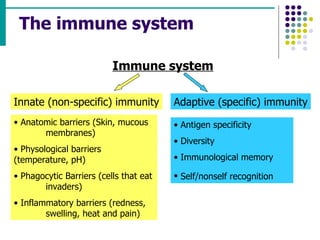
The immune system Immune system Anatomic barriers (Skin, mucous  membranes)   Physological barriers  (temperature, pH)   Phagocytic Barriers (cells that eat  invaders)   Inflammatory barriers (redness,  swelling, heat and pain)   Antigen specificity   Diversity   Immunological memory   Self/nonself recognition   Innate (non-specific) immunity Adaptive (specific) immunity
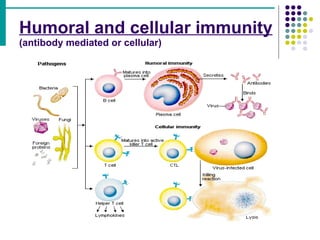
Humoral and cellular immunity   (antibody mediated or cellular)
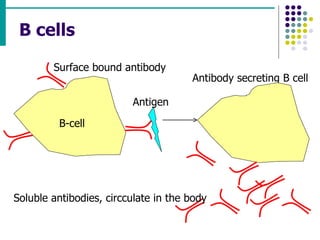
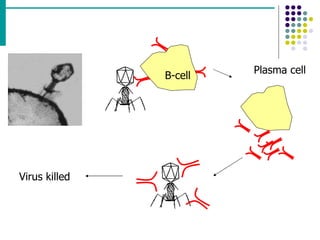
B cells B-cell Surface bound antibody Antigen Antibody secreting B cell Soluble antibodies, circculate in the body
Plasma cell Virus killed B-cell
T cells Two types: Helper T cells (Th): activates other cells Cytotoxic T cells (Tc): can kill other cells T cells can only recognize antigens associated with certain molecules (MHC)
Presentation of antigens  to T cells Proteins (peptides) from inside the cell are presented by MHC I molecules to Tc cells. Proteins (peptides) from the outside of cells are presented by MHC II molecules to Th cells. MHC I on almost all cells MHC II on specialized antigen-presenting cells
ACQUIRED   IMMUNITY The resistance that an individual acquires during life Two types : 1. Active Immunity 2. Passive Immunity Active Immunity  : Resistance developed as a result of antigenic stimulus Passive Immunity  : Resistance transmitted passively in ready made form
Active Immunity   - Adaptive immunity : Adaptive response of  host  to specific pathogen or antigen - Active functioning of the host’s immune  apparatus, synthesis  antibodies and  immunologically active cells - Latent period - Negative phase - Long lasting - Secondary response is faster - Immunological memory - More effective and gives better protection
  Passive Immunity   Ready made form of immunity Recipients immune system plays no active role No antigenic stimulus No latent period, protection effective immediately No negative phase Transient , lasting for few weeks to days No secondary response, diminishes with repetition Less effective and Inferior o active immunity Acts immediately and ‘Instant form of Immunity’
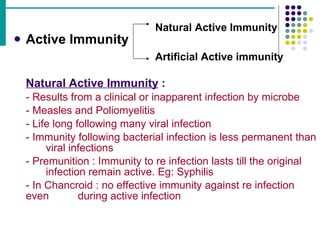
Active Immunity Natural Active Immunity  : - Results from a clinical or inapparent infection by microbe - Measles and Poliomyelitis - Life long following many viral infection - Immunity following bacterial infection is less permanent than  viral infections - Premunition : Immunity to re infection lasts till the original  infection remain active. Eg: Syphilis - In Chancroid : no effective immunity against re infection  even  during active infection Natural Active Immunity Artificial Active immunity
Artificial Active Immunity -  Resistance induced by  Vaccines  – live or  killed microorganisms or their products -  Live vaccines   :  Parallels natural infection - Gives protection for a long period - requires booster doses -  Killed vaccines  :  Less immunogenic - Protection lasts for a short period - Repeated doses required - Parenteral administration required to initiate  humoral antibody response
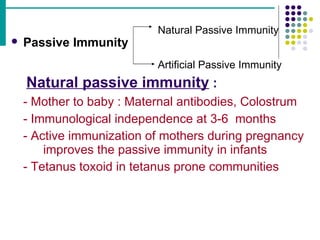
Passive Immunity     Natural passive immunity   : - Mother to baby : Maternal antibodies, Colostrum - Immunological independence at 3-6  months - Active immunization of mothers during pregnancy  improves the passive immunity in infants - Tetanus toxoid in tetanus prone communities Natural Passive Immunity Artificial Passive Immunity
Artificial Passive Immunity  : Administration of antibodies - Hyper immune sera - Hyper immune globulin - Convalescent sera - Pooled Human gamma globulin Treatment of infections in non immune persons Confers immediate and Temporary protection Suppression of active immunity in  Erythroblastosis fetalis
Passive Immunity Antibodies are obtained from someone else Conferred naturally from a mother to her foetus Conferred artificially from immune serum or gamma globulin Immunological memory does not occur Protection provided by “borrowed antibodies” is temporary.
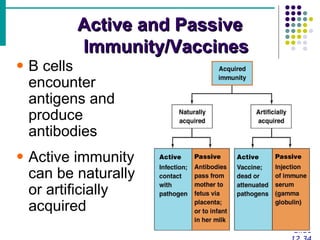
Active and Passive Immunity/Vaccines Slide 12.34 B cells encounter antigens and produce antibodies Active immunity can be naturally or artificially acquired
Combined Immunization :   Active & Passive Adoptive immunity :   Injection of immunologically competent lymphocytes (Transfer factor) Measurement of immunity - Antibody titers by - Agglutination & Precipitation - CFT, HI - NT & ELISA Local Immunity Herd Immunity

Acquired immunity

  • 1.
  • 2.
    The immune systemImmune system Anatomic barriers (Skin, mucous membranes) Physological barriers (temperature, pH) Phagocytic Barriers (cells that eat invaders) Inflammatory barriers (redness, swelling, heat and pain) Antigen specificity Diversity Immunological memory Self/nonself recognition Innate (non-specific) immunity Adaptive (specific) immunity
  • 3.
    Humoral and cellularimmunity (antibody mediated or cellular)
  • 4.
    B cells B-cellSurface bound antibody Antigen Antibody secreting B cell Soluble antibodies, circculate in the body
  • 5.
    Plasma cell Viruskilled B-cell
  • 6.
    T cells Twotypes: Helper T cells (Th): activates other cells Cytotoxic T cells (Tc): can kill other cells T cells can only recognize antigens associated with certain molecules (MHC)
  • 7.
    Presentation of antigens to T cells Proteins (peptides) from inside the cell are presented by MHC I molecules to Tc cells. Proteins (peptides) from the outside of cells are presented by MHC II molecules to Th cells. MHC I on almost all cells MHC II on specialized antigen-presenting cells
  • 8.
    ACQUIRED IMMUNITY The resistance that an individual acquires during life Two types : 1. Active Immunity 2. Passive Immunity Active Immunity : Resistance developed as a result of antigenic stimulus Passive Immunity : Resistance transmitted passively in ready made form
  • 9.
    Active Immunity - Adaptive immunity : Adaptive response of host to specific pathogen or antigen - Active functioning of the host’s immune apparatus, synthesis antibodies and immunologically active cells - Latent period - Negative phase - Long lasting - Secondary response is faster - Immunological memory - More effective and gives better protection
  • 10.
    PassiveImmunity Ready made form of immunity Recipients immune system plays no active role No antigenic stimulus No latent period, protection effective immediately No negative phase Transient , lasting for few weeks to days No secondary response, diminishes with repetition Less effective and Inferior o active immunity Acts immediately and ‘Instant form of Immunity’
  • 11.
    Active Immunity NaturalActive Immunity : - Results from a clinical or inapparent infection by microbe - Measles and Poliomyelitis - Life long following many viral infection - Immunity following bacterial infection is less permanent than viral infections - Premunition : Immunity to re infection lasts till the original infection remain active. Eg: Syphilis - In Chancroid : no effective immunity against re infection even during active infection Natural Active Immunity Artificial Active immunity
  • 12.
    Artificial Active Immunity- Resistance induced by Vaccines – live or killed microorganisms or their products - Live vaccines : Parallels natural infection - Gives protection for a long period - requires booster doses - Killed vaccines : Less immunogenic - Protection lasts for a short period - Repeated doses required - Parenteral administration required to initiate humoral antibody response
  • 13.
    Passive Immunity Natural passive immunity : - Mother to baby : Maternal antibodies, Colostrum - Immunological independence at 3-6 months - Active immunization of mothers during pregnancy improves the passive immunity in infants - Tetanus toxoid in tetanus prone communities Natural Passive Immunity Artificial Passive Immunity
  • 14.
    Artificial Passive Immunity : Administration of antibodies - Hyper immune sera - Hyper immune globulin - Convalescent sera - Pooled Human gamma globulin Treatment of infections in non immune persons Confers immediate and Temporary protection Suppression of active immunity in Erythroblastosis fetalis
  • 15.
    Passive Immunity Antibodiesare obtained from someone else Conferred naturally from a mother to her foetus Conferred artificially from immune serum or gamma globulin Immunological memory does not occur Protection provided by “borrowed antibodies” is temporary.
  • 16.
    Active and PassiveImmunity/Vaccines Slide 12.34 B cells encounter antigens and produce antibodies Active immunity can be naturally or artificially acquired
  • 17.
    Combined Immunization : Active & Passive Adoptive immunity : Injection of immunologically competent lymphocytes (Transfer factor) Measurement of immunity - Antibody titers by - Agglutination & Precipitation - CFT, HI - NT & ELISA Local Immunity Herd Immunity

Editor's Notes

  • #3 We will focus on adaptive responses. All these feature of an adaptive response require very specific interactions of molecules. Will describe B and T cells and their roles. Immunological memory - vaccination
  • #4 The important difference between B and T cells is how they can recognize antigens.
  • #5 • Antibody producing, have membrane bound antibodies, proliferation......., memory – plasma, point out the molecular interactions.
  • #7 • Has a T-cell receptor – only recognition of antigens together with MHC molecules. Explain how this work and the difference between class I and class II molecules. Point out the importance of molecular interaction. Explain how Th cells can help B cells - drawing
  • #8 Draw the pictures!!!!