GymnospermsGymnosperms
Gymnosperms
“Naked Seed Plants”
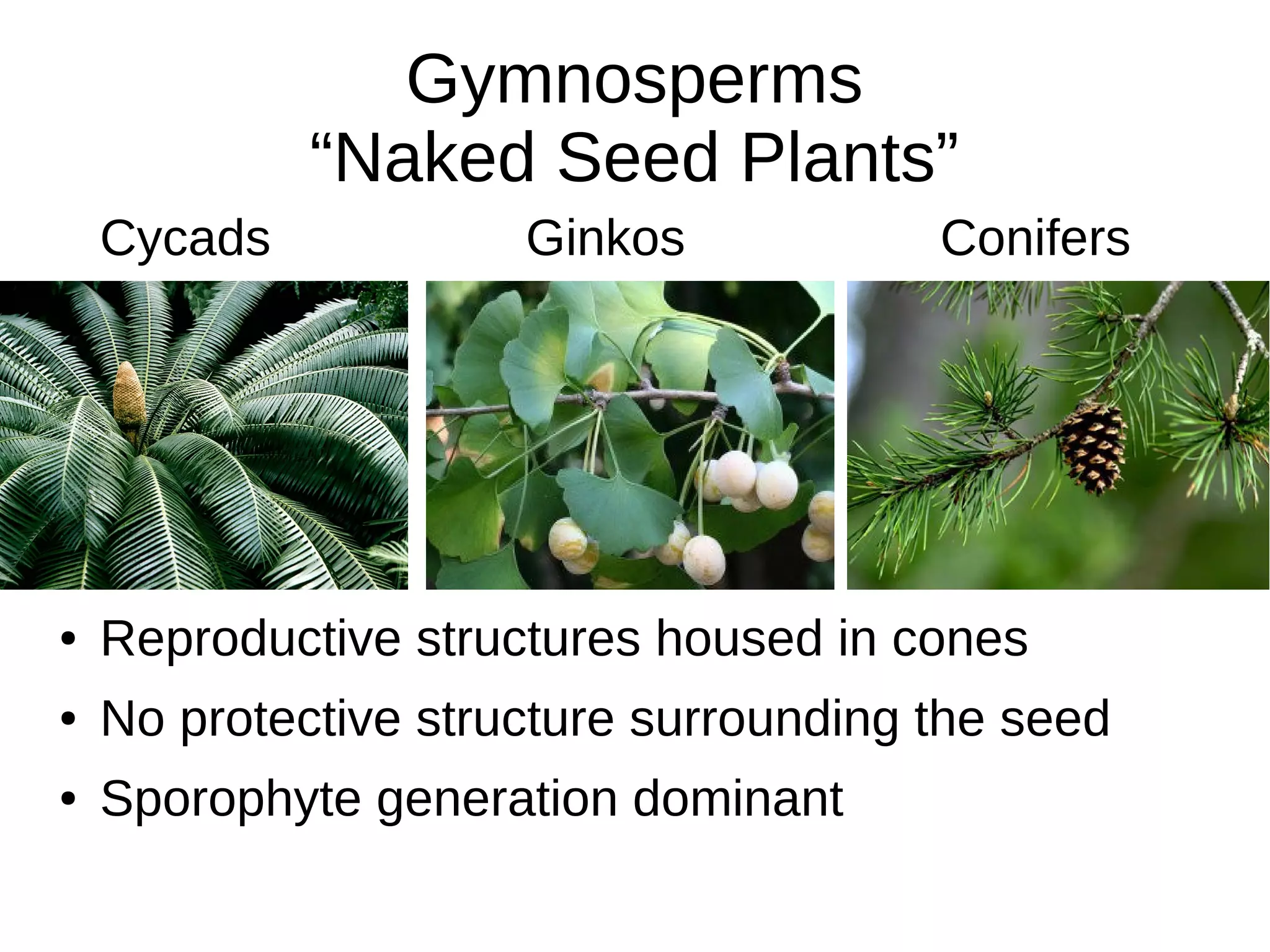
Cycads Ginkos Conifers
● Reproductive structures housed in cones
● No protective structure surrounding the seed
● Sporophyte generation dominant
Adaptation to Life on Land
● Woody growth – Support large plant and position
leaves (needles) optimally for photosynthesis
● Needles – Modified leaves
- Less surface area for water loss
- Covered by a waxy cuticle
● Roots – Strong woody system allows for optimal
collection of water and nutrients
● Pollen – Male gametes transported by wind or
pollinators instead of swimming in water
● Seeds – embryo enclosed with stored food allows for
greater survival & germination
Adaptation to Life on Land
● Woody growth – Support large plant and
position leaves (needles) optimally for
photosynthesis
● Needles – Modified leaves
- Less surface area for water loss
- Covered by a waxy cuticle
● Roots – Shallow, wide root system allows for
optimal collection of water and nutrients where
soil is poor/thin
● Seeds – embryo enclosed with stored food
allows for greater survival & germination
Woody Stems
Woody Stems
https://youtu.be/mbdur2TjTbk - Tree Rings
Needles
Gymnosperm Life Cycle
● Typical gymnosperms are monoecious and produce
heterospores from male and female cones
● Male cones give rise to microspores, which produce pollen
grains (meiosis)
● Female cones give rise to megaspores, which produce
ovules (meiosis)
● Pollen grains land on the female cone (pollination)
Gymnosperm Life Cycle
● Pollen tube develops from the pollen grain to initiate
fertilization; the pollen grain divides into two sperm
cells by mitosis; one of the sperm cells unites with the
egg cell during fertilization.
● Fertilized ovule develops into diploid sporophyte
embryo
● Seed that is formed is made up of three tissues: the
seed coat (parent sporophyte), food (gametophyte),
and the embryo (new sporophyte).
Gymnosperm Life Cycle
Gymnosperm Seed

Gymnosperms

  • 1.
  • 2.
    Gymnosperms “Naked Seed Plants” CycadsGinkos Conifers ● Reproductive structures housed in cones ● No protective structure surrounding the seed ● Sporophyte generation dominant
  • 3.
    Adaptation to Lifeon Land ● Woody growth – Support large plant and position leaves (needles) optimally for photosynthesis ● Needles – Modified leaves - Less surface area for water loss - Covered by a waxy cuticle ● Roots – Strong woody system allows for optimal collection of water and nutrients ● Pollen – Male gametes transported by wind or pollinators instead of swimming in water ● Seeds – embryo enclosed with stored food allows for greater survival & germination
  • 4.
    Adaptation to Lifeon Land ● Woody growth – Support large plant and position leaves (needles) optimally for photosynthesis ● Needles – Modified leaves - Less surface area for water loss - Covered by a waxy cuticle ● Roots – Shallow, wide root system allows for optimal collection of water and nutrients where soil is poor/thin ● Seeds – embryo enclosed with stored food allows for greater survival & germination
  • 5.
  • 6.
  • 7.
  • 8.
  • 9.
    Gymnosperm Life Cycle ●Typical gymnosperms are monoecious and produce heterospores from male and female cones ● Male cones give rise to microspores, which produce pollen grains (meiosis) ● Female cones give rise to megaspores, which produce ovules (meiosis) ● Pollen grains land on the female cone (pollination)
  • 10.
    Gymnosperm Life Cycle ●Pollen tube develops from the pollen grain to initiate fertilization; the pollen grain divides into two sperm cells by mitosis; one of the sperm cells unites with the egg cell during fertilization. ● Fertilized ovule develops into diploid sporophyte embryo ● Seed that is formed is made up of three tissues: the seed coat (parent sporophyte), food (gametophyte), and the embryo (new sporophyte).
  • 11.
  • 12.