1 of 41

© Boardworks Ltd 2006
• Pathogens
• Microorganisms that cause diseases
• Commensals
• Those that live in harmony with the host
without causing any damage to it

2 of 41

© Boardworks Ltd 2006
INFECTION

• Lodging and multiplication of pathogens in or
on tissues of a host

3 of 41

© Boardworks Ltd 2006
Primary infection

• Infection that develops in an otherwise healthy
host

4 of 41

© Boardworks Ltd 2006
Re - infection

• Infection by the same organism again in the
same host

5 of 41

© Boardworks Ltd 2006
Secondary infection

• Infection in the host affected by primary
infection by a new organism

6 of 41

© Boardworks Ltd 2006
Disease-causing organisms
Organisms that cause disease are called pathogens.
What are the four major types of pathogen?

bacteria

fungi

protozoa
virus
7 of 41

© Boardworks Ltd 2006
How do pathogens cause illness?
Pathogens cause illness in three main ways:
Toxins
Toxins are harmful substances produced by the pathogen
that poison the body’s tissue and enzymes.
Reproduction
A rise in the number of pathogens can damage a cell, even
causing it to burst. Some pathogens hijack resources that the
cell needs to survive.
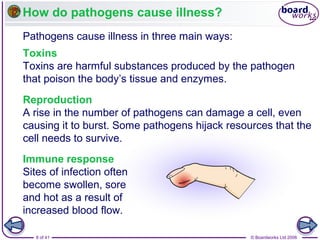
Immune response
Sites of infection often
become swollen, sore
and hot as a result of
increased blood flow.
8 of 41

© Boardworks Ltd 2006
How are pathogens spread?
Different pathogens have different transmission routes:

insect bites
food and water

direct contact
9 of 41

airborne droplets

indirect contact
© Boardworks Ltd 2006
Immunity to
Infection
Fighting infection
How does the body fight infection?

11 of 41

© Boardworks Ltd 2006
Immunity to Infection
• Immunity is the acquired ability to defend
against infection by disease-causing
organisms.
Overview of your immune system
•

First line of defense: Physical barriers that viruses, bacteria must cross
– skin covers ~2 m2
– Mucous membranes that line digestive, respiratory, reproductive tracts cover
~400 m2

•

Second line of defense: Innate immune system (germline-encoded
receptors -- no adaptation to specific pathogens)
– Macrophages (Greek for “big eater”), neutrophils, natural killer (NK) cells

•

Third line of defense (vertebrates only): Adaptive immune system
(adapts to defend against specific pathogens using variable receptors)
– B cells make antibodies that vary -- can make an antibody specific for any
new antigen
– T cells mediate cellular responses using variable receptors (T cell receptors;
TCRs)
First line of defence

14 of 41

© Boardworks Ltd 2006
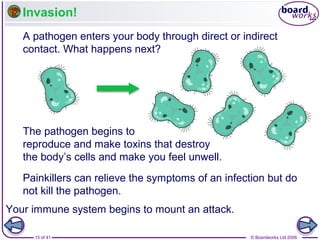
Invasion!
A pathogen enters your body through direct or indirect
contact. What happens next?

The pathogen begins to
reproduce and make toxins that destroy
the body’s cells and make you feel unwell.
Painkillers can relieve the symptoms of an infection but do
not kill the pathogen.
Your immune system begins to mount an attack.
15 of 41

© Boardworks Ltd 2006
Second line of defence – Innate immunity
Macrophages

16 of 41

© Boardworks Ltd 2006
Second line of defence - Natural killer (NK) cells

•

Can kill tumor cells, virus-infected cells, bacteria, parasites, fungi in
tissues

•

Identify targets based on “missing self”
– Two types of NK receptors: inhibitory and activating
– If inhibitory receptor recognizes a self protein (a class I MHC molecule) on a target
cell, the NK cell is turned OFF even if activating receptor binds a ligand on the
same target cell
– If activating receptor binds a ligand, but inhibitory receptor does not (target cell has
down-regulated class I MHC proteins), NK cells kill
– Many virally-infected cells and tumor cells down-regulate expression of class I
MHC molecules (NK cells important for preventing cancers)

17 of 41

© Boardworks Ltd 2006
Resisting attack
TB bacteria have a number of adaptations that enable them
to resist phagocytosis:
 They produce chemicals that prevent macrophages from
being attracted to sites of infection.
 They have a waxy cell wall that resists enzyme attack
and secretes chemicals that block lysosomes from fusing
with phagosomes.

How does the immune system deal with these bacteria?

18 of 41

© Boardworks Ltd 2006
Third line of defence - Lymphocytes
Lymphocytes are a type of white blood cell found in the
blood or lymph nodes and made by bone marrow. There are
several types of lymphocyte, including:
 T-lymphocytes – recognise antigens
on pathogens and either attack them
directly or co-ordinate the activity of
other cells of the immune system.

 B-lymphocytes – recognise
antigens and produce special
chemicals called antibodies.

19 of 41

© Boardworks Ltd 2006
B lymphocytes
Antibodies are special
Y-shaped proteins
produced by
B-lymphocytes in
response to antigens.
Antibodies work by binding to antigens on pathogens,
‘labelling’ them and causing them to clump together.
The pathogen can then be destroyed by:
 phagocytosis by macrophages
 T-lymphocytes
 the antibodies themselves.
20 of 41

© Boardworks Ltd 2006
Antibodies
Each different type of antigen causes a different type of
antibody to be produced.
An antibody can only bind to the antigen that caused it to be
produced.

21 of 41

© Boardworks Ltd 2006
Delayed response
The B-lymphocyte that produces the correct antibody for the
antigen begins dividing to produce many more antibodyproducing cells.
It takes a few days to produce enough
antibodies to destroy the pathogen. This
means there is delay between infection
and the person beginning to feel better.

Once a pathogen has been destroyed, a few memory cells
remain. These recognize the pathogen if it re-infects, and
make the immune response much quicker and more effective.
This is called active immunity.
22 of 41

© Boardworks Ltd 2006
Antibody levels during infection

23 of 41

© Boardworks Ltd 2006
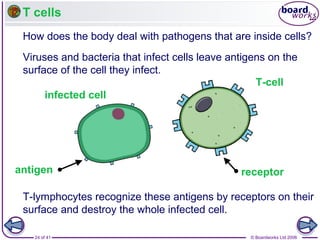
T cells
How does the body deal with pathogens that are inside cells?
Viruses and bacteria that infect cells leave antigens on the
surface of the cell they infect.
T-cell
infected cell

antigen

receptor

T-lymphocytes recognize these antigens by receptors on their
surface and destroy the whole infected cell.
24 of 41

© Boardworks Ltd 2006
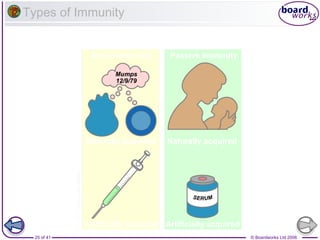
Types of Immunity

Active immunity

Passive immunity

Naturally acquired

Naturally acquired

Artificially acquired Artificially acquired
25 of 41

© Boardworks Ltd 2006
Types of Immunity
• Natural immunity is the result of a body’s previous
encounter with an organism.
• Artificial immunity results from the injection of a
vaccine or an antibody. Vaccines stimulate active
immunity whereas injection antibody or antiserum is
an example of passive immunity.

26 of 41

© Boardworks Ltd 2006
Types of Immunity
• Active immunity is when the immune system
encounters and antigen and is primed to recognise it
and destroy it quickly the next time it is encountered.
This is active immunity because the body’s immune
system prepares itself for future challenges.
• Passive immunity is short-term and involves the
transfer of immunity from one individual to
another via antibody-rich serum. This may be
artificial as is the case with anti-venom or natural, as
in antibodies crossing the placenta to protect the
developing foetus.

27 of 41

© Boardworks Ltd 2006
Immunity
Active immunity
Production of a person’s own
antibodies. Long lasting
Natural Active
Artificial Active
When pathogen
Vaccination – usually
enters body in the contains a safe antigen
normal way, we
from the pathogen.
make antibodies
Person makes
antibodies without
becoming ill

Passive immunity
An individual is given antibodies by another
Short-term resistance (weeks- 6months)

Natural Passive
Baby in utero
(placenta)
Breast-fed babies

Artificial Passive
Gamma globulin
injection
Extremely fast, but
short lived (e.g. snake
venom)

Edward Jenner
28 of 41

© Boardworks Ltd 2006
Passive immunity
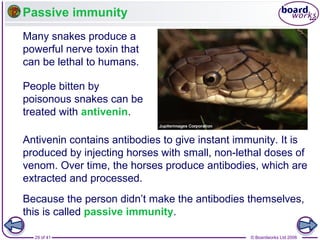
Many snakes produce a
powerful nerve toxin that
can be lethal to humans.
People bitten by
poisonous snakes can be
treated with antivenin.
Antivenin contains antibodies to give instant immunity. It is
produced by injecting horses with small, non-lethal doses of
venom. Over time, the horses produce antibodies, which are
extracted and processed.
Because the person didn’t make the antibodies themselves,
this is called passive immunity.
29 of 41

© Boardworks Ltd 2006
What are vaccines?
Vaccines contain a small amount of dead or weakened
pathogen particles.
A vaccine stimulates the production of
antibodies and memory cells against the
target pathogen, without making the
person ill.
If a vaccinated person is later infected
by the same pathogen, their immune
system can destroy it very quickly.
Parents of two-year-old children are offered a combined
measles, mumps and rubella (MMR) vaccine to protect their
child. What has happened to MMR vaccination rates recently?
30 of 41

© Boardworks Ltd 2006
Measles, mumps and rubella
MMR vaccination rates used
to be high, but fell following a
media scare story.

The media reported on
controversial research
speculating that MMR
could cause autism, a
behavioural disorder
causing learning and
communication difficulties.

31 of 41

© Boardworks Ltd 2006
Glossary (1/2)
antibiotic – A drug that can destroy or prevent the growth
of bacteria.

antibody – A Y-shaped protein produced by the body that
binds to antigens.

antigen – A substance on pathogens that stimulates the
production of antibodies.

B-lymphocyte – A white blood cell that produces
antibodies.

immunization – The process of protecting against
infection by using a vaccine.

immune response – The body’s defence against foreign
material such as pathogens.
32 of 41

© Boardworks Ltd 2006
Glossary (2/2)
immunity – The ability to fight infection by pathogens. It
can be active or passive.

pathogen – A disease-causing micro-organism.
phagocytosis – The process where a type of white blood
cell called a macrophage ingests and destroys a pathogen.

T-lymphocyte – A type of white blood cell that recognises
and destroys pathogens, and co-ordinates the immune
response.

tuberculosis – A serious bacterial disease that mainly
affects the respiratory system.

vaccine – A small amount of dead or weakened pathogen
that stimulates antibody production.
33 of 41

© Boardworks Ltd 2006
Multiple-choice quiz

34 of 41

© Boardworks Ltd 2006
• Please read after going back
• Things here are highly volatile

35 of 41

© Boardworks Ltd 2006

infections and immunity

  • 1.
    1 of 41 ©Boardworks Ltd 2006
  • 2.
    • Pathogens • Microorganismsthat cause diseases • Commensals • Those that live in harmony with the host without causing any damage to it 2 of 41 © Boardworks Ltd 2006
  • 3.
    INFECTION • Lodging andmultiplication of pathogens in or on tissues of a host 3 of 41 © Boardworks Ltd 2006
  • 4.
    Primary infection • Infectionthat develops in an otherwise healthy host 4 of 41 © Boardworks Ltd 2006
  • 5.
    Re - infection •Infection by the same organism again in the same host 5 of 41 © Boardworks Ltd 2006
  • 6.
    Secondary infection • Infectionin the host affected by primary infection by a new organism 6 of 41 © Boardworks Ltd 2006
  • 7.
    Disease-causing organisms Organisms thatcause disease are called pathogens. What are the four major types of pathogen? bacteria fungi protozoa virus 7 of 41 © Boardworks Ltd 2006
  • 8.
    How do pathogenscause illness? Pathogens cause illness in three main ways: Toxins Toxins are harmful substances produced by the pathogen that poison the body’s tissue and enzymes. Reproduction A rise in the number of pathogens can damage a cell, even causing it to burst. Some pathogens hijack resources that the cell needs to survive. Immune response Sites of infection often become swollen, sore and hot as a result of increased blood flow. 8 of 41 © Boardworks Ltd 2006
  • 9.
    How are pathogensspread? Different pathogens have different transmission routes: insect bites food and water direct contact 9 of 41 airborne droplets indirect contact © Boardworks Ltd 2006
  • 10.
  • 11.
    Fighting infection How doesthe body fight infection? 11 of 41 © Boardworks Ltd 2006
  • 12.
    Immunity to Infection •Immunity is the acquired ability to defend against infection by disease-causing organisms.
  • 13.
    Overview of yourimmune system • First line of defense: Physical barriers that viruses, bacteria must cross – skin covers ~2 m2 – Mucous membranes that line digestive, respiratory, reproductive tracts cover ~400 m2 • Second line of defense: Innate immune system (germline-encoded receptors -- no adaptation to specific pathogens) – Macrophages (Greek for “big eater”), neutrophils, natural killer (NK) cells • Third line of defense (vertebrates only): Adaptive immune system (adapts to defend against specific pathogens using variable receptors) – B cells make antibodies that vary -- can make an antibody specific for any new antigen – T cells mediate cellular responses using variable receptors (T cell receptors; TCRs)
  • 14.
    First line ofdefence 14 of 41 © Boardworks Ltd 2006
  • 15.
    Invasion! A pathogen entersyour body through direct or indirect contact. What happens next? The pathogen begins to reproduce and make toxins that destroy the body’s cells and make you feel unwell. Painkillers can relieve the symptoms of an infection but do not kill the pathogen. Your immune system begins to mount an attack. 15 of 41 © Boardworks Ltd 2006
  • 16.
    Second line ofdefence – Innate immunity Macrophages 16 of 41 © Boardworks Ltd 2006
  • 17.
    Second line ofdefence - Natural killer (NK) cells • Can kill tumor cells, virus-infected cells, bacteria, parasites, fungi in tissues • Identify targets based on “missing self” – Two types of NK receptors: inhibitory and activating – If inhibitory receptor recognizes a self protein (a class I MHC molecule) on a target cell, the NK cell is turned OFF even if activating receptor binds a ligand on the same target cell – If activating receptor binds a ligand, but inhibitory receptor does not (target cell has down-regulated class I MHC proteins), NK cells kill – Many virally-infected cells and tumor cells down-regulate expression of class I MHC molecules (NK cells important for preventing cancers) 17 of 41 © Boardworks Ltd 2006
  • 18.
    Resisting attack TB bacteriahave a number of adaptations that enable them to resist phagocytosis:  They produce chemicals that prevent macrophages from being attracted to sites of infection.  They have a waxy cell wall that resists enzyme attack and secretes chemicals that block lysosomes from fusing with phagosomes. How does the immune system deal with these bacteria? 18 of 41 © Boardworks Ltd 2006
  • 19.
    Third line ofdefence - Lymphocytes Lymphocytes are a type of white blood cell found in the blood or lymph nodes and made by bone marrow. There are several types of lymphocyte, including:  T-lymphocytes – recognise antigens on pathogens and either attack them directly or co-ordinate the activity of other cells of the immune system.  B-lymphocytes – recognise antigens and produce special chemicals called antibodies. 19 of 41 © Boardworks Ltd 2006
  • 20.
    B lymphocytes Antibodies arespecial Y-shaped proteins produced by B-lymphocytes in response to antigens. Antibodies work by binding to antigens on pathogens, ‘labelling’ them and causing them to clump together. The pathogen can then be destroyed by:  phagocytosis by macrophages  T-lymphocytes  the antibodies themselves. 20 of 41 © Boardworks Ltd 2006
  • 21.
    Antibodies Each different typeof antigen causes a different type of antibody to be produced. An antibody can only bind to the antigen that caused it to be produced. 21 of 41 © Boardworks Ltd 2006
  • 22.
    Delayed response The B-lymphocytethat produces the correct antibody for the antigen begins dividing to produce many more antibodyproducing cells. It takes a few days to produce enough antibodies to destroy the pathogen. This means there is delay between infection and the person beginning to feel better. Once a pathogen has been destroyed, a few memory cells remain. These recognize the pathogen if it re-infects, and make the immune response much quicker and more effective. This is called active immunity. 22 of 41 © Boardworks Ltd 2006
  • 23.
    Antibody levels duringinfection 23 of 41 © Boardworks Ltd 2006
  • 24.
    T cells How doesthe body deal with pathogens that are inside cells? Viruses and bacteria that infect cells leave antigens on the surface of the cell they infect. T-cell infected cell antigen receptor T-lymphocytes recognize these antigens by receptors on their surface and destroy the whole infected cell. 24 of 41 © Boardworks Ltd 2006
  • 25.
    Types of Immunity Activeimmunity Passive immunity Naturally acquired Naturally acquired Artificially acquired Artificially acquired 25 of 41 © Boardworks Ltd 2006
  • 26.
    Types of Immunity •Natural immunity is the result of a body’s previous encounter with an organism. • Artificial immunity results from the injection of a vaccine or an antibody. Vaccines stimulate active immunity whereas injection antibody or antiserum is an example of passive immunity. 26 of 41 © Boardworks Ltd 2006
  • 27.
    Types of Immunity •Active immunity is when the immune system encounters and antigen and is primed to recognise it and destroy it quickly the next time it is encountered. This is active immunity because the body’s immune system prepares itself for future challenges. • Passive immunity is short-term and involves the transfer of immunity from one individual to another via antibody-rich serum. This may be artificial as is the case with anti-venom or natural, as in antibodies crossing the placenta to protect the developing foetus. 27 of 41 © Boardworks Ltd 2006
  • 28.
    Immunity Active immunity Production ofa person’s own antibodies. Long lasting Natural Active Artificial Active When pathogen Vaccination – usually enters body in the contains a safe antigen normal way, we from the pathogen. make antibodies Person makes antibodies without becoming ill Passive immunity An individual is given antibodies by another Short-term resistance (weeks- 6months) Natural Passive Baby in utero (placenta) Breast-fed babies Artificial Passive Gamma globulin injection Extremely fast, but short lived (e.g. snake venom) Edward Jenner 28 of 41 © Boardworks Ltd 2006
  • 29.
    Passive immunity Many snakesproduce a powerful nerve toxin that can be lethal to humans. People bitten by poisonous snakes can be treated with antivenin. Antivenin contains antibodies to give instant immunity. It is produced by injecting horses with small, non-lethal doses of venom. Over time, the horses produce antibodies, which are extracted and processed. Because the person didn’t make the antibodies themselves, this is called passive immunity. 29 of 41 © Boardworks Ltd 2006
  • 30.
    What are vaccines? Vaccinescontain a small amount of dead or weakened pathogen particles. A vaccine stimulates the production of antibodies and memory cells against the target pathogen, without making the person ill. If a vaccinated person is later infected by the same pathogen, their immune system can destroy it very quickly. Parents of two-year-old children are offered a combined measles, mumps and rubella (MMR) vaccine to protect their child. What has happened to MMR vaccination rates recently? 30 of 41 © Boardworks Ltd 2006
  • 31.
    Measles, mumps andrubella MMR vaccination rates used to be high, but fell following a media scare story. The media reported on controversial research speculating that MMR could cause autism, a behavioural disorder causing learning and communication difficulties. 31 of 41 © Boardworks Ltd 2006
  • 32.
    Glossary (1/2) antibiotic –A drug that can destroy or prevent the growth of bacteria. antibody – A Y-shaped protein produced by the body that binds to antigens. antigen – A substance on pathogens that stimulates the production of antibodies. B-lymphocyte – A white blood cell that produces antibodies. immunization – The process of protecting against infection by using a vaccine. immune response – The body’s defence against foreign material such as pathogens. 32 of 41 © Boardworks Ltd 2006
  • 33.
    Glossary (2/2) immunity –The ability to fight infection by pathogens. It can be active or passive. pathogen – A disease-causing micro-organism. phagocytosis – The process where a type of white blood cell called a macrophage ingests and destroys a pathogen. T-lymphocyte – A type of white blood cell that recognises and destroys pathogens, and co-ordinates the immune response. tuberculosis – A serious bacterial disease that mainly affects the respiratory system. vaccine – A small amount of dead or weakened pathogen that stimulates antibody production. 33 of 41 © Boardworks Ltd 2006
  • 34.
    Multiple-choice quiz 34 of41 © Boardworks Ltd 2006
  • 35.
    • Please readafter going back • Things here are highly volatile 35 of 41 © Boardworks Ltd 2006

Editor's Notes

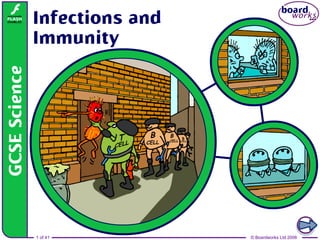
  • #12 Teacher notes This illustration contains several discussion points relating to the immune response. Pathogens inside the building are holding a couple of white blood cells hostage. Outside, one of the pathogens has been caught (i.e. recognized) by a T-cell, who is co-ordinating the attack (immune response) on the rest of the pathogens. B-cells ( the riot police) are awaiting instructions from the T-cell. The clubs held by the B-cells represent antibodies that they will use to attack the pathogens.
  • #17 Teacher notes This five-stage animation illustrates the process of phagocytosis of a bacterium by a macrophage. Suitable prompts could include: How does the macrophage know to ingest the bacterium? How does the macrophage envelop the bacterium? How could the macrophage safely destroy the bacterium?
  • #24 Teacher notes Students could be asked to draw predicted graphs on mini whiteboards and then compare them with these graphs to consolidate their understanding of the previous slide.
  • #29 Gamma globulin – from animals
  • #30 Photo credit: © 2006 Jupiterimages Corporation
  • #32 Photo credit: © 2006 Jupiterimages Corporation
  • #35 Teacher notes This multiple-choice quiz could be used as a plenary activity to assess students’ understanding of infections and immunity. The questions can be skipped through without answering by clicking “next”. Students could be asked to complete the questions in their books and the activity could be concluded by the completion on the IWB.