Defending against infection Jo Stafferton Suitable for GCSE AQA Biology 4411 (does  not  include information on the nature of pathogens or viruses, you’ll need to find that yourself!)
Passive immunity There are a number of different ways the body protects itself against pathogens. Definition:  Pathogen -  micro-organisms that cause disease. The first defence is  passive immunity , which tries to stop the pathogen entering the body. The body’s passive immunity systems include: The skin which acts a physical barrier. Mucus and cilia in the respiratory system which trap and move along bacteria. Hydrochloric acid in the stomach. Enzymes (lysozyme) in tears
Active immunity If the pathogen manages to get past the past immunity defences, then active immunity becomes involved. White blood cells play a key role in active immunity. Remember to use the word  ingest  not  eat   White blood cells White blood cells can: Ingest  pathogens and destroy them. Produce  antibodies  to destroy pathogens. Produce  antitoxins  that neutralise the toxins produced by the pathogens.
White Blood Cells White blood cells can be put into two main groups. 1.  Phagocytes  or  Macrophages 2.  Lymphocytes
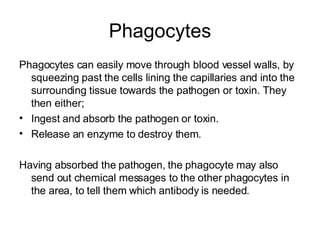
Phagocytes Phagocytes can easily move through blood vessel walls, by squeezing past the cells lining the capillaries and into the surrounding tissue towards the pathogen or toxin. They then either; Ingest and absorb the pathogen or toxin. Release an enzyme to destroy them. Having absorbed the pathogen, the phagocyte may also send out chemical messages to the other phagocytes in the area, to tell them which antibody is needed.
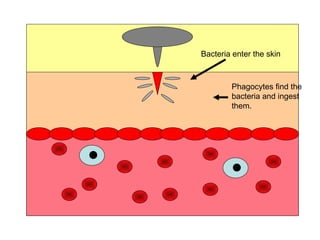
Bacteria enter the skin Phagocytes find the bacteria and ingest them.
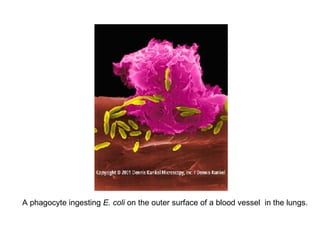
A phagocyte ingesting  E. coli  on the outer surface of a blood vessel  in the lungs.
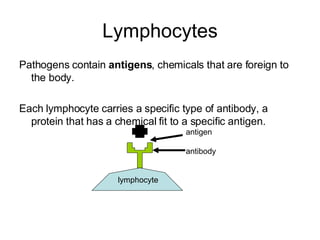
Lymphocytes Pathogens contain  antigens , chemicals that are foreign to the body.  Each lymphocyte carries a specific type of antibody, a protein that has a chemical fit to a specific antigen. antigen antibody lymphocyte
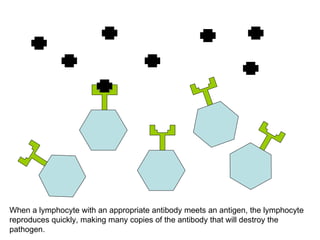
When a lymphocyte with an appropriate antibody meets an antigen, the lymphocyte  reproduces quickly, making many copies of the antibody that will destroy the pathogen.
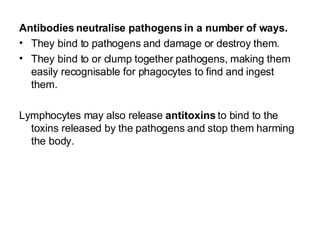
Antibodies neutralise pathogens in a number of ways. They bind to pathogens and damage or destroy them. They bind to or clump together pathogens, making them easily recognisable for phagocytes to find and ingest them. Lymphocytes may also release  antitoxins  to bind to the toxins released by the pathogens and stop them harming the body.
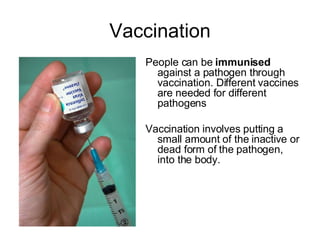
Vaccination People can be  immunised  against a pathogen through vaccination. Different vaccines are needed for different pathogens   Vaccination involves putting a small amount of the inactive or dead form of the pathogen,  into the body.
Vaccines can contain:   live pathogens treated to make them harmless  harmless fragments of the pathogen  toxins produced by pathogens  dead pathogens.  These all act as antigens.  When the vaccine is injected into the body, it stimulates the white blood cells to produce antibodies against the pathogen.  
Antibiotics  Antibiotics  are substances that kill  bacteria  or stop their growth. They do not work against  viruses . An example of an antibiotic is Penicillin Penicillin, discovered in 1928 by Alexander Fleming was the first antibiotic to be discovered. He noticed that some bacteria he had left in a petri dish had been killed by the naturally occurring  penicillium  mould.   Penicillin damaged the bacteria. Since the discovery of penicillin, many other antibiotics have now been discovered or developed.
Resistance Bacteria can develop resistance to antibiotics via natural selection. In a large population of bacteria, there may be some bacteria that are not affected by the antibiotic, they survive and go onto reproduce, producing even more bacteria that have inherited the trait of being resistant to the antibiotic.   MRSA is methicillin-resistant  Staphylococcus aureus . It is very dangerous because it is resistant to most antibiotics.  Antibiotics must not be overused, if we are to slow down, or stop, the increase in resistant bacteria. Other drugs Other drugs such as aspirin, cold ‘cures’ etc. can be taken to ease the symptoms of an infectious illness but they do not affect the pathogen directly
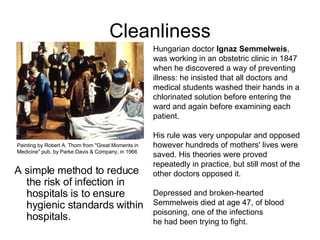
Cleanliness A simple method to reduce the risk of infection in hospitals is to ensure hygienic standards within hospitals.  Hungarian doctor  Ignaz Semmelweis , was working in an obstetric clinic in 1847 when he discovered a way of preventing illness: he insisted that all doctors and medical students washed their hands in a chlorinated solution before entering the ward and again before examining each patient.  His rule was very unpopular and opposed however hundreds of mothers' lives were saved. His theories were proved repeatedly in practice, but still most of the other doctors opposed it.  Depressed and broken-hearted Semmelweis died at age 47, of blood poisoning, one of the infections  he had been trying to fight.  Painting by Robert A. Thom from "Great Moments in Medicine" pub. by Parke Davis & Company, in 1966
Sources BBC Bitesize http://www.bbc.co.uk/schools/gcsebitesize/science/aqa/human/defendingagainstinfectionrev1.shtml Art in the teaching of microbiology http://www.personal.psu.edu/jel5/micro/art.htm Plus worth watching Video on the possible bird flu pandemic http://news.bbc.co.uk/player/nol/newsid_4880000/newsid_4886700/4886720.stm?bw=bb&mp=wm&nol_storyid=4886720&news=1

Defending Against Infection

  • 1.
    Defending against infectionJo Stafferton Suitable for GCSE AQA Biology 4411 (does not include information on the nature of pathogens or viruses, you’ll need to find that yourself!)
  • 2.
    Passive immunity Thereare a number of different ways the body protects itself against pathogens. Definition: Pathogen - micro-organisms that cause disease. The first defence is passive immunity , which tries to stop the pathogen entering the body. The body’s passive immunity systems include: The skin which acts a physical barrier. Mucus and cilia in the respiratory system which trap and move along bacteria. Hydrochloric acid in the stomach. Enzymes (lysozyme) in tears
  • 3.
    Active immunity Ifthe pathogen manages to get past the past immunity defences, then active immunity becomes involved. White blood cells play a key role in active immunity. Remember to use the word ingest not eat White blood cells White blood cells can: Ingest pathogens and destroy them. Produce antibodies to destroy pathogens. Produce antitoxins that neutralise the toxins produced by the pathogens.
  • 4.
    White Blood CellsWhite blood cells can be put into two main groups. 1. Phagocytes or Macrophages 2. Lymphocytes
  • 5.
    Phagocytes Phagocytes caneasily move through blood vessel walls, by squeezing past the cells lining the capillaries and into the surrounding tissue towards the pathogen or toxin. They then either; Ingest and absorb the pathogen or toxin. Release an enzyme to destroy them. Having absorbed the pathogen, the phagocyte may also send out chemical messages to the other phagocytes in the area, to tell them which antibody is needed.
  • 6.
    Bacteria enter theskin Phagocytes find the bacteria and ingest them.
  • 7.
    A phagocyte ingesting E. coli on the outer surface of a blood vessel in the lungs.
  • 8.
    Lymphocytes Pathogens contain antigens , chemicals that are foreign to the body. Each lymphocyte carries a specific type of antibody, a protein that has a chemical fit to a specific antigen. antigen antibody lymphocyte
  • 9.
    When a lymphocytewith an appropriate antibody meets an antigen, the lymphocyte reproduces quickly, making many copies of the antibody that will destroy the pathogen.
  • 10.
    Antibodies neutralise pathogensin a number of ways. They bind to pathogens and damage or destroy them. They bind to or clump together pathogens, making them easily recognisable for phagocytes to find and ingest them. Lymphocytes may also release antitoxins to bind to the toxins released by the pathogens and stop them harming the body.
  • 11.
    Vaccination People canbe immunised against a pathogen through vaccination. Different vaccines are needed for different pathogens   Vaccination involves putting a small amount of the inactive or dead form of the pathogen, into the body.
  • 12.
    Vaccines can contain:  live pathogens treated to make them harmless harmless fragments of the pathogen toxins produced by pathogens dead pathogens. These all act as antigens. When the vaccine is injected into the body, it stimulates the white blood cells to produce antibodies against the pathogen.  
  • 13.
    Antibiotics Antibiotics are substances that kill bacteria or stop their growth. They do not work against viruses . An example of an antibiotic is Penicillin Penicillin, discovered in 1928 by Alexander Fleming was the first antibiotic to be discovered. He noticed that some bacteria he had left in a petri dish had been killed by the naturally occurring penicillium mould.   Penicillin damaged the bacteria. Since the discovery of penicillin, many other antibiotics have now been discovered or developed.
  • 14.
    Resistance Bacteria candevelop resistance to antibiotics via natural selection. In a large population of bacteria, there may be some bacteria that are not affected by the antibiotic, they survive and go onto reproduce, producing even more bacteria that have inherited the trait of being resistant to the antibiotic.   MRSA is methicillin-resistant Staphylococcus aureus . It is very dangerous because it is resistant to most antibiotics. Antibiotics must not be overused, if we are to slow down, or stop, the increase in resistant bacteria. Other drugs Other drugs such as aspirin, cold ‘cures’ etc. can be taken to ease the symptoms of an infectious illness but they do not affect the pathogen directly
  • 15.
    Cleanliness A simplemethod to reduce the risk of infection in hospitals is to ensure hygienic standards within hospitals. Hungarian doctor Ignaz Semmelweis , was working in an obstetric clinic in 1847 when he discovered a way of preventing illness: he insisted that all doctors and medical students washed their hands in a chlorinated solution before entering the ward and again before examining each patient. His rule was very unpopular and opposed however hundreds of mothers' lives were saved. His theories were proved repeatedly in practice, but still most of the other doctors opposed it. Depressed and broken-hearted Semmelweis died at age 47, of blood poisoning, one of the infections he had been trying to fight. Painting by Robert A. Thom from "Great Moments in Medicine" pub. by Parke Davis & Company, in 1966
  • 16.
    Sources BBC Bitesizehttp://www.bbc.co.uk/schools/gcsebitesize/science/aqa/human/defendingagainstinfectionrev1.shtml Art in the teaching of microbiology http://www.personal.psu.edu/jel5/micro/art.htm Plus worth watching Video on the possible bird flu pandemic http://news.bbc.co.uk/player/nol/newsid_4880000/newsid_4886700/4886720.stm?bw=bb&mp=wm&nol_storyid=4886720&news=1