PHYLUM ARTHROPODS
“JOINTED LEGS”
PHYLUM ARTHROPODA
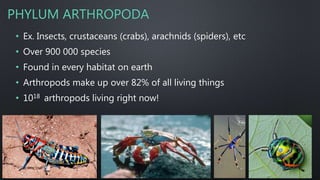
• Ex. Insects, crustaceans (crabs), arachnids (spiders), etc
• Over 900 000 species
• Found in every habitat on earth
• Arthropods make up over 82% of all living things
• 1018 arthropods living right now!
ARTHROPOD CHARACTERISTICS
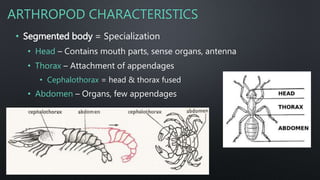
• Segmented body = Specialization
• Head – Contains mouth parts, sense organs, antenna
• Thorax – Attachment of appendages
• Cephalothorax = head & thorax fused
• Abdomen – Organs, few appendages
ARTHROPOD CHARACTERISTICS
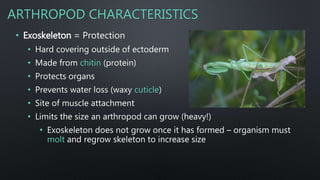
• Exoskeleton = Protection
• Hard covering outside of ectoderm
• Made from chitin (protein)
• Protects organs
• Prevents water loss (waxy cuticle)
• Site of muscle attachment
• Limits the size an arthropod can grow (heavy!)
• Exoskeleton does not grow once it has formed – organism must
molt and regrow skeleton to increase size
ARTHROPOD CHARACTERISTICS
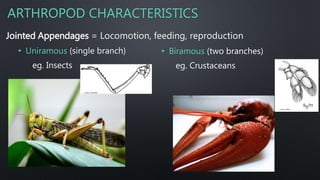
Jointed Appendages = Locomotion, feeding, reproduction
• Uniramous (single branch)
eg. Insects
• Biramous (two branches)
eg. Crustaceans
ARTHROPOD CHARACTERISTICS
• Body Type: Bilateral Symmetry
• Body Organization: Triploblastic (3 layers)
• Body Cavity: Coelom (fluid filled cavity fully lined by mesoderm)
ARTHROPOD CHARACTERISTICS
• Digestive System
• Complete – Mouth and anus separate
• Specialized by segmentation
• Specialized mouthparts
• Chelicera – Piercing, sucking or Mandible – Biting, chewing
ARTHROPOD CHARACTERISTICS
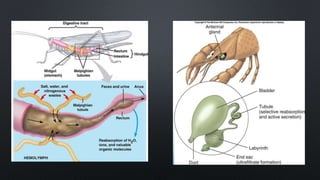
• Excretory System
• Anus
• Malpighian Tubules (terrestrial)
• Nitrogenous wastes crystalized and combined with feces
• Conserve water
• Green Gland (aquatic)
• Concentrates nitrogenous wastes
• Excreted nead base of antennae
ARTHROPOD CHARACTERISTICS
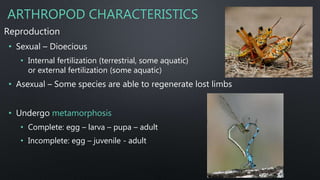
Reproduction
• Sexual – Dioecious
• Internal fertilization (terrestrial, some aquatic)
or external fertilization (some aquatic)
• Asexual – Some species are able to regenerate lost limbs
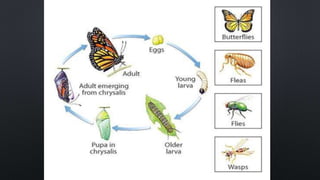
• Undergo metamorphosis
• Complete: egg – larva – pupa – adult
• Incomplete: egg – juvenile - adult
ARTHROPOD CHARACTERISTICS
• Nervous System
• Brain
• Ventral nerve cord
• Specialized sensory organs
• Antenna
• Compound eyes & ocelli
• Olfactory organs
ARTHROPOD CHARACTERISTICS
• Respiration
• Aquatic - Gills
• Terrestrial – Book lungs (arachnids)
– Trachea/Spiracles (insects)
ARTHROPOD CHARACTERISTICS
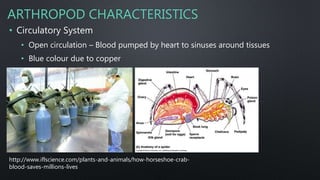
• Circulatory System
• Open circulation – Blood pumped by heart to sinuses around tissues
• Blue colour due to copper
http://www.iflscience.com/plants-and-animals/how-horseshoe-crab-
blood-saves-millions-lives
ARTHROPOD CHARACTERISTICS
• Ecological Roles
• Predators/Prey
• Parasites/Vectors (lice, ticks, mosquitos)
• Food source
• Agricultural pests (locusts, catepillars, beetles, )
• Pollinators (bees, butterflies)
• Produce honey, silk
• Medical uses (bee pollen, crab blood)

Phylum arthropoda characteristics

  • 1.
  • 2.
    PHYLUM ARTHROPODA • Ex.Insects, crustaceans (crabs), arachnids (spiders), etc • Over 900 000 species • Found in every habitat on earth • Arthropods make up over 82% of all living things • 1018 arthropods living right now!
  • 3.
    ARTHROPOD CHARACTERISTICS • Segmentedbody = Specialization • Head – Contains mouth parts, sense organs, antenna • Thorax – Attachment of appendages • Cephalothorax = head & thorax fused • Abdomen – Organs, few appendages
  • 4.
    ARTHROPOD CHARACTERISTICS • Exoskeleton= Protection • Hard covering outside of ectoderm • Made from chitin (protein) • Protects organs • Prevents water loss (waxy cuticle) • Site of muscle attachment • Limits the size an arthropod can grow (heavy!) • Exoskeleton does not grow once it has formed – organism must molt and regrow skeleton to increase size
  • 5.
    ARTHROPOD CHARACTERISTICS Jointed Appendages= Locomotion, feeding, reproduction • Uniramous (single branch) eg. Insects • Biramous (two branches) eg. Crustaceans
  • 6.
    ARTHROPOD CHARACTERISTICS • BodyType: Bilateral Symmetry • Body Organization: Triploblastic (3 layers) • Body Cavity: Coelom (fluid filled cavity fully lined by mesoderm)
  • 7.
    ARTHROPOD CHARACTERISTICS • DigestiveSystem • Complete – Mouth and anus separate • Specialized by segmentation • Specialized mouthparts • Chelicera – Piercing, sucking or Mandible – Biting, chewing
  • 9.
    ARTHROPOD CHARACTERISTICS • ExcretorySystem • Anus • Malpighian Tubules (terrestrial) • Nitrogenous wastes crystalized and combined with feces • Conserve water • Green Gland (aquatic) • Concentrates nitrogenous wastes • Excreted nead base of antennae
  • 11.
    ARTHROPOD CHARACTERISTICS Reproduction • Sexual– Dioecious • Internal fertilization (terrestrial, some aquatic) or external fertilization (some aquatic) • Asexual – Some species are able to regenerate lost limbs • Undergo metamorphosis • Complete: egg – larva – pupa – adult • Incomplete: egg – juvenile - adult
  • 14.
    ARTHROPOD CHARACTERISTICS • NervousSystem • Brain • Ventral nerve cord • Specialized sensory organs • Antenna • Compound eyes & ocelli • Olfactory organs
  • 15.
    ARTHROPOD CHARACTERISTICS • Respiration •Aquatic - Gills • Terrestrial – Book lungs (arachnids) – Trachea/Spiracles (insects)
  • 16.
    ARTHROPOD CHARACTERISTICS • CirculatorySystem • Open circulation – Blood pumped by heart to sinuses around tissues • Blue colour due to copper http://www.iflscience.com/plants-and-animals/how-horseshoe-crab- blood-saves-millions-lives
  • 18.
    ARTHROPOD CHARACTERISTICS • EcologicalRoles • Predators/Prey • Parasites/Vectors (lice, ticks, mosquitos) • Food source • Agricultural pests (locusts, catepillars, beetles, ) • Pollinators (bees, butterflies) • Produce honey, silk • Medical uses (bee pollen, crab blood)