The Immune SystemThe Immune System
Objectives: Define and ComprehendObjectives: Define and Comprehend
 Nonspecific vs. specific immunityNonspecific vs. specific immunity
responsesresponses
 Different types of nonspecific responsesDifferent types of nonspecific responses
 Humoral vs. cell-mediated immunityHumoral vs. cell-mediated immunity
Nonspecific vs. specificNonspecific vs. specific
defensesdefenses
 NonspecificNonspecific defenses do not distinguishdefenses do not distinguish
one infectious microbe from anotherone infectious microbe from another
 SpecificSpecific defenses recognize and defenddefenses recognize and defend
against invading microbes and canceragainst invading microbes and cancer
cellscells
1 minute brain storm1 minute brain storm
 What is an immune system?What is an immune system?
 What are the components of an immuneWhat are the components of an immune
system?system?
Nonspecific defensesNonspecific defenses
 Skin is a barrier that most bacteria andSkin is a barrier that most bacteria and
viruses can’t penetrateviruses can’t penetrate
 Acids secreted by skin prohibit growth ofAcids secreted by skin prohibit growth of
many microbesmany microbes
 Sweat, saliva, and tears contain enzymes thatSweat, saliva, and tears contain enzymes that
attack bacterial cell wallsattack bacterial cell walls
 Mucus produced in digestive andMucus produced in digestive and
respiratory systems also protects againstrespiratory systems also protects against
microbesmicrobes
Nonspecific defensesNonspecific defenses
 Microbes that penetrate skin, digestive, orMicrobes that penetrate skin, digestive, or
respiratory systems face neutrophils andrespiratory systems face neutrophils and
monocytesmonocytes
 macrophages that “eat” bacteria and virusesmacrophages that “eat” bacteria and viruses
 Interferons and complement proteinsInterferons and complement proteins
attack microbes either directly or indirectlyattack microbes either directly or indirectly
by impeding their reproductionby impeding their reproduction
Nonspecific defensesNonspecific defenses
 Interferons are produced by infected cellsInterferons are produced by infected cells
 Diffuse to healthy cells where they cause theDiffuse to healthy cells where they cause the
cell to inhibit viral productioncell to inhibit viral production
 Complement proteins are activated byComplement proteins are activated by
microbes or immune systemmicrobes or immune system
 Coat infected cells –easier to eatCoat infected cells –easier to eat
 Can amplify inflammatory responseCan amplify inflammatory response
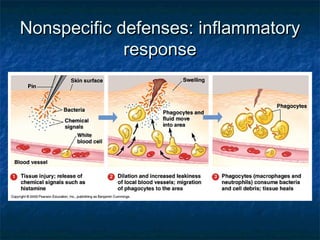
Nonspecific defenses: inflammatoryNonspecific defenses: inflammatory
responseresponse
Nonspecific defenses: inflammatoryNonspecific defenses: inflammatory
responseresponse
 Redness, heat, and swelling caused byRedness, heat, and swelling caused by
 Increase in blood flow, fluid, and cellsIncrease in blood flow, fluid, and cells
 Inflammatory response disinfects andInflammatory response disinfects and
cleans injured tissuescleans injured tissues
 Pus = dead white cells and fluidPus = dead white cells and fluid
 Systemic response is widespreadSystemic response is widespread
 Toxins or microorganisms released inToxins or microorganisms released in
bloodstreambloodstream
 Circulates through bodyCirculates through body
Nonspecific defenses: inflammatoryNonspecific defenses: inflammatory
responseresponse
 Systemic response cont’d.Systemic response cont’d.
 Inflammatory weapons: increase white bloodInflammatory weapons: increase white blood
cells, fevercells, fever
 Low-grade fever can stimulate phagocytosis andLow-grade fever can stimulate phagocytosis and
inhibit growth of many microorganismsinhibit growth of many microorganisms
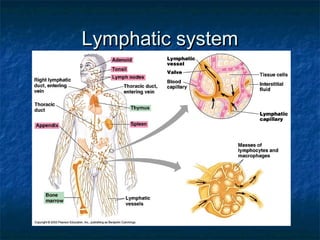
Lymphatic systemLymphatic system
 Involved in both specific and nonspecificInvolved in both specific and nonspecific
responsesresponses
 Lymphatic system defenses occur in lymphLymphatic system defenses occur in lymph
nodes and lymphatic system organsnodes and lymphatic system organs
 Packed with lymphocytes and macrophagesPacked with lymphocytes and macrophages
 Lymph carries microbes from infection sites and someLymph carries microbes from infection sites and some
cancer cellscancer cells
 In the lymphatic organs, macrophages may “eat” theIn the lymphatic organs, macrophages may “eat” the
invaders (nonspecific)invaders (nonspecific)
 Lymphocytes can be involved in specific immuneLymphocytes can be involved in specific immune
responseresponse
Lymphatic systemLymphatic system
 Why do your lymph nodes swell when youWhy do your lymph nodes swell when you
are fighting certain kinds of infections?are fighting certain kinds of infections?
 Production of lymphocytes in nodesProduction of lymphocytes in nodes
Specific immunitySpecific immunity
 Often more effective than nonspecific responseOften more effective than nonspecific response
 It also amplifies nonspecific responseIt also amplifies nonspecific response
 Specific response begins due to presence of anSpecific response begins due to presence of an
antigenantigen
 Can either increase number of cells that attackCan either increase number of cells that attack
invader directly ORinvader directly OR
 Produce antibodiesProduce antibodies
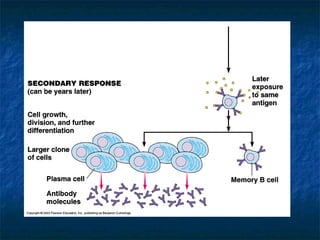
 Immune system “remembers” antigens it hasImmune system “remembers” antigens it has
previously encounteredpreviously encountered
 Responds immediately and vigorouslyResponds immediately and vigorously
 Is adaptiveIs adaptive
Specific ImmunitySpecific Immunity
 Vaccines:Vaccines:
D:VaccinesVaccines.mpgD:VaccinesVaccines.mpg
Objectives: Define & ComprehendObjectives: Define & Comprehend
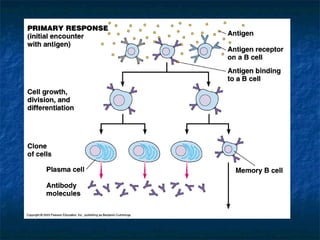
 Role of clonal selection in immunity responseRole of clonal selection in immunity response
 Primary vs. secondary responsePrimary vs. secondary response
 AntibodiesAntibodies
 T cellsT cells
 Autoimmune vs. immunodeficiency diseasesAutoimmune vs. immunodeficiency diseases
 AllergiesAllergies
 HIV/AIDSHIV/AIDS
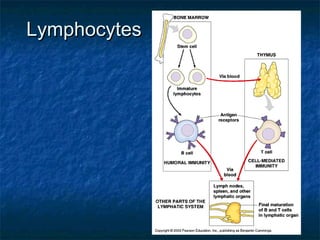
LymphocytesLymphocytes
Specific Immunity: LymphocytesSpecific Immunity: Lymphocytes
 Humoral systemHumoral system defends againstdefends against
bacteria and viruses present in body fluidsbacteria and viruses present in body fluids
 Fluids: blood, lymph, and interstitial fluidFluids: blood, lymph, and interstitial fluid
 Antibodies,Antibodies, secreted by B cellssecreted by B cells and dissolvedand dissolved
in the blood, are carried in lymph and blood toin the blood, are carried in lymph and blood to
sites of infectionssites of infections
 Cell-mediated immunityCell-mediated immunity
 T-cells circulate in blood and lymphT-cells circulate in blood and lymph
 Attack body cellsAttack body cells that have been infectedthat have been infected
Specific Immunity: LymphocytesSpecific Immunity: Lymphocytes
 For BOTH humoral and cell-mediatedFor BOTH humoral and cell-mediated
immunityimmunity
 B & T cells have antigen receptorsB & T cells have antigen receptors
(antibodies) that protrude from cell surface(antibodies) that protrude from cell surface
 specific for one type of antigen**specific for one type of antigen**
 Each person has between 100 million to 100Each person has between 100 million to 100
billion different kinds of B & T cells!billion different kinds of B & T cells!
AntigensAntigens
 Most antigens are molecules that areMost antigens are molecules that are
present on viral surfaces or foreign cellspresent on viral surfaces or foreign cells
 B cells respond to free antigens in bodyB cells respond to free antigens in body
fluidfluid
 Different antibodies can bind to the sameDifferent antibodies can bind to the same
antigenantigen
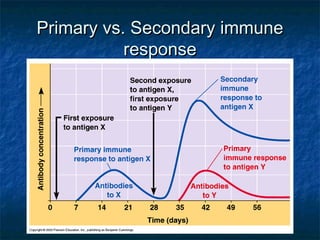
Primary vs. Secondary immunePrimary vs. Secondary immune
responseresponse
QuestionQuestion
 Why are “childhood” diseases referred toWhy are “childhood” diseases referred to
as such?as such?
 First exposure occurs during childhood, whichFirst exposure occurs during childhood, which
then confers immunity during remaining yearsthen confers immunity during remaining years
of the individual’s lifeof the individual’s life
How do antibodies block invaders?How do antibodies block invaders?
 Antibodies bond to antigen molecules,Antibodies bond to antigen molecules,
which marks them and results in either:which marks them and results in either:
 An increase in the possibility of phagocytosisAn increase in the possibility of phagocytosis
 Activation of complement proteins that canActivation of complement proteins that can
cause the invader’s cell to rupture***cause the invader’s cell to rupture***
 D:ImageLibrary16-2624-TheImmuneSystem24-11-AntibodiesAnim.movD:ImageLibrary16-2624-TheImmuneSystem24-11-AntibodiesAnim.mov
Role of T cells in ImmunityRole of T cells in Immunity
 T cells battle pathogens that haveT cells battle pathogens that have alreadyalready
entered body cellsentered body cells
 Respond to antigens that have bonded toRespond to antigens that have bonded to
body cell surfacesbody cell surfaces
 Mount cell-mediated defense and aid humoralMount cell-mediated defense and aid humoral
immunityimmunity
T cellsT cells
 Cytotoxic T cellsCytotoxic T cells
 Only T cells that kill other cellsOnly T cells that kill other cells
 Synthesize a protein that ruptures infected cellSynthesize a protein that ruptures infected cell
 Helper T cellsHelper T cells
 Secrete stimulatory proteins that helpSecrete stimulatory proteins that help
 Promote production of more helper T cells andPromote production of more helper T cells and
memory cellsmemory cells
 Activate cytotoxic T cellsActivate cytotoxic T cells
 Stimulate B cells to produce antibodiesStimulate B cells to produce antibodies
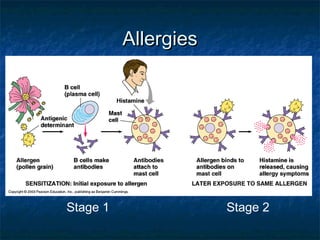
AllergiesAllergies
Stage 1 Stage 2

Immune system

  • 1.
    The Immune SystemTheImmune System
  • 2.
    Objectives: Define andComprehendObjectives: Define and Comprehend  Nonspecific vs. specific immunityNonspecific vs. specific immunity responsesresponses  Different types of nonspecific responsesDifferent types of nonspecific responses  Humoral vs. cell-mediated immunityHumoral vs. cell-mediated immunity
  • 3.
    Nonspecific vs. specificNonspecificvs. specific defensesdefenses  NonspecificNonspecific defenses do not distinguishdefenses do not distinguish one infectious microbe from anotherone infectious microbe from another  SpecificSpecific defenses recognize and defenddefenses recognize and defend against invading microbes and canceragainst invading microbes and cancer cellscells
  • 4.
    1 minute brainstorm1 minute brain storm  What is an immune system?What is an immune system?  What are the components of an immuneWhat are the components of an immune system?system?
  • 5.
    Nonspecific defensesNonspecific defenses Skin is a barrier that most bacteria andSkin is a barrier that most bacteria and viruses can’t penetrateviruses can’t penetrate  Acids secreted by skin prohibit growth ofAcids secreted by skin prohibit growth of many microbesmany microbes  Sweat, saliva, and tears contain enzymes thatSweat, saliva, and tears contain enzymes that attack bacterial cell wallsattack bacterial cell walls  Mucus produced in digestive andMucus produced in digestive and respiratory systems also protects againstrespiratory systems also protects against microbesmicrobes
  • 6.
    Nonspecific defensesNonspecific defenses Microbes that penetrate skin, digestive, orMicrobes that penetrate skin, digestive, or respiratory systems face neutrophils andrespiratory systems face neutrophils and monocytesmonocytes  macrophages that “eat” bacteria and virusesmacrophages that “eat” bacteria and viruses  Interferons and complement proteinsInterferons and complement proteins attack microbes either directly or indirectlyattack microbes either directly or indirectly by impeding their reproductionby impeding their reproduction
  • 7.
    Nonspecific defensesNonspecific defenses Interferons are produced by infected cellsInterferons are produced by infected cells  Diffuse to healthy cells where they cause theDiffuse to healthy cells where they cause the cell to inhibit viral productioncell to inhibit viral production  Complement proteins are activated byComplement proteins are activated by microbes or immune systemmicrobes or immune system  Coat infected cells –easier to eatCoat infected cells –easier to eat  Can amplify inflammatory responseCan amplify inflammatory response
  • 8.
    Nonspecific defenses: inflammatoryNonspecificdefenses: inflammatory responseresponse
  • 9.
    Nonspecific defenses: inflammatoryNonspecificdefenses: inflammatory responseresponse  Redness, heat, and swelling caused byRedness, heat, and swelling caused by  Increase in blood flow, fluid, and cellsIncrease in blood flow, fluid, and cells  Inflammatory response disinfects andInflammatory response disinfects and cleans injured tissuescleans injured tissues  Pus = dead white cells and fluidPus = dead white cells and fluid  Systemic response is widespreadSystemic response is widespread  Toxins or microorganisms released inToxins or microorganisms released in bloodstreambloodstream  Circulates through bodyCirculates through body
  • 10.
    Nonspecific defenses: inflammatoryNonspecificdefenses: inflammatory responseresponse  Systemic response cont’d.Systemic response cont’d.  Inflammatory weapons: increase white bloodInflammatory weapons: increase white blood cells, fevercells, fever  Low-grade fever can stimulate phagocytosis andLow-grade fever can stimulate phagocytosis and inhibit growth of many microorganismsinhibit growth of many microorganisms
  • 11.
  • 12.
    Lymphatic systemLymphatic system Involved in both specific and nonspecificInvolved in both specific and nonspecific responsesresponses  Lymphatic system defenses occur in lymphLymphatic system defenses occur in lymph nodes and lymphatic system organsnodes and lymphatic system organs  Packed with lymphocytes and macrophagesPacked with lymphocytes and macrophages  Lymph carries microbes from infection sites and someLymph carries microbes from infection sites and some cancer cellscancer cells  In the lymphatic organs, macrophages may “eat” theIn the lymphatic organs, macrophages may “eat” the invaders (nonspecific)invaders (nonspecific)  Lymphocytes can be involved in specific immuneLymphocytes can be involved in specific immune responseresponse
  • 13.
    Lymphatic systemLymphatic system Why do your lymph nodes swell when youWhy do your lymph nodes swell when you are fighting certain kinds of infections?are fighting certain kinds of infections?  Production of lymphocytes in nodesProduction of lymphocytes in nodes
  • 14.
    Specific immunitySpecific immunity Often more effective than nonspecific responseOften more effective than nonspecific response  It also amplifies nonspecific responseIt also amplifies nonspecific response  Specific response begins due to presence of anSpecific response begins due to presence of an antigenantigen  Can either increase number of cells that attackCan either increase number of cells that attack invader directly ORinvader directly OR  Produce antibodiesProduce antibodies  Immune system “remembers” antigens it hasImmune system “remembers” antigens it has previously encounteredpreviously encountered  Responds immediately and vigorouslyResponds immediately and vigorously  Is adaptiveIs adaptive
  • 15.
    Specific ImmunitySpecific Immunity Vaccines:Vaccines: D:VaccinesVaccines.mpgD:VaccinesVaccines.mpg
  • 16.
    Objectives: Define &ComprehendObjectives: Define & Comprehend  Role of clonal selection in immunity responseRole of clonal selection in immunity response  Primary vs. secondary responsePrimary vs. secondary response  AntibodiesAntibodies  T cellsT cells  Autoimmune vs. immunodeficiency diseasesAutoimmune vs. immunodeficiency diseases  AllergiesAllergies  HIV/AIDSHIV/AIDS
  • 17.
  • 18.
    Specific Immunity: LymphocytesSpecificImmunity: Lymphocytes  Humoral systemHumoral system defends againstdefends against bacteria and viruses present in body fluidsbacteria and viruses present in body fluids  Fluids: blood, lymph, and interstitial fluidFluids: blood, lymph, and interstitial fluid  Antibodies,Antibodies, secreted by B cellssecreted by B cells and dissolvedand dissolved in the blood, are carried in lymph and blood toin the blood, are carried in lymph and blood to sites of infectionssites of infections  Cell-mediated immunityCell-mediated immunity  T-cells circulate in blood and lymphT-cells circulate in blood and lymph  Attack body cellsAttack body cells that have been infectedthat have been infected
  • 19.
    Specific Immunity: LymphocytesSpecificImmunity: Lymphocytes  For BOTH humoral and cell-mediatedFor BOTH humoral and cell-mediated immunityimmunity  B & T cells have antigen receptorsB & T cells have antigen receptors (antibodies) that protrude from cell surface(antibodies) that protrude from cell surface  specific for one type of antigen**specific for one type of antigen**  Each person has between 100 million to 100Each person has between 100 million to 100 billion different kinds of B & T cells!billion different kinds of B & T cells!
  • 20.
    AntigensAntigens  Most antigensare molecules that areMost antigens are molecules that are present on viral surfaces or foreign cellspresent on viral surfaces or foreign cells  B cells respond to free antigens in bodyB cells respond to free antigens in body fluidfluid  Different antibodies can bind to the sameDifferent antibodies can bind to the same antigenantigen
  • 21.
    Primary vs. SecondaryimmunePrimary vs. Secondary immune responseresponse
  • 24.
    QuestionQuestion  Why are“childhood” diseases referred toWhy are “childhood” diseases referred to as such?as such?  First exposure occurs during childhood, whichFirst exposure occurs during childhood, which then confers immunity during remaining yearsthen confers immunity during remaining years of the individual’s lifeof the individual’s life
  • 25.
    How do antibodiesblock invaders?How do antibodies block invaders?  Antibodies bond to antigen molecules,Antibodies bond to antigen molecules, which marks them and results in either:which marks them and results in either:  An increase in the possibility of phagocytosisAn increase in the possibility of phagocytosis  Activation of complement proteins that canActivation of complement proteins that can cause the invader’s cell to rupture***cause the invader’s cell to rupture***  D:ImageLibrary16-2624-TheImmuneSystem24-11-AntibodiesAnim.movD:ImageLibrary16-2624-TheImmuneSystem24-11-AntibodiesAnim.mov
  • 26.
    Role of Tcells in ImmunityRole of T cells in Immunity  T cells battle pathogens that haveT cells battle pathogens that have alreadyalready entered body cellsentered body cells  Respond to antigens that have bonded toRespond to antigens that have bonded to body cell surfacesbody cell surfaces  Mount cell-mediated defense and aid humoralMount cell-mediated defense and aid humoral immunityimmunity
  • 27.
    T cellsT cells Cytotoxic T cellsCytotoxic T cells  Only T cells that kill other cellsOnly T cells that kill other cells  Synthesize a protein that ruptures infected cellSynthesize a protein that ruptures infected cell  Helper T cellsHelper T cells  Secrete stimulatory proteins that helpSecrete stimulatory proteins that help  Promote production of more helper T cells andPromote production of more helper T cells and memory cellsmemory cells  Activate cytotoxic T cellsActivate cytotoxic T cells  Stimulate B cells to produce antibodiesStimulate B cells to produce antibodies
  • 28.