TELE3113 Analogue and Digital
         Communications –
         Digital Band-pass Modulation


                                    Wei Zhang
                                w.zhang@unsw.edu.au


               School of Electrical Engineering and Telecommunications
                          The University of New South Wales


29 Sept 2009
Passband Communication
•   In baseband date transmission, a sequence of bits is represented in
    the form of discrete pulse modulated wave (PAM, PPM, PWM) or
    digital baseband modulated wave (PCM, DM, DPCM) that are
    transmitted over a low-pass channel (e.g., a coaxial cable).

•   For a bandpass channel, e.g., wireless radio, microwave, satellite,
    optical fibre, we have to resort to the use of a modulation strategy
    configured around a carrier signal.

•   Passband signals are generated by modulating a baseband signal
    onto a carrier.

•   The frequency band of the transmitted signals over the channel is
    centred at the carrier frequency.
Passband Communication
• Passband Analog communication
  – A baseband analog signal is modulated onto a carrier using AM,
    FM, PM techniques.


• Passband Digital communication
  – A baseband digital signal is modulated onto a carrier using
    digital signalling techniques such as
      • ASK (Amplitude shift keying),
      • PSK (Phase shift keying),
      • FSK. (frequency shift keying),
Passband Digital Signalling
•   In digital signalling, the binary digital information is first encoded
    using a particular coding scheme, e.g. Polar NRZ, Unipolar RZ,
    Manchester, etc.

•   The code is then impressed on a carrier by using a conventional
    modulation technique.

•   For digital signalling, modulation is the switching (keying) of a
    carrier waveform parameter (amplitude, phase or frequency)
    between preset levels, whose values are discrete.

•   This impresses the code, and therefore the information, on the
    carrier.
Two types of digital signalling
Digital signalling can be
1.   Binary         (ASK, BPSK, FSK)
     The digital information is transmitted a bit at a time
2.   Multilevel (QAM, Quardrature PSK, M-ary PSK)
     Several bits are grouped together too form symbols, and then symbols are
     modulated and then transmitted as one unit.


The primary performance issues in digital transmission:
•    Optimal transmitter and receiver design,
•    Minimising average probability of symbol error,
•    spectral properties, bandwidth occupied by a modulation scheme
•    An important property of any modulation scheme is its spectral
     characteristic. This determines the bandwidth required for
     transmission.
Binary Digital Signalling
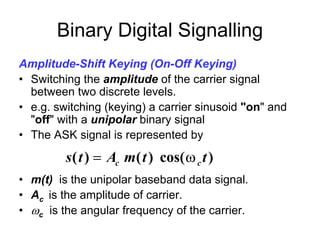
Amplitude-Shift Keying (On-Off Keying)
• Switching the amplitude of the carrier signal
  between two discrete levels.
• e.g. switching (keying) a carrier sinusoid "on" and
  "off" with a unipolar binary signal
• The ASK signal is represented by

         s ( t ) = Ac m( t ) cos( ω c t )
• m(t) is the unipolar baseband data signal.
• Ac is the amplitude of carrier.
• ωc is the angular frequency of the carrier.
• The spectrum of ASK signal, S(f), can be
  found from the Fourier transform
            ∞
• S ( f ) = ∫ A m( t ) cos( ω t )e − j 2πft dt
                   c                   c
            −∞
            ∞ A
        = ∫    c
                       m( t ) e − j 2π ( f − f c )t + e − j 2π ( f + f c )t dt
            −∞    2
            Ac
        =        (M ( f    − f c ) + M ( f + f c ))
            2

• Note: the bandwidth required to transmit
  the ASK s(t) is twice the bandwidth of the
  modulating signal m(t).
                    i.e. BT=2B
ASK & OOK
Detection of ASK
•   ASK can be generated and detected in the same fashion as AM.
•   ASK may be detected by coherent or noncoherent approaches.
Frequency-Shift Keying (FSK)
• Switching the frequency of the carrier
  signal between discrete levels.
• In FSK, each discrete level of a code is
  represented by a specific frequency.
• e.g. A binary code with two levels is
  represented by two discrete frequencies.
Frequency-Shift Keying (FSK)
• In the time domain, the FSK signal is
  represented by
                    ⎡            t
                                          ⎤
    s (t ) = Ac cos ⎢ωc t + D f ∫ m(t )dt ⎥
                    ⎣           −∞        ⎦
m(t) is the baseband data signal.
Ac is the amplitude of the carrier.
Df is the frequency deviation [rad./volt/sec].
FSK
Detection of FSK
• FSK can be detected by either coherent or
  incoherent detection
Binary Phase-Shift Keying (BPSK)
• Switching the phase of the carrier signal
  between two discrete levels. Usually the two
  levels differ by 180º.
• The BPSK signal is represented by
                     [
     s ( t ) = Ac cos ω c t + D p m( t )   ]
  m(t) is the baseband data signal.
  Ac is the amplitude of the carrier.
  Dp = is the peak phase deviation [rad./volt].
Binary Phase-Shift Keying (BPSK)
                                 ref Couch pg 343

•   let m(t) a polar signal with peak values of ± 1 and rectangular pulse
    shape. Then

                      (         )                         (         )
       s ( t ) = Ac cos D p m( t ) cos( ω c t ) − Ac sin D p m( t ) sin( ω c t )
            = Ac   cos( D ) cos( ω t ) − A
                          p          c       c      ( )
                                                 sin D p m( t ) sin( ω c t )

Since cosine is an even function.

     – The first term is called the pilot carrier term which does not
       carry any useful information --- power wasted!
     – The second term is the data term carrying the coded message.
     – The peak phase deviation Dp determines the ratio of the data to
       the pilot term.
Optimal BPSK
• To maximise the signalling power efficiency
  (large proportion of power is to be carried by the
  data term), the pilot term must be minimised, i.e.
            Dp = ∆θ = 90º = π/2

• Hence for the optimal BPSK, the signal becomes

        s ( t ) = − Ac m( t ) sin( ω c t )

• The transmitted signal phase is switched
  between two values, 0, 1800
BPSK
Detection of BPSK
• Coherent (Synchronous) detection must
  be used

                multiplier
  BPSK signal                          baseband digital signal
                                 LPF


                  cos ( ω c t)
Detection of BPSK
• If a low-level pilot carrier component is
  transmitted a PLL can be used to recover
  carrier
• Otherwise a Costas loop may be used to
  synthesise the carrier reference from this
  BPSK-SC signal
  – 180º phase ambiguity must be resolved
     • Can be accomplished by sending a known test
       signal
     • or using differential coding
Figure 3-57 Ziemer Costas phase-locked loop.
         Note: m2(t) ambiguity for ±1
Costas phase-locked loop
• Note: m2(t) thus ambiguity for ±1
• Hence loop is just as likely to phase lock
  such that the demodulated output is
  proportional to – m(t) as it is to m(t)
• Thus we cannot be sure of the polarity of
  the output and binary 1’s could be read as
  binary 0’s
Differential Phase-Shift Keying
                 (DPSK)
• Motivation of DPSK:
  – Remove the 180º phase ambiguity in
    BPSK by using differential coding at the
    Tx and differential decoding at the Rx.
  – When serial data is passed through
    many circuits along a communications
    channel the waveform is often
    unintentionally inverted
     • Often occurs during switching between
       several data paths
Differential Phase-Shift Keying
                (DPSK)
• Differential Coding
  – In differential coding, an input binary data
    sequence {dn} is encoded into differential data
    {en} determined by
               en = d n ⊕ en −1
    where ⊕ is a modulo 2 adder or exclusive OR
    gate (XOR) operation
Differential Phase-Shift Keying
                (DPSK)
• Each digit in the encoded sequence is
  obtained by comparing the present input
  bit with the past encoded bit
• A binary 1 is encoded if the present input
  bit and the past encoded bit are of
  opposite state
• A binary 0 is encoded if the states are the
  same
Differential Phase-Shift Keying
                (DPSK)
• At the receiver side, the encoded data {en} is
                                 ~
  decoded to produce the data {d n } by
               ~ ~ ~
               d n = en ⊕ en −1
     The tilde denotes data at the receiver.
• Hence the encoded signal is decoded by
  comparing the state of adjacent bits
  – If the present received encoded bit has the same
    state as the past encoded bit a binary 0 is decoded
  – A binary 1 is decoded for opposite states
General Differential Coding System
Example of Differential Coding
Generation of DPSK


                  logic network                   phase-shift keying
                                                                       DPSK signal


baseband binary data


                                                             carrier

                                  one bit delay
Detection of DPSK
                                  multiplier
           DPSK signal                                         baseband data
                                                      LPF


              one bit delay

When the baseband data is represented in polar code:
e.g. 1 --- -1v and 0 --- +1v,
the modulo 2 adder logic at the receiver side can be easily
realised using a one-bit delay and a multiplier.
              0   =   1   ⊕   1          +1    =   -1 ×   -1
              1   =   1   ⊕   0          -1    =   -1 ×   +1
              1   =   0   ⊕   1          -1    =   +1 ×   -1
              0   =   0   ⊕   0          +1    =   +1 ×   +1

Tele3113 wk10tue

  • 1.
    TELE3113 Analogue andDigital Communications – Digital Band-pass Modulation Wei Zhang w.zhang@unsw.edu.au School of Electrical Engineering and Telecommunications The University of New South Wales 29 Sept 2009
  • 2.
    Passband Communication • In baseband date transmission, a sequence of bits is represented in the form of discrete pulse modulated wave (PAM, PPM, PWM) or digital baseband modulated wave (PCM, DM, DPCM) that are transmitted over a low-pass channel (e.g., a coaxial cable). • For a bandpass channel, e.g., wireless radio, microwave, satellite, optical fibre, we have to resort to the use of a modulation strategy configured around a carrier signal. • Passband signals are generated by modulating a baseband signal onto a carrier. • The frequency band of the transmitted signals over the channel is centred at the carrier frequency.
  • 3.
    Passband Communication • PassbandAnalog communication – A baseband analog signal is modulated onto a carrier using AM, FM, PM techniques. • Passband Digital communication – A baseband digital signal is modulated onto a carrier using digital signalling techniques such as • ASK (Amplitude shift keying), • PSK (Phase shift keying), • FSK. (frequency shift keying),
  • 4.
    Passband Digital Signalling • In digital signalling, the binary digital information is first encoded using a particular coding scheme, e.g. Polar NRZ, Unipolar RZ, Manchester, etc. • The code is then impressed on a carrier by using a conventional modulation technique. • For digital signalling, modulation is the switching (keying) of a carrier waveform parameter (amplitude, phase or frequency) between preset levels, whose values are discrete. • This impresses the code, and therefore the information, on the carrier.
  • 5.
    Two types ofdigital signalling Digital signalling can be 1. Binary (ASK, BPSK, FSK) The digital information is transmitted a bit at a time 2. Multilevel (QAM, Quardrature PSK, M-ary PSK) Several bits are grouped together too form symbols, and then symbols are modulated and then transmitted as one unit. The primary performance issues in digital transmission: • Optimal transmitter and receiver design, • Minimising average probability of symbol error, • spectral properties, bandwidth occupied by a modulation scheme • An important property of any modulation scheme is its spectral characteristic. This determines the bandwidth required for transmission.
  • 6.
    Binary Digital Signalling Amplitude-ShiftKeying (On-Off Keying) • Switching the amplitude of the carrier signal between two discrete levels. • e.g. switching (keying) a carrier sinusoid "on" and "off" with a unipolar binary signal • The ASK signal is represented by s ( t ) = Ac m( t ) cos( ω c t ) • m(t) is the unipolar baseband data signal. • Ac is the amplitude of carrier. • ωc is the angular frequency of the carrier.
  • 7.
    • The spectrumof ASK signal, S(f), can be found from the Fourier transform ∞ • S ( f ) = ∫ A m( t ) cos( ω t )e − j 2πft dt c c −∞ ∞ A = ∫ c m( t ) e − j 2π ( f − f c )t + e − j 2π ( f + f c )t dt −∞ 2 Ac = (M ( f − f c ) + M ( f + f c )) 2 • Note: the bandwidth required to transmit the ASK s(t) is twice the bandwidth of the modulating signal m(t). i.e. BT=2B
  • 8.
  • 9.
    Detection of ASK • ASK can be generated and detected in the same fashion as AM. • ASK may be detected by coherent or noncoherent approaches.
  • 10.
    Frequency-Shift Keying (FSK) •Switching the frequency of the carrier signal between discrete levels. • In FSK, each discrete level of a code is represented by a specific frequency. • e.g. A binary code with two levels is represented by two discrete frequencies.
  • 11.
    Frequency-Shift Keying (FSK) •In the time domain, the FSK signal is represented by ⎡ t ⎤ s (t ) = Ac cos ⎢ωc t + D f ∫ m(t )dt ⎥ ⎣ −∞ ⎦ m(t) is the baseband data signal. Ac is the amplitude of the carrier. Df is the frequency deviation [rad./volt/sec].
  • 12.
  • 13.
    Detection of FSK •FSK can be detected by either coherent or incoherent detection
  • 14.
    Binary Phase-Shift Keying(BPSK) • Switching the phase of the carrier signal between two discrete levels. Usually the two levels differ by 180º. • The BPSK signal is represented by [ s ( t ) = Ac cos ω c t + D p m( t ) ] m(t) is the baseband data signal. Ac is the amplitude of the carrier. Dp = is the peak phase deviation [rad./volt].
  • 15.
    Binary Phase-Shift Keying(BPSK) ref Couch pg 343 • let m(t) a polar signal with peak values of ± 1 and rectangular pulse shape. Then ( ) ( ) s ( t ) = Ac cos D p m( t ) cos( ω c t ) − Ac sin D p m( t ) sin( ω c t ) = Ac cos( D ) cos( ω t ) − A p c c ( ) sin D p m( t ) sin( ω c t ) Since cosine is an even function. – The first term is called the pilot carrier term which does not carry any useful information --- power wasted! – The second term is the data term carrying the coded message. – The peak phase deviation Dp determines the ratio of the data to the pilot term.
  • 16.
    Optimal BPSK • Tomaximise the signalling power efficiency (large proportion of power is to be carried by the data term), the pilot term must be minimised, i.e. Dp = ∆θ = 90º = π/2 • Hence for the optimal BPSK, the signal becomes s ( t ) = − Ac m( t ) sin( ω c t ) • The transmitted signal phase is switched between two values, 0, 1800
  • 17.
  • 18.
    Detection of BPSK •Coherent (Synchronous) detection must be used multiplier BPSK signal baseband digital signal LPF cos ( ω c t)
  • 19.
    Detection of BPSK •If a low-level pilot carrier component is transmitted a PLL can be used to recover carrier • Otherwise a Costas loop may be used to synthesise the carrier reference from this BPSK-SC signal – 180º phase ambiguity must be resolved • Can be accomplished by sending a known test signal • or using differential coding
  • 20.
    Figure 3-57 ZiemerCostas phase-locked loop. Note: m2(t) ambiguity for ±1
  • 21.
    Costas phase-locked loop •Note: m2(t) thus ambiguity for ±1 • Hence loop is just as likely to phase lock such that the demodulated output is proportional to – m(t) as it is to m(t) • Thus we cannot be sure of the polarity of the output and binary 1’s could be read as binary 0’s
  • 22.
    Differential Phase-Shift Keying (DPSK) • Motivation of DPSK: – Remove the 180º phase ambiguity in BPSK by using differential coding at the Tx and differential decoding at the Rx. – When serial data is passed through many circuits along a communications channel the waveform is often unintentionally inverted • Often occurs during switching between several data paths
  • 23.
    Differential Phase-Shift Keying (DPSK) • Differential Coding – In differential coding, an input binary data sequence {dn} is encoded into differential data {en} determined by en = d n ⊕ en −1 where ⊕ is a modulo 2 adder or exclusive OR gate (XOR) operation
  • 24.
    Differential Phase-Shift Keying (DPSK) • Each digit in the encoded sequence is obtained by comparing the present input bit with the past encoded bit • A binary 1 is encoded if the present input bit and the past encoded bit are of opposite state • A binary 0 is encoded if the states are the same
  • 25.
    Differential Phase-Shift Keying (DPSK) • At the receiver side, the encoded data {en} is ~ decoded to produce the data {d n } by ~ ~ ~ d n = en ⊕ en −1 The tilde denotes data at the receiver. • Hence the encoded signal is decoded by comparing the state of adjacent bits – If the present received encoded bit has the same state as the past encoded bit a binary 0 is decoded – A binary 1 is decoded for opposite states
  • 26.
  • 27.
  • 28.
    Generation of DPSK logic network phase-shift keying DPSK signal baseband binary data carrier one bit delay
  • 29.
    Detection of DPSK multiplier DPSK signal baseband data LPF one bit delay When the baseband data is represented in polar code: e.g. 1 --- -1v and 0 --- +1v, the modulo 2 adder logic at the receiver side can be easily realised using a one-bit delay and a multiplier. 0 = 1 ⊕ 1 +1 = -1 × -1 1 = 1 ⊕ 0 -1 = -1 × +1 1 = 0 ⊕ 1 -1 = +1 × -1 0 = 0 ⊕ 0 +1 = +1 × +1