TELE3113 Analogue and Digital
      Communications
                 VSB Modulation

                      Wei Zhang
                 w.zhang@unsw.edu.au


School of Electrical Engineering and Telecommunications
          The University of New South Wales
Motivation

   The spectrally efficient transmission of wideband signals
   (e.g., TV video signals) contain significant low frequencies.
   SSB has a narrow BW, so it is not practical in this case.
   DSB-SC requires a BW equal to twice the message BW, so
   it is not an option.

A compromise method of modulation that lies between SSB
and DSB-SC in the spectra characteristics is needed.


                                                TELE3113 - VSB Modulation. August 12, 2009. – p.1/
VSB

Instead of completely removing a sideband, a vestige of that
sideband is transmitted; hence, the name “vestigial sideband”.
The transmission BW of a VSB modulated signal is defined by

                         BT = fv + W,

where fv is the vestige BW and W is the message BW. Typically,
fv is 25% of W .


                                                TELE3113 - VSB Modulation. August 12, 2009. – p.2/
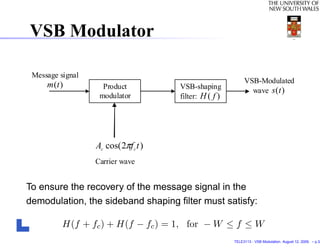
VSB Modulator

 Message signal
                                                             VSB-Modulated
     m (t )         Product           VSB-shaping
                                                               wave s (t )
                   modulator          filter: H ( f )


                  Ac cos( 2πf c t )
                  Carrier wave


To ensure the recovery of the message signal in the
demodulation, the sideband shaping filter must satisfy:

          H(f + fc ) + H(f − fc ) = 1, for − W ≤ f ≤ W
                                                        TELE3113 - VSB Modulation. August 12, 2009. – p.3/
Sinusoidal VSB (1)

 Consider the VSB modulation of the single-tone message
 signal m(t) = Am cos(2πfm t). Let the upper and lower
 side-frequencies be attenuated by the factor k and (1 − k),
 respectively. The VSB spectrum is therefore,
             kAm Ac
  S(f ) =            [δ(f − fc − fm ) + δ(f + fc + fm )]
                4
             (1 − k)Am Ac
         +                 [δ(f − fc + fm ) + δ(f + fc − fm )].
                   4
 k = 1 , S(f ) reduces to the DSB-SC spectrum
     2

 k = 0, S(f ) reduces to the lower SSB spectrum
 k = 1, S(f ) reduces to the upper SSB spectrum
                                               TELE3113 - VSB Modulation. August 12, 2009. – p.4/
Sinusoidal VSB (2)

From the spectrum S(f ), we can get the VSB modulated wave,

         Am Ac
s(t) =         k[exp(j2π(fc + fm )t) + exp(−j2π(fc + fm )t)]
          4
         Am Ac
     +         (1 − k)[exp(j2π(fc − fm )t) + exp(−j2π(fc − fm )t)]
          4
It can be further expressed as
                   Am Ac
         s(t) =          cos(2πfc t) cos(2πfm t)
                    2
                   Am Ac
               +         (1 − 2k) sin(2πfc t) sin(2πfm t)
                    2


                                                  TELE3113 - VSB Modulation. August 12, 2009. – p.5/
Demodulation of VSB (1)

  Modulated                                                  Demodulated
  wave s (t )                     v(t )                      signal v o (t )
                 Product                       Low-pass
                modulator                        filter

                       Ac' cos(2πf c t + φ )

                   Local
                 oscillator


 It applies equally well to the demodulation of DSB-SC, SSB
 and VSB.
 Suppose that the local oscillator can provide the same
 frequency as the carrier frequency in the modulator and a
 phase difference φ equal to zero.
                                                          TELE3113 - VSB Modulation. August 12, 2009. – p.6/
Demodulation of VSB (2)

 The output of the product modulator is given by

                    v(t) = Ac s(t) cos(2πfc t)

 where s(t) is the VSB modulated wave.
 Next, we want to show how to demodulate the message
 signal m(t) from v(t).
 Suppose s(t) ⇔ S(f ). Then, the FT of the signal v(t) is
 given by

                     Ac
            V (f ) =    [S(f − fc ) + S(f + fc )].                                (1)
                     2

                                                 TELE3113 - VSB Modulation. August 12, 2009. – p.7/
Demodulation of VSB (3)

 Note that S(f ) is the spectrum of the VSB modulated signal
 s(t). From the block diagram of the VSB modulator, we can
 obtain
              S(f ) = F [m(t)Ac cos(2πfc t)]H(f )
 where F [·] denotes the FT operator.
 Suppose m(t) ⇔ M (f ). Then,

                              Ac
     F [m(t)Ac cos(2πfc t)] =    [M (f − fc ) + M (f + fc )].
                              2
 Therefore,
                  Ac
          S(f ) =    [M (f − fc ) + M (f + fc )]H(f ).
                  2
                                                TELE3113 - VSB Modulation. August 12, 2009. – p.8/
Demodulation of VSB (4)

 Shifting the VSB spectrum S(f ) by ±fc , we obtain

                      Ac
      S(f − fc ) =       [M (f − 2fc ) + M (f )]H(f − fc )
                      2
                      Ac
      S(f + fc ) =       [M (f ) + M (f + 2fc )]H(f + fc )
                      2
 Then, V (f ) in equation (1) reduces to

            Ac Ac
 V (f ) =         M (f )
             4
            Ac Ac
        +         [M (f − 2fc )H(f − fc ) + M (f + 2fc )H(f + fc )].
             4
                                                    Ac Ac
 After passing v(t) through LPF, we get vo (t) =      4 m(t).
                                               TELE3113 - VSB Modulation. August 12, 2009. – p.9/

Tele3113 wk4wed

  • 1.
    TELE3113 Analogue andDigital Communications VSB Modulation Wei Zhang w.zhang@unsw.edu.au School of Electrical Engineering and Telecommunications The University of New South Wales
  • 2.
    Motivation The spectrally efficient transmission of wideband signals (e.g., TV video signals) contain significant low frequencies. SSB has a narrow BW, so it is not practical in this case. DSB-SC requires a BW equal to twice the message BW, so it is not an option. A compromise method of modulation that lies between SSB and DSB-SC in the spectra characteristics is needed. TELE3113 - VSB Modulation. August 12, 2009. – p.1/
  • 3.
    VSB Instead of completelyremoving a sideband, a vestige of that sideband is transmitted; hence, the name “vestigial sideband”. The transmission BW of a VSB modulated signal is defined by BT = fv + W, where fv is the vestige BW and W is the message BW. Typically, fv is 25% of W . TELE3113 - VSB Modulation. August 12, 2009. – p.2/
  • 4.
    VSB Modulator Messagesignal VSB-Modulated m (t ) Product VSB-shaping wave s (t ) modulator filter: H ( f ) Ac cos( 2πf c t ) Carrier wave To ensure the recovery of the message signal in the demodulation, the sideband shaping filter must satisfy: H(f + fc ) + H(f − fc ) = 1, for − W ≤ f ≤ W TELE3113 - VSB Modulation. August 12, 2009. – p.3/
  • 5.
    Sinusoidal VSB (1) Consider the VSB modulation of the single-tone message signal m(t) = Am cos(2πfm t). Let the upper and lower side-frequencies be attenuated by the factor k and (1 − k), respectively. The VSB spectrum is therefore, kAm Ac S(f ) = [δ(f − fc − fm ) + δ(f + fc + fm )] 4 (1 − k)Am Ac + [δ(f − fc + fm ) + δ(f + fc − fm )]. 4 k = 1 , S(f ) reduces to the DSB-SC spectrum 2 k = 0, S(f ) reduces to the lower SSB spectrum k = 1, S(f ) reduces to the upper SSB spectrum TELE3113 - VSB Modulation. August 12, 2009. – p.4/
  • 6.
    Sinusoidal VSB (2) Fromthe spectrum S(f ), we can get the VSB modulated wave, Am Ac s(t) = k[exp(j2π(fc + fm )t) + exp(−j2π(fc + fm )t)] 4 Am Ac + (1 − k)[exp(j2π(fc − fm )t) + exp(−j2π(fc − fm )t)] 4 It can be further expressed as Am Ac s(t) = cos(2πfc t) cos(2πfm t) 2 Am Ac + (1 − 2k) sin(2πfc t) sin(2πfm t) 2 TELE3113 - VSB Modulation. August 12, 2009. – p.5/
  • 7.
    Demodulation of VSB(1) Modulated Demodulated wave s (t ) v(t ) signal v o (t ) Product Low-pass modulator filter Ac' cos(2πf c t + φ ) Local oscillator It applies equally well to the demodulation of DSB-SC, SSB and VSB. Suppose that the local oscillator can provide the same frequency as the carrier frequency in the modulator and a phase difference φ equal to zero. TELE3113 - VSB Modulation. August 12, 2009. – p.6/
  • 8.
    Demodulation of VSB(2) The output of the product modulator is given by v(t) = Ac s(t) cos(2πfc t) where s(t) is the VSB modulated wave. Next, we want to show how to demodulate the message signal m(t) from v(t). Suppose s(t) ⇔ S(f ). Then, the FT of the signal v(t) is given by Ac V (f ) = [S(f − fc ) + S(f + fc )]. (1) 2 TELE3113 - VSB Modulation. August 12, 2009. – p.7/
  • 9.
    Demodulation of VSB(3) Note that S(f ) is the spectrum of the VSB modulated signal s(t). From the block diagram of the VSB modulator, we can obtain S(f ) = F [m(t)Ac cos(2πfc t)]H(f ) where F [·] denotes the FT operator. Suppose m(t) ⇔ M (f ). Then, Ac F [m(t)Ac cos(2πfc t)] = [M (f − fc ) + M (f + fc )]. 2 Therefore, Ac S(f ) = [M (f − fc ) + M (f + fc )]H(f ). 2 TELE3113 - VSB Modulation. August 12, 2009. – p.8/
  • 10.
    Demodulation of VSB(4) Shifting the VSB spectrum S(f ) by ±fc , we obtain Ac S(f − fc ) = [M (f − 2fc ) + M (f )]H(f − fc ) 2 Ac S(f + fc ) = [M (f ) + M (f + 2fc )]H(f + fc ) 2 Then, V (f ) in equation (1) reduces to Ac Ac V (f ) = M (f ) 4 Ac Ac + [M (f − 2fc )H(f − fc ) + M (f + 2fc )H(f + fc )]. 4 Ac Ac After passing v(t) through LPF, we get vo (t) = 4 m(t). TELE3113 - VSB Modulation. August 12, 2009. – p.9/