The document discusses coherent and non-coherent digital modulation techniques, specifically focusing on Phase Shift Keying (PSK) and Frequency Shift Keying (FSK). It highlights the operational principles, advantages, and disadvantages of Binary PSK (BPSK) and Binary FSK (BFSK), noting applications in communication systems such as WLAN, Bluetooth, and caller ID. Additionally, it addresses signal detection challenges and references key literature on the subject.
OUTLINE
• Introduction
• •Coherent Digital modulation Techniques
• • PSK
• • FSK
• • Non-Coherent Digital modulation Techniques
• • FSK
• • Applications of ASK,FSK and PSK
3.
INTRODUCTION
• •
In digitalcommunication, the modulation process involves switching or keying the
amplitude, frequency or phase of the carrier in accordance with the input data.
• • There are three basic modulation techniques for the transmission of digital data. i.e.
• • Amplitude Shift Keying
• • Frequency Shift Keying
• • Phase Shift Keying
4.
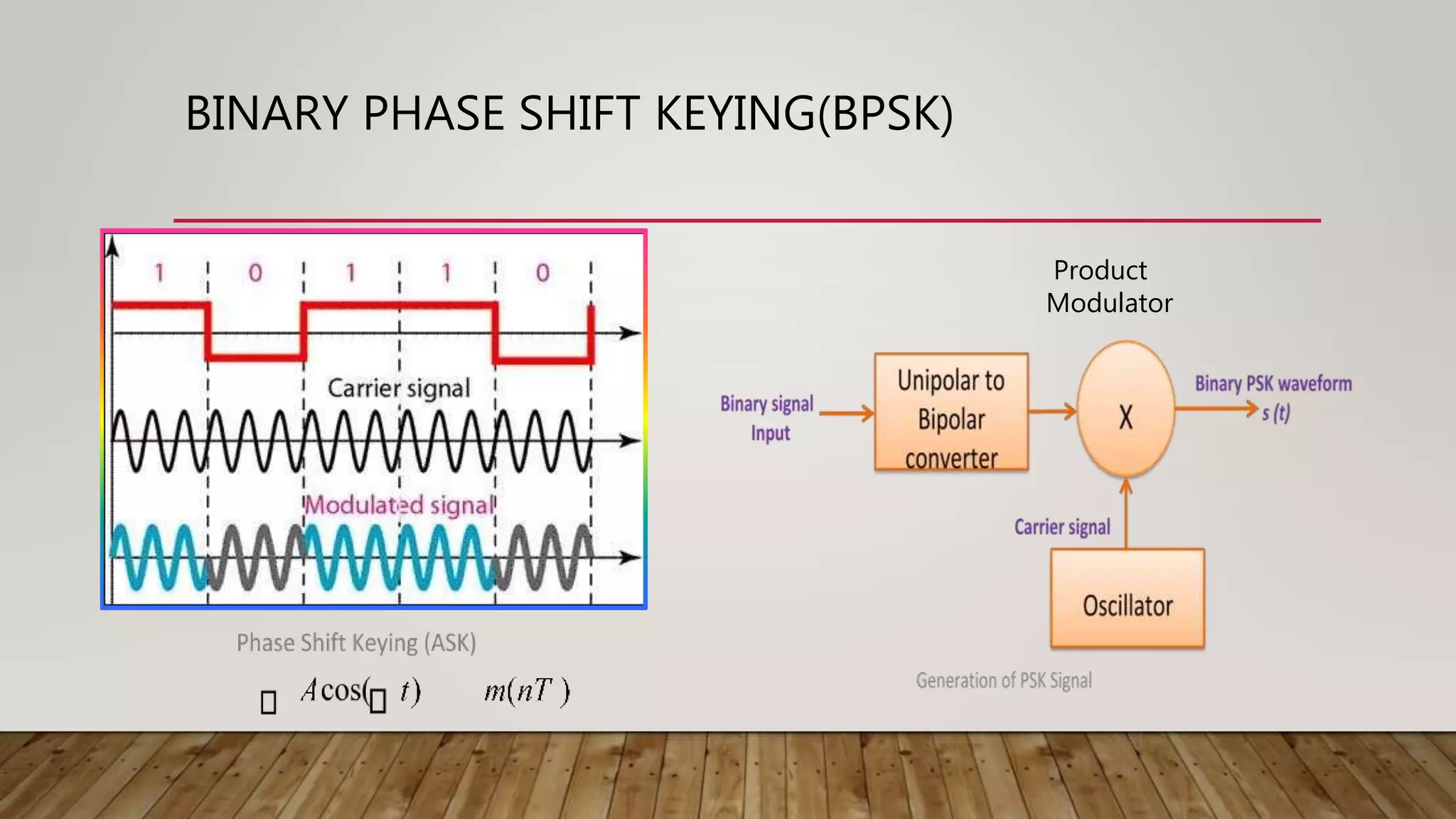
BINARY PHASE SHIFTKEYING(BPSK)
• The most basic (binary) form of PSK involves the process of switching the carrier
either in phase or out of phase, correspondence to a sequence of digital pulses
that constitute the information signal.
• • One binary digit is represented by the carrier wave and the other binary digit is
represented by the 1800 out of phase of the original carrier whereas the
Frequency remains fixed
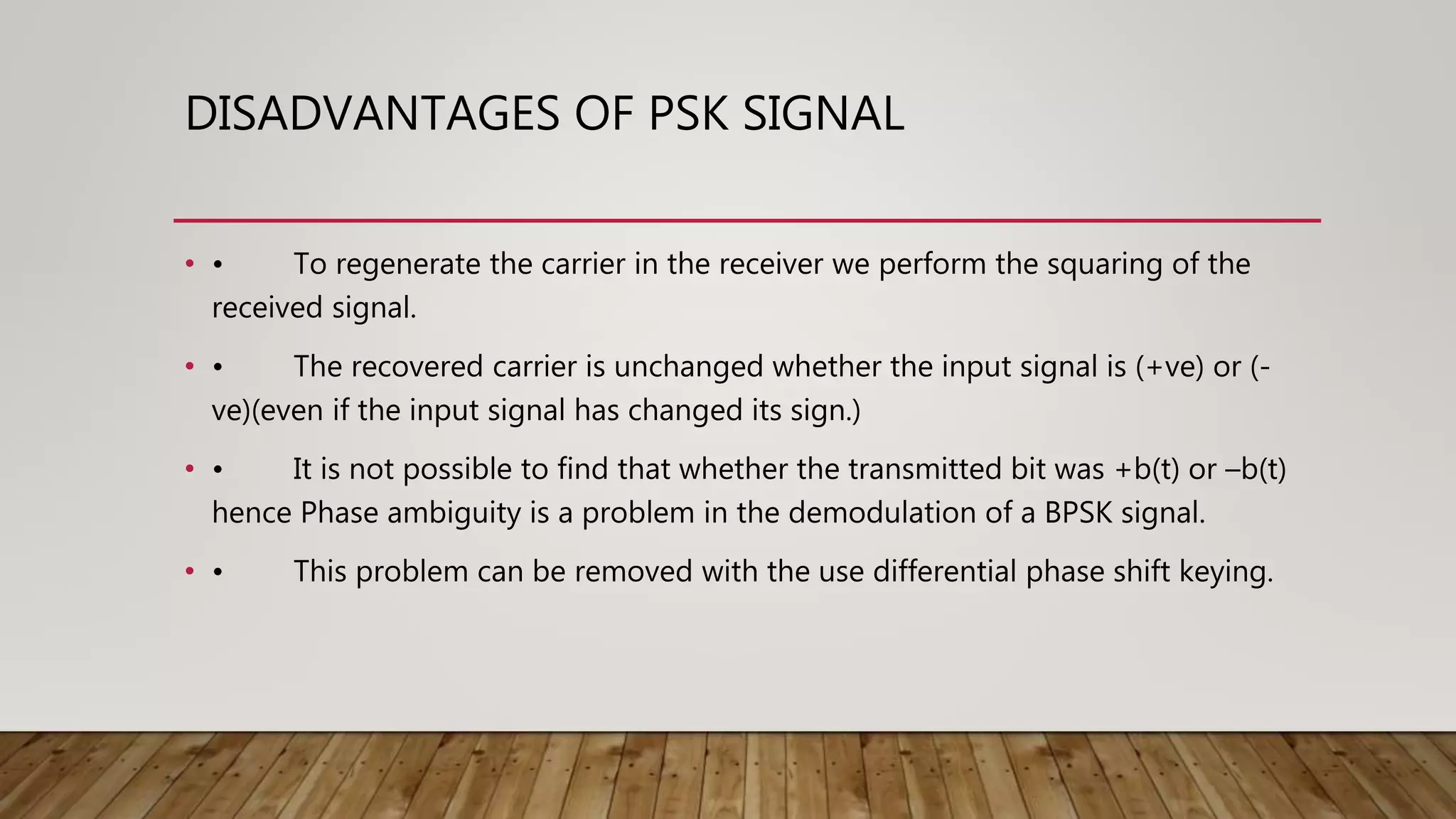
DISADVANTAGES OF PSKSIGNAL
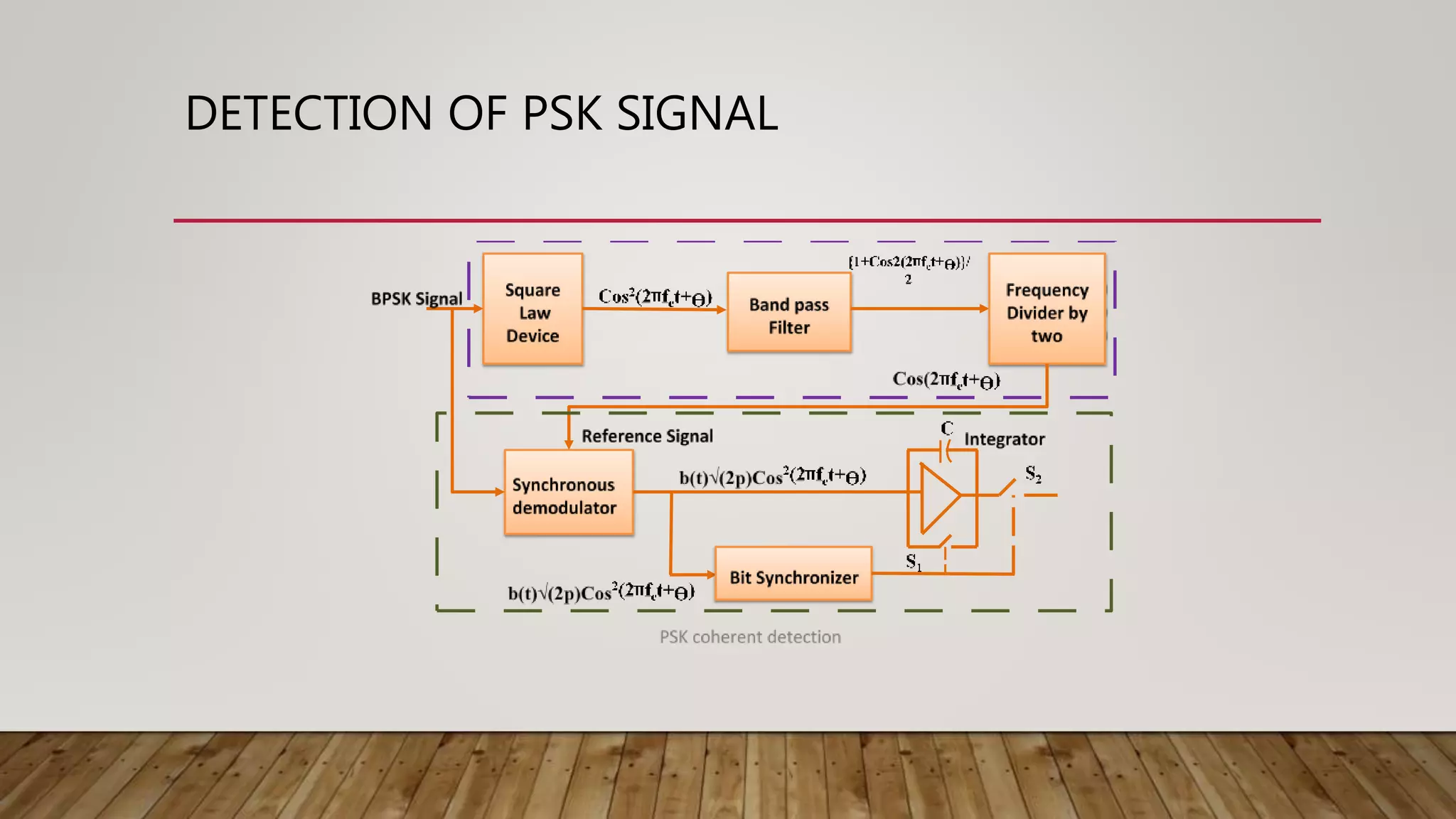
• • To regenerate the carrier in the receiver we perform the squaring of the
received signal.
• • The recovered carrier is unchanged whether the input signal is (+ve) or (-
ve)(even if the input signal has changed its sign.)
• • It is not possible to find that whether the transmitted bit was +b(t) or –b(t)
hence Phase ambiguity is a problem in the demodulation of a BPSK signal.
• • This problem can be removed with the use differential phase shift keying.
8.
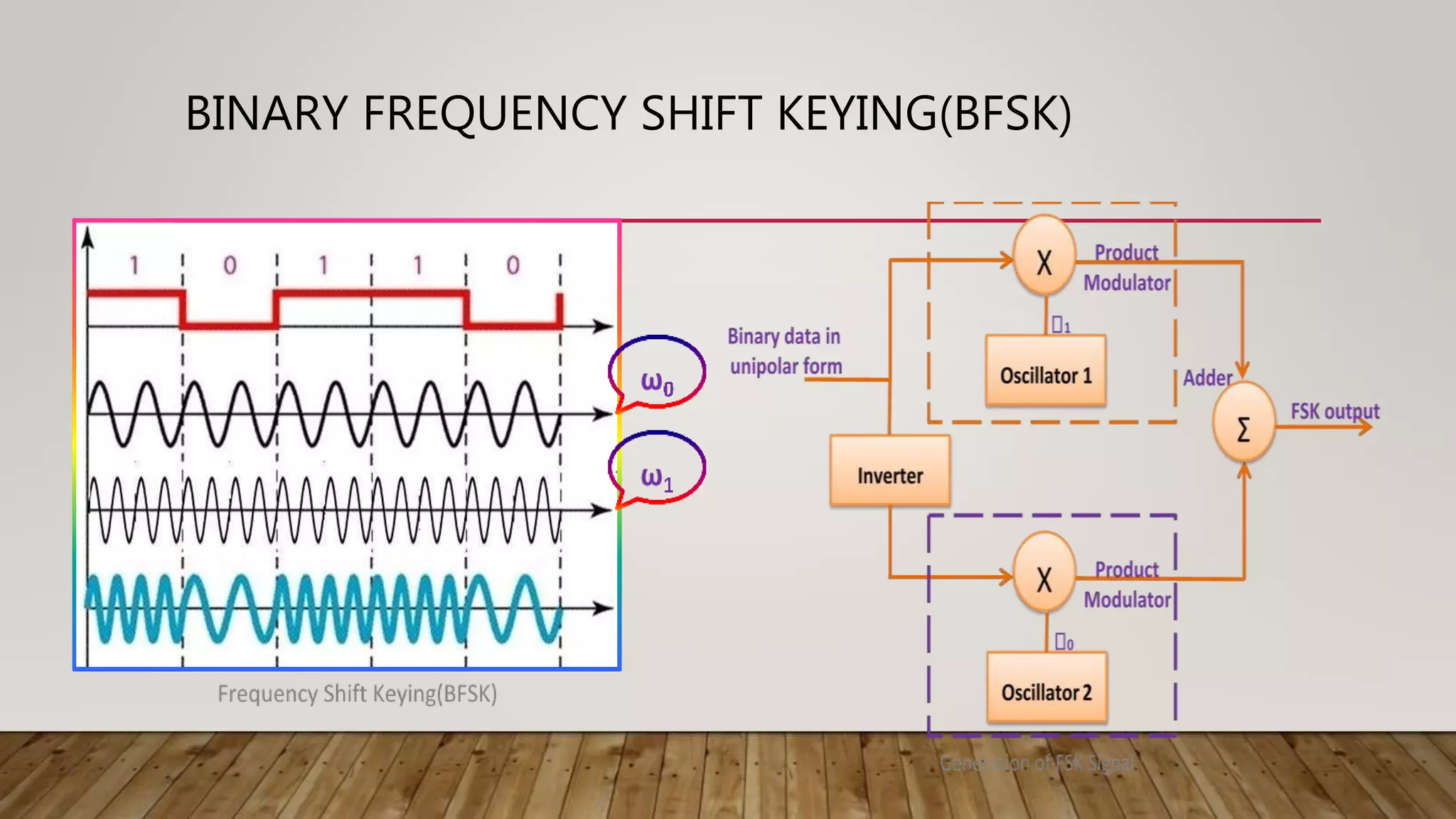
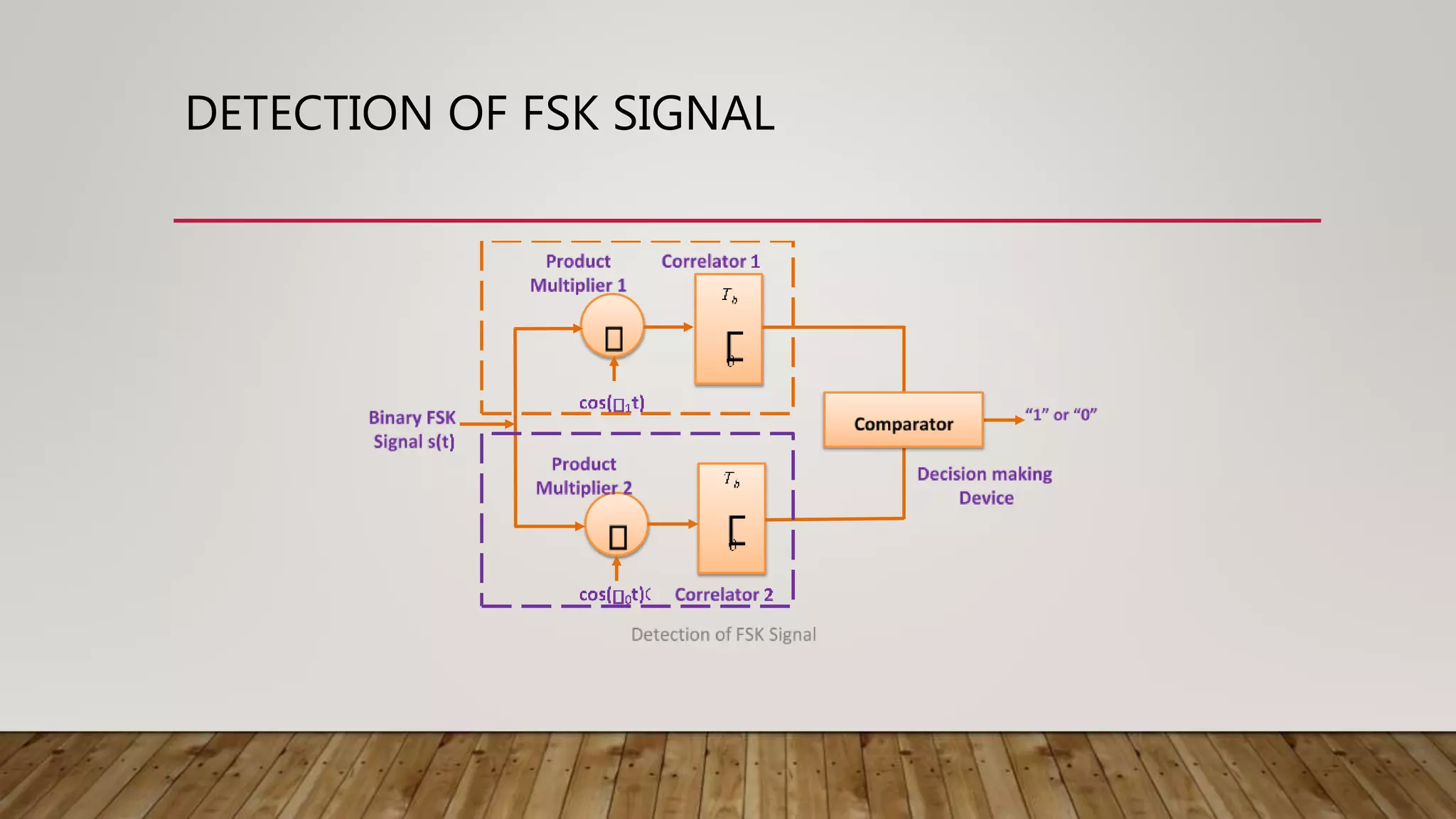
BINARY FREQUENCY SHIFTKEYING(BFSK)
• The most basic (binary) form of FSK involves the process of varying the frequency
of a carrier wave by choosing one of the two frequencies (binary FSK) in
correspondence to a sequence of digital pulses that constitute the information
signal.
• • Two binary digits are represented by two frequencies around the carrier
frequency whereas the Amplitude remains fixed.
DISADVANTAGES OF BFSKSIGNALS
• The generation of BFSK is easier but it has many disadvantages compared to BPSK signal.
• • Bandwidth is greater in comparison to BPSK and is almost double the bandwidth of
BPSK.
• • The error rate of BFSK is higher
APPLICATIONS OF FSKAND PSK
• FSK signal can be transmitted via telephone lines, fiber
• optics or wireless media. FSK is commonly used for
• caller ID and remote metering applications.
• • PSK is typically applied in wireless local area networks
• (WLAN), Bluetooth technology and radio frequency
• identification (RFID) standards used in biometric,
• passport and contactless payment systems.
14.
REFERENCES
• • LathiB.P. “Modern Digital and Analog Communication Systems” Oxford
Publications, Fourth Edition
• • J.S. Chitode “ Digital Communication ” Technical
• Publications, First Edition.
• • Taub H.,Schilling D.L.,Saha G. “Taub’s Principle of Communication Systems”,
McGraw-Hill, Third edition
• • Forouzan B. A, “Data Communications and Networking”, McGraw-Hill, 2nd Ed.,
2000
• • https://www.techopedia.com/definition/3004/frequency -shift-keying-fsk