TELE3113 Analogue and Digital
      Communications
                   Wideband FM

                      Wei Zhang
                 w.zhang@unsw.edu.au


School of Electrical Engineering and Telecommunications
          The University of New South Wales
Fourier Series

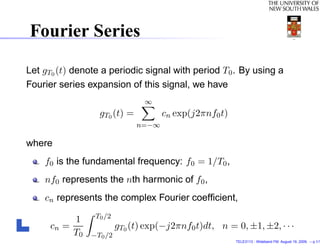
Let gT0 (t) denote a periodic signal with period T0 . By using a
Fourier series expansion of this signal, we have
                                ∞
                  gT0 (t) =          cn exp(j2πnf0 t)
                              n=−∞

where
    f0 is the fundamental frequency: f0 = 1/T0 ,
    nf0 represents the nth harmonic of f0 ,
    cn represents the complex Fourier coefficient,
                 T0 /2
          1
     cn =                gT0 (t) exp(−j2πnf0 t)dt, n = 0, ±1, ±2, · · ·
          T0    −T0 /2
                                                        TELE3113 - Wideband FM. August 19, 2009. – p.1/1
Bessel Function (1)

The nth order Bessel function of the first kind and argument
β, denoted by Jn (β), is given by
                              π
                   1
         Jn (β) =                 exp [j(β sin x − nx)] dx.                              (1)
                  2π        −π
               1

                    J0(β)

                      J1(β)
                            J2(β)
              0.5
                                    J (β)
                                     3      J (β)
                                             4


               0


                                                          TELE3113 - Wideband FM. August 19, 2009. – p.2/1
Bessel Function (2)

Some properties:
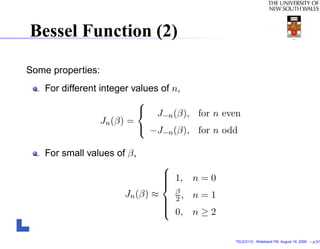
    For different integer values of n,
                            
                             J (β), for n even
                                 −n
                   Jn (β) =
                             −J−n (β), for n odd

    For small values of β,
                                  
                                   1,
                                        n=0
                                  
                                  
                       Jn (β) ≈     β
                                   2,   n=1
                                  
                                   0,
                                  
                                         n≥2

                                               TELE3113 - Wideband FM. August 19, 2009. – p.3/1
Wideband FM (1)

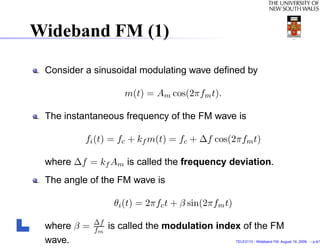
 Consider a sinusoidal modulating wave defined by

                     m(t) = Am cos(2πfm t).

 The instantaneous frequency of the FM wave is

          fi (t) = fc + kf m(t) = fc + ∆f cos(2πfm t)

 where ∆f = kf Am is called the frequency deviation.
 The angle of the FM wave is

                   θi (t) = 2πfc t + β sin(2πfm t)
             ∆f
 where β =   fm   is called the modulation index of the FM
 wave.                                               TELE3113 - Wideband FM. August 19, 2009. – p.4/1
Wideband FM (2)
The FM wave is then given by

        s(t) = Ac cos[θi (t)] = Ac cos[2πfc t + β sin(2πfm t)].

Using cos θ = [exp(jθ)], where the operator [x] denotes the
real part of x, we get

           s(t) =      [Ac exp(j2πfc t + jβ sin(2πfm t))]
                 =     [˜(t) exp(j2πfc t)],
                        s                                                            (2)

where

                 s(t) = Ac exp [jβ sin(2πfm t)] .
                 ˜                                                                   (3)


                                                      TELE3113 - Wideband FM. August 19, 2009. – p.5/1
Wideband FM (3)

Theorem 1: s(t) in Eq. (3) is a periodic function of time t with a
            ˜
fundamental frequency equal to fm .

Proof: Replacing time t in s(t) with t + k/fm for any integer k,
                           ˜
we have

        s(t + k/fm ) = Ac exp [jβ sin(2πfm (t + k/fm ))]
        ˜
                      = Ac exp [jβ sin(2πfm t + 2πk)]
                      = Ac exp [jβ sin(2πfm t)]
                      = s(t).
                        ˜

It completes the proof.

                                                   TELE3113 - Wideband FM. August 19, 2009. – p.6/1
Wideband FM (4)

Since s(t) is a periodic signal with period 1/fm (see Theorem 1),
       ˜
we may expand s(t) in the form of a complex Fourier series as
                 ˜
follows:
                             ∞
               s(t) =
               ˜                   cn exp(j2πnfm t),                                   (4)
                            n=−∞

where the complex Fourier coefficient
                 1/(2fm )
  cn = f m                  s(t) exp(−j2πnfm t)dt
                            ˜
              −/(2fm )
                    1/(2fm )
      = f m Ac                 exp [jβ sin(2πfm t)] exp(−j2πnfm t)dt. (5)
                  −/(2fm )

                                                        TELE3113 - Wideband FM. August 19, 2009. – p.7/1
Wideband FM (5)

Define x = 2πfm t. Hence, we may express cn in Eq. (5) as
                          π
                   Ac
              cn =            exp [j(β sin x − nx)] dx.
                   2π    −π

Using Bessel function Jn (β) in Eq. (1), we therefore have

                          cn = Ac Jn (β).

Then, Eq. (4) can be written as
                         ∞
            s(t) = Ac
            ˜                  Jn (β) exp(j2πnfm t).                                  (6)
                        n=−∞


                                                       TELE3113 - Wideband FM. August 19, 2009. – p.8/1
Wideband FM (6)

Substituting Eq. (6) into Eq. (2), we get
                          ∞
        s(t) =       Ac        Jn (β) exp[j2π(fc + nfm )t]
                        n=−∞
                       ∞
              = Ac          Jn (β) [exp(j2π(fc + nfm )t)]
                     n=−∞
                       ∞
              = Ac          Jn (β) cos[2π(fc + nfm )t].                             (7)
                     n=−∞


                                                     TELE3113 - Wideband FM. August 19, 2009. – p.9/1
Spectrum of Wideband FM

The spectrum of s(t) is given by
                  ∞
            Ac
  S(f ) =               Jn (β)[δ(f − fc − nfm ) + δ(f + fc + nfm )].
            2    n=−∞

    S(f ) contains an infinite set of side frequencies ±f c ,
    ±fc ± fm , ±fc ± 2fm , · · ·
    For small values of β, S(f ) is effectively composed of ±f c
    and ±fc ± fm . This case corresponds to the narrow-band
    FM.
    The amplitude of the carrier component varies with β
    according to J0 (β).
                                                      TELE3113 - Wideband FM. August 19, 2009. – p.10/1

Tele3113 wk5wed

  • 1.
    TELE3113 Analogue andDigital Communications Wideband FM Wei Zhang w.zhang@unsw.edu.au School of Electrical Engineering and Telecommunications The University of New South Wales
  • 2.
    Fourier Series Let gT0(t) denote a periodic signal with period T0 . By using a Fourier series expansion of this signal, we have ∞ gT0 (t) = cn exp(j2πnf0 t) n=−∞ where f0 is the fundamental frequency: f0 = 1/T0 , nf0 represents the nth harmonic of f0 , cn represents the complex Fourier coefficient, T0 /2 1 cn = gT0 (t) exp(−j2πnf0 t)dt, n = 0, ±1, ±2, · · · T0 −T0 /2 TELE3113 - Wideband FM. August 19, 2009. – p.1/1
  • 3.
    Bessel Function (1) Thenth order Bessel function of the first kind and argument β, denoted by Jn (β), is given by π 1 Jn (β) = exp [j(β sin x − nx)] dx. (1) 2π −π 1 J0(β) J1(β) J2(β) 0.5 J (β) 3 J (β) 4 0 TELE3113 - Wideband FM. August 19, 2009. – p.2/1
  • 4.
    Bessel Function (2) Someproperties: For different integer values of n,   J (β), for n even −n Jn (β) =  −J−n (β), for n odd For small values of β,   1,  n=0   Jn (β) ≈ β  2, n=1   0,  n≥2 TELE3113 - Wideband FM. August 19, 2009. – p.3/1
  • 5.
    Wideband FM (1) Consider a sinusoidal modulating wave defined by m(t) = Am cos(2πfm t). The instantaneous frequency of the FM wave is fi (t) = fc + kf m(t) = fc + ∆f cos(2πfm t) where ∆f = kf Am is called the frequency deviation. The angle of the FM wave is θi (t) = 2πfc t + β sin(2πfm t) ∆f where β = fm is called the modulation index of the FM wave. TELE3113 - Wideband FM. August 19, 2009. – p.4/1
  • 6.
    Wideband FM (2) TheFM wave is then given by s(t) = Ac cos[θi (t)] = Ac cos[2πfc t + β sin(2πfm t)]. Using cos θ = [exp(jθ)], where the operator [x] denotes the real part of x, we get s(t) = [Ac exp(j2πfc t + jβ sin(2πfm t))] = [˜(t) exp(j2πfc t)], s (2) where s(t) = Ac exp [jβ sin(2πfm t)] . ˜ (3) TELE3113 - Wideband FM. August 19, 2009. – p.5/1
  • 7.
    Wideband FM (3) Theorem1: s(t) in Eq. (3) is a periodic function of time t with a ˜ fundamental frequency equal to fm . Proof: Replacing time t in s(t) with t + k/fm for any integer k, ˜ we have s(t + k/fm ) = Ac exp [jβ sin(2πfm (t + k/fm ))] ˜ = Ac exp [jβ sin(2πfm t + 2πk)] = Ac exp [jβ sin(2πfm t)] = s(t). ˜ It completes the proof. TELE3113 - Wideband FM. August 19, 2009. – p.6/1
  • 8.
    Wideband FM (4) Sinces(t) is a periodic signal with period 1/fm (see Theorem 1), ˜ we may expand s(t) in the form of a complex Fourier series as ˜ follows: ∞ s(t) = ˜ cn exp(j2πnfm t), (4) n=−∞ where the complex Fourier coefficient 1/(2fm ) cn = f m s(t) exp(−j2πnfm t)dt ˜ −/(2fm ) 1/(2fm ) = f m Ac exp [jβ sin(2πfm t)] exp(−j2πnfm t)dt. (5) −/(2fm ) TELE3113 - Wideband FM. August 19, 2009. – p.7/1
  • 9.
    Wideband FM (5) Definex = 2πfm t. Hence, we may express cn in Eq. (5) as π Ac cn = exp [j(β sin x − nx)] dx. 2π −π Using Bessel function Jn (β) in Eq. (1), we therefore have cn = Ac Jn (β). Then, Eq. (4) can be written as ∞ s(t) = Ac ˜ Jn (β) exp(j2πnfm t). (6) n=−∞ TELE3113 - Wideband FM. August 19, 2009. – p.8/1
  • 10.
    Wideband FM (6) SubstitutingEq. (6) into Eq. (2), we get ∞ s(t) = Ac Jn (β) exp[j2π(fc + nfm )t] n=−∞ ∞ = Ac Jn (β) [exp(j2π(fc + nfm )t)] n=−∞ ∞ = Ac Jn (β) cos[2π(fc + nfm )t]. (7) n=−∞ TELE3113 - Wideband FM. August 19, 2009. – p.9/1
  • 11.
    Spectrum of WidebandFM The spectrum of s(t) is given by ∞ Ac S(f ) = Jn (β)[δ(f − fc − nfm ) + δ(f + fc + nfm )]. 2 n=−∞ S(f ) contains an infinite set of side frequencies ±f c , ±fc ± fm , ±fc ± 2fm , · · · For small values of β, S(f ) is effectively composed of ±f c and ±fc ± fm . This case corresponds to the narrow-band FM. The amplitude of the carrier component varies with β according to J0 (β). TELE3113 - Wideband FM. August 19, 2009. – p.10/1