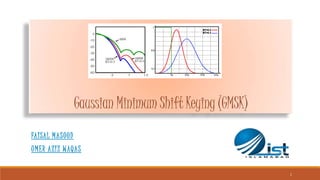
Gaussian Minimum Shift Keying (GMSK)
FAISAL MASOOD
UMER AZIZ WAQAS
1
outlines
What is GMSK?
An Overview to MSK
Performance & reliability
Bit Error Rate
Time domain and frequency response
Modulation & Demodulation of GMSK
Transmitter & Receiver
Advantages and disadvantages
Generation of GMSK
Applications & Conclusion
2
What is GMSK?
 Gaussian Minimum Shift Keying (GMSK) is a form of continuous-phase FSK in which the phase
is changed between symbols to provide a constant envelope
 Consequently it is a popular alternative to QPSK
 A Gaussian filter is used before frequency modulation
 GMSK is advanced version of MSK
3
An overview to MSK
Minimum shift keying (minimum frequency separation)
Phase continuous (CPFSK)
Frequency changes
Baseband modulation starts with a bitstream of 0’s,1’s and a bit clock
This baseband signal is generated by first using NRZ filter
Then FM is applied to produce MSK
ISI is also introduced
4
GMSK & Msk
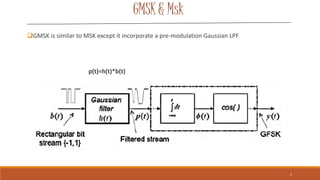
GMSK is similar to MSK except it incorporate a pre-modulation Gaussian LPF
p(t)=h(t)*b(t)
5
Gaussian filter
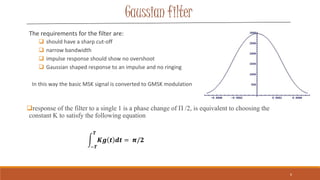
The requirements for the filter are:
 should have a sharp cut-off
 narrow bandwidth
 impulse response should show no overshoot
 Gaussian shaped response to an impulse and no ringing
In this way the basic MSK signal is converted to GMSK modulation
response of the filter to a single 1 is a phase change of Π /2, is equivalent to choosing the
constant K to satisfy the following equation
−𝑻
𝑻
𝑲𝒈 𝒕 𝒅𝒕 = 𝞹/𝟐
6
Reliability of gmsk data message
The reliability of a data message produced by a GMSK system is highly dependent on the
following:
 Receiver thermal noise: this is produced partly by the receive antenna and mostly by the radio
receiver.
Channel fading: this is caused by the multipath propagation nature of the radio channel
 Band limiting: This is mostly associated with the receiver
 DC drifts: may be caused by a number of factors such as temperature variations, asymmetry of
the frequency response of the receiver, frequency drifts of the receiver local oscillator
7
Performance criteria
𝑬 𝒃
𝑵 𝒐
=
𝑺
𝑹. 𝑵 𝒐
=
𝑺
𝑵
𝑩 𝒏
𝑹
Where ;
𝐸 𝑏  Energy/bit
S  Signal Power
R  Data rate in b/sec
𝑁𝑜  Noise
𝐵𝑛  Noise bandwidth of IF filter
Bn x No N noise power
 The performance of a GMSK modem is generally quantified by measurement of the signal-to-noise
ratio (SNR) versus BER. SNR is related to Eb/N0 by
8
Bit error rate
GMSK bit rate offers better performance within one decibel of optimum MSK when
the 3dB bandwidth bit duration product BT is equal to 0.25
Bit error probability for GMSK is
Bandwidth-time product BT.
Describes the amount of the symbols overlap
 BT = 0.3 for GSM networks
Good spectral efficiency
𝑷 𝒆 = 𝑸
𝟐𝜸𝑬 𝒃
𝑵 𝒐
Where 𝛾 is constant related to BT.
𝛾=
0.85 𝑓𝑜𝑟 𝑀𝑆𝐾 𝐵𝑇 = ∞
0.68 𝑓𝑜𝑟 𝐺𝑀𝑆𝐾 𝐵𝑇 = 0.25
9
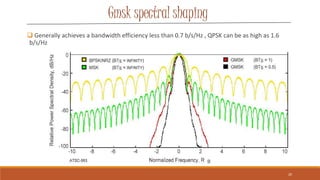
Frequency Response
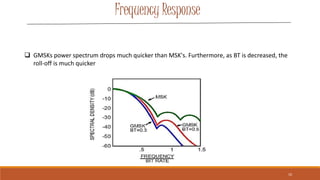
 GMSKs power spectrum drops much quicker than MSK's. Furthermore, as BT is decreased, the
roll-off is much quicker
10
Time-domain response
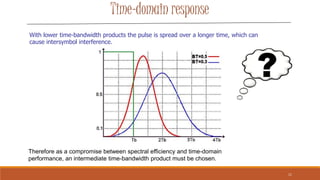
With lower time-bandwidth products the pulse is spread over a longer time, which can
cause intersymbol interference.
Therefore as a compromise between spectral efficiency and time-domain
performance, an intermediate time-bandwidth product must be chosen.
11
modulation
Modulation index = 0.5
Implementation is cheaper
12
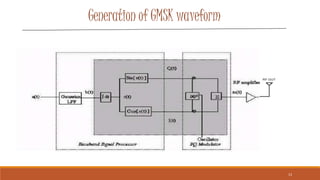
Generation of GMSK waveform
13
Pulse shape
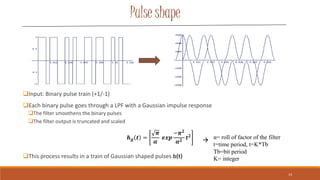
Input: Binary pulse train (+1/-1)
Each binary pulse goes through a LPF with a Gaussian impulse response
The filter smoothens the binary pulses
The filter output is truncated and scaled
This process results in a train of Gaussian shaped pulses b(t)
𝒉 𝒈 𝒕 =
𝝅
𝜶
𝒆𝒙𝒑
−𝝅 𝟐
𝜶 𝟐 𝒕 𝟐 α= roll of factor of the filter
t=time period, t=K*Tb
Tb=bit period
K= integer

14
SUMMING AND INTEGRATION
The pulses are summed together (left)
The signal is integrated over time to obtain a continuous waveform c(t) which captures the bit
transition information (right)
15
I&Q Signals
The resulting waveform is divided into In-Phase and
Quadrature components
In-phase: (Left)
Quadrature: (Right)
The two signal components are then up-converted to the
carrier frequency
I(t) = cos[c(t)] Q(t) = sin[c(t)]
16
GMSK Waveform
upconverting the I(t) produces
= cos[c(t)] cos((2Πfct)
Upconverting the Q(t) produces
= -sin[c(t)] sin(2Πfct)
m(t)= cos (2Πfct) I(t) + (-sin(2Πfct) Q(t))
17
GMSK RECEIVER
18
DEMODULATION
 Acrtan derives back Φ, which is applied to derivator to get NRZ signal.
19
Gmsk spectral shaping
 Generally achieves a bandwidth efficiency less than 0.7 b/s/Hz , QPSK can be as high as 1.6
b/s/Hz
20
Advantages
High spectral efficiency
Reducing sideband power
Excellent power efficiency due to constant envelope
Good choice for voice modulation
ISI is tolerable
GMSK is highly useful in wireless communication
Good BER performance
Self synchronizing capability
21
disadvantages
Higher power level than QPSK
Requiring more complex channel equalization algorithms such as an adaptive equalizer at the
receiver
Probability of error is higher then MSK.
𝒑 𝒆 ≤ 𝑴 − 𝟏 𝑸
𝑬 𝒃 𝐥𝐨𝐠 𝟐 𝑴
𝑵 𝒐
Where;
Q  Q-function
Eb  energy of bit
No  Noise
22
Most widely used
in the Global
System for Mobile
Communications
(GSM)
Used for CDPD
(cellular digital
packet data)
overlay
network
Used in remote
controlled devices
i.e. cellular phones,
Bluetooth headsets
etc
Used for GPRS
& EDGE
systems
Applications
23
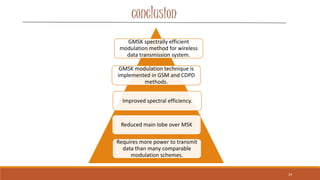
conclusion
GMSK spectrally efficient
modulation method for wireless
data transmission system.
GMSK modulation technique is
implemented in GSM and CDPD
methods.
Improved spectral efficiency.
Reduced main lobe over MSK
Requires more power to transmit
data than many comparable
modulation schemes.
24
references
Rappaport TS. Wireless
Communications, Prentice Hall PTR
Proakis J. Digital Communications,
McGraw & Hill Int.
Fitton M. Principles of Digital
Modulation,
Ke-Lin Du & M.N.S.Swamy.
Wireless
Communication Systems,
Cambridge University Press
25
Questions & Answers
Knowledge is about “courage to ask”.
26

Gmsk

  • 1.
    Gaussian Minimum ShiftKeying (GMSK) FAISAL MASOOD UMER AZIZ WAQAS 1
  • 2.
    outlines What is GMSK? AnOverview to MSK Performance & reliability Bit Error Rate Time domain and frequency response Modulation & Demodulation of GMSK Transmitter & Receiver Advantages and disadvantages Generation of GMSK Applications & Conclusion 2
  • 3.
    What is GMSK? Gaussian Minimum Shift Keying (GMSK) is a form of continuous-phase FSK in which the phase is changed between symbols to provide a constant envelope  Consequently it is a popular alternative to QPSK  A Gaussian filter is used before frequency modulation  GMSK is advanced version of MSK 3
  • 4.
    An overview toMSK Minimum shift keying (minimum frequency separation) Phase continuous (CPFSK) Frequency changes Baseband modulation starts with a bitstream of 0’s,1’s and a bit clock This baseband signal is generated by first using NRZ filter Then FM is applied to produce MSK ISI is also introduced 4
  • 5.
    GMSK & Msk GMSKis similar to MSK except it incorporate a pre-modulation Gaussian LPF p(t)=h(t)*b(t) 5
  • 6.
    Gaussian filter The requirementsfor the filter are:  should have a sharp cut-off  narrow bandwidth  impulse response should show no overshoot  Gaussian shaped response to an impulse and no ringing In this way the basic MSK signal is converted to GMSK modulation response of the filter to a single 1 is a phase change of Π /2, is equivalent to choosing the constant K to satisfy the following equation −𝑻 𝑻 𝑲𝒈 𝒕 𝒅𝒕 = 𝞹/𝟐 6
  • 7.
    Reliability of gmskdata message The reliability of a data message produced by a GMSK system is highly dependent on the following:  Receiver thermal noise: this is produced partly by the receive antenna and mostly by the radio receiver. Channel fading: this is caused by the multipath propagation nature of the radio channel  Band limiting: This is mostly associated with the receiver  DC drifts: may be caused by a number of factors such as temperature variations, asymmetry of the frequency response of the receiver, frequency drifts of the receiver local oscillator 7
  • 8.
    Performance criteria 𝑬 𝒃 𝑵𝒐 = 𝑺 𝑹. 𝑵 𝒐 = 𝑺 𝑵 𝑩 𝒏 𝑹 Where ; 𝐸 𝑏  Energy/bit S  Signal Power R  Data rate in b/sec 𝑁𝑜  Noise 𝐵𝑛  Noise bandwidth of IF filter Bn x No N noise power  The performance of a GMSK modem is generally quantified by measurement of the signal-to-noise ratio (SNR) versus BER. SNR is related to Eb/N0 by 8
  • 9.
    Bit error rate GMSKbit rate offers better performance within one decibel of optimum MSK when the 3dB bandwidth bit duration product BT is equal to 0.25 Bit error probability for GMSK is Bandwidth-time product BT. Describes the amount of the symbols overlap  BT = 0.3 for GSM networks Good spectral efficiency 𝑷 𝒆 = 𝑸 𝟐𝜸𝑬 𝒃 𝑵 𝒐 Where 𝛾 is constant related to BT. 𝛾= 0.85 𝑓𝑜𝑟 𝑀𝑆𝐾 𝐵𝑇 = ∞ 0.68 𝑓𝑜𝑟 𝐺𝑀𝑆𝐾 𝐵𝑇 = 0.25 9
  • 10.
    Frequency Response  GMSKspower spectrum drops much quicker than MSK's. Furthermore, as BT is decreased, the roll-off is much quicker 10
  • 11.
    Time-domain response With lowertime-bandwidth products the pulse is spread over a longer time, which can cause intersymbol interference. Therefore as a compromise between spectral efficiency and time-domain performance, an intermediate time-bandwidth product must be chosen. 11
  • 12.
    modulation Modulation index =0.5 Implementation is cheaper 12
  • 13.
    Generation of GMSKwaveform 13
  • 14.
    Pulse shape Input: Binarypulse train (+1/-1) Each binary pulse goes through a LPF with a Gaussian impulse response The filter smoothens the binary pulses The filter output is truncated and scaled This process results in a train of Gaussian shaped pulses b(t) 𝒉 𝒈 𝒕 = 𝝅 𝜶 𝒆𝒙𝒑 −𝝅 𝟐 𝜶 𝟐 𝒕 𝟐 α= roll of factor of the filter t=time period, t=K*Tb Tb=bit period K= integer  14
  • 15.
    SUMMING AND INTEGRATION Thepulses are summed together (left) The signal is integrated over time to obtain a continuous waveform c(t) which captures the bit transition information (right) 15
  • 16.
    I&Q Signals The resultingwaveform is divided into In-Phase and Quadrature components In-phase: (Left) Quadrature: (Right) The two signal components are then up-converted to the carrier frequency I(t) = cos[c(t)] Q(t) = sin[c(t)] 16
  • 17.
    GMSK Waveform upconverting theI(t) produces = cos[c(t)] cos((2Πfct) Upconverting the Q(t) produces = -sin[c(t)] sin(2Πfct) m(t)= cos (2Πfct) I(t) + (-sin(2Πfct) Q(t)) 17
  • 18.
  • 19.
    DEMODULATION  Acrtan derivesback Φ, which is applied to derivator to get NRZ signal. 19
  • 20.
    Gmsk spectral shaping Generally achieves a bandwidth efficiency less than 0.7 b/s/Hz , QPSK can be as high as 1.6 b/s/Hz 20
  • 21.
    Advantages High spectral efficiency Reducingsideband power Excellent power efficiency due to constant envelope Good choice for voice modulation ISI is tolerable GMSK is highly useful in wireless communication Good BER performance Self synchronizing capability 21
  • 22.
    disadvantages Higher power levelthan QPSK Requiring more complex channel equalization algorithms such as an adaptive equalizer at the receiver Probability of error is higher then MSK. 𝒑 𝒆 ≤ 𝑴 − 𝟏 𝑸 𝑬 𝒃 𝐥𝐨𝐠 𝟐 𝑴 𝑵 𝒐 Where; Q  Q-function Eb  energy of bit No  Noise 22
  • 23.
    Most widely used inthe Global System for Mobile Communications (GSM) Used for CDPD (cellular digital packet data) overlay network Used in remote controlled devices i.e. cellular phones, Bluetooth headsets etc Used for GPRS & EDGE systems Applications 23
  • 24.
    conclusion GMSK spectrally efficient modulationmethod for wireless data transmission system. GMSK modulation technique is implemented in GSM and CDPD methods. Improved spectral efficiency. Reduced main lobe over MSK Requires more power to transmit data than many comparable modulation schemes. 24
  • 25.
    references Rappaport TS. Wireless Communications,Prentice Hall PTR Proakis J. Digital Communications, McGraw & Hill Int. Fitton M. Principles of Digital Modulation, Ke-Lin Du & M.N.S.Swamy. Wireless Communication Systems, Cambridge University Press 25
  • 26.
    Questions & Answers Knowledgeis about “courage to ask”. 26