TELE3113 Analogue and Digital
      Communications
                 SSB Modulation

                      Wei Zhang
                 w.zhang@unsw.edu.au


School of Electrical Engineering and Telecommunications
          The University of New South Wales
Last week ...
We have studied:
    Amplitude Modulation:
       s(t) = [1 + ka m(t)]c(t).
       Simple envelope detection, but low power efficiency.
    DSB-SC Modulation:
       s(t) = m(t)c(t).
       High power efficiency, but requiring a perfect phase
       recovery for coherent detection.
Both AM and DSB-SC have two symmetric sidebands in the
modulated wave, thereby causing the wastage of bandwidth.

                                               TELE3113 - SSB Modulation. August 11, 2009. – p.1/1
From DSB-SC to SSB (1)

First, let us review DSB-SC modulation of a single-tone
message signal m(t) = Am cos(2πfm t). The modulated signal is

sDSB (t) = m(t)c(t) = Am Ac cos(2πfm t) cos(2πfc t)
           1                           1
         =   Am Ac cos[2π(fc + fm )t] + Am Ac cos[2π(fc − fm )t].
           2                           2
The FT of the DSB-SC modulated signal is given by
                Am Ac                   Am Ac
  SDSB (f ) =         δ(f − fc − fm ) +       δ(f + fc + fm )
                 4                       4
                Am Ac                   Am Ac
            +         δ(f − fc + fm ) +       δ(f + fc − fm ).
                 4                       4


                                                TELE3113 - SSB Modulation. August 11, 2009. – p.2/1
From DSB-SC to SSB (2)

Suppose that we want to generate a sinusoidal SSB modulated
wave that retains the upper side-frequency at fc + fm . By
suppressing the second term in the equation of s DSB (t), we get
                         1
              sUSSB (t) = Am Ac cos[2π(fc + fm )t].
                         2
It can be further expressed as (using the trigonometric identity
cos(x + y) = cos x cos y − sin x sin y)
                         1
          sUSSB (t) =      Am Ac cos(2πfc t) cos(2πfm t)
                         2
                         1
                     −     Am Ac sin(2πfc t) sin(2πfm t).
                         2

                                                  TELE3113 - SSB Modulation. August 11, 2009. – p.3/1
From DSB-SC to SSB (3)

Suppose that we want to generate a sinusoidal SSB modulated
wave that retains the lower side-frequency at fc − fm . By
suppressing the first term in the equation of sDSB (t), we get
                         1
              sLSSB (t) = Am Ac cos[2π(fc − fm )t].
                         2
We further express it as
                           1
          sLSSB (t) =        Am Ac cos(2πfc t) cos(2πfm t)
                           2
                           1
                    +        Am Ac sin(2πfc t) sin(2πfm t).
                           2


                                                    TELE3113 - SSB Modulation. August 11, 2009. – p.4/1
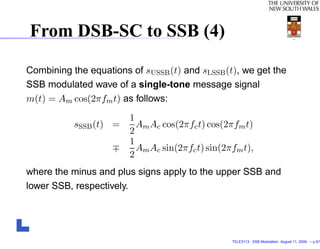
From DSB-SC to SSB (4)

Combining the equations of sUSSB (t) and sLSSB (t), we get the
SSB modulated wave of a single-tone message signal
m(t) = Am cos(2πfm t) as follows:
                        1
           sSSB (t) =     Am Ac cos(2πfc t) cos(2πfm t)
                        2
                        1
                          Am Ac sin(2πfc t) sin(2πfm t),
                        2
where the minus and plus signs apply to the upper SSB and
lower SSB, respectively.


                                                  TELE3113 - SSB Modulation. August 11, 2009. – p.5/1
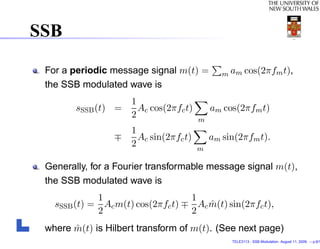
SSB

 For a periodic message signal m(t) =          m am cos(2πfm t),
 the SSB modulated wave is
                     1
        sSSB (t) =     Ac cos(2πfc t)       am cos(2πfm t)
                     2                  m
                     1
                       Ac sin(2πfc t)       am sin(2πfm t).
                     2                  m

 Generally, for a Fourier transformable message signal m(t),
 the SSB modulated wave is
             1                      1
   sSSB (t) = Ac m(t) cos(2πfc t)     Ac m(t) sin(2πfc t),
                                         ˆ
             2                      2
       ˆ
 where m(t) is Hilbert transform of m(t). (See next page)
                                                 TELE3113 - SSB Modulation. August 11, 2009. – p.6/1
Hilbert Transform (1)

            ˆ
 The signal m(t) is the Hilbert transform of the signal m(t),
 defined as
                        1 ∞ m(τ )
            m(t) =
             ˆ                        dτ
                        π −∞ t − τ
                                1
                    = m(t)         . (convolution)
                                πt
 If m(t) ⇔ M (f ), then

                        ˆ
               m(t) ⇔ M (f ) = −jsgn(f )M (f ),
               ˆ
                                      
                                       1, f > 0
                                      
                                      
                                      
 where the sign function is sgn(f ) =    0, f = 0
                                      
                                      
                                       −1, f < 0
                                      
                                              TELE3113 - SSB Modulation. August 11, 2009. – p.7/1
Hilbert Transform (2)

                                        1
            m (t )           h (t ) =                 m(t )
                                                      ˆ
                                        πt

            Illustration of Hilbert transform in time domain


    M(f )                 H ( f ) = − j sgn( f )               ˆ
                                                               M(f )


      Illustration of Hilbert transform in frequency domain


                                                          TELE3113 - SSB Modulation. August 11, 2009. – p.8/1
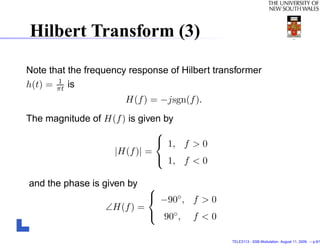
Hilbert Transform (3)

Note that the frequency response of Hilbert transformer
       1
h(t) = πt is
                       H(f ) = −jsgn(f ).
The magnitude of H(f ) is given by
                              
                               1, f > 0
                   |H(f )| =
                               1, f < 0

and the phase is given by  
                            −90◦ , f > 0
                  ∠H(f ) =
                            90◦ , f < 0

                                                TELE3113 - SSB Modulation. August 11, 2009. – p.9/1
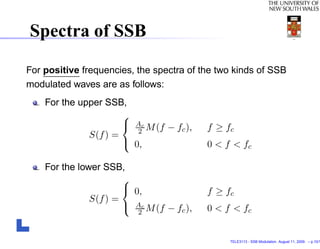
Spectra of SSB

For positive frequencies, the spectra of the two kinds of SSB
modulated waves are as follows:
    For the upper SSB,
                      
                       Ac M (f − f ),     f ≥ fc
                         2         c
              S(f ) =
                       0,                 0 < f < fc

    For the lower SSB,
                       
                        0,                f ≥ fc
               S(f ) =
                        Ac M (f − fc ),   0 < f < fc
                          2


                                                TELE3113 - SSB Modulation. August 11, 2009. – p.10/1
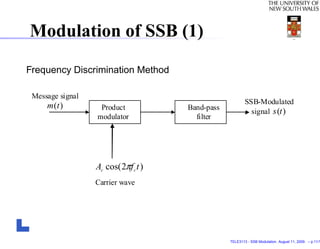
Modulation of SSB (1)
Frequency Discrimination Method

 Message signal
                                                          SSB-Modulated
     m (t )        Product            Band-pass
                                                            signal s (t )
                  modulator             filter


                  Ac cos( 2πf c t )
                  Carrier wave


                                                  TELE3113 - SSB Modulation. August 11, 2009. – p.11/1
Modulation of SSB (2)
Phase Discrimination Method


                                                       +
       Message signal                                               SSB-Modulated
           m(t )             Product                                  signal s (t )
                                                            ∑
                            modulator

                                   cos(2πf c t )                m

                                               Oscillator


            Wideband           − 900
                            Phase-shifter
           Phase-shifter

                                   sin(2πf c t )
                   ˆ
                   m (t )
                             Product
                            modulator
                                                                    TELE3113 - SSB Modulation. August 11, 2009. – p.12/1
Demodulation of SSB

  Modulated                                                    Demodulated
  wave s (t )                     v(t )                        signal v o (t )
                 Product                       Low-pass
                modulator                        filter

                       Ac' cos(2πf c t + φ )

                   Local
                 oscillator


 Suppose in the receiver the local oscillator can provide the
 same frequency, but arbitrary phase difference φ,
 measured with respect to the carrier wave c(t).
 It applies equally well to the demodulation of both DSB-SC
 and SSB.
                                                          TELE3113 - SSB Modulation. August 11, 2009. – p.13/1

Tele3113 wk4tue

  • 1.
    TELE3113 Analogue andDigital Communications SSB Modulation Wei Zhang w.zhang@unsw.edu.au School of Electrical Engineering and Telecommunications The University of New South Wales
  • 2.
    Last week ... Wehave studied: Amplitude Modulation: s(t) = [1 + ka m(t)]c(t). Simple envelope detection, but low power efficiency. DSB-SC Modulation: s(t) = m(t)c(t). High power efficiency, but requiring a perfect phase recovery for coherent detection. Both AM and DSB-SC have two symmetric sidebands in the modulated wave, thereby causing the wastage of bandwidth. TELE3113 - SSB Modulation. August 11, 2009. – p.1/1
  • 3.
    From DSB-SC toSSB (1) First, let us review DSB-SC modulation of a single-tone message signal m(t) = Am cos(2πfm t). The modulated signal is sDSB (t) = m(t)c(t) = Am Ac cos(2πfm t) cos(2πfc t) 1 1 = Am Ac cos[2π(fc + fm )t] + Am Ac cos[2π(fc − fm )t]. 2 2 The FT of the DSB-SC modulated signal is given by Am Ac Am Ac SDSB (f ) = δ(f − fc − fm ) + δ(f + fc + fm ) 4 4 Am Ac Am Ac + δ(f − fc + fm ) + δ(f + fc − fm ). 4 4 TELE3113 - SSB Modulation. August 11, 2009. – p.2/1
  • 4.
    From DSB-SC toSSB (2) Suppose that we want to generate a sinusoidal SSB modulated wave that retains the upper side-frequency at fc + fm . By suppressing the second term in the equation of s DSB (t), we get 1 sUSSB (t) = Am Ac cos[2π(fc + fm )t]. 2 It can be further expressed as (using the trigonometric identity cos(x + y) = cos x cos y − sin x sin y) 1 sUSSB (t) = Am Ac cos(2πfc t) cos(2πfm t) 2 1 − Am Ac sin(2πfc t) sin(2πfm t). 2 TELE3113 - SSB Modulation. August 11, 2009. – p.3/1
  • 5.
    From DSB-SC toSSB (3) Suppose that we want to generate a sinusoidal SSB modulated wave that retains the lower side-frequency at fc − fm . By suppressing the first term in the equation of sDSB (t), we get 1 sLSSB (t) = Am Ac cos[2π(fc − fm )t]. 2 We further express it as 1 sLSSB (t) = Am Ac cos(2πfc t) cos(2πfm t) 2 1 + Am Ac sin(2πfc t) sin(2πfm t). 2 TELE3113 - SSB Modulation. August 11, 2009. – p.4/1
  • 6.
    From DSB-SC toSSB (4) Combining the equations of sUSSB (t) and sLSSB (t), we get the SSB modulated wave of a single-tone message signal m(t) = Am cos(2πfm t) as follows: 1 sSSB (t) = Am Ac cos(2πfc t) cos(2πfm t) 2 1 Am Ac sin(2πfc t) sin(2πfm t), 2 where the minus and plus signs apply to the upper SSB and lower SSB, respectively. TELE3113 - SSB Modulation. August 11, 2009. – p.5/1
  • 7.
    SSB For aperiodic message signal m(t) = m am cos(2πfm t), the SSB modulated wave is 1 sSSB (t) = Ac cos(2πfc t) am cos(2πfm t) 2 m 1 Ac sin(2πfc t) am sin(2πfm t). 2 m Generally, for a Fourier transformable message signal m(t), the SSB modulated wave is 1 1 sSSB (t) = Ac m(t) cos(2πfc t) Ac m(t) sin(2πfc t), ˆ 2 2 ˆ where m(t) is Hilbert transform of m(t). (See next page) TELE3113 - SSB Modulation. August 11, 2009. – p.6/1
  • 8.
    Hilbert Transform (1) ˆ The signal m(t) is the Hilbert transform of the signal m(t), defined as 1 ∞ m(τ ) m(t) = ˆ dτ π −∞ t − τ 1 = m(t) . (convolution) πt If m(t) ⇔ M (f ), then ˆ m(t) ⇔ M (f ) = −jsgn(f )M (f ), ˆ   1, f > 0    where the sign function is sgn(f ) = 0, f = 0    −1, f < 0  TELE3113 - SSB Modulation. August 11, 2009. – p.7/1
  • 9.
    Hilbert Transform (2) 1 m (t ) h (t ) = m(t ) ˆ πt Illustration of Hilbert transform in time domain M(f ) H ( f ) = − j sgn( f ) ˆ M(f ) Illustration of Hilbert transform in frequency domain TELE3113 - SSB Modulation. August 11, 2009. – p.8/1
  • 10.
    Hilbert Transform (3) Notethat the frequency response of Hilbert transformer 1 h(t) = πt is H(f ) = −jsgn(f ). The magnitude of H(f ) is given by   1, f > 0 |H(f )| =  1, f < 0 and the phase is given by   −90◦ , f > 0 ∠H(f ) =  90◦ , f < 0 TELE3113 - SSB Modulation. August 11, 2009. – p.9/1
  • 11.
    Spectra of SSB Forpositive frequencies, the spectra of the two kinds of SSB modulated waves are as follows: For the upper SSB,   Ac M (f − f ), f ≥ fc 2 c S(f ) =  0, 0 < f < fc For the lower SSB,   0, f ≥ fc S(f ) =  Ac M (f − fc ), 0 < f < fc 2 TELE3113 - SSB Modulation. August 11, 2009. – p.10/1
  • 12.
    Modulation of SSB(1) Frequency Discrimination Method Message signal SSB-Modulated m (t ) Product Band-pass signal s (t ) modulator filter Ac cos( 2πf c t ) Carrier wave TELE3113 - SSB Modulation. August 11, 2009. – p.11/1
  • 13.
    Modulation of SSB(2) Phase Discrimination Method + Message signal SSB-Modulated m(t ) Product signal s (t ) ∑ modulator cos(2πf c t ) m Oscillator Wideband − 900 Phase-shifter Phase-shifter sin(2πf c t ) ˆ m (t ) Product modulator TELE3113 - SSB Modulation. August 11, 2009. – p.12/1
  • 14.
    Demodulation of SSB Modulated Demodulated wave s (t ) v(t ) signal v o (t ) Product Low-pass modulator filter Ac' cos(2πf c t + φ ) Local oscillator Suppose in the receiver the local oscillator can provide the same frequency, but arbitrary phase difference φ, measured with respect to the carrier wave c(t). It applies equally well to the demodulation of both DSB-SC and SSB. TELE3113 - SSB Modulation. August 11, 2009. – p.13/1