1


  TELE3113 Analogue and Digital Communications
                  Tutorial 4

                                                      I. P ROBLEM 1
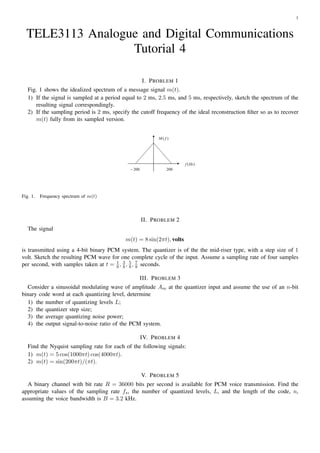
   Fig. 1 shows the idealized spectrum of a message signal m(t).
   1) If the signal is sampled at a period equal to 2 ms, 2.5 ms, and 5 ms, respectively, sketch the spectrum of the
      resulting signal correspondingly.
   2) If the sampling period is 2 ms, specify the cutoff frequency of the ideal reconstruction filter so as to recover
      m(t) fully from its sampled version.


                                                             M( f )


                                                                        f (Hz )
                                              − 200              200


Fig. 1.   Frequency spectrum of m(t)


                                                      II. P ROBLEM 2
   The signal
                                            m(t) = 8 sin(2πt), volts
is transmitted using a 4-bit binary PCM system. The quantizer is of the the mid-riser type, with a step size of 1
volt. Sketch the resulting PCM wave for one complete cycle of the input. Assume a sampling rate of four samples
per second, with samples taken at t = 8 , 3 , 5 , 7 seconds.
                                      1
                                          8 8 8

                                                      III. P ROBLEM 3
  Consider a sinusoidal modulating wave of amplitude Am at the quantizer input and assume the use of an n-bit
binary code word at each quantizing level, determine
  1) the number of quantizing levels L;
  2) the quantizer step size;
  3) the average quantizing noise power;
  4) the output signal-to-noise ratio of the PCM system.

                                                      IV. P ROBLEM 4
   Find the Nyquist sampling rate for each of the following signals:
   1) m(t) = 5 cos(1000πt) cos(4000πt).
   2) m(t) = sin(200πt)/(πt).

                                                      V. P ROBLEM 5
  A binary channel with bit rate R = 36000 bits per second is available for PCM voice transmission. Find the
appropriate values of the sampling rate fs , the number of quantized levels, L, and the length of the code, n,
assuming the voice bandwidth is B = 3.2 kHz.

Tele3113 tut4

  • 1.
    1 TELE3113Analogue and Digital Communications Tutorial 4 I. P ROBLEM 1 Fig. 1 shows the idealized spectrum of a message signal m(t). 1) If the signal is sampled at a period equal to 2 ms, 2.5 ms, and 5 ms, respectively, sketch the spectrum of the resulting signal correspondingly. 2) If the sampling period is 2 ms, specify the cutoff frequency of the ideal reconstruction filter so as to recover m(t) fully from its sampled version. M( f ) f (Hz ) − 200 200 Fig. 1. Frequency spectrum of m(t) II. P ROBLEM 2 The signal m(t) = 8 sin(2πt), volts is transmitted using a 4-bit binary PCM system. The quantizer is of the the mid-riser type, with a step size of 1 volt. Sketch the resulting PCM wave for one complete cycle of the input. Assume a sampling rate of four samples per second, with samples taken at t = 8 , 3 , 5 , 7 seconds. 1 8 8 8 III. P ROBLEM 3 Consider a sinusoidal modulating wave of amplitude Am at the quantizer input and assume the use of an n-bit binary code word at each quantizing level, determine 1) the number of quantizing levels L; 2) the quantizer step size; 3) the average quantizing noise power; 4) the output signal-to-noise ratio of the PCM system. IV. P ROBLEM 4 Find the Nyquist sampling rate for each of the following signals: 1) m(t) = 5 cos(1000πt) cos(4000πt). 2) m(t) = sin(200πt)/(πt). V. P ROBLEM 5 A binary channel with bit rate R = 36000 bits per second is available for PCM voice transmission. Find the appropriate values of the sampling rate fs , the number of quantized levels, L, and the length of the code, n, assuming the voice bandwidth is B = 3.2 kHz.