TELE3113 Analogue and Digital
      Communications
                Pulse Modulation

                      Wei Zhang
                 w.zhang@unsw.edu.au


School of Electrical Engineering and Telecommunications
          The University of New South Wales
What did we study

In previous lectures, we studied continuous-wave (CW)
modulation:
    Some parameter of a sinusoidal carrier wave is varied
    continuously in accordance with the message signal.
    Amplitude Modulation (AM, DSB-SC, SSB, VSB)
    Angle Modulation (PM, FM)


                                              TELE3113 - Pulse Modulation. Sept. 1, 2009. – p.1/1
What will we study

Next, we will study Pulse Modulation:
    Some parameter of a pulse train is varied in accordance
    with the message signal.
    Analogue pulse modulation: some feature of the pulse
    (e.g. amplitude, duration, or position) is varied continuously
    in accordance with the sample value of the message signal.
    Digital pulse modulation: the message signal is discrete
    in both time and amplitude, thereby transmitting a sequence
    of coded pulses.


                                                 TELE3113 - Pulse Modulation. Sept. 1, 2009. – p.2/1
Sampling Process 1

Let ga (t) be a continuous-time (CT) signal that is sampled
uniformly at t = nT , generating the sequence g[n],

                g[n] = ga (nT ), −∞ < n < ∞                                        (1)

where T is the sampling period and n is an integer.


                                                  TELE3113 - Pulse Modulation. Sept. 1, 2009. – p.3/1
Sampling Process 2

                              Sampling
                     ga(t)                 g[n]


                     ga(t)                  gp(t)


                               p(t)


                                             ∞
p(t) is a periodic impulse train: p(t) =     n=−∞ δ(t   − nT ).


                                                    TELE3113 - Pulse Modulation. Sept. 1, 2009. – p.4/1
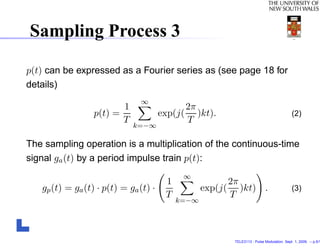
Sampling Process 3

p(t) can be expressed as a Fourier series as (see page 18 for
details)
                                ∞
                           1                    2π
                  p(t) =               exp(j(      )kt).                                      (2)
                           T                    T
                               k=−∞

The sampling operation is a multiplication of the continuous-time
signal ga (t) by a period impulse train p(t):
                                             ∞
                                        1                   2π
   gp (t) = ga (t) · p(t) = ga (t) ·               exp(j(      )kt) .                         (3)
                                        T                   T
                                            k=−∞


                                                             TELE3113 - Pulse Modulation. Sept. 1, 2009. – p.5/1
FT of Sampled Signal

Assume Ga (jω) ⇔ ga (t), i.e., Ga (jω) = F [ga (t)]. From the
frequency-shifting property of the FT, we have
                           2π                  2π
         F [ga (t) · exp(j( )kt)] = Ga (j(ω − k )).                                 (4)
                           T                   T
Next, taking FT on both sides of (3) and using (4), we get
                            ∞
                       1
Gp (jω) = F [gp (t)] =            Ga (j(ω − kωT )), −∞ < k < ∞ (5)
                       T
                           k=−∞

             2π
where ωT =   T    denotes the angular sampling frequency.


                                                   TELE3113 - Pulse Modulation. Sept. 1, 2009. – p.6/1
Sampling Theorem

Sampling theorem: Let ga (t) be a bandlimited signal with
Ga (jω) = 0 for |ω| > ωm . Then ga (t) is uniquely determined by
its samples ga (nT ), −∞ < n < ∞, if

                         ωT ≥ 2ωm ,                                                (6)

where
                               2π
                          ωT =    .                                                (7)
                               T


                                                  TELE3113 - Pulse Modulation. Sept. 1, 2009. – p.7/1
Signal Recovery 1

Question: Suppose that g[n] is obtained by uniformly sampling
a bandlimited analog signal ga (t) with a highest frequency ωm at
a sampling rate ωT = 2π satisfying (6), can the original analog
                          T
signal ga (t) be fully recovered from the given sequence g[n]?

Answer: YES, ga (t) can be fully recovered by generating an
impulse train gp (t) and then passing gp (t) through an ideal low
pass filter (LPF) H(jω) with a gain T and a cutoff frequency ω c
satisfying ωm < ωc < ωT − ωm .
                                                 ∧
            g[n]         gp(t)       LPF         g a(t)


                                                     TELE3113 - Pulse Modulation. Sept. 1, 2009. – p.8/1
Representation in Spectrum

                                    G a ( jω )


                                                                     ω
                            − ωm        ωm


                                              Sampling
           Recovery


                      LPF          G p ( jω )


     •••
                                                               •••

                                                                     ω
             − ωT                                 ωT     2ωT
                                   ωm        ωc
                                                                 TELE3113 - Pulse Modulation. Sept. 1, 2009. – p.9/1
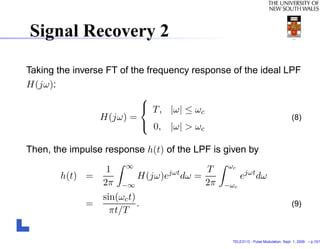
Signal Recovery 2

Taking the inverse FT of the frequency response of the ideal LPF
H(jω):
                           
                            T, |ω| ≤ ω
                                         c
                 H(jω) =                                      (8)
                            0, |ω| > ωc

Then, the impulse response h(t) of the LPF is given by
                                               ωc
                   1    ∞
                                jωt   T
        h(t) =            H(jω)e dω =               ejωt dω
                  2π   −∞             2π      −ωc
                  sin(ωc t)
              =             .                                                     (9)
                    πt/T


                                                TELE3113 - Pulse Modulation. Sept. 1, 2009. – p.10/1
Signal Recovery 3

Consider the impulse train gp (t) be expressed as
                                           ∞
    gp (t) = ga (t) · p(t) = ga (t) ·           δ(t − nT )
                                         n=−∞
                 ∞                              ∞
           =          ga (nT )δ(t − nT ) =            g[n]δ(t − nT ). (10)
               n=−∞                            n=−∞

Therefore, the output of the LPF is given by the convolution of
gp (t) with the impulse response h(t):
                             ∞
                 ga (t) =
                 ˆ                 g[n]h(t − nT ).                                      (11)
                            n=−∞


                                                        TELE3113 - Pulse Modulation. Sept. 1, 2009. – p.11/1
Signal Recovery 4

Substituting h(t) from (9) in (11) and assuming for simplicity
ωc = ωT /2 = π/T , we arrive at
                           ∞
                                 sin[π(t − nT )/T ]
              ga (t) =
              ˆ             g[n]
                       n=−∞
                                   π(t − nT )/T
                           ∞
                                         t − nT
                     =      g[n] · sinc(        ),                                (12)
                       n=−∞
                                            T

where sinc(x) is defined as sinc(x) = sin(πx)/(πx).
The reconstructed analog signal ga (t) is obtained by shifting in
                                  ˆ
time the impulse response of the LPF h(t) by an amount nT and
scaling it an amplitude by the factor g[n] for −∞ < n < ∞ and
then summing up all shifted versions.
                                                  TELE3113 - Pulse Modulation. Sept. 1, 2009. – p.12/1
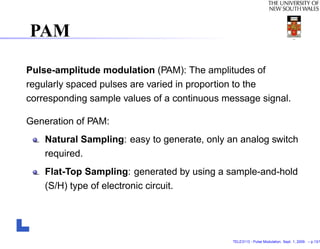
PAM

Pulse-amplitude modulation (PAM): The amplitudes of
regularly spaced pulses are varied in proportion to the
corresponding sample values of a continuous message signal.

Generation of PAM:
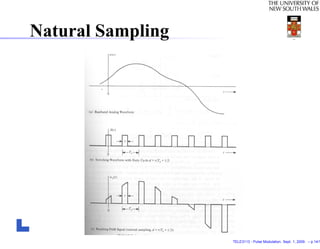
    Natural Sampling: easy to generate, only an analog switch
    required.
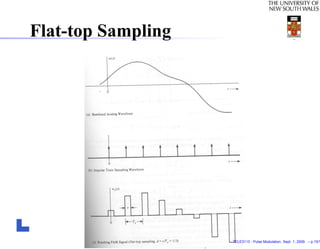
    Flat-Top Sampling: generated by using a sample-and-hold
    (S/H) type of electronic circuit.


                                              TELE3113 - Pulse Modulation. Sept. 1, 2009. – p.13/1
Natural Sampling


                   TELE3113 - Pulse Modulation. Sept. 1, 2009. – p.14/1
Flat-top Sampling


                    TELE3113 - Pulse Modulation. Sept. 1, 2009. – p.15/1
PDM and PPM

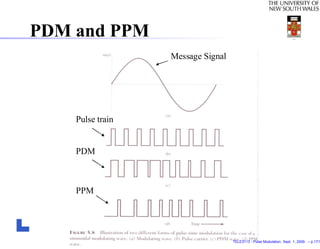
 Pulse-duration modulation (PDM): The duration of the
 pulses are varied according to the sample values of the
 message signal. Also referred to as pulse-width modulation
 or pulse-length modulation.
 Pulse-position modulation (PPM): The leading or trailing
 edge of each pulse is varied in accordance with the
 message signal.


                                            TELE3113 - Pulse Modulation. Sept. 1, 2009. – p.16/1
PDM and PPM
                  Message Signal


    Pulse train


    PDM


    PPM


                                   TELE3113 - Pulse Modulation. Sept. 1, 2009. – p.17/1
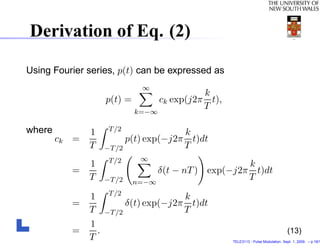
Derivation of Eq. (2)

Using Fourier series, p(t) can be expressed as
                               ∞
                                               k
                     p(t) =          ck exp(j2π t),
                                               T
                              k=−∞

where                 T /2
               1                        k
        ck =               p(t) exp(−j2π t)dt
               T     −T /2              T
                      T /2     ∞
               1                                      k
          =                        δ(t − nT ) exp(−j2π t)dt
               T     −T /2    n=−∞
                                                      T
                      T /2
               1                        k
          =                δ(t) exp(−j2π t)dt
               T     −T /2              T
               1
          =      .                                                                    (13)
               T                                      TELE3113 - Pulse Modulation. Sept. 1, 2009. – p.18/1

Tele3113 wk7tue

  • 1.
    TELE3113 Analogue andDigital Communications Pulse Modulation Wei Zhang w.zhang@unsw.edu.au School of Electrical Engineering and Telecommunications The University of New South Wales
  • 2.
    What did westudy In previous lectures, we studied continuous-wave (CW) modulation: Some parameter of a sinusoidal carrier wave is varied continuously in accordance with the message signal. Amplitude Modulation (AM, DSB-SC, SSB, VSB) Angle Modulation (PM, FM) TELE3113 - Pulse Modulation. Sept. 1, 2009. – p.1/1
  • 3.
    What will westudy Next, we will study Pulse Modulation: Some parameter of a pulse train is varied in accordance with the message signal. Analogue pulse modulation: some feature of the pulse (e.g. amplitude, duration, or position) is varied continuously in accordance with the sample value of the message signal. Digital pulse modulation: the message signal is discrete in both time and amplitude, thereby transmitting a sequence of coded pulses. TELE3113 - Pulse Modulation. Sept. 1, 2009. – p.2/1
  • 4.
    Sampling Process 1 Letga (t) be a continuous-time (CT) signal that is sampled uniformly at t = nT , generating the sequence g[n], g[n] = ga (nT ), −∞ < n < ∞ (1) where T is the sampling period and n is an integer. TELE3113 - Pulse Modulation. Sept. 1, 2009. – p.3/1
  • 5.
    Sampling Process 2 Sampling ga(t) g[n] ga(t) gp(t) p(t) ∞ p(t) is a periodic impulse train: p(t) = n=−∞ δ(t − nT ). TELE3113 - Pulse Modulation. Sept. 1, 2009. – p.4/1
  • 6.
    Sampling Process 3 p(t)can be expressed as a Fourier series as (see page 18 for details) ∞ 1 2π p(t) = exp(j( )kt). (2) T T k=−∞ The sampling operation is a multiplication of the continuous-time signal ga (t) by a period impulse train p(t): ∞ 1 2π gp (t) = ga (t) · p(t) = ga (t) · exp(j( )kt) . (3) T T k=−∞ TELE3113 - Pulse Modulation. Sept. 1, 2009. – p.5/1
  • 7.
    FT of SampledSignal Assume Ga (jω) ⇔ ga (t), i.e., Ga (jω) = F [ga (t)]. From the frequency-shifting property of the FT, we have 2π 2π F [ga (t) · exp(j( )kt)] = Ga (j(ω − k )). (4) T T Next, taking FT on both sides of (3) and using (4), we get ∞ 1 Gp (jω) = F [gp (t)] = Ga (j(ω − kωT )), −∞ < k < ∞ (5) T k=−∞ 2π where ωT = T denotes the angular sampling frequency. TELE3113 - Pulse Modulation. Sept. 1, 2009. – p.6/1
  • 8.
    Sampling Theorem Sampling theorem:Let ga (t) be a bandlimited signal with Ga (jω) = 0 for |ω| > ωm . Then ga (t) is uniquely determined by its samples ga (nT ), −∞ < n < ∞, if ωT ≥ 2ωm , (6) where 2π ωT = . (7) T TELE3113 - Pulse Modulation. Sept. 1, 2009. – p.7/1
  • 9.
    Signal Recovery 1 Question:Suppose that g[n] is obtained by uniformly sampling a bandlimited analog signal ga (t) with a highest frequency ωm at a sampling rate ωT = 2π satisfying (6), can the original analog T signal ga (t) be fully recovered from the given sequence g[n]? Answer: YES, ga (t) can be fully recovered by generating an impulse train gp (t) and then passing gp (t) through an ideal low pass filter (LPF) H(jω) with a gain T and a cutoff frequency ω c satisfying ωm < ωc < ωT − ωm . ∧ g[n] gp(t) LPF g a(t) TELE3113 - Pulse Modulation. Sept. 1, 2009. – p.8/1
  • 10.
    Representation in Spectrum G a ( jω ) ω − ωm ωm Sampling Recovery LPF G p ( jω ) ••• ••• ω − ωT ωT 2ωT ωm ωc TELE3113 - Pulse Modulation. Sept. 1, 2009. – p.9/1
  • 11.
    Signal Recovery 2 Takingthe inverse FT of the frequency response of the ideal LPF H(jω):   T, |ω| ≤ ω c H(jω) = (8)  0, |ω| > ωc Then, the impulse response h(t) of the LPF is given by ωc 1 ∞ jωt T h(t) = H(jω)e dω = ejωt dω 2π −∞ 2π −ωc sin(ωc t) = . (9) πt/T TELE3113 - Pulse Modulation. Sept. 1, 2009. – p.10/1
  • 12.
    Signal Recovery 3 Considerthe impulse train gp (t) be expressed as ∞ gp (t) = ga (t) · p(t) = ga (t) · δ(t − nT ) n=−∞ ∞ ∞ = ga (nT )δ(t − nT ) = g[n]δ(t − nT ). (10) n=−∞ n=−∞ Therefore, the output of the LPF is given by the convolution of gp (t) with the impulse response h(t): ∞ ga (t) = ˆ g[n]h(t − nT ). (11) n=−∞ TELE3113 - Pulse Modulation. Sept. 1, 2009. – p.11/1
  • 13.
    Signal Recovery 4 Substitutingh(t) from (9) in (11) and assuming for simplicity ωc = ωT /2 = π/T , we arrive at ∞ sin[π(t − nT )/T ] ga (t) = ˆ g[n] n=−∞ π(t − nT )/T ∞ t − nT = g[n] · sinc( ), (12) n=−∞ T where sinc(x) is defined as sinc(x) = sin(πx)/(πx). The reconstructed analog signal ga (t) is obtained by shifting in ˆ time the impulse response of the LPF h(t) by an amount nT and scaling it an amplitude by the factor g[n] for −∞ < n < ∞ and then summing up all shifted versions. TELE3113 - Pulse Modulation. Sept. 1, 2009. – p.12/1
  • 14.
    PAM Pulse-amplitude modulation (PAM):The amplitudes of regularly spaced pulses are varied in proportion to the corresponding sample values of a continuous message signal. Generation of PAM: Natural Sampling: easy to generate, only an analog switch required. Flat-Top Sampling: generated by using a sample-and-hold (S/H) type of electronic circuit. TELE3113 - Pulse Modulation. Sept. 1, 2009. – p.13/1
  • 15.
    Natural Sampling TELE3113 - Pulse Modulation. Sept. 1, 2009. – p.14/1
  • 16.
    Flat-top Sampling TELE3113 - Pulse Modulation. Sept. 1, 2009. – p.15/1
  • 17.
    PDM and PPM Pulse-duration modulation (PDM): The duration of the pulses are varied according to the sample values of the message signal. Also referred to as pulse-width modulation or pulse-length modulation. Pulse-position modulation (PPM): The leading or trailing edge of each pulse is varied in accordance with the message signal. TELE3113 - Pulse Modulation. Sept. 1, 2009. – p.16/1
  • 18.
    PDM and PPM Message Signal Pulse train PDM PPM TELE3113 - Pulse Modulation. Sept. 1, 2009. – p.17/1
  • 19.
    Derivation of Eq.(2) Using Fourier series, p(t) can be expressed as ∞ k p(t) = ck exp(j2π t), T k=−∞ where T /2 1 k ck = p(t) exp(−j2π t)dt T −T /2 T T /2 ∞ 1 k = δ(t − nT ) exp(−j2π t)dt T −T /2 n=−∞ T T /2 1 k = δ(t) exp(−j2π t)dt T −T /2 T 1 = . (13) T TELE3113 - Pulse Modulation. Sept. 1, 2009. – p.18/1