1
Communication Engineering
Sayeed Islam
Assistant Professor,
Department of EEE,
November, 2016
2
: Bandpass Modulation and Demodulation
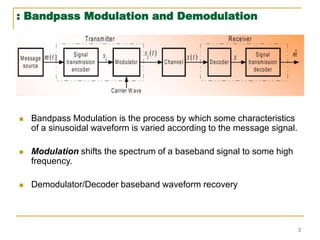
 Bandpass Modulation is the process by which some characteristics
of a sinusoidal waveform is varied according to the message signal.
 Modulation shifts the spectrum of a baseband signal to some high
frequency.
 Demodulator/Decoder baseband waveform recovery
3
4.1 Why Modulate?
 Most channels require that the baseband signal be shifted to a higher
frequency
 For example in case of a wireless channel antenna size is inversely
proportional to the center frequency, this is difficult to realize for baseband
signals.
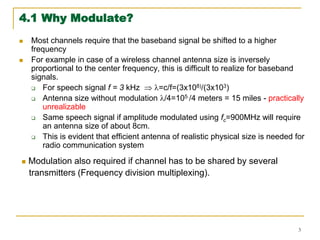
 For speech signal f = 3 kHz  =c/f=(3x108)/(3x103)
 Antenna size without modulation /4=105 /4 meters = 15 miles - practically
unrealizable
 Same speech signal if amplitude modulated using fc=900MHz will require
an antenna size of about 8cm.
 This is evident that efficient antenna of realistic physical size is needed for
radio communication system
 Modulation also required if channel has to be shared by several
transmitters (Frequency division multiplexing).
4
4.2 Digital Bandpass Modulation Techniques
Three ways of representing bandpass signal:
 (1) Magnitude and Phase (M & P)
 Any bandpass signal can be represented as:
 A(t) ≥ 0 is real valued signal representing the magnitude
 Θ(t) is the genarlized angle
 φ(t) is the phase
 The representation is easy to interpret physically, but often is not
mathematically convenient
 In this form, the modulated signal can represent information through
changing three parameters of the signal namely:
 Amplitude A(t) : as in Amplitude Shift Keying (ASK)
 Phase φ(t) : as in Phase Shift Keying (PSK)
 Frequency dΘ(t)/ dt : as in Frequency Shift Keying (FSK)
)]
(
cos[
)
(
cos[
)
(
)
( 0 t
t
t
A
t
t
A
t
s 

 




5
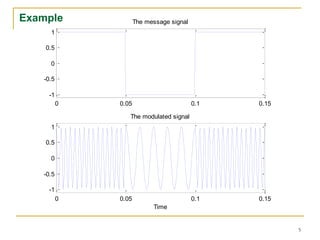
0 0.05 0.1 0.15
-1
-0.5
0
0.5
1
The message signal
0 0.05 0.1 0.15
-1
-0.5
0
0.5
1
Time
The modulated signal
Example
6
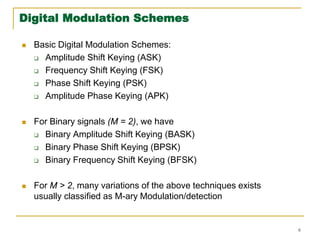
Digital Modulation Schemes
 Basic Digital Modulation Schemes:
 Amplitude Shift Keying (ASK)
 Frequency Shift Keying (FSK)
 Phase Shift Keying (PSK)
 Amplitude Phase Keying (APK)
 For Binary signals (M = 2), we have
 Binary Amplitude Shift Keying (BASK)
 Binary Phase Shift Keying (BPSK)
 Binary Frequency Shift Keying (BFSK)
 For M > 2, many variations of the above techniques exists
usually classified as M-ary Modulation/detection
8
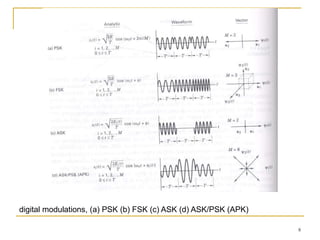
digital modulations, (a) PSK (b) FSK (c) ASK (d) ASK/PSK (APK)
9
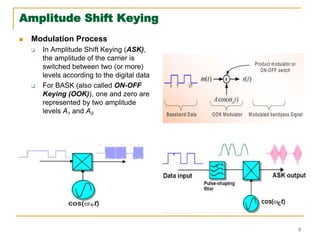
Amplitude Shift Keying
 Modulation Process
 In Amplitude Shift Keying (ASK),
the amplitude of the carrier is
switched between two (or more)
levels according to the digital data
 For BASK (also called ON-OFF
Keying (OOK)), one and zero are
represented by two amplitude
levels A1 and A0
10
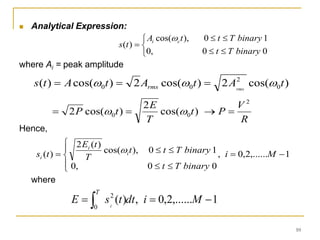
 Analytical Expression:
where Ai = peak amplitude
Hence,
where








0
0
,
0
1
0
),
cos(
)
(
binary
T
t
binary
T
t
t
A
t
s c
i 
)
cos(
2
)
cos(
2
)
cos(
)
( 0
2
0
0 t
A
t
A
t
A
t
s rms
rms 

 


R
V
P
t
T
E
t
P
2
0
0 )
cos(
2
)
cos(
2 


 












 1
,......
2
,
0
,
0
0
,
0
1
0
),
cos(
)
(
2
)
( M
i
binary
T
t
binary
T
t
t
T
t
E
t
s i
i
i

1
,......
2
,
0
,
)
(
0
2


  M
i
dt
t
s
E
T
i
11
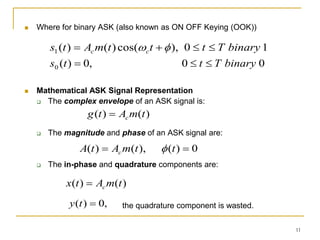
 Where for binary ASK (also known as ON OFF Keying (OOK))
 Mathematical ASK Signal Representation
 The complex envelope of an ASK signal is:
 The magnitude and phase of an ASK signal are:
 The in-phase and quadrature components are:
the quadrature component is wasted.
1
0
),
cos(
)
(
)
(
1 binary
T
t
t
t
m
A
t
s c
c 


 

0
0
,
0
)
(
0 binary
T
t
t
s 


)
(
)
( t
m
A
t
g c

0
)
(
),
(
)
( 
 t
t
m
A
t
A c 
)
(
)
( t
m
A
t
x c

,
0
)
( 
t
y
12
Detectors for ASK
Coherent Receiver
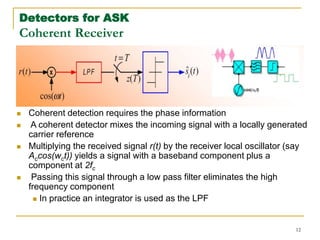
 Coherent detection requires the phase information
 A coherent detector mixes the incoming signal with a locally generated
carrier reference
 Multiplying the received signal r(t) by the receiver local oscillator (say
Accos(wct)) yields a signal with a baseband component plus a
component at 2fc
 Passing this signal through a low pass filter eliminates the high
frequency component
 In practice an integrator is used as the LPF
13
Noncoherent Receiver
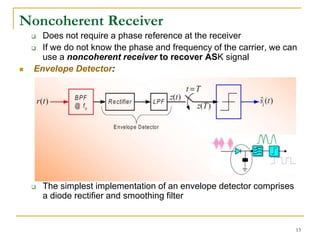
 Does not require a phase reference at the receiver
 If we do not know the phase and frequency of the carrier, we can
use a noncoherent receiver to recover ASK signal
 Envelope Detector:
 The simplest implementation of an envelope detector comprises
a diode rectifier and smoothing filter
14
Frequency Shift Keying (FSK)
 In FSK, the instantaneous carrier frequency is switched between 2 or
more levels according to the baseband digital data
 data bits select a carrier at one of two frequencies
 the data is encoded in the frequency
 Until recently, FSK has been the most widely used form of digital
modulation;Why?
 Simple both to generate and detect
 Insensitive to amplitude fluctuations in the channel
 FSK conveys the data using distinct carrier frequencies to represent
symbol states
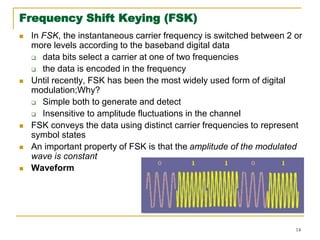
 An important property of FSK is that the amplitude of the modulated
wave is constant
 Waveform
15
 Analytical Expression
 General expression is
Where
1
,....
1
,
0
),
cos(
2
)
( 


 M
i
t
T
E
t
s i
s
s
i





form
Analog
)
(
)
(
]
)
(
[
)
(
0
0









  

t
m
f
f
t
dt
d
f
d
m
t
t
d
i
i
t
d
i






b
s
b
s
i kT
T
kE
E
and
f
i
f
f 



 ,
0
1



 i
i f
f
f
1
,....
1
,
0
),
2
2
cos(
2
)
( 0 



 M
i
ft
i
t
f
T
E
t
s
s
s
i 


EEE323_7.pptx

  • 1.
    1 Communication Engineering Sayeed Islam AssistantProfessor, Department of EEE, November, 2016
  • 2.
    2 : Bandpass Modulationand Demodulation  Bandpass Modulation is the process by which some characteristics of a sinusoidal waveform is varied according to the message signal.  Modulation shifts the spectrum of a baseband signal to some high frequency.  Demodulator/Decoder baseband waveform recovery
  • 3.
    3 4.1 Why Modulate? Most channels require that the baseband signal be shifted to a higher frequency  For example in case of a wireless channel antenna size is inversely proportional to the center frequency, this is difficult to realize for baseband signals.  For speech signal f = 3 kHz  =c/f=(3x108)/(3x103)  Antenna size without modulation /4=105 /4 meters = 15 miles - practically unrealizable  Same speech signal if amplitude modulated using fc=900MHz will require an antenna size of about 8cm.  This is evident that efficient antenna of realistic physical size is needed for radio communication system  Modulation also required if channel has to be shared by several transmitters (Frequency division multiplexing).
  • 4.
    4 4.2 Digital BandpassModulation Techniques Three ways of representing bandpass signal:  (1) Magnitude and Phase (M & P)  Any bandpass signal can be represented as:  A(t) ≥ 0 is real valued signal representing the magnitude  Θ(t) is the genarlized angle  φ(t) is the phase  The representation is easy to interpret physically, but often is not mathematically convenient  In this form, the modulated signal can represent information through changing three parameters of the signal namely:  Amplitude A(t) : as in Amplitude Shift Keying (ASK)  Phase φ(t) : as in Phase Shift Keying (PSK)  Frequency dΘ(t)/ dt : as in Frequency Shift Keying (FSK) )] ( cos[ ) ( cos[ ) ( ) ( 0 t t t A t t A t s        
  • 5.
    5 0 0.05 0.10.15 -1 -0.5 0 0.5 1 The message signal 0 0.05 0.1 0.15 -1 -0.5 0 0.5 1 Time The modulated signal Example
  • 6.
    6 Digital Modulation Schemes Basic Digital Modulation Schemes:  Amplitude Shift Keying (ASK)  Frequency Shift Keying (FSK)  Phase Shift Keying (PSK)  Amplitude Phase Keying (APK)  For Binary signals (M = 2), we have  Binary Amplitude Shift Keying (BASK)  Binary Phase Shift Keying (BPSK)  Binary Frequency Shift Keying (BFSK)  For M > 2, many variations of the above techniques exists usually classified as M-ary Modulation/detection
  • 7.
    8 digital modulations, (a)PSK (b) FSK (c) ASK (d) ASK/PSK (APK)
  • 8.
    9 Amplitude Shift Keying Modulation Process  In Amplitude Shift Keying (ASK), the amplitude of the carrier is switched between two (or more) levels according to the digital data  For BASK (also called ON-OFF Keying (OOK)), one and zero are represented by two amplitude levels A1 and A0
  • 9.
    10  Analytical Expression: whereAi = peak amplitude Hence, where         0 0 , 0 1 0 ), cos( ) ( binary T t binary T t t A t s c i  ) cos( 2 ) cos( 2 ) cos( ) ( 0 2 0 0 t A t A t A t s rms rms       R V P t T E t P 2 0 0 ) cos( 2 ) cos( 2                   1 ,...... 2 , 0 , 0 0 , 0 1 0 ), cos( ) ( 2 ) ( M i binary T t binary T t t T t E t s i i i  1 ,...... 2 , 0 , ) ( 0 2     M i dt t s E T i
  • 10.
    11  Where forbinary ASK (also known as ON OFF Keying (OOK))  Mathematical ASK Signal Representation  The complex envelope of an ASK signal is:  The magnitude and phase of an ASK signal are:  The in-phase and quadrature components are: the quadrature component is wasted. 1 0 ), cos( ) ( ) ( 1 binary T t t t m A t s c c       0 0 , 0 ) ( 0 binary T t t s    ) ( ) ( t m A t g c  0 ) ( ), ( ) (   t t m A t A c  ) ( ) ( t m A t x c  , 0 ) (  t y
  • 11.
    12 Detectors for ASK CoherentReceiver  Coherent detection requires the phase information  A coherent detector mixes the incoming signal with a locally generated carrier reference  Multiplying the received signal r(t) by the receiver local oscillator (say Accos(wct)) yields a signal with a baseband component plus a component at 2fc  Passing this signal through a low pass filter eliminates the high frequency component  In practice an integrator is used as the LPF
  • 12.
    13 Noncoherent Receiver  Doesnot require a phase reference at the receiver  If we do not know the phase and frequency of the carrier, we can use a noncoherent receiver to recover ASK signal  Envelope Detector:  The simplest implementation of an envelope detector comprises a diode rectifier and smoothing filter
  • 13.
    14 Frequency Shift Keying(FSK)  In FSK, the instantaneous carrier frequency is switched between 2 or more levels according to the baseband digital data  data bits select a carrier at one of two frequencies  the data is encoded in the frequency  Until recently, FSK has been the most widely used form of digital modulation;Why?  Simple both to generate and detect  Insensitive to amplitude fluctuations in the channel  FSK conveys the data using distinct carrier frequencies to represent symbol states  An important property of FSK is that the amplitude of the modulated wave is constant  Waveform
  • 14.
    15  Analytical Expression General expression is Where 1 ,.... 1 , 0 ), cos( 2 ) (     M i t T E t s i s s i      form Analog ) ( ) ( ] ) ( [ ) ( 0 0              t m f f t dt d f d m t t d i i t d i       b s b s i kT T kE E and f i f f      , 0 1     i i f f f 1 ,.... 1 , 0 ), 2 2 cos( 2 ) ( 0      M i ft i t f T E t s s s i  