Outlines
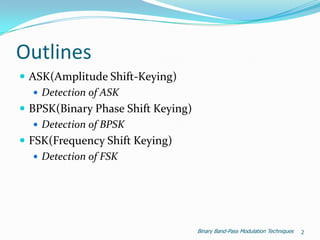
 ASK(Amplitude Shift-Keying)
    Detection of ASK
 BPSK(Binary Phase Shift Keying)
    Detection of BPSK
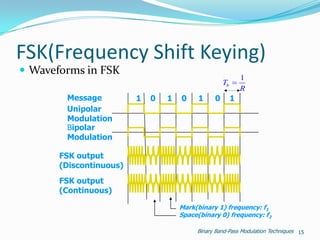
 FSK(Frequency Shift Keying)
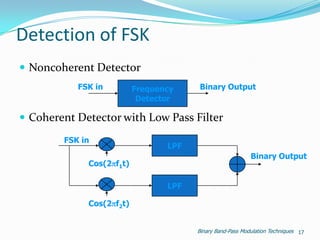
    Detection of FSK


                                    Binary Band-Pass Modulation Techniques   2
ASK (Amplitude Shift Keying)
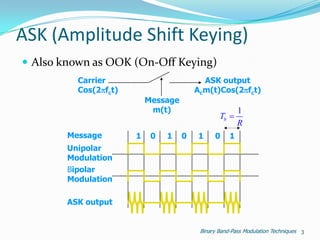
 Also known as OOK (On-Off Keying)
          Carrier                          ASK output
          Cos(2fct)                     Acm(t)Cos(2fct)
                           Message
                            m(t)                         1
                                                 Tb 
                                                         R
        Message        1    0   1    0   1     0     1
        Unipolar
        Modulation
        Bipolar
        Modulation

        ASK output


                                          Binary Band-Pass Modulation Techniques 3
ASK (Amplitude Shift Keying)
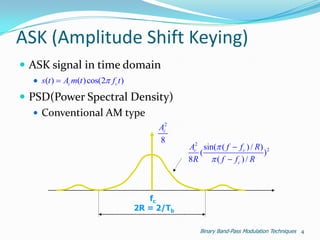
 ASK signal in time domain
   s(t )  Ac m(t ) cos(2 f c t )
 PSD(Power Spectral Density)
    Conventional AM type
                                           Ac2
                                           8
                                                  Ac2 sin( ( f  f c ) / R) 2
                                                     (                      )
                                                  8R  ( f  f c ) / R


                                         fc
                                      2R = 2/Tb

                                                     Binary Band-Pass Modulation Techniques 4
ASK (Amplitude Shift Keying)
• The two binary values are represented by two different
  amplitudes of the carrier frequency
• The resulting modulated signal for one bit time is
          A cos(2f ct ), binary 1
 s(t )  
         0,               binary 0

• Susceptible to noise
• Inefficient modulation technique
• used for
    up to 1200bps on voice grade lines
    very high speeds over optical fiber


                                           Binary Band-Pass Modulation Techniques 5
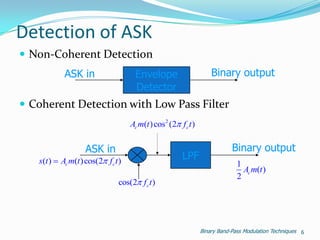
Detection of ASK
 Non-Coherent Detection
            ASK in                     Envelope                       Binary output
                                       Detector
 Coherent Detection with Low Pass Filter
                                     Ac m(t ) cos 2 (2 f c t )


                    ASK in                                                    Binary output
   s(t )  Ac m(t ) cos(2 f c t )
                                                         LPF
                                                                                1
                                                                                  Ac m(t )
                                                                                2
                                 cos(2 f c t )


                                                                  Binary Band-Pass Modulation Techniques 6
Detection of ASK
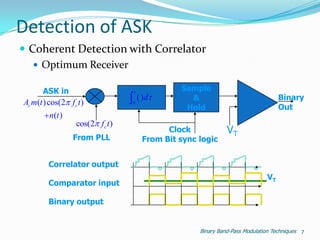
 Coherent Detection with Correlator
    Optimum Receiver

       ASK in                         t
                                                   Sample
Ac m(t ) cos(2 f c t )               ( ) d
                                      0
                                                     &                                Binary
                                                    Hold                              Out
        n(t )
                    cos(2 f c t )
                                                Clock             VT
                  From PLL                From Bit sync logic


         Correlator output
                                                                                 VT
         Comparator input

         Binary output


                                                        Binary Band-Pass Modulation Techniques 7
Detection of ASK
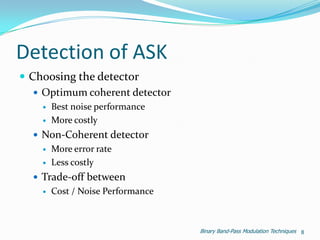
 Choosing the detector
    Optimum coherent detector
       Best noise performance
       More costly
   Non-Coherent detector
       More error rate
       Less costly
   Trade-off between
       Cost / Noise Performance


                                   Binary Band-Pass Modulation Techniques 8
BPSK(Binary Phase Shift Keying)
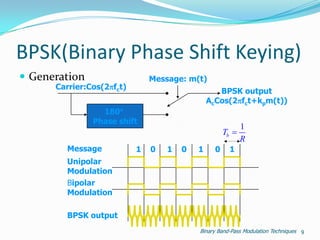
 Generation                   Message: m(t)
      Carrier:Cos(2fct)
                                                  BPSK output
                                               AcCos(2fct+kpm(t))
                 180
               Phase shift
                                                            1
                                                     Tb 
                                                            R
        Message            1   0   1   0   1     0    1
        Unipolar
        Modulation
        Bipolar
        Modulation

        BPSK output
                                           Binary Band-Pass Modulation Techniques 9
BPSK(Binary Phase Shift Keying)
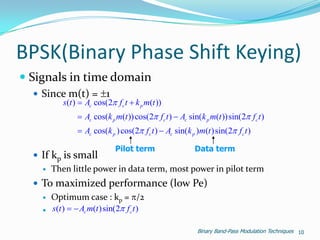
 Signals in time domain
   Since m(t) = 1
         s(t )  Ac cos(2 f c t  k p m(t ))
               Ac cos(k p m(t )) cos(2 f c t )  Ac sin(k p m(t ))sin(2 f c t )
               Ac cos(k p ) cos(2 f c t )  Ac sin(k p )m(t )sin(2 f c t )

                            Pilot term                  Data term
   If kp is small
     Then little power in data term, most power in pilot term

   To maximized performance (low Pe)
     Optimum case : kp = /2

     s (t )   Ac m(t )sin(2 f c t )


                                                         Binary Band-Pass Modulation Techniques 10
BPSK(Binary Phase Shift Keying)
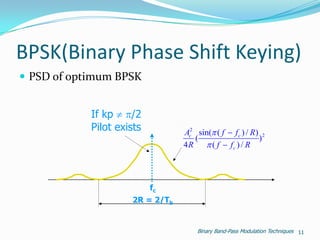
 PSD of optimum BPSK


            If kp  /2
            Pilot exists         Ac2 sin( ( f  f c ) / R) 2
                                    (                      )
                                 4R  ( f  fc ) / R


                           fc
                     2R = 2/Tb


                                     Binary Band-Pass Modulation Techniques 11
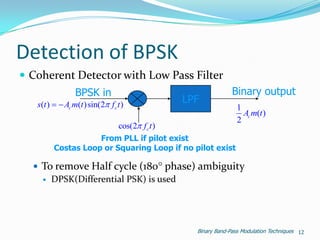
Detection of BPSK
 Coherent Detector with Low Pass Filter
                 BPSK in                                         Binary output
   s(t )   Ac m(t )sin(2 f c t )
                                                  LPF
                                                                   1
                                                                     Ac m(t )
                                                                   2
                                 cos(2 f c t )
                    From PLL if pilot exist
         Costas Loop or Squaring Loop if no pilot exist

   To remove Half cycle (180 phase) ambiguity
     DPSK(Differential PSK) is used


                                                    Binary Band-Pass Modulation Techniques 12
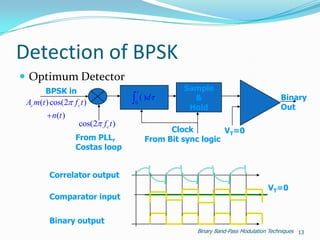
Detection of BPSK
 Optimum Detector
        BPSK in                        t
                                                    Sample
 Ac m(t ) cos(2 f c t )               ( ) d
                                       0
                                                      &                                Binary
                                                     Hold                              Out
         n(t )
                     cos(2 f c t )
                                                 Clock         VT=0
                   From PLL,               From Bit sync logic
                   Costas loop


         Correlator output
                                                                                  VT=0
         Comparator input

         Binary output
                                                       Binary Band-Pass Modulation Techniques 13
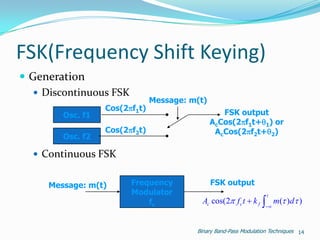
FSK(Frequency Shift Keying)
 Generation
    Discontinuous FSK
                               Message: m(t)
                  Cos(2f1t)
        Osc. f1                                   FSK output
                                               AcCos(2f1t+1) or
                  Cos(2f2t)                    AcCos(2f2t+2)
        Osc. f2

   Continuous FSK


     Message: m(t)       Frequency             FSK output
                         Modulator                                     t
                             fc            Ac cos(2 f c t  k f   
                                                                   
                                                                           m( ) d )


                                         Binary Band-Pass Modulation Techniques 14
FSK(Frequency Shift Keying)
 Waveforms in FSK
                                                           1
                                                    Tb 
                                                           R
        Message          1   0   1   0     1    0     1
        Unipolar
        Modulation
        Bipolar
        Modulation

       FSK output
       (Discontinuous)
       FSK output
       (Continuous)

                                     Mark(binary 1) frequency: f1
                                     Space(binary 0) frequency: f2

                                          Binary Band-Pass Modulation Techniques 15
BFSK(Binary Frequency Shift
Keying)
• The most common form of FSK is Binary FSK (BFSK)
• Two binary values represented by two different
  frequencies ( f1 and f2 )          0   0   1   1    0    1    0   0    0    1    0

         A cos(2f1t ), binary 1
                                     f2 f2 f1 f1 f2 f1 f2 f2 f2 f1 f2
s(t )  
         A cos(2f 2t ), binary 0

• less susceptible to noise than ASK
• used for
    up to 1200bps on voice grade lines
    high frequency radio (3 to 30MHz)
    even higher frequency on LANs using coaxial cable


                                             Binary Band-Pass Modulation Techniques 16
Detection of FSK
 Noncoherent Detector
           FSK in         Frequency    Binary Output
                           Detector

 Coherent Detector with Low Pass Filter
        FSK in
                                 LPF
                                                           Binary Output
             Cos(2f1t)

                                 LPF

             Cos(2f2t)


                                       Binary Band-Pass Modulation Techniques 17
Detection of FSK
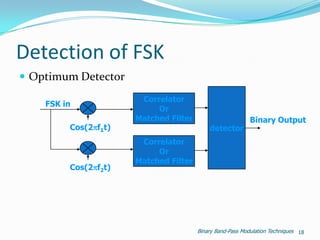
 Optimum Detector
                       Correlator
    FSK in
                           Or
                      Matched Filter                       Binary Output
         Cos(2f1t)                        detector
                       Correlator
                           Or
                      Matched Filter
         Cos(2f2t)


                                       Binary Band-Pass Modulation Techniques 18
Binary Pass-Band Modulation Techniques

Binary Pass-Band Modulation Techniques

  • 2.
    Outlines  ASK(Amplitude Shift-Keying)  Detection of ASK  BPSK(Binary Phase Shift Keying)  Detection of BPSK  FSK(Frequency Shift Keying)  Detection of FSK Binary Band-Pass Modulation Techniques 2
  • 3.
    ASK (Amplitude ShiftKeying)  Also known as OOK (On-Off Keying) Carrier ASK output Cos(2fct) Acm(t)Cos(2fct) Message m(t) 1 Tb  R Message 1 0 1 0 1 0 1 Unipolar Modulation Bipolar Modulation ASK output Binary Band-Pass Modulation Techniques 3
  • 4.
    ASK (Amplitude ShiftKeying)  ASK signal in time domain  s(t )  Ac m(t ) cos(2 f c t )  PSD(Power Spectral Density)  Conventional AM type Ac2 8 Ac2 sin( ( f  f c ) / R) 2 ( ) 8R  ( f  f c ) / R fc 2R = 2/Tb Binary Band-Pass Modulation Techniques 4
  • 5.
    ASK (Amplitude ShiftKeying) • The two binary values are represented by two different amplitudes of the carrier frequency • The resulting modulated signal for one bit time is  A cos(2f ct ), binary 1 s(t )   0, binary 0 • Susceptible to noise • Inefficient modulation technique • used for  up to 1200bps on voice grade lines  very high speeds over optical fiber Binary Band-Pass Modulation Techniques 5
  • 6.
    Detection of ASK Non-Coherent Detection ASK in Envelope Binary output Detector  Coherent Detection with Low Pass Filter Ac m(t ) cos 2 (2 f c t ) ASK in Binary output s(t )  Ac m(t ) cos(2 f c t ) LPF 1 Ac m(t ) 2 cos(2 f c t ) Binary Band-Pass Modulation Techniques 6
  • 7.
    Detection of ASK Coherent Detection with Correlator  Optimum Receiver ASK in t Sample Ac m(t ) cos(2 f c t )  ( ) d 0 & Binary Hold Out  n(t ) cos(2 f c t ) Clock VT From PLL From Bit sync logic Correlator output VT Comparator input Binary output Binary Band-Pass Modulation Techniques 7
  • 8.
    Detection of ASK Choosing the detector  Optimum coherent detector  Best noise performance  More costly  Non-Coherent detector  More error rate  Less costly  Trade-off between  Cost / Noise Performance Binary Band-Pass Modulation Techniques 8
  • 9.
    BPSK(Binary Phase ShiftKeying)  Generation Message: m(t) Carrier:Cos(2fct) BPSK output AcCos(2fct+kpm(t)) 180 Phase shift 1 Tb  R Message 1 0 1 0 1 0 1 Unipolar Modulation Bipolar Modulation BPSK output Binary Band-Pass Modulation Techniques 9
  • 10.
    BPSK(Binary Phase ShiftKeying)  Signals in time domain  Since m(t) = 1 s(t )  Ac cos(2 f c t  k p m(t ))  Ac cos(k p m(t )) cos(2 f c t )  Ac sin(k p m(t ))sin(2 f c t )  Ac cos(k p ) cos(2 f c t )  Ac sin(k p )m(t )sin(2 f c t ) Pilot term Data term  If kp is small  Then little power in data term, most power in pilot term  To maximized performance (low Pe)  Optimum case : kp = /2  s (t )   Ac m(t )sin(2 f c t ) Binary Band-Pass Modulation Techniques 10
  • 11.
    BPSK(Binary Phase ShiftKeying)  PSD of optimum BPSK If kp  /2 Pilot exists Ac2 sin( ( f  f c ) / R) 2 ( ) 4R  ( f  fc ) / R fc 2R = 2/Tb Binary Band-Pass Modulation Techniques 11
  • 12.
    Detection of BPSK Coherent Detector with Low Pass Filter BPSK in Binary output s(t )   Ac m(t )sin(2 f c t ) LPF 1 Ac m(t ) 2 cos(2 f c t ) From PLL if pilot exist Costas Loop or Squaring Loop if no pilot exist  To remove Half cycle (180 phase) ambiguity  DPSK(Differential PSK) is used Binary Band-Pass Modulation Techniques 12
  • 13.
    Detection of BPSK Optimum Detector BPSK in t Sample Ac m(t ) cos(2 f c t )  ( ) d 0 & Binary Hold Out  n(t ) cos(2 f c t ) Clock VT=0 From PLL, From Bit sync logic Costas loop Correlator output VT=0 Comparator input Binary output Binary Band-Pass Modulation Techniques 13
  • 14.
    FSK(Frequency Shift Keying) Generation  Discontinuous FSK Message: m(t) Cos(2f1t) Osc. f1 FSK output AcCos(2f1t+1) or Cos(2f2t) AcCos(2f2t+2) Osc. f2  Continuous FSK Message: m(t) Frequency FSK output Modulator t fc Ac cos(2 f c t  k f   m( ) d ) Binary Band-Pass Modulation Techniques 14
  • 15.
    FSK(Frequency Shift Keying) Waveforms in FSK 1 Tb  R Message 1 0 1 0 1 0 1 Unipolar Modulation Bipolar Modulation FSK output (Discontinuous) FSK output (Continuous) Mark(binary 1) frequency: f1 Space(binary 0) frequency: f2 Binary Band-Pass Modulation Techniques 15
  • 16.
    BFSK(Binary Frequency Shift Keying) •The most common form of FSK is Binary FSK (BFSK) • Two binary values represented by two different frequencies ( f1 and f2 ) 0 0 1 1 0 1 0 0 0 1 0  A cos(2f1t ), binary 1 f2 f2 f1 f1 f2 f1 f2 f2 f2 f1 f2 s(t )    A cos(2f 2t ), binary 0 • less susceptible to noise than ASK • used for  up to 1200bps on voice grade lines  high frequency radio (3 to 30MHz)  even higher frequency on LANs using coaxial cable Binary Band-Pass Modulation Techniques 16
  • 17.
    Detection of FSK Noncoherent Detector FSK in Frequency Binary Output Detector  Coherent Detector with Low Pass Filter FSK in LPF Binary Output Cos(2f1t) LPF Cos(2f2t) Binary Band-Pass Modulation Techniques 17
  • 18.
    Detection of FSK Optimum Detector Correlator FSK in Or Matched Filter Binary Output Cos(2f1t) detector Correlator Or Matched Filter Cos(2f2t) Binary Band-Pass Modulation Techniques 18