TELE3113 Analogue and Digital
          Communications – Quantization


                                        Wei Zhang
                                    w.zhang@unsw.edu.au


                   School of Electrical Engineering and Telecommunications
                              The University of New South Wales


TELE3113 - PCM   2 Sept. 2009                                                p. -1
Analog-to-Digital Conversion
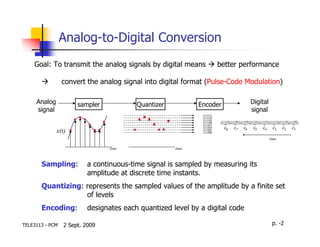
    Goal: To transmit the analog signals by digital means              better performance

                 convert the analog signal into digital format (Pulse-Code Modulation)

     Analog           sampler           Quantizer          Encoder                              Digital
     signal                                                                                     signal
                                                             1111111
                                                             1111110
                                                             1111101
                                                             1111100    1111101 1111001 1111001 1111011 1111101 1111110 1111101 1111001
                                                             1111011
                                                             1111010      c8      c7      c6      c5      c4     c3      c2      c1
              x(t)                                           1111001
                                                             1111000

                                                                                                               time

                                time                time


       Sampling:         a continuous-time signal is sampled by measuring its
                         amplitude at discrete time instants.
       Quantizing: represents the sampled values of the amplitude by a finite set
                   of levels
       Encoding:         designates each quantized level by a digital code

TELE3113 - PCM   2 Sept. 2009                                                                                    p. -2
Reconstruction of Sampled Signal
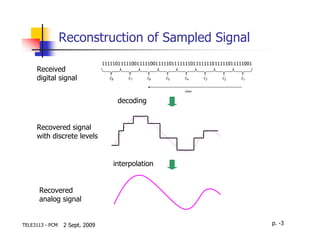
                                1111101 11110011111001 1111011 1111101 1111110 11111011111001
     Received
     digital signal                c8       c7      c6   c5      c4      c3     c2      c1


                                                                 time

                                         decoding


     Recovered signal
     with discrete levels


                                        interpolation


      Recovered
      analog signal


TELE3113 - PCM   2 Sept. 2009                                                                   p. -3
Sampling

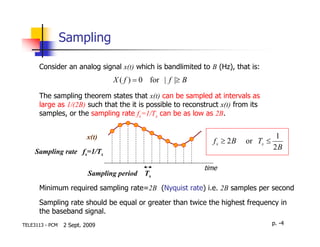
      Consider an analog signal x(t) which is bandlimited to B (Hz), that is:
                                 X ( f ) = 0 for | f |≥ B
      The sampling theorem states that x(t) can be sampled at intervals as
      large as 1/(2B) such that the it is possible to reconstruct x(t) from its
      samples, or the sampling rate fs=1/Ts can be as low as 2B.


                         x(t)                                                        1
                                                               f s ≥ 2B   or Ts ≤
                                                                                    2B
     Sampling rate fs=1/Ts

                                                            time
                          Sampling period   Ts

      Minimum required sampling rate=2B (Nyquist rate) i.e. 2B samples per second

      Sampling rate should be equal or greater than twice the highest frequency in
      the baseband signal.
TELE3113 - PCM   2 Sept. 2009                                                       p. -4
Analogue Pulse Modulation


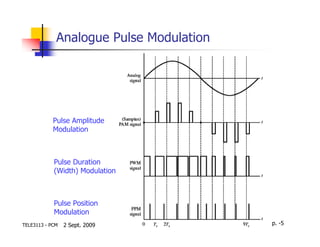
            Pulse Amplitude
            Modulation


            Pulse Duration
            (Width) Modulation


            Pulse Position
            Modulation
TELE3113 - PCM   2 Sept. 2009            p. -5
Quantization
        After the sampling process, the sampled points will be transformed into a
        set of predefined levels (quantized level) Quantization
        Assume the signal amplitude of x(t) lies within [-Vmax ,+Vmax], we divide the
        total peak-to-peak range (2Vmax) into L levels in which the quantized
        levels mi (i=0,…,(L-1)) are defined as their respective mid-ways.
         Vmax                             xq(t)        x(t)
                                                                                                    Output
         m7                                                             ∆7
                                                                                                   m7= 7∆/2
         m6                                                             ∆6


                                                                                        uniform
                                                                                                   m6= 5∆/2
         m5                                                             ∆5                         m5= 3∆/2
         m4                                                             ∆4                         m4= ∆/2
         m3                                                             ∆3 time        −4∆ −3∆ −2∆ −∆         ∆ 2∆ 3∆ 4∆ Input
         m2                                                             ∆2
                                                                                                      −3∆/2
                                                                                                               uniform
         m1                                                             ∆1                            −5∆/2
         m0                                                             ∆0                            −7∆/2
         -Vmax
                                Sampling time
                                                                                                  Uniform quantizer
                                                                               2Vmax              (midrise type)
        For uniform quantization,               ∆ i ( i =0 ,L,( L −1)) = ∆ =
                                                                                 L                                       p. -6
TELE3113 - PCM   2 Sept. 2009
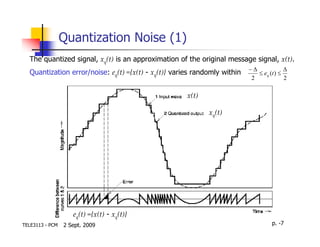
Quantization Noise (1)
  The quantized signal, xq(t) is an approximation of the original message signal, x(t).
                                                                           −∆             ∆
  Quantization error/noise: eq(t) ={x(t) - xq(t)} varies randomly within      ≤ eq (t ) ≤
                                                                            2             2

                                                      x(t)

                                                             xq(t)


                    eq(t) ={x(t) - xq(t)}
TELE3113 - PCM   2 Sept. 2009                                                       p. -7
Quantization Noise (2)
            Assume the quantization error varies uniformly within [-∆/2, ∆/2]
            with a pdf of f(eq)=1/∆, then
                             ∆ 2                             ∆ 2
                     2
                     q               [         ]
                   e (t ) = ∫ f (eq ) eq (t ) deq =
                                               2    1
                                                       ∫
                                                    ∆ −∆ 2
                                                               [ 2
                                                          eq (t ) deq  ]           Q f (eq ) =
                                                                                                 1
                                                                                                 ∆
                           −∆ 2

                                                         3    ∆ 2
                                                      1 eq             ∆2 Vmax
                                                                           2
                                                                                                     2Vmax
                                                    =                =   =              with ∆ =
                                                      ∆ 3     −∆ 2
                                                                       12 3L2                          L

            To minimize eq(t), we can use smaller ∆ or more quantized levels L.
                                                          2
            In general, the average power of a signal is x (t )                           or x 2 (t )

                                    x 2 (t )       3L2 x 2 (t )
                 average SNRx =      2
                                               =       2
                                    eq (t )           Vmax
                                             3L2 x 2 (t )                                       V2        
                 average SNRx (dB) = 10 log                          = 4.77 + 20 log L − 10 log 2max      
                                             Vmax
                                                  2
                                                                                                 x (t )    
                                                                                                          


TELE3113 - PCM    2 Sept. 2009                                                                                   p. -8
Quantization Noise (3)

                                                                                                 2
                                                                                                Vmax
        If x(t) is a full-scale sinusoidal signal, i.e. x(t)=Vmaxcosωt , then x (t ) = x (t ) =      2   2

                                                                                                 2
        Thus,
                 average SNRx (dB) = 4.77 + 20 log L − 10 log(2 ) = (1.76 + 20 log L ) dB


         If x(t) is uniformly distributed in the range [-Vmax,+Vmax], then pdf f(x)=1/(2Vmax),
                           Vmax                         Vmax
                                                  1                                            1
                  x (t ) = ∫ f ( x)[x(t )] dx =              ∫ [x(t )]2 dx
                                        2
                   2
                                                                               Q f (eq ) =
                          −Vmax
                                                2Vmax   −Vmax
                                                                                             2Vmax
                                                             Vmax
                                                1       x3               2
                                                                        Vmax
                                            =                         =
                                              2Vmax 3                    3
         Thus,                                                −Vmax


                  average SNRx (dB) = 4.77 + 20 log L − 10 log(3) = 20 log L dB


TELE3113 - PCM   2 Sept. 2009                                                                                p. -9
Non-uniform Quantization (1)
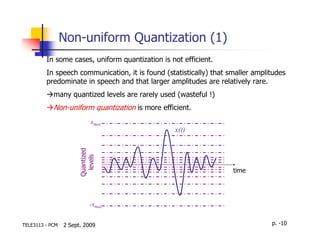
         In some cases, uniform quantization is not efficient.
         In speech communication, it is found (statistically) that smaller amplitudes
         predominate in speech and that larger amplitudes are relatively rare.
            many quantized levels are rarely used (wasteful !)
            Non-uniform quantization is more efficient.
                            xmax
                                                 x(t)
                      Quantized
                        levels


                                                                    time


                            -xmax


TELE3113 - PCM   2 Sept. 2009                                                   p. -10
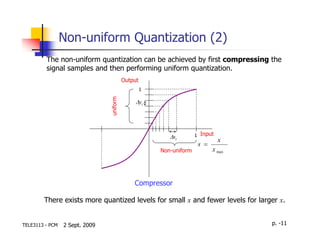
Non-uniform Quantization (2)
         The non-uniform quantization can be achieved by first compressing the
         signal samples and then performing uniform quantization.
                                          Output
                                                   1


                                uniform
                                               ∆yi


                                                          ∆ si       1 Input
                                                                               x
                                                                      s =
                                                       Non-uniform          x max


                                              Compressor

        There exists more quantized levels for small x and fewer levels for larger x.


TELE3113 - PCM   2 Sept. 2009                                                       p. -11
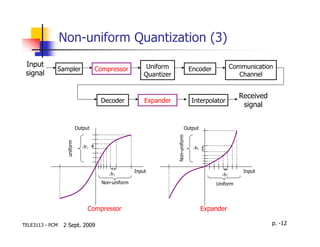
Non-uniform Quantization (3)
 Input                                                     Uniform                                      Communication
             Sampler                  Compressor                                    Encoder
 signal                                                   Quantizer                                        Channel


                                                                                                          Received
                                       Decoder            Expander                  Interpolator
                                                                                                           signal


                            Output                                              Output


                                                                      Non-uniform
                  uniform


                               ∆ yi                                                  ∆si


                                           ∆si        Input                                                 Input
                                                                                                 ∆ yi
                                        Non-uniform                                            Uniform


                                  Compressor                                               Expander

TELE3113 - PCM   2 Sept. 2009                                                                                        p. -12
Non-uniform Quantization (4)
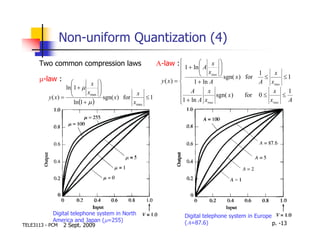
      Two common compression laws                               Α-law : 1 + ln  A x 
                                                                                     
                                                                                    
                                                                          
                                                                                  xmax  sgn( x ) for 1 ≤ x ≤ 1
      µ-law :                                                  y ( x) =      1 + ln A                A xmax
                               x
                  ln1 + µ
                    
                                    
                                                                          A
                             xmax                    x                                x                      x     1
          y ( x) =                  sgn( x) for          ≤1                           sgn( x )   for 0 ≤      ≤
                      ln (1 + µ )                   xmax                  1 + ln A xmax
                                                                                                           xmax   A


             Digital telephone system in North                            Digital telephone system in Europe
             America and Japan (µ=255)                                    (Α=87.6)
TELE3113 - PCM 2 Sept. 2009                                                                                  p. -13

Tele3113 wk7wed

  • 1.
    TELE3113 Analogue andDigital Communications – Quantization Wei Zhang w.zhang@unsw.edu.au School of Electrical Engineering and Telecommunications The University of New South Wales TELE3113 - PCM 2 Sept. 2009 p. -1
  • 2.
    Analog-to-Digital Conversion Goal: To transmit the analog signals by digital means better performance convert the analog signal into digital format (Pulse-Code Modulation) Analog sampler Quantizer Encoder Digital signal signal 1111111 1111110 1111101 1111100 1111101 1111001 1111001 1111011 1111101 1111110 1111101 1111001 1111011 1111010 c8 c7 c6 c5 c4 c3 c2 c1 x(t) 1111001 1111000 time time time Sampling: a continuous-time signal is sampled by measuring its amplitude at discrete time instants. Quantizing: represents the sampled values of the amplitude by a finite set of levels Encoding: designates each quantized level by a digital code TELE3113 - PCM 2 Sept. 2009 p. -2
  • 3.
    Reconstruction of SampledSignal 1111101 11110011111001 1111011 1111101 1111110 11111011111001 Received digital signal c8 c7 c6 c5 c4 c3 c2 c1 time decoding Recovered signal with discrete levels interpolation Recovered analog signal TELE3113 - PCM 2 Sept. 2009 p. -3
  • 4.
    Sampling Consider an analog signal x(t) which is bandlimited to B (Hz), that is: X ( f ) = 0 for | f |≥ B The sampling theorem states that x(t) can be sampled at intervals as large as 1/(2B) such that the it is possible to reconstruct x(t) from its samples, or the sampling rate fs=1/Ts can be as low as 2B. x(t) 1 f s ≥ 2B or Ts ≤ 2B Sampling rate fs=1/Ts time Sampling period Ts Minimum required sampling rate=2B (Nyquist rate) i.e. 2B samples per second Sampling rate should be equal or greater than twice the highest frequency in the baseband signal. TELE3113 - PCM 2 Sept. 2009 p. -4
  • 5.
    Analogue Pulse Modulation Pulse Amplitude Modulation Pulse Duration (Width) Modulation Pulse Position Modulation TELE3113 - PCM 2 Sept. 2009 p. -5
  • 6.
    Quantization After the sampling process, the sampled points will be transformed into a set of predefined levels (quantized level) Quantization Assume the signal amplitude of x(t) lies within [-Vmax ,+Vmax], we divide the total peak-to-peak range (2Vmax) into L levels in which the quantized levels mi (i=0,…,(L-1)) are defined as their respective mid-ways. Vmax xq(t) x(t) Output m7 ∆7 m7= 7∆/2 m6 ∆6 uniform m6= 5∆/2 m5 ∆5 m5= 3∆/2 m4 ∆4 m4= ∆/2 m3 ∆3 time −4∆ −3∆ −2∆ −∆ ∆ 2∆ 3∆ 4∆ Input m2 ∆2 −3∆/2 uniform m1 ∆1 −5∆/2 m0 ∆0 −7∆/2 -Vmax Sampling time Uniform quantizer 2Vmax (midrise type) For uniform quantization, ∆ i ( i =0 ,L,( L −1)) = ∆ = L p. -6 TELE3113 - PCM 2 Sept. 2009
  • 7.
    Quantization Noise (1) The quantized signal, xq(t) is an approximation of the original message signal, x(t). −∆ ∆ Quantization error/noise: eq(t) ={x(t) - xq(t)} varies randomly within ≤ eq (t ) ≤ 2 2 x(t) xq(t) eq(t) ={x(t) - xq(t)} TELE3113 - PCM 2 Sept. 2009 p. -7
  • 8.
    Quantization Noise (2) Assume the quantization error varies uniformly within [-∆/2, ∆/2] with a pdf of f(eq)=1/∆, then ∆ 2 ∆ 2 2 q [ ] e (t ) = ∫ f (eq ) eq (t ) deq = 2 1 ∫ ∆ −∆ 2 [ 2 eq (t ) deq ] Q f (eq ) = 1 ∆ −∆ 2 3 ∆ 2 1 eq ∆2 Vmax 2 2Vmax = = = with ∆ = ∆ 3 −∆ 2 12 3L2 L To minimize eq(t), we can use smaller ∆ or more quantized levels L. 2 In general, the average power of a signal is x (t ) or x 2 (t ) x 2 (t ) 3L2 x 2 (t ) average SNRx = 2 = 2 eq (t ) Vmax  3L2 x 2 (t )   V2  average SNRx (dB) = 10 log   = 4.77 + 20 log L − 10 log 2max   Vmax 2   x (t )      TELE3113 - PCM 2 Sept. 2009 p. -8
  • 9.
    Quantization Noise (3) 2 Vmax If x(t) is a full-scale sinusoidal signal, i.e. x(t)=Vmaxcosωt , then x (t ) = x (t ) = 2 2 2 Thus, average SNRx (dB) = 4.77 + 20 log L − 10 log(2 ) = (1.76 + 20 log L ) dB If x(t) is uniformly distributed in the range [-Vmax,+Vmax], then pdf f(x)=1/(2Vmax), Vmax Vmax 1 1 x (t ) = ∫ f ( x)[x(t )] dx = ∫ [x(t )]2 dx 2 2 Q f (eq ) = −Vmax 2Vmax −Vmax 2Vmax Vmax 1 x3 2 Vmax = = 2Vmax 3 3 Thus, −Vmax average SNRx (dB) = 4.77 + 20 log L − 10 log(3) = 20 log L dB TELE3113 - PCM 2 Sept. 2009 p. -9
  • 10.
    Non-uniform Quantization (1) In some cases, uniform quantization is not efficient. In speech communication, it is found (statistically) that smaller amplitudes predominate in speech and that larger amplitudes are relatively rare. many quantized levels are rarely used (wasteful !) Non-uniform quantization is more efficient. xmax x(t) Quantized levels time -xmax TELE3113 - PCM 2 Sept. 2009 p. -10
  • 11.
    Non-uniform Quantization (2) The non-uniform quantization can be achieved by first compressing the signal samples and then performing uniform quantization. Output 1 uniform ∆yi ∆ si 1 Input x s = Non-uniform x max Compressor There exists more quantized levels for small x and fewer levels for larger x. TELE3113 - PCM 2 Sept. 2009 p. -11
  • 12.
    Non-uniform Quantization (3) Input Uniform Communication Sampler Compressor Encoder signal Quantizer Channel Received Decoder Expander Interpolator signal Output Output Non-uniform uniform ∆ yi ∆si ∆si Input Input ∆ yi Non-uniform Uniform Compressor Expander TELE3113 - PCM 2 Sept. 2009 p. -12
  • 13.
    Non-uniform Quantization (4) Two common compression laws Α-law : 1 + ln  A x          xmax  sgn( x ) for 1 ≤ x ≤ 1 µ-law :   y ( x) =  1 + ln A A xmax x ln1 + µ     A xmax x x x 1 y ( x) =   sgn( x) for ≤1  sgn( x ) for 0 ≤ ≤ ln (1 + µ ) xmax 1 + ln A xmax  xmax A Digital telephone system in North Digital telephone system in Europe America and Japan (µ=255) (Α=87.6) TELE3113 - PCM 2 Sept. 2009 p. -13