TELE3113 Analogue and Digital
         Communications –
         Detection Theory
                                   Wei Zhang
                               w.zhang@unsw.edu.au


              School of Electrical Engineering and Telecommunications
                         The University of New South Wales

6 Oct. 2009                          TELE3113                           1
Digital Signal Detection
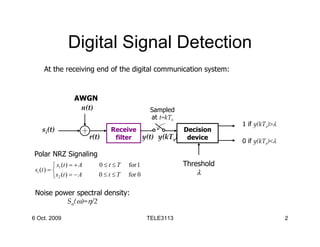
     At the receiving end of the digital communication system:


                    AWGN
                     n(t)                        Sampled
                                                 at t=kTs
                                                                        1 if y(kTs)>λ
    si(t)                          Receive             Decision
                            r(t)    filter y(t) y(kTs) device
                                                                        0 if y(kTs)<λ

Polar NRZ Signaling
            s (t ) = + A      0≤t ≤T   for 1               Threshold
 si (t ) =  1                                                 λ
           s2 (t ) = − A      0≤t ≤T   for 0

 Noise power spectral density:
          Sn(ω)=η/2

6 Oct. 2009                                     TELE3113                                2
Digital Signal Detection
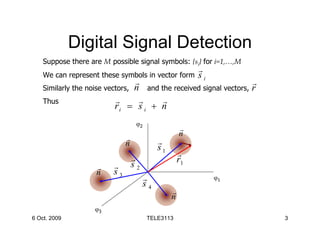
    Suppose there are M possible signal symbols: {si} for i=1,…,M
                                                          r
    We can represent these symbols in vector form         si
                                 r                                  r
    Similarly the noise vectors, n and the received signal vectors, r
    Thus                   r      r     r
                           ri = s i + n
                                   ϕ2
                                                     r
                              r                      n
                              n             r
                                            s1
                                  r                  r
                                  s2                 r1
                    r    r
                    n    s3
                                       r                       ϕ1
                                       s4
                                                 r
                                                 n
                    ϕ3
6 Oct. 2009                             TELE3113                        3
Digital Signal Detection
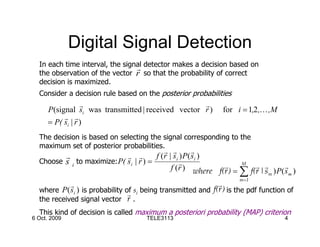
  In each time interval, the signal detector makes a decision based on
                                 r
  the observation of the vector r so that the probability of correct
  decision is maximized.
  Consider a decision rule based on the posterior probabilities
                 r                                 r
     P(signal si was transmitted | received vector r )          for i = 1,2 ,K ,M
          r r
     = P( si | r )
  The decision is based on selecting the signal corresponding to the
  maximum set of posterior probabilities.
                                           r r         r
         r                   r r        f (r | si ) P( si )
  Choose s i to maximize: P( si | r ) =           r          r
                                              f (r ) where f(r ) =
                                                                   M
                                                                       r r          r
                                                                   ∑ f(r | s m ) P( s m )
                                                                      m =1
            r                                                  r
  where P ( s i ) is probability of si being transmitted and
                                  r
                                                             f(r ) is the pdf function of
  the received signal vector r .
  This kind of decision is called maximum a posteriori probability (MAP) criterion
6 Oct. 2009                           TELE3113                                        4
Digital Signal Detection
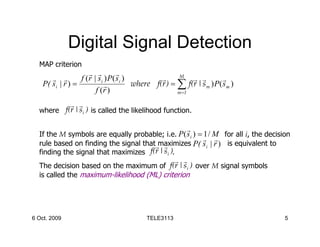
  MAP criterion
                     r r         r
       r r        f (r | si ) P( si )         r      M
                                                         r r         r
    P( si | r ) =           r         where f(r ) = ∑ f(r | s m ) P( s m )
                        f (r )                      m =1

              r r
  where f(r | si ) is called the likelihood function.

                                                        r
  If the M symbols are equally probable; i.e. P ( si ) = 1 / M for all i, the decision
                                                         r r
  rule based on finding the signal thatrmaximizes P( si | r ) is equivalent to
                                           r
  finding the signal that maximizes  f(r | si ).
                                            r r
  The decision based on the maximum of    f(r | si ) over M signal symbols
  is called the maximum-likelihood (ML) criterion


6 Oct. 2009                               TELE3113                                  5
Digital Signal Detection
                r  r  r
        Recall:     r = si + n
        For AWGN, the noise {nk} components are uncorrelated Gaussian
        variables which are statistically independent
              E[nk ] = 0 (zero mean) , E[rk ] = E[sik + nk ] = sik
                                                       η                                  η
              Variance σ n = E[n 2 ] − (E[n]) =              → σ r2 = σ n =
                         2                         2                    2

                                                        2                                  2
        Thus {rk} are statistically independent Gaussian variables
                    r r        N
                  f(r | si ) = Π f(rk | sik )   where N is number of base vectors
                              k =1                                          1                              2         2
                                                                                                               /( 2σ n )
                                                and    f(rk | sik ) =                  e −( rk − sik )
                                                                        2π σ n
                                                                        1           − ( rk − sik ) 2 / η
                                                                  =             e
                                                                        πη
        Take natural logarithm on both sides, gives
                                 r r        −N           1 N
                                                ln(πη ) − ∑ (rk − sik )
                                                                        2
                            ln f(r | si ) =
6 Oct. 2009                                  2
                                             TELE3113    η k =1                                                            6
Digital Signal Detection
                         r r        −N          1 N
                                       ln(πη ) − ∑ (rk − sik )
                                                               2
                    ln f(r | si ) =
                                     2          η k =1           r r     r
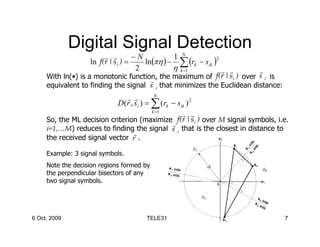
     With ln(•) is a monotonic function, the maximum of f(r | si ) over s i is
                                         r
     equivalent to finding the signal s i that minimizes the Euclidean distance:
                                         N
                               r r
                           D(r , si ) = ∑ (rk − sik ) 2
                                        k =1
                                                  r r
     So, the ML decision criterion (maximize f(r | si ) over M signal symbols, i.e.
                                              r
     i=1,…M) reduces to finding the signal s i that is the closest in distance to
                                r
     the received signal vector r .

     Example: 3 signal symbols.
     Note the decision regions formed by
     the perpendicular bisectors of any
     two signal symbols.


6 Oct. 2009                           TELE3113                                     7
Digital Signal Detection
                                                                 r
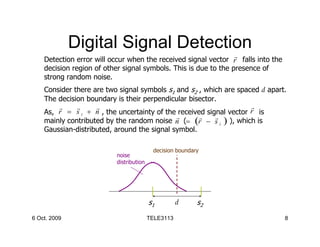
    Detection error will occur when the received signal vector r falls into the
    decision region of other signal symbols. This is due to the presence of
    strong random noise.
    Consider there are two signal symbols s1 and s2 , which are spaced d apart.
    The decision boundary is their perpendicular bisector.
        r     r     r                                               r
    As, r = s i + n , the uncertainty of the received signal vector r is
                                             r      r     r
    mainly contributed by the random noise n (= (r − s i ) ), which is
    Gaussian-distributed, around the signal symbol.

                                          decision boundary
                          noise
                          distribution


                                         s1         d     s2
6 Oct. 2009                              TELE3113                                 8
Digital Signal Detection
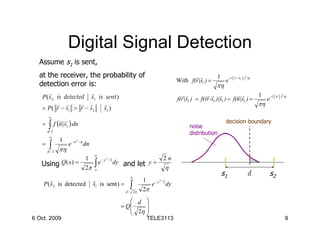
  Assume s1 is sent,
  at the receiver, the probability of                                                          rr        1 −(     r r
                                                                                                                  r − s1 )2 /η
                                                                                        With f(r |s1 ) =   e
  detection error is:                                                                                     πη
       r                r                                                                 rr           rr r             rr       1 −(      r
   P ( s 2 is detected s1 is sent )                                                     f(r |s1 ) = f((r -s1 )|s1 ) = f(n|s1 ) =   e
                                                                                                                                           n )2 /η

           r r       r r    r                                                                                                    πη
   = P ( r − s1 > r − s 2   s1 )
        ∞
                 rr
   =    ∫     f (n |s1 ) dn                                                                  noise
                                                                                                               decision boundary
       d/ 2
                                                                                             distribution
        ∞
                 1
        ∫
                            2
                                /η
   =                 e −n            dn
       d /2     πη
                                          ∞
                                     1                                           2n
                                          ∫
                                                  2

   Using Q ( x) =                           e−y       /2
                                                           dy and let y =
                                     2π    x                                     η
                                                                 ∞
                                                                                                            s1              d         s2
        r                                 r                             1 − y2 / 2
    P ( s2 is detected                    s1 is sent ) =         ∫      2π
                                                                           e       dy
                                                               d / 2η

                                                                 d 
                                                             = Q    
                                                                 2η 
                                                                    
6 Oct. 2009                                                              TELE3113                                                                9
Digital Signal Detection
                        r
        For a signal symbol set: {si } for i = 1,...M

        Detection error probability is
                      M
                                             r           r
                Pe = ∑ P[erroneous detection|si sent ]P[ si ]
                      i =1
                                  r r
                      M      M   s k − si    r
                   ≤ ∑∑ Q                    P[ si ]
                     i =1 i ≠ k  2η
                                            
                                             
                          k =1

                                                               r
        If all signal symbols are equally probable, i.e.   P[ si ] = 1 / M
                       M
                                               r           r
                  Pe = ∑ P[erroneous detection|si sent ]P[ si ]
                      i =1
                                    r r
                     1       M   M s k − si     
                   ≤   ∑∑ Q  2η
                     M i =1 i ≠ k 
                                                 
                                                
                                                 
                            k =1


6 Oct. 2009                                   TELE3113                       10
Digital Signal Detection
     Calculation of error probabilities:

                                            (
     (a) Antipodal signaling: s1 = + E ,0 ; s2 = − E ,0)          (            )
        Pe = P ( s 2 is detected | s1 ) P ( s1 ) + P ( s1 is detected | s 2 ) P ( s 2 )
              2 E                   
           ≤Q      P ( s1 ) + Q 2 E  P ( s 2 )
               2η               2η 
                                                                      s2               s1
               2E 
           = Q     [P ( s1 ) + P ( s 2 )]
               η                                                      − E               + E
                  
               2E 
           = Q
               η 
                                                                        signal symbol energy=E
                  
       Example: for NRZ signaling which takes amplitude either +A or 0. For bit
               interval Tb, the energy per bit Eb=A2Tb.
                                    A2T          
                             Pe = Q      = Q Eb 
                                    η         η 
6 Oct. 2009                         TELE3113 
                                                                            11
Digital Signal Detection
                                               (
     (b) Orthogonal signaling: s1 = + E ,0 ; s2 = 0,+ E    )        (         )
        Pe = P( s 2 is detected | s1 ) P( s1 ) + P( s1 is detected | s 2 ) P ( s 2 )       + E    s2
                           2E                       
           ≤ Q                   P( s1 ) + Q 2 E  P( s 2 )                     s1
                           2η                2η 
                                                    
                                                                                 + E
                           E                           E
           = Q
                              
                                 [P(s1 ) + P( s 2 )] = Q 
                                                          η
                           η                                
     (c) Square            signaling:
         s1 = + (                 )     (              )        (
                            E ,− E ; s2 = + E ,+ E ; s3 = − E ,+ E ; s4 = − E ,− E)         (          )
                     4
          Pe = ∑ P ( si is not detected | si ) P ( si )                               s3    + E              s2
                    i =1

                           2 E
                                                                   
                                                                        
                     4
              ≤ ∑ P ( si )Q            + Q 2 2 E  + Q 2 E
                            2η             2η         2η          
                i =1                                              
                                                                                     − E              + E

                   2E      E                                                      s4   − E               s1
                  
              = 2Q     + Q 2 
                            η
6 Oct. 2009        η                        TELE3113                                                   12
Digital Signal Detection
     Integrate-and-Dump detector


r(t)=si(t)+n(t)                          s (t ) = + A             0≤t ≤T    for 1
                              si (t ) =  1
                                        s2 (t ) = − A             0≤t ≤T    for 0
                                                          t 0 +T
                                                                                    a1 (t ) + no   for 1
     Output of the integrator:                    z (t ) = ∫ [si (t ) + n(t )]dt = 
                     t 0 +T
                                                           t0                      a2 (t ) + no    for 0
     where a1 =        ∫ Adt = AT
                      t0
                     t 0 +T

              a2 =     ∫ (− A)dt = − AT
                       t0
                     t 0 +T

              no =     ∫ n(t )dt
                       t0


6 Oct. 2009                                              TELE3113                                           13
Digital Signal Detection
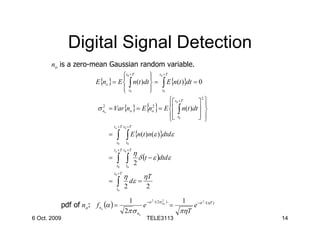
       no is a zero-mean Gaussian random variable.
                                 t0 +T
                                             t 0 +T
                                             
                      E{no } = E  ∫ n(t )dt  = ∫ E{n(t )}dt = 0
                                  t0
                                             t0
                                             
                                                        t 0 +T  
                                                                  2
                                                      
                                                            { }
                      σ no = Var{no } = E no = E  ∫ n(t )dt  
                        2                     2                     
                                                        t0
                                                      
                                                                  
                                                                  
                                t o +T t 0 +T

                            =     ∫ ∫ E{n(t )n(ε )}dtdε
                                 t0      t0
                                t o +T t 0 +T
                                                  η
                            =     ∫ ∫                 δ (t − ε )dtdε
                                 t0      t0
                                                  2
                                t 0 +T
                                         η              ηT
                            =     ∫
                                 t0
                                         2
                                              dε =
                                                            2

                                              1                                   1
          pdf of no: f n (α ) =
                                                            −α 2 /( 2σ no )
                                                                       2                       2
                                                        e                     =         e −α       /(ηT )
                        o
                                         2π σ no                                  πηT
6 Oct. 2009                                                 TELE3113                                        14
Digital Signal Detection
                                    s1 (t ) = + A                    0≤t ≤T                  for 1
    As                   si (t ) = 
                                   s 0 (t ) = − A                    0≤t ≤T                  for 0                    s0                    s1

    We choose the decision threshold to be 0.                                                                                0
                                                                                                                     − AT                + AT
    Two cases of detection error:
    (a) +A is transmitted but (AT+no)<0                                                               no<-AT
    (b) -A is transmitted but (-AT+no)>0                                                          no>+AT
   Error probability:
  Pe = P (no < − AT | A) P ( A) + P (no > AT | A) P (− A)
                     − AT              2                        ∞           2
                             e −α          /(ηT )
                                                                     e −α       /(ηT )
     = P ( A)
                     −∞
                         ∫            πηT
                                                    dα + P (− A) ∫
                                                                AT     πηT
                                                                                         dα

         ∞           2
              e −α       /(ηT )
                                                                                                               2 A2T 
                                      dα [P( A) + P (− A)]
                                                                                                                                         ∞        2
                                                                                                                                        e −u / 2
     =   ∫        πηT
                                                                                          Thus,         Pe = Q
                                                                                                              
                                                                                                                           Q Q(x ) = ∫          du
         AT
                                                                                                                 η                 x    2π
              ∞                   2
               e −u / 2                                        2α                                              2 Eb 
     = ∫
                                                                                                                                     T
                        du                             Qu =
                  2π                                           ηT                                          = Q
                                                                                                               η 
                                                                                                                           Q Eb = ∫ A2 dt
       2 A2T η
                                                                                                                                   0
6 Oct. 2009                                                                         TELE3113                                                          15

Tele3113 wk11tue

  • 1.
    TELE3113 Analogue andDigital Communications – Detection Theory Wei Zhang w.zhang@unsw.edu.au School of Electrical Engineering and Telecommunications The University of New South Wales 6 Oct. 2009 TELE3113 1
  • 2.
    Digital Signal Detection At the receiving end of the digital communication system: AWGN n(t) Sampled at t=kTs 1 if y(kTs)>λ si(t) Receive Decision r(t) filter y(t) y(kTs) device 0 if y(kTs)<λ Polar NRZ Signaling  s (t ) = + A 0≤t ≤T for 1 Threshold si (t ) =  1 λ s2 (t ) = − A 0≤t ≤T for 0 Noise power spectral density: Sn(ω)=η/2 6 Oct. 2009 TELE3113 2
  • 3.
    Digital Signal Detection Suppose there are M possible signal symbols: {si} for i=1,…,M r We can represent these symbols in vector form si r r Similarly the noise vectors, n and the received signal vectors, r Thus r r r ri = s i + n ϕ2 r r n n r s1 r r s2 r1 r r n s3 r ϕ1 s4 r n ϕ3 6 Oct. 2009 TELE3113 3
  • 4.
    Digital Signal Detection In each time interval, the signal detector makes a decision based on r the observation of the vector r so that the probability of correct decision is maximized. Consider a decision rule based on the posterior probabilities r r P(signal si was transmitted | received vector r ) for i = 1,2 ,K ,M r r = P( si | r ) The decision is based on selecting the signal corresponding to the maximum set of posterior probabilities. r r r r r r f (r | si ) P( si ) Choose s i to maximize: P( si | r ) = r r f (r ) where f(r ) = M r r r ∑ f(r | s m ) P( s m ) m =1 r r where P ( s i ) is probability of si being transmitted and r f(r ) is the pdf function of the received signal vector r . This kind of decision is called maximum a posteriori probability (MAP) criterion 6 Oct. 2009 TELE3113 4
  • 5.
    Digital Signal Detection MAP criterion r r r r r f (r | si ) P( si ) r M r r r P( si | r ) = r where f(r ) = ∑ f(r | s m ) P( s m ) f (r ) m =1 r r where f(r | si ) is called the likelihood function. r If the M symbols are equally probable; i.e. P ( si ) = 1 / M for all i, the decision r r rule based on finding the signal thatrmaximizes P( si | r ) is equivalent to r finding the signal that maximizes f(r | si ). r r The decision based on the maximum of f(r | si ) over M signal symbols is called the maximum-likelihood (ML) criterion 6 Oct. 2009 TELE3113 5
  • 6.
    Digital Signal Detection r r r Recall: r = si + n For AWGN, the noise {nk} components are uncorrelated Gaussian variables which are statistically independent E[nk ] = 0 (zero mean) , E[rk ] = E[sik + nk ] = sik η η Variance σ n = E[n 2 ] − (E[n]) = → σ r2 = σ n = 2 2 2 2 2 Thus {rk} are statistically independent Gaussian variables r r N f(r | si ) = Π f(rk | sik ) where N is number of base vectors k =1 1 2 2 /( 2σ n ) and f(rk | sik ) = e −( rk − sik ) 2π σ n 1 − ( rk − sik ) 2 / η = e πη Take natural logarithm on both sides, gives r r −N 1 N ln(πη ) − ∑ (rk − sik ) 2 ln f(r | si ) = 6 Oct. 2009 2 TELE3113 η k =1 6
  • 7.
    Digital Signal Detection r r −N 1 N ln(πη ) − ∑ (rk − sik ) 2 ln f(r | si ) = 2 η k =1 r r r With ln(•) is a monotonic function, the maximum of f(r | si ) over s i is r equivalent to finding the signal s i that minimizes the Euclidean distance: N r r D(r , si ) = ∑ (rk − sik ) 2 k =1 r r So, the ML decision criterion (maximize f(r | si ) over M signal symbols, i.e. r i=1,…M) reduces to finding the signal s i that is the closest in distance to r the received signal vector r . Example: 3 signal symbols. Note the decision regions formed by the perpendicular bisectors of any two signal symbols. 6 Oct. 2009 TELE3113 7
  • 8.
    Digital Signal Detection r Detection error will occur when the received signal vector r falls into the decision region of other signal symbols. This is due to the presence of strong random noise. Consider there are two signal symbols s1 and s2 , which are spaced d apart. The decision boundary is their perpendicular bisector. r r r r As, r = s i + n , the uncertainty of the received signal vector r is r r r mainly contributed by the random noise n (= (r − s i ) ), which is Gaussian-distributed, around the signal symbol. decision boundary noise distribution s1 d s2 6 Oct. 2009 TELE3113 8
  • 9.
    Digital Signal Detection Assume s1 is sent, at the receiver, the probability of rr 1 −( r r r − s1 )2 /η With f(r |s1 ) = e detection error is: πη r r rr rr r rr 1 −( r P ( s 2 is detected s1 is sent ) f(r |s1 ) = f((r -s1 )|s1 ) = f(n|s1 ) = e n )2 /η r r r r r πη = P ( r − s1 > r − s 2 s1 ) ∞ rr = ∫ f (n |s1 ) dn noise decision boundary d/ 2 distribution ∞ 1 ∫ 2 /η = e −n dn d /2 πη ∞ 1 2n ∫ 2 Using Q ( x) = e−y /2 dy and let y = 2π x η ∞ s1 d s2 r r 1 − y2 / 2 P ( s2 is detected s1 is sent ) = ∫ 2π e dy d / 2η  d  = Q   2η    6 Oct. 2009 TELE3113 9
  • 10.
    Digital Signal Detection r For a signal symbol set: {si } for i = 1,...M Detection error probability is M r r Pe = ∑ P[erroneous detection|si sent ]P[ si ] i =1 r r M M  s k − si  r ≤ ∑∑ Q   P[ si ] i =1 i ≠ k  2η    k =1 r If all signal symbols are equally probable, i.e. P[ si ] = 1 / M M r r Pe = ∑ P[erroneous detection|si sent ]P[ si ] i =1 r r 1 M M s k − si  ≤ ∑∑ Q  2η M i =1 i ≠ k      k =1 6 Oct. 2009 TELE3113 10
  • 11.
    Digital Signal Detection Calculation of error probabilities: ( (a) Antipodal signaling: s1 = + E ,0 ; s2 = − E ,0) ( ) Pe = P ( s 2 is detected | s1 ) P ( s1 ) + P ( s1 is detected | s 2 ) P ( s 2 ) 2 E    ≤Q   P ( s1 ) + Q 2 E  P ( s 2 )  2η   2η      s2 s1  2E  = Q  [P ( s1 ) + P ( s 2 )]  η  − E + E    2E  = Q  η   signal symbol energy=E   Example: for NRZ signaling which takes amplitude either +A or 0. For bit interval Tb, the energy per bit Eb=A2Tb.  A2T    Pe = Q  = Q Eb   η   η  6 Oct. 2009  TELE3113    11
  • 12.
    Digital Signal Detection ( (b) Orthogonal signaling: s1 = + E ,0 ; s2 = 0,+ E ) ( ) Pe = P( s 2 is detected | s1 ) P( s1 ) + P( s1 is detected | s 2 ) P ( s 2 ) + E s2  2E    ≤ Q  P( s1 ) + Q 2 E  P( s 2 ) s1  2η   2η      + E  E   E = Q   [P(s1 ) + P( s 2 )] = Q   η  η   (c) Square signaling: s1 = + ( ) ( ) ( E ,− E ; s2 = + E ,+ E ; s3 = − E ,+ E ; s4 = − E ,− E) ( ) 4 Pe = ∑ P ( si is not detected | si ) P ( si ) s3 + E s2 i =1  2 E        4 ≤ ∑ P ( si )Q  + Q 2 2 E  + Q 2 E   2η   2η   2η  i =1         − E + E  2E   E s4 − E s1  = 2Q  + Q 2    η 6 Oct. 2009  η    TELE3113 12
  • 13.
    Digital Signal Detection Integrate-and-Dump detector r(t)=si(t)+n(t)  s (t ) = + A 0≤t ≤T for 1 si (t ) =  1 s2 (t ) = − A 0≤t ≤T for 0 t 0 +T  a1 (t ) + no for 1 Output of the integrator: z (t ) = ∫ [si (t ) + n(t )]dt =  t 0 +T t0 a2 (t ) + no for 0 where a1 = ∫ Adt = AT t0 t 0 +T a2 = ∫ (− A)dt = − AT t0 t 0 +T no = ∫ n(t )dt t0 6 Oct. 2009 TELE3113 13
  • 14.
    Digital Signal Detection no is a zero-mean Gaussian random variable. t0 +T   t 0 +T  E{no } = E  ∫ n(t )dt  = ∫ E{n(t )}dt = 0  t0   t0    t 0 +T   2  { } σ no = Var{no } = E no = E  ∫ n(t )dt   2 2    t0      t o +T t 0 +T = ∫ ∫ E{n(t )n(ε )}dtdε t0 t0 t o +T t 0 +T η = ∫ ∫ δ (t − ε )dtdε t0 t0 2 t 0 +T η ηT = ∫ t0 2 dε = 2 1 1 pdf of no: f n (α ) = −α 2 /( 2σ no ) 2 2 e = e −α /(ηT ) o 2π σ no πηT 6 Oct. 2009 TELE3113 14
  • 15.
    Digital Signal Detection  s1 (t ) = + A 0≤t ≤T for 1 As si (t ) =  s 0 (t ) = − A 0≤t ≤T for 0 s0 s1 We choose the decision threshold to be 0. 0 − AT + AT Two cases of detection error: (a) +A is transmitted but (AT+no)<0 no<-AT (b) -A is transmitted but (-AT+no)>0 no>+AT Error probability: Pe = P (no < − AT | A) P ( A) + P (no > AT | A) P (− A) − AT 2 ∞ 2 e −α /(ηT ) e −α /(ηT ) = P ( A) −∞ ∫ πηT dα + P (− A) ∫ AT πηT dα ∞ 2 e −α /(ηT )  2 A2T  dα [P( A) + P (− A)] ∞ 2 e −u / 2 = ∫ πηT Thus, Pe = Q   Q Q(x ) = ∫ du AT  η   x 2π ∞ 2 e −u / 2 2α  2 Eb  = ∫ T du Qu = 2π ηT = Q  η   Q Eb = ∫ A2 dt 2 A2T η   0 6 Oct. 2009 TELE3113 15