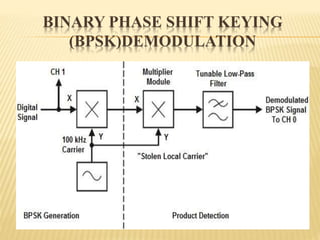
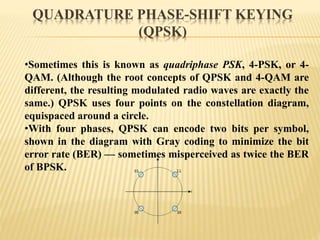
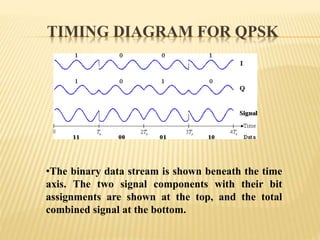
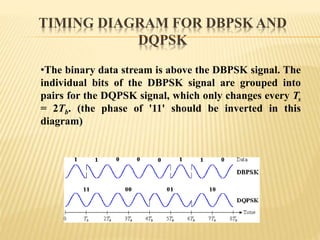
The document discusses phase-shift keying (PSK) modulation techniques. It begins with an introduction to PSK and how it uses phases to encode digital data. It then discusses binary phase-shift keying (BPSK) which uses two phases separated by 180 degrees to encode one bit per symbol. BPSK is robust but has a low data rate. Quadrature phase-shift keying (QPSK) is then introduced, which uses four phases separated by 90 degrees to encode two bits per symbol, doubling the data rate of BPSK. Implementations of BPSK and QPSK modulators and demodulators are provided along with diagrams of their constellation plots.