1 Presented by :- SUSHANT MISHRA EC-2 Under the guidance of :- FinFETs: From Circuit to Architecture
Talk Outline Background  Low Power FinFET Circuits Unusual Logic Styles Unusual Dual-V dd /Dual-V th  Circuits Architectural Impact Other Ongoing Work Conclusions 2
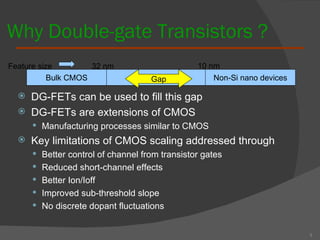
Why Double-gate Transistors ? DG-FETs can be used to fill this gap DG-FETs are extensions of CMOS Manufacturing processes similar to CMOS Key limitations of CMOS scaling addressed through Better control of channel from transistor gates Reduced short-channel effects Better Ion/Ioff Improved sub-threshold slope No discrete dopant fluctuations 3 Non-Si nano devices Bulk CMOS Feature size 32 nm  10 nm  DG-FETs Gap
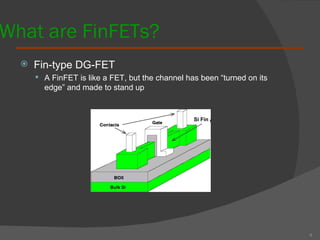
What are FinFETs? Fin-type DG-FET A FinFET is like a FET, but the channel has been “turned on its edge” and made to stand up 4 Si Fin
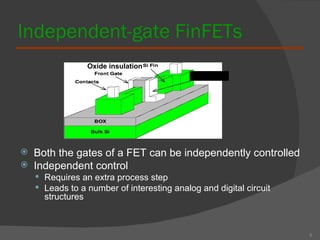
Independent-gate FinFETs Both the gates of a FET can be independently controlled Independent control  Requires an extra process step Leads to a number of interesting analog and digital circuit structures 5 Back Gate Oxide insulation
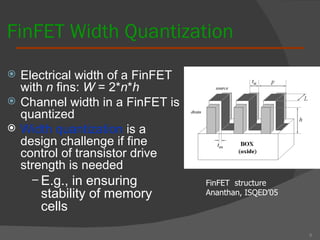
FinFET Width Quantization Electrical width of a FinFET with  n  fins:  W  = 2* n * h Channel width in a FinFET is quantized Width quantization  is a design challenge if fine control of transistor drive strength is needed E.g., in ensuring stability of memory cells 6 FinFET  structure  Ananthan, ISQED’05
Talk Outline Background  Low Power FinFET Circuits Unusual Logic Styles Unusual Dual-V dd /Dual-V th  Circuits Architectural Impact Other Ongoing Work Conclusions
Motivation: Power Consumption Traditional view of CMOS power consumption Active mode: Dynamic power (switching + short circuit + glitching) Standby mode: Leakage power Problem: rising active leakage 40% of total active mode power consumption (70nm bulk CMOS)  † † J. Kao, S. Narendra and A. Chandrakasan, “Subthreshold leakage modeling and reduction techniques,”  in Proc. ICCAD, 2002.
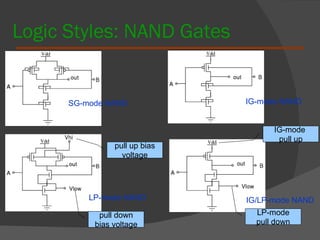
Logic Styles: NAND Gates SG-mode NAND IG-mode NAND LP-mode NAND IG/LP-mode NAND pull up bias voltage pull down bias voltage IG-mode  pull up LP-mode pull down
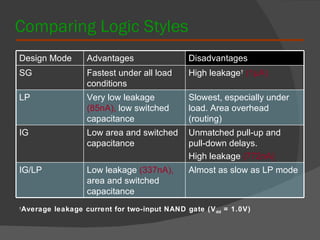
Comparing Logic Styles † Average leakage current for two-input NAND gate (V dd  = 1.0V)   Design Mode  Advantages Disadvantages SG Fastest under all load conditions High leakage †   (1 μ A) LP Very low leakage  (85nA),  low switched capacitance Slowest, especially under load. Area overhead (routing) IG Low area and switched capacitance Unmatched pull-up and  pull-down delays.  High leakage  (772nA) IG/LP Low leakage  (337nA),  area and switched capacitance Almost as slow as LP mode
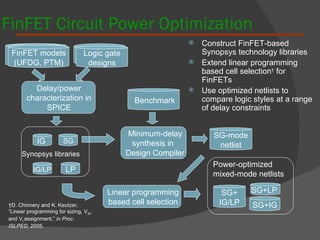
FinFET Circuit Power Optimization Construct FinFET-based Synopsys technology libraries Extend linear programming based cell selection †  for FinFETs Use optimized netlists to compare logic styles at a range of delay constraints † D. Chinnery and K. Keutzer, “Linear programming for sizing, V dd  and V t  assignment,”  in Proc. ISLPED , 2005. Benchmark Minimum-delay synthesis in  Design Compiler SG-mode  netlist Power-optimized mixed-mode netlists SG+ IG/LP SG+IG SG+LP  Linear programming based cell selection 32 nm PTM  FinFET models Delay/power  characterization in  SPICE  LP IG/LP IG  SG Synopsys   libraries   32 nm PTM  inFET models FinFET models (UFDG, PTM) Logic gate designs Logic gate designs
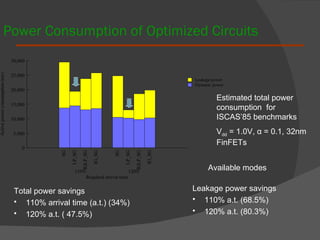
Power Consumption of Optimized Circuits Leakage power savings 110% a.t. (68.5%) 120% a.t. (80.3%) Total power savings 110% arrival time (a.t.) (34%) 120% a.t. ( 47.5%) Estimated total power consumption  for ISCAS’85 benchmarks V dd  = 1.0V,  α  = 0.1, 32nm FinFETs Available modes
Talk Outline Background  Low Power FinFET Circuits Unusual Logic Styles Unusual Dual-V dd /Dual-V th  Circuits Architectural Impact Other Ongoing Work Conclusions
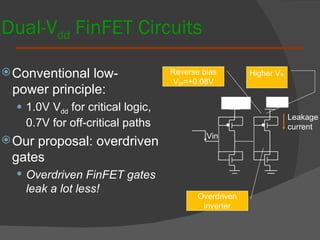
Dual-V dd  FinFET Circuits Conventional low- power principle: 1.0V V dd  for critical logic, 0.7V for off-critical paths Our proposal: overdriven gates Overdriven FinFET gates leak a lot less! 1.08V 1V Leakage current Vin Reverse bias V gs =+0.08V Overdriven inverter Higher V th
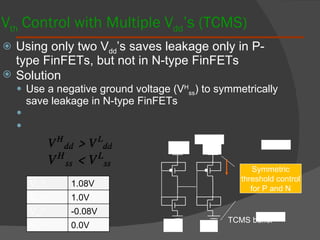
Using only two V dd ’s saves leakage only in P-type FinFETs, but not in N-type FinFETs Solution Use a negative ground voltage (V H ss ) to symmetrically save leakage in N-type FinFETs V th  Control with Multiple V dd ’s (TCMS) V dd H V ss H V dd L V ss L TCMS buffer Symmetric threshold control for P and N V dd H 1.08V V dd L 1.0V V ss H -0.08V V ss L 0.0V
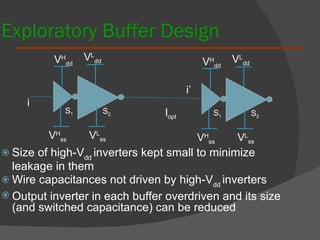
Exploratory Buffer Design Size of high-V dd  inverters kept small to minimize leakage in them Wire capacitances not driven by high-V dd  inverters Output inverter in each buffer overdriven and its size (and switched capacitance) can be reduced l opt S 1 S 2 V H dd V H ss V L ss V L dd S 1 S 2 V H dd V H ss V L ss V L dd i i’
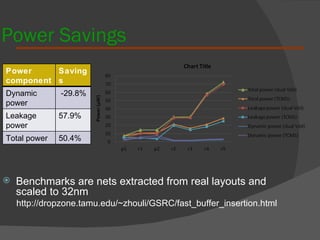
Power Savings Benchmarks are nets extracted from real layouts and scaled to 32nm http://dropzone.tamu.edu/~zhouli/GSRC/fast_buffer_insertion.html Power component Savings Dynamic power -29.8% Leakage power 57.9% Total power 50.4%
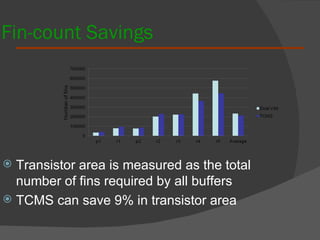
Fin-count Savings Transistor area is measured as the total number of fins required by all buffers TCMS can save 9% in transistor area
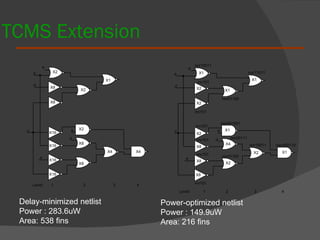
TCMS Extension Delay-minimized netlist Power : 283.6uW Area: 538 fins Power-optimized netlist Power : 149.9uW Area: 216 fins
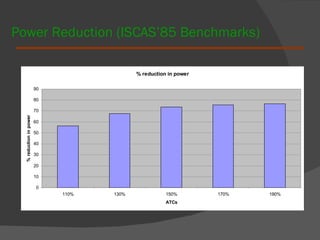
Power Reduction (ISCAS’85 Benchmarks)
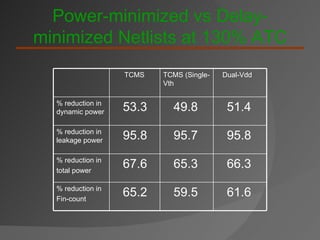
Power-minimized vs Delay-minimized Netlists at 130% ATC TCMS TCMS (Single-Vth Dual-Vdd % reduction in dynamic power 53.3 49.8 51.4 % reduction in leakage power 95.8 95.7 95.8 % reduction in total power 67.6 65.3 66.3 % reduction in Fin-count 65.2 59.5 61.6
Talk Outline Background  Low Power FinFET Circuits Unusual Logic Styles Unusual Dual-V dd /Dual-V th  Circuits Architectural Impact Other Ongoing Work Conclusions
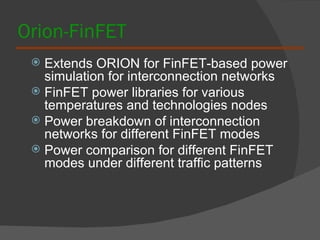
Orion-FinFET Extends ORION for FinFET-based power simulation for interconnection networks FinFET power libraries for various temperatures and technologies nodes Power breakdown of interconnection networks for different FinFET modes Power comparison for different FinFET modes under different traffic patterns
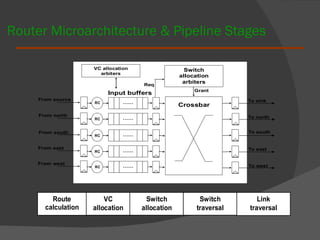
Router Microarchitecture & Pipeline Stages
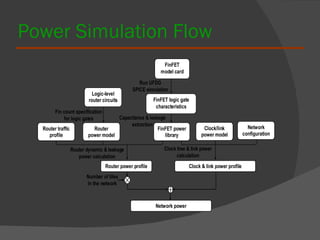
Power Simulation Flow
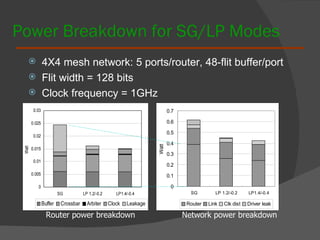
Power Breakdown for SG/LP Modes 4X4 mesh network: 5 ports/router, 48-flit buffer/port Flit width = 128 bits Clock frequency = 1GHz Router power breakdown Network power breakdown
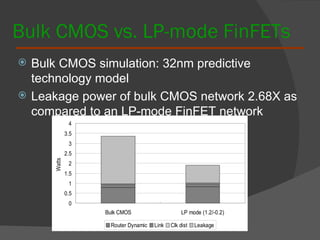
Bulk CMOS vs. LP-mode FinFETs Bulk CMOS simulation: 32nm predictive technology model Leakage power of bulk CMOS network 2.68X as compared to an LP-mode FinFET network
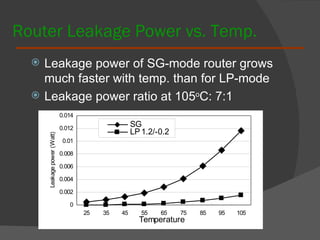
Router Leakage Power vs. Temp.   Leakage power of SG-mode router grows much faster with temp. than for LP-mode  Leakage power ratio at 105 o C: 7:1
Talk Outline Background  Low Power FinFET Circuits Unusual Logic Styles Unusual Dual-V dd /Dual-V th  Circuits Architectural Impact Other ongoing work Conclusions
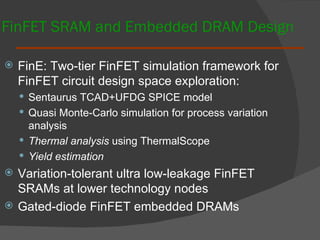
FinFET SRAM and Embedded DRAM Design FinE: Two-tier FinFET simulation framework for FinFET circuit design space exploration:  Sentaurus TCAD+UFDG SPICE model Quasi Monte-Carlo simulation for process variation analysis Thermal analysis  using ThermalScope Yield estimation Variation-tolerant ultra low-leakage FinFET SRAMs at lower technology nodes Gated-diode FinFET embedded DRAMs
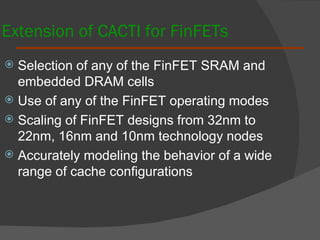
Extension of CACTI for FinFETs Selection of any of the FinFET SRAM and embedded DRAM cells Use of any of the FinFET operating modes Scaling of FinFET designs from 32nm to 22nm, 16nm and 10nm technology nodes Accurately modeling the behavior of a wide range of cache configurations
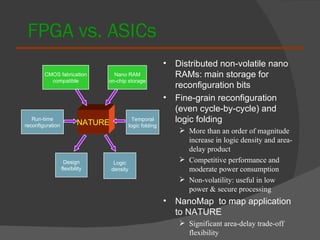
FPGA vs. ASICs NATURE CMOS fabrication compatible Nano RAM on-chip storage Run-time reconfiguration Temporal logic folding Design flexibility Logic density Distributed non-volatile nano RAMs: main storage for reconfiguration bits Fine-grain reconfiguration (even cycle-by-cycle) and logic folding   More than an order of magnitude increase in logic density and area-delay product Competitive performance and moderate power consumption Non-volatility: useful in low power & secure processing NanoMap  to map application to NATURE Significant area-delay trade-off flexibility
Conclusions FinFETs a necessary semiconductor evolution step because of bulk CMOS scaling problems beyond 32nm  Use of the FinFET back gate leads to very interesting design opportunities Rich diversity of design styles, made possible by independent control of FinFET gates, can be used effectively to reduce total active power consumption TCMS able to reduce both delay and subthreshold leakage current in a logic circuit simultaneously Time has arrived to start exploring the architectural trade-offs made possible by switch to FinFETs

Sushant

  • 1.
    1 Presented by:- SUSHANT MISHRA EC-2 Under the guidance of :- FinFETs: From Circuit to Architecture
  • 2.
    Talk Outline Background Low Power FinFET Circuits Unusual Logic Styles Unusual Dual-V dd /Dual-V th Circuits Architectural Impact Other Ongoing Work Conclusions 2
  • 3.
    Why Double-gate Transistors? DG-FETs can be used to fill this gap DG-FETs are extensions of CMOS Manufacturing processes similar to CMOS Key limitations of CMOS scaling addressed through Better control of channel from transistor gates Reduced short-channel effects Better Ion/Ioff Improved sub-threshold slope No discrete dopant fluctuations 3 Non-Si nano devices Bulk CMOS Feature size 32 nm 10 nm DG-FETs Gap
  • 4.
    What are FinFETs?Fin-type DG-FET A FinFET is like a FET, but the channel has been “turned on its edge” and made to stand up 4 Si Fin
  • 5.
    Independent-gate FinFETs Boththe gates of a FET can be independently controlled Independent control Requires an extra process step Leads to a number of interesting analog and digital circuit structures 5 Back Gate Oxide insulation
  • 6.
    FinFET Width QuantizationElectrical width of a FinFET with n fins: W = 2* n * h Channel width in a FinFET is quantized Width quantization is a design challenge if fine control of transistor drive strength is needed E.g., in ensuring stability of memory cells 6 FinFET structure Ananthan, ISQED’05
  • 7.
    Talk Outline Background Low Power FinFET Circuits Unusual Logic Styles Unusual Dual-V dd /Dual-V th Circuits Architectural Impact Other Ongoing Work Conclusions
  • 8.
    Motivation: Power ConsumptionTraditional view of CMOS power consumption Active mode: Dynamic power (switching + short circuit + glitching) Standby mode: Leakage power Problem: rising active leakage 40% of total active mode power consumption (70nm bulk CMOS) † † J. Kao, S. Narendra and A. Chandrakasan, “Subthreshold leakage modeling and reduction techniques,” in Proc. ICCAD, 2002.
  • 9.
    Logic Styles: NANDGates SG-mode NAND IG-mode NAND LP-mode NAND IG/LP-mode NAND pull up bias voltage pull down bias voltage IG-mode pull up LP-mode pull down
  • 10.
    Comparing Logic Styles† Average leakage current for two-input NAND gate (V dd = 1.0V) Design Mode Advantages Disadvantages SG Fastest under all load conditions High leakage † (1 μ A) LP Very low leakage (85nA), low switched capacitance Slowest, especially under load. Area overhead (routing) IG Low area and switched capacitance Unmatched pull-up and pull-down delays. High leakage (772nA) IG/LP Low leakage (337nA), area and switched capacitance Almost as slow as LP mode
  • 11.
    FinFET Circuit PowerOptimization Construct FinFET-based Synopsys technology libraries Extend linear programming based cell selection † for FinFETs Use optimized netlists to compare logic styles at a range of delay constraints † D. Chinnery and K. Keutzer, “Linear programming for sizing, V dd and V t assignment,” in Proc. ISLPED , 2005. Benchmark Minimum-delay synthesis in Design Compiler SG-mode netlist Power-optimized mixed-mode netlists SG+ IG/LP SG+IG SG+LP Linear programming based cell selection 32 nm PTM FinFET models Delay/power characterization in SPICE LP IG/LP IG SG Synopsys libraries 32 nm PTM inFET models FinFET models (UFDG, PTM) Logic gate designs Logic gate designs
  • 12.
    Power Consumption ofOptimized Circuits Leakage power savings 110% a.t. (68.5%) 120% a.t. (80.3%) Total power savings 110% arrival time (a.t.) (34%) 120% a.t. ( 47.5%) Estimated total power consumption for ISCAS’85 benchmarks V dd = 1.0V, α = 0.1, 32nm FinFETs Available modes
  • 13.
    Talk Outline Background Low Power FinFET Circuits Unusual Logic Styles Unusual Dual-V dd /Dual-V th Circuits Architectural Impact Other Ongoing Work Conclusions
  • 14.
    Dual-V dd FinFET Circuits Conventional low- power principle: 1.0V V dd for critical logic, 0.7V for off-critical paths Our proposal: overdriven gates Overdriven FinFET gates leak a lot less! 1.08V 1V Leakage current Vin Reverse bias V gs =+0.08V Overdriven inverter Higher V th
  • 15.
    Using only twoV dd ’s saves leakage only in P-type FinFETs, but not in N-type FinFETs Solution Use a negative ground voltage (V H ss ) to symmetrically save leakage in N-type FinFETs V th Control with Multiple V dd ’s (TCMS) V dd H V ss H V dd L V ss L TCMS buffer Symmetric threshold control for P and N V dd H 1.08V V dd L 1.0V V ss H -0.08V V ss L 0.0V
  • 16.
    Exploratory Buffer DesignSize of high-V dd inverters kept small to minimize leakage in them Wire capacitances not driven by high-V dd inverters Output inverter in each buffer overdriven and its size (and switched capacitance) can be reduced l opt S 1 S 2 V H dd V H ss V L ss V L dd S 1 S 2 V H dd V H ss V L ss V L dd i i’
  • 17.
    Power Savings Benchmarksare nets extracted from real layouts and scaled to 32nm http://dropzone.tamu.edu/~zhouli/GSRC/fast_buffer_insertion.html Power component Savings Dynamic power -29.8% Leakage power 57.9% Total power 50.4%
  • 18.
    Fin-count Savings Transistorarea is measured as the total number of fins required by all buffers TCMS can save 9% in transistor area
  • 19.
    TCMS Extension Delay-minimizednetlist Power : 283.6uW Area: 538 fins Power-optimized netlist Power : 149.9uW Area: 216 fins
  • 20.
  • 21.
    Power-minimized vs Delay-minimizedNetlists at 130% ATC TCMS TCMS (Single-Vth Dual-Vdd % reduction in dynamic power 53.3 49.8 51.4 % reduction in leakage power 95.8 95.7 95.8 % reduction in total power 67.6 65.3 66.3 % reduction in Fin-count 65.2 59.5 61.6
  • 22.
    Talk Outline Background Low Power FinFET Circuits Unusual Logic Styles Unusual Dual-V dd /Dual-V th Circuits Architectural Impact Other Ongoing Work Conclusions
  • 23.
    Orion-FinFET Extends ORIONfor FinFET-based power simulation for interconnection networks FinFET power libraries for various temperatures and technologies nodes Power breakdown of interconnection networks for different FinFET modes Power comparison for different FinFET modes under different traffic patterns
  • 24.
  • 25.
  • 26.
    Power Breakdown forSG/LP Modes 4X4 mesh network: 5 ports/router, 48-flit buffer/port Flit width = 128 bits Clock frequency = 1GHz Router power breakdown Network power breakdown
  • 27.
    Bulk CMOS vs.LP-mode FinFETs Bulk CMOS simulation: 32nm predictive technology model Leakage power of bulk CMOS network 2.68X as compared to an LP-mode FinFET network
  • 28.
    Router Leakage Powervs. Temp. Leakage power of SG-mode router grows much faster with temp. than for LP-mode Leakage power ratio at 105 o C: 7:1
  • 29.
    Talk Outline Background Low Power FinFET Circuits Unusual Logic Styles Unusual Dual-V dd /Dual-V th Circuits Architectural Impact Other ongoing work Conclusions
  • 30.
    FinFET SRAM andEmbedded DRAM Design FinE: Two-tier FinFET simulation framework for FinFET circuit design space exploration: Sentaurus TCAD+UFDG SPICE model Quasi Monte-Carlo simulation for process variation analysis Thermal analysis using ThermalScope Yield estimation Variation-tolerant ultra low-leakage FinFET SRAMs at lower technology nodes Gated-diode FinFET embedded DRAMs
  • 31.
    Extension of CACTIfor FinFETs Selection of any of the FinFET SRAM and embedded DRAM cells Use of any of the FinFET operating modes Scaling of FinFET designs from 32nm to 22nm, 16nm and 10nm technology nodes Accurately modeling the behavior of a wide range of cache configurations
  • 32.
    FPGA vs. ASICsNATURE CMOS fabrication compatible Nano RAM on-chip storage Run-time reconfiguration Temporal logic folding Design flexibility Logic density Distributed non-volatile nano RAMs: main storage for reconfiguration bits Fine-grain reconfiguration (even cycle-by-cycle) and logic folding More than an order of magnitude increase in logic density and area-delay product Competitive performance and moderate power consumption Non-volatility: useful in low power & secure processing NanoMap to map application to NATURE Significant area-delay trade-off flexibility
  • 33.
    Conclusions FinFETs anecessary semiconductor evolution step because of bulk CMOS scaling problems beyond 32nm Use of the FinFET back gate leads to very interesting design opportunities Rich diversity of design styles, made possible by independent control of FinFET gates, can be used effectively to reduce total active power consumption TCMS able to reduce both delay and subthreshold leakage current in a logic circuit simultaneously Time has arrived to start exploring the architectural trade-offs made possible by switch to FinFETs