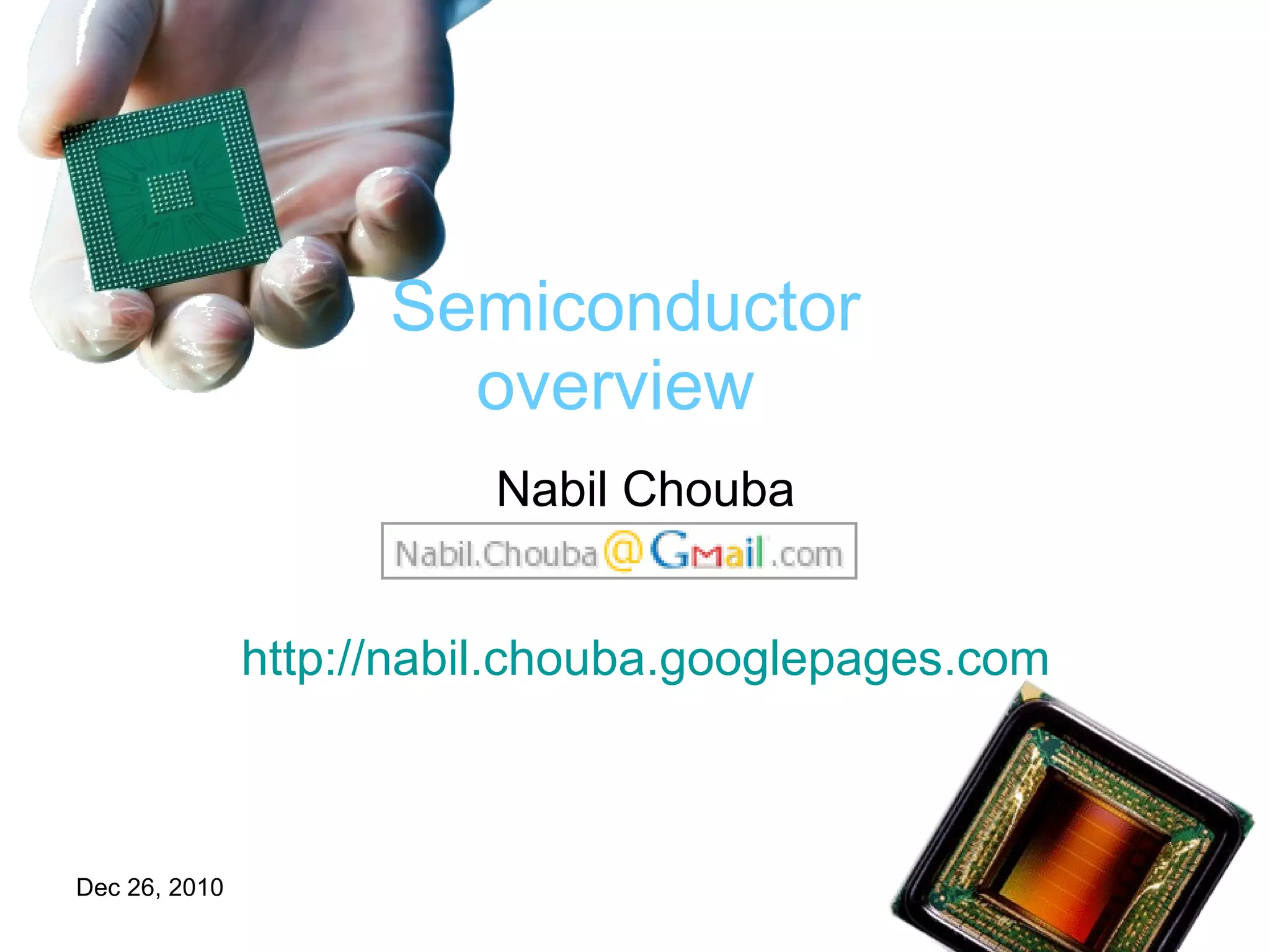
Nabil Chouba http:// nabil.chouba.googlepages.com Semiconductor  overview
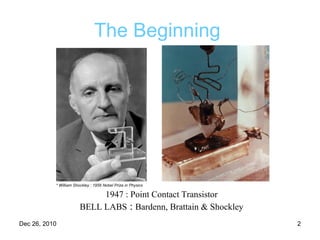
The Beginning   1947 : Point Contact Transistor  BELL LABS  :  Bardenn, Brattain & Shockley  * William Shockley : 1956 Nobel Prize in Physics
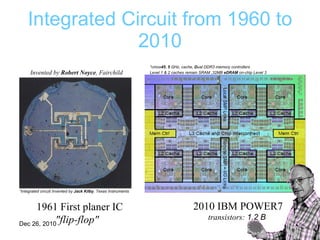
Integrated Circuit from 1960 to 2010 1961 First planer IC "flip-flop"   2010 IBM POWER7   transistors:  1.2 B   Invented by  Robert Noyce ,   Fairchild  *integrated circuit Invented by  Jack Kilby , Texas Instruments   *cmos 45 ,  5  GHz, cache,  D ual DDR3 memory controllers   Level 1 & 2 caches remain SRAM ,32MB  eDRAM  on-chip Level 3
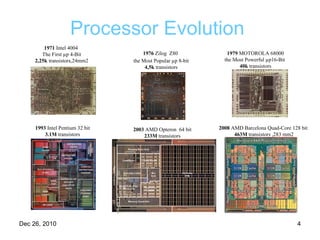
Processor Evolution   1979  MOTOROLA 68000 the Most Powerful µp16-Bit  40k  transistors 1971  Intel 4004  The First µp  4-Bit 2,25k  transistors,24mm2 1976  Zilog   Z80  the Most Popular µp 8-bit 4,5k  transistors 1993  Intel Pentium 32 bit 3.1M  transistors 2003  AMD  Opteron  64 bit 233M  transistors 2008   AMD Barcelona Quad-Core 128 bit  463M  transistors ,283 mm2
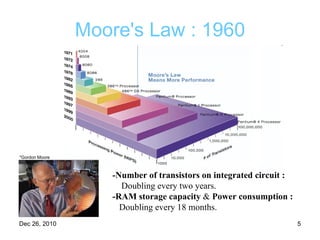
Moore's Law : 1960 -Number of transistors on integrated circuit : Doubling every two years. -RAM storage capacity  &  Power consumption : Doubling every 18 months.  *Gordon Moore
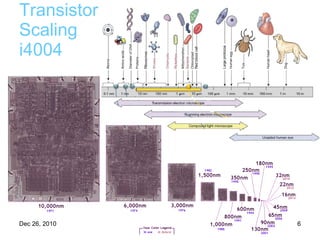
Transistor Scaling i4004
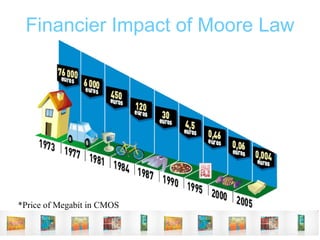
Financier Impact of Moore Law *Price of Megabit in CMOS
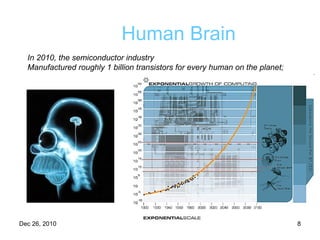
Human Brain   In 2010, the semiconductor industry Manufactured roughly 1 billion transistors for every human on the planet;
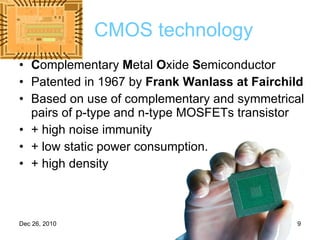
CMOS technology C omplementary  M etal  O xide  S emiconductor  Patented in 1967 by  Frank Wanlass at Fairchild Based on use of complementary and symmetrical pairs of p-type and n-type MOSFETs transistor + high noise immunity  + low static power consumption.  + high density
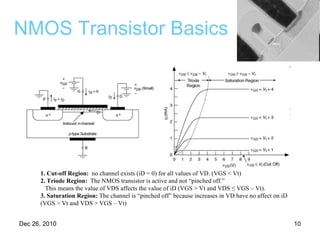
NMOS Transistor Basics 1. Cut-off Region:  no channel exists (iD = 0) for all values of VD. (VGS < Vt)  2. Triode Region:  The NMOS transistor is active and not “pinched off.”  This means the value of VDS affects the value of iD (VGS > Vt and VDS ≤ VGS – Vt).  3. Saturation Region:  The channel is “pinched off” because increases in VD have no affect on iD  (VGS > Vt and VDS > VGS – Vt)
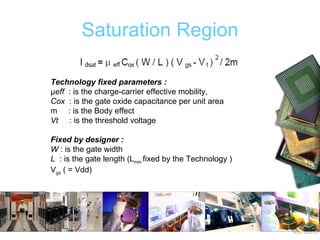
Saturation Region Technology fixed parameters : μ eff   : is the charge-carrier effective mobility, Cox   : is the gate oxide capacitance per unit area m  : is the Body effect Vt   : is the threshold voltage  Fixed by designer :  W  : is the gate width L   : is the gate length (L min  fixed by the Technology ) V gs  ( = Vdd)
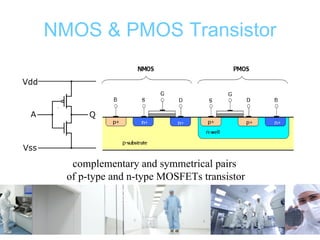
NMOS & PMOS Transistor complementary and symmetrical pairs  of p-type and n-type MOSFETs transistor
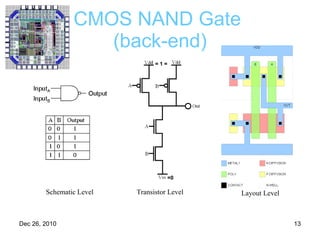
CMOS NAND Gate  (back-end) Transistor Level Schematic Level Layout Level =0 = 1 =
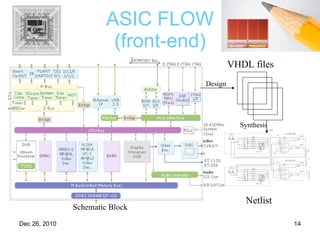
ASIC FLOW (front-end) Schematic Block VHDL files Netlist Design Synthesis
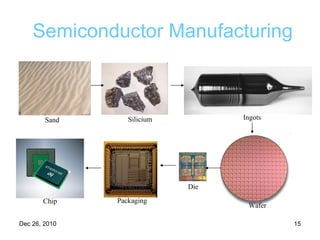
Semiconductor Manufacturing   Sand Silicium   Wafer Die Packaging Chip Ingots
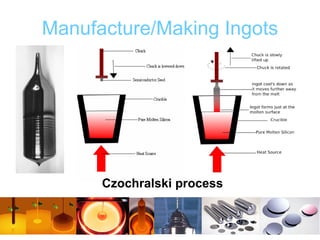
Manufacture/Making Ingots Czochralski process
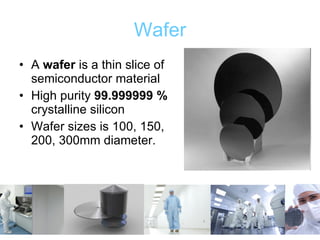
Wafer A  wafer  is a thin slice of semiconductor material  High purity  99.999999 %  crystalline silicon  Wafer sizes is 100, 150, 200, 300mm diameter.
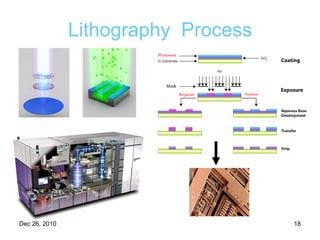
Lithography  Process
Stepper Costing several hundred to several thousand million yen ASML, Ultratech, Nikon, Canon  - Early days of lithography used 456 nm wavelength light.  - Lithography today is using 193 nm wavelength light.
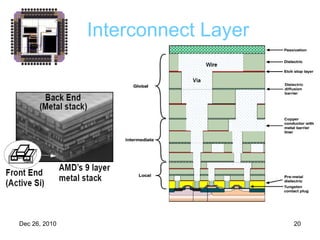
Interconnect Layer
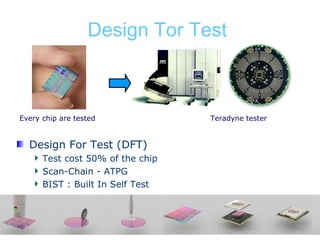
Design Tor Test   Every chip are tested Teradyne tester Design For Test (DFT) Test cost 50% of the chip Scan-Chain - ATPG BIST : Built In Self Test
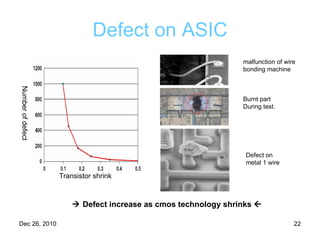
Defect on ASIC    Defect increase as cmos technology shrinks     Defect on metal 1 wire malfunction of wire bonding machine Number of defect  Transistor shrink Burnt part  During test.
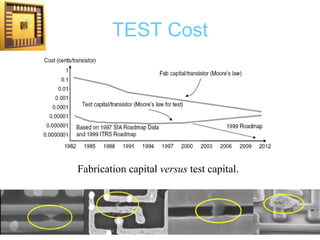
TEST Cost Fabrication capital  versus  test capital.
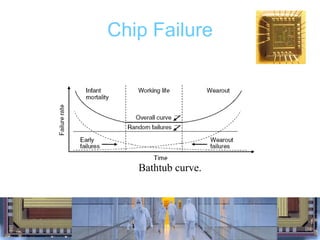
Chip Failure Bathtub curve.
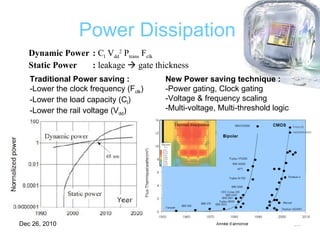
Power Dissipation   Thermal dissipation Traditional Power saving : -Lower the clock frequency (F clk ) -Lower the load capacity (C l ) -Lower the rail voltage (V dd ) Dynamic Power :  C l  V dd 2  P trans  F clk   Static Power :  leakage    gate thickness   New Power saving technique : -Power gating, Clock gating -Voltage & frequency scaling -Multi-voltage, Multi-threshold logic
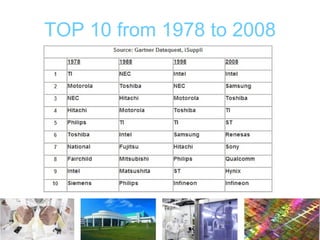
TOP 10 from 1978 to 2008
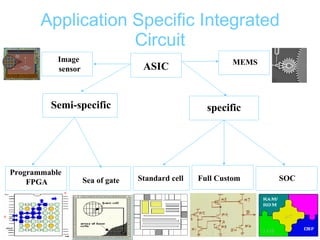
Application Specific Integrated Circuit ASIC Semi- specific specific Programmable  FPGA Sea of gate Standard cell Full Custom SOC Image  sensor MEMS
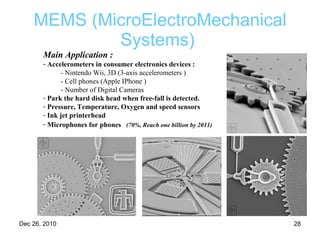
MEMS (MicroElectroMechanical Systems)   Main Application :   Accelerometers in consumer electronics devices : - Nintendo Wii, 3D (3-axis accelerometers ) - Cell phones (Apple IPhone ) - Number of Digital Cameras  Park the hard disk head when free-fall is detected. Pressure, Temperature, Oxygen and speed sensors Ink jet printerhead Microphones for phones   (70%, Reach one billion by 2011)
 
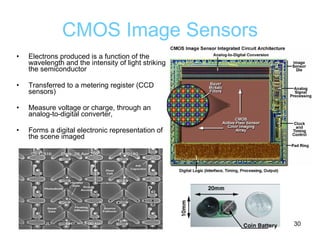
CMOS Image Sensors Electrons produced is a function of the wavelength and the intensity of light striking the semiconductor  Transferred to a metering register (CCD sensors) Measure voltage or charge, through an analog-to-digital converter,  Forms a digital electronic representation of the scene imaged
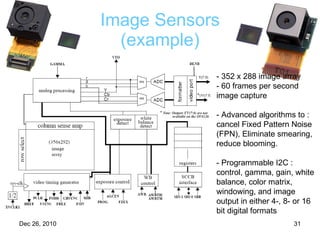
Image Sensors (example) - 352 x 288 image array - 60 frames per second image capture - Advanced algorithms to : cancel Fixed Pattern Noise (FPN), Eliminate smearing, reduce blooming.  - Programmable I2C : control, gamma, gain, white balance, color matrix, windowing, and image output in either 4-, 8- or 16 bit digital formats
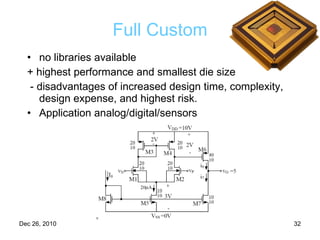
Full Custom no libraries available + highest performance and smallest die size - disadvantages of increased design time, complexity, design expense, and highest risk. Application analog/digital/sensors
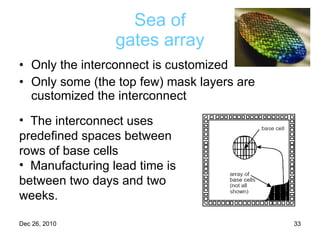
Sea of gates array Only the interconnect is customized Only some (the top few) mask layers are customized the interconnect The interconnect uses predefined spaces between rows of base cells Manufacturing lead time is between two days and two weeks.
Advantages  : =>  mixed system possible ( analog/digital) =>  internal   flexibility =>  high density Disadvantages  : => middle cost =>  technology transistors / standard cell imposed and fixed   =>  complex   to master the technology   Sea of Gate  or  masked gate array (MGA)
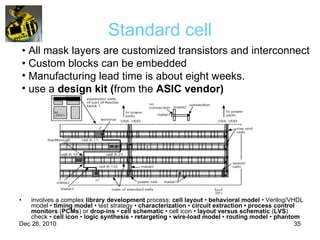
Standard cell involves a complex  library development  process:  cell layout  •  behavioral model  • Verilog/VHDL model •  timing model  • test strategy •  characterization  •  circuit extraction • process control monitors  ( PCMs ) or  drop-ins  •  cell schematic  • cell icon •  layout versus schematic  ( LVS ) check •  cell icon  •  logic synthesis  •  retargeting  •  wire-load model  •  routing model  •  phantom •  All mask layers are customized transistors and interconnect •  Custom blocks can be embedded Manufacturing lead time is about eight weeks. use a  design kit ( from the  ASIC vendor)
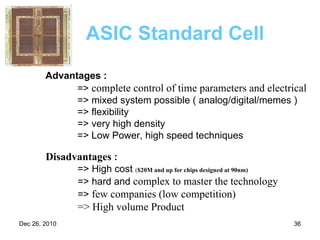
Advantages : =>  complete control of time parameters and electrical => mixed system possible ( analog/digital/memes ) => flexibility => very high density => Low Power, high speed techniques  Disadvantages  : => High cost  ( $20M and up for chips designed at 90nm)  => hard and  complex   to master the technology   =>  few companies (low competition) => High volume Product  ASIC Standard Cell
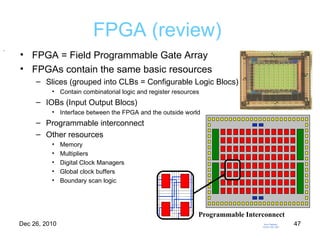
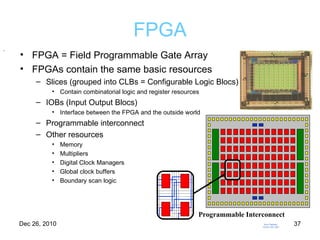
FPGA Ken Chapman (Xilinx UK) 2003 . Programmable Interconnect FPGA = Field Programmable Gate Array FPGAs contain the same basic resources Slices (grouped into CLBs = Configurable Logic Blocs) Contain combinatorial logic and register resources IOBs (Input Output Blocs) Interface between the FPGA and the outside world Programmable interconnect  Other resources Memory Multipliers Digital Clock Managers Global clock buffers Boundary scan logic
Advantages:  => Technology easy to master  => Reduced development time  => Reprogrammable for some (ideal for prototyping)  => Low cost   Disadvantages:  => Non-optimized performance  => Internal architecture completely frozen  => Only digital (with some exceptions) FPGA Field Programmable Gate Array
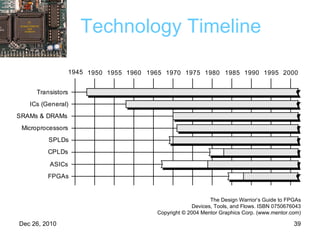
The Design Warrior’s Guide to FPGAs Devices, Tools, and Flows. ISBN 0750676043 Copyright © 2004 Mentor Graphics Corp. (www.mentor.com) Technology Timeline
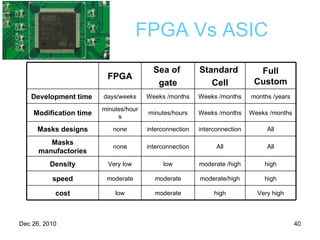
FPGA Vs ASIC high moderate/high moderate /high All interconnection Weeks /months Weeks /months Standard  Cell Very high moderate low cost high moderate moderate speed high low Very low Density All interconnection none Masks manufactories All interconnection none Masks designs Weeks /months minutes/hours minutes/hours Modification time months /years Weeks /months days/weeks Development time  Full Custom Sea of  gate FPGA
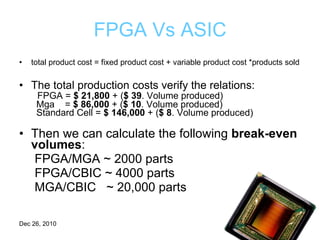
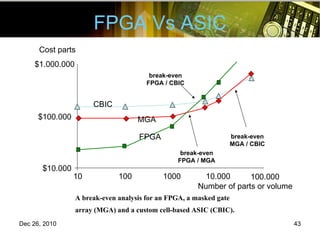
FPGA Vs ASIC total product cost = fixed product cost + variable product cost *products sold The total production costs verify the relations:     FPGA =  $ 21,800  + ( $ 39 . Volume produced)    Mga  =  $ 86,000  + ( $ 10 . Volume produced)    Standard Cell =  $ 146,000  + ( $ 8 . Volume produced)  Then we can calculate the following  break-even volumes :   FPGA/MGA ~ 2000 parts   FPGA/CBIC ~ 4000 parts   MGA/CBIC  ~ 20,000 parts
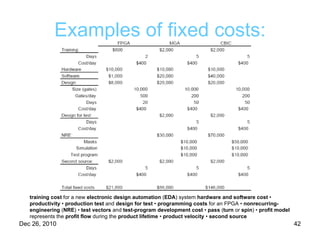
Examples of fixed costs: training cost  for a new  electronic design automation  ( EDA ) system  hardware and software cost  •  productivity  •  production test  and  design for test  •  programming costs  for an FPGA •  nonrecurring-engineering  ( NRE ) •  test vectors  and  test-program development cost  •  pass  ( turn  or  spin ) •  profit model  represents the  profit flow  during the  product lifetime  •  product velocity  •  second source
FPGA Vs ASIC A break-even analysis for an FPGA, a masked gate  array (MGA) and a custom cell-based ASIC (CBIC).   Cost parts Number of parts or volume $1.000.000 $100.000 $10.000 10 100 1000 10.000 100.000 break-even FPGA / CBIC break-even FPGA / MGA break-even MGA / CBIC CBIC MGA FPGA
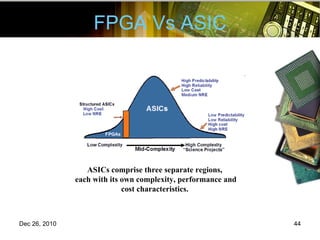
FPGA Vs ASIC ASICs comprise three separate regions,  each with its own complexity, performance and cost characteristics.
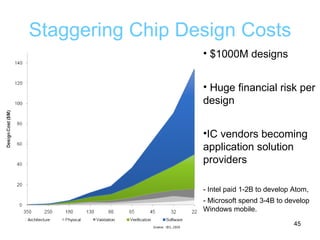
Staggering Chip Design Costs $1000M designs Huge financial risk per design IC vendors becoming application solution providers - Intel paid 1-2B to develop Atom,  - Microsoft spend 3-4B to develop Windows mobile.
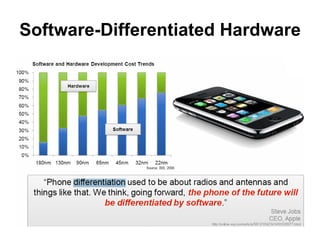
Software-Differentiated Hardware
FPGA (review)  Ken Chapman (Xilinx UK) 2003 . Programmable Interconnect FPGA = Field Programmable Gate Array FPGAs contain the same basic resources Slices (grouped into CLBs = Configurable Logic Blocs) Contain combinatorial logic and register resources IOBs (Input Output Blocs) Interface between the FPGA and the outside world Programmable interconnect  Other resources Memory Multipliers Digital Clock Managers Global clock buffers Boundary scan logic
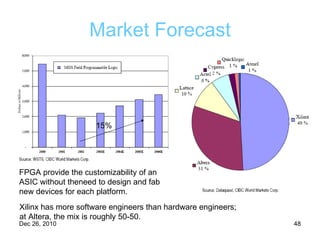
Market Forecast 15% FPGA provide the customizability of an ASIC without theneed to design and fab new devices for each platform. Xilinx has more software engineers than hardware engineers;  at Altera, the mix is roughly 50-50.
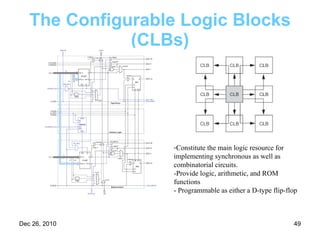
The Configurable Logic Blocks (CLBs) Constitute the main logic resource for implementing synchronous as well as combinatorial circuits. -Provide logic, arithmetic, and ROM functions - Programmable as either a D-type flip-flop
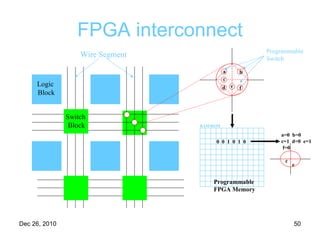
FPGA interconnect Logic  Block Switch  Block Wire Segment Programmable  Switch a c b e d f a=0  b=0  c=1  d=0  e=1  f=0 0  0  1  0  1  0 Programmable  FPGA Memory RAM/ROM c e
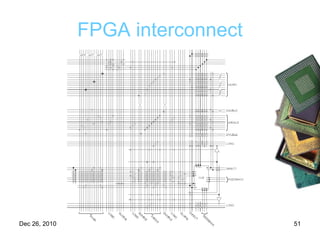
FPGA interconnect
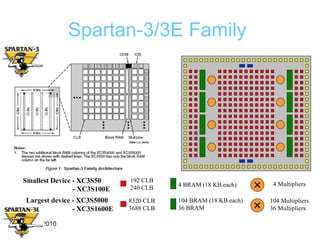
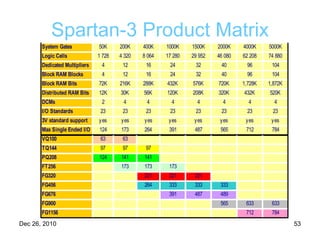
Spartan-3/3E Family  Smallest Device - XC3S50  - XC3S100E 192 CLB 240 CLB 4 BRAM (18 KB each) 4 Multipliers Largest device - XC3S5000  - XC3S1600E 8320 CLB 3688 CLB 104 BRAM (18 KB each) 36 BRAM 104 Multipliers 36 Multipliers
Spartan-3 Product Matrix
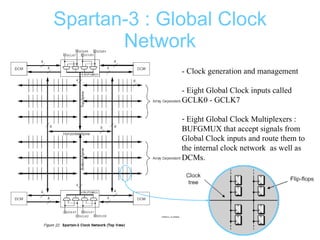
Spartan-3 : Global Clock Network -  Clock generation and management  - Eight Global Clock inputs called GCLK0 - GCLK7 Eight Global Clock Multiplexers : BUFGMUX that accept signals from Global Clock inputs and route them to the internal clock network  as well as DCMs.
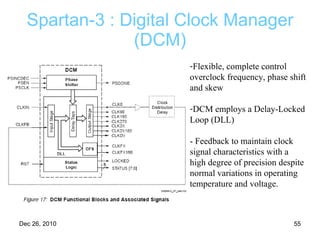
Spartan-3 : Digital Clock Manager (DCM) Flexible, complete control overclock frequency, phase shift and skew  DCM employs a Delay-Locked Loop (DLL) - Feedback to maintain clock signal characteristics with a high degree of precision despite normal variations in operating temperature and voltage.
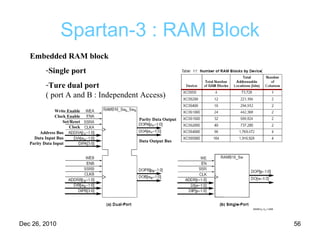
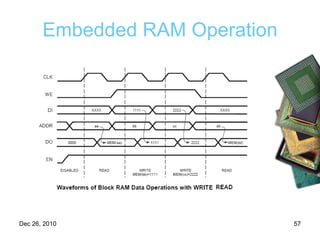
Spartan-3 : RAM Block Embedded RAM block Single port  Ture dual port  ( port A and B : Independent Access) Write Enable Clock Enable Set/Reset Clock Data Output Bus Parity Data Output Address Bus Data Input Bus Parity Data Input
Embedded RAM Operation
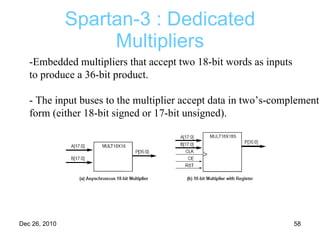
Spartan-3 : Dedicated Multipliers -Embedded multipliers that accept two 18-bit words as inputs  to produce a 36-bit product. - The input buses to the multiplier accept data in two’s-complement form (either 18-bit signed or 17-bit unsigned).
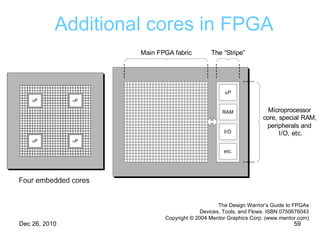
Additional cores  in FPGA The Design Warrior’s Guide to FPGAs Devices, Tools, and Flows. ISBN 0750676043 Copyright © 2004 Mentor Graphics Corp. (www.mentor.com)
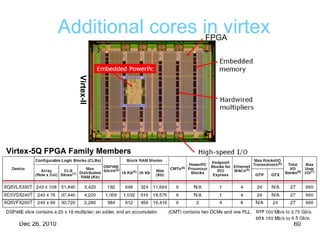
Additional cores  in virtex FPGA Virtex-5Q FPGA Family Members Virtex-II
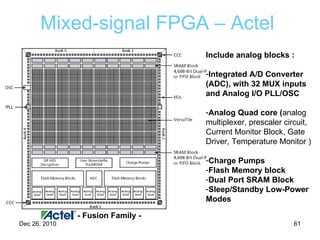
Mixed-signal FPGA – Actel  - Fusion Family -  Include analog blocks :  Integrated A/D Converter (ADC), with 32 MUX inputs and Analog I/O PLL/OSC Analog Quad core ( analog multiplexer, prescaler circuit, Current Monitor Block, Gate Driver, Temperature Monitor ) Charge Pumps Flash Memory block Dual Port SRAM Block Sleep/Standby Low-Power Modes
EDA Tools 1) Functional Verification Duopoly - Synopsys Vera and Cadence SpecMan &quot;e&quot; 2) Formal Verification Alternatives - Jasper, Mentor 0-In, Synopsys Magellan, Cadence IFV, Real Intent 3) RTL Simulation Triopoloy - Mentor ModelSim, Cadence NC-Sim, Synopsys VCS 4) RTL Synthesis Monopoly - Synopsys Design Compiler Alternatives - Cadence RTL Compiler, Magma BlastRTL, OAsys 5) Equivalence Checking Duopoly - Cadence Verplex and Synopsys Formality
EDA Tools 6) Test/ATPG/Scan/BIST Duopoly - Mentor FastScan/DFT Advisor and Synopsys TetraMax Alternatives: LogicVision 7) Floorplanning Semi-monopoly - Cadence First Encounter Alternatives: Magma Hydra, Synopsys Jupiter, Atoptech Apogee 8) Place and Route Triopoloy - Synopsys ICC, Magma Talus, Cadence Encounter Alternatives - Atoptech, Mentor Sierra 9) RC Extraction Duopoly - Synopsys Star-RCXT and Cadence Fire&Ice Alternatives - Mentor Calibre-xRC, Magma QuartzRC, Sequence Columbus
EDA Tools 10) IR Analysis Semi-monopoly - Apache Redhawk Alternatives - Cadence VoltageStorm 11) DRC/LVS Monopoly - Mentor Calibre Alternatives - Synopsys Hercules, Magma Quartz 12) Static Timing Monopoly - Synopsys PrimeTime Alternatives - Cadence ETS, Extreme GoldTime, Incentia TimeCraft, CLK-DA Amber, Magma QuartzTime 13) Signal Integrity Duopoly - Synopsys PT-SI and Cadence CeltIC Alternatives - Extreme GoldTime, Incentia TimeCraft, CLK-DA Amber
EDA Tools 16) FPGA Duopoly - Mentor Exemplar and Synopsys Synplicity Alternatives - tools from Xilinx and Altera 14) SPICE Alternatives - Synopsys HSIM/HSPICE, Cadence Spectre, Magma FineSim, Mentor, Nascentric, Berkeley 15) Full Custom Monopoly - Cadence Virtuoso Alternatives - SpringSoft Laker, Magma Titan, Synopsys Orion 17) Emulators/Acceletors Monopoly - Cadence Palladium Alternatives - Mentor Veloce, EVE, Dini, Synopsys HAPS

Semiconductor overview

  • 1.
    Nabil Chouba http://nabil.chouba.googlepages.com Semiconductor overview
  • 2.
    The Beginning 1947 : Point Contact Transistor  BELL LABS : Bardenn, Brattain & Shockley * William Shockley : 1956 Nobel Prize in Physics
  • 3.
    Integrated Circuit from1960 to 2010 1961 First planer IC &quot;flip-flop&quot; 2010 IBM POWER7 transistors: 1.2 B Invented by Robert Noyce , Fairchild *integrated circuit Invented by Jack Kilby , Texas Instruments *cmos 45 , 5 GHz, cache, D ual DDR3 memory controllers Level 1 & 2 caches remain SRAM ,32MB eDRAM on-chip Level 3
  • 4.
    Processor Evolution 1979 MOTOROLA 68000 the Most Powerful µp16-Bit 40k transistors 1971 Intel 4004 The First µp 4-Bit 2,25k transistors,24mm2 1976 Zilog Z80 the Most Popular µp 8-bit 4,5k transistors 1993 Intel Pentium 32 bit 3.1M transistors 2003 AMD Opteron 64 bit 233M transistors 2008 AMD Barcelona Quad-Core 128 bit 463M transistors ,283 mm2
  • 5.
    Moore's Law :1960 -Number of transistors on integrated circuit : Doubling every two years. -RAM storage capacity & Power consumption : Doubling every 18 months. *Gordon Moore
  • 6.
  • 7.
    Financier Impact ofMoore Law *Price of Megabit in CMOS
  • 8.
    Human Brain In 2010, the semiconductor industry Manufactured roughly 1 billion transistors for every human on the planet;
  • 9.
    CMOS technology Complementary M etal O xide S emiconductor Patented in 1967 by Frank Wanlass at Fairchild Based on use of complementary and symmetrical pairs of p-type and n-type MOSFETs transistor + high noise immunity + low static power consumption. + high density
  • 10.
    NMOS Transistor Basics1. Cut-off Region: no channel exists (iD = 0) for all values of VD. (VGS < Vt) 2. Triode Region: The NMOS transistor is active and not “pinched off.” This means the value of VDS affects the value of iD (VGS > Vt and VDS ≤ VGS – Vt). 3. Saturation Region: The channel is “pinched off” because increases in VD have no affect on iD (VGS > Vt and VDS > VGS – Vt)
  • 11.
    Saturation Region Technologyfixed parameters : μ eff : is the charge-carrier effective mobility, Cox : is the gate oxide capacitance per unit area m : is the Body effect Vt : is the threshold voltage Fixed by designer : W : is the gate width L : is the gate length (L min fixed by the Technology ) V gs ( = Vdd)
  • 12.
    NMOS & PMOSTransistor complementary and symmetrical pairs of p-type and n-type MOSFETs transistor
  • 13.
    CMOS NAND Gate (back-end) Transistor Level Schematic Level Layout Level =0 = 1 =
  • 14.
    ASIC FLOW (front-end)Schematic Block VHDL files Netlist Design Synthesis
  • 15.
    Semiconductor Manufacturing Sand Silicium Wafer Die Packaging Chip Ingots
  • 16.
  • 17.
    Wafer A wafer is a thin slice of semiconductor material High purity 99.999999 % crystalline silicon Wafer sizes is 100, 150, 200, 300mm diameter.
  • 18.
  • 19.
    Stepper Costing severalhundred to several thousand million yen ASML, Ultratech, Nikon, Canon - Early days of lithography used 456 nm wavelength light. - Lithography today is using 193 nm wavelength light.
  • 20.
  • 21.
    Design Tor Test Every chip are tested Teradyne tester Design For Test (DFT) Test cost 50% of the chip Scan-Chain - ATPG BIST : Built In Self Test
  • 22.
    Defect on ASIC Defect increase as cmos technology shrinks  Defect on metal 1 wire malfunction of wire bonding machine Number of defect Transistor shrink Burnt part During test.
  • 23.
    TEST Cost Fabricationcapital versus test capital.
  • 24.
  • 25.
    Power Dissipation Thermal dissipation Traditional Power saving : -Lower the clock frequency (F clk ) -Lower the load capacity (C l ) -Lower the rail voltage (V dd ) Dynamic Power : C l V dd 2 P trans F clk Static Power : leakage  gate thickness New Power saving technique : -Power gating, Clock gating -Voltage & frequency scaling -Multi-voltage, Multi-threshold logic
  • 26.
    TOP 10 from1978 to 2008
  • 27.
    Application Specific IntegratedCircuit ASIC Semi- specific specific Programmable FPGA Sea of gate Standard cell Full Custom SOC Image sensor MEMS
  • 28.
    MEMS (MicroElectroMechanical Systems) Main Application : Accelerometers in consumer electronics devices : - Nintendo Wii, 3D (3-axis accelerometers ) - Cell phones (Apple IPhone ) - Number of Digital Cameras Park the hard disk head when free-fall is detected. Pressure, Temperature, Oxygen and speed sensors Ink jet printerhead Microphones for phones (70%, Reach one billion by 2011)
  • 29.
  • 30.
    CMOS Image SensorsElectrons produced is a function of the wavelength and the intensity of light striking the semiconductor Transferred to a metering register (CCD sensors) Measure voltage or charge, through an analog-to-digital converter, Forms a digital electronic representation of the scene imaged
  • 31.
    Image Sensors (example)- 352 x 288 image array - 60 frames per second image capture - Advanced algorithms to : cancel Fixed Pattern Noise (FPN), Eliminate smearing, reduce blooming. - Programmable I2C : control, gamma, gain, white balance, color matrix, windowing, and image output in either 4-, 8- or 16 bit digital formats
  • 32.
    Full Custom nolibraries available + highest performance and smallest die size - disadvantages of increased design time, complexity, design expense, and highest risk. Application analog/digital/sensors
  • 33.
    Sea of gatesarray Only the interconnect is customized Only some (the top few) mask layers are customized the interconnect The interconnect uses predefined spaces between rows of base cells Manufacturing lead time is between two days and two weeks.
  • 34.
    Advantages :=> mixed system possible ( analog/digital) => internal flexibility => high density Disadvantages : => middle cost => technology transistors / standard cell imposed and fixed => complex to master the technology Sea of Gate or masked gate array (MGA)
  • 35.
    Standard cell involvesa complex library development process: cell layout • behavioral model • Verilog/VHDL model • timing model • test strategy • characterization • circuit extraction • process control monitors ( PCMs ) or drop-ins • cell schematic • cell icon • layout versus schematic ( LVS ) check • cell icon • logic synthesis • retargeting • wire-load model • routing model • phantom • All mask layers are customized transistors and interconnect • Custom blocks can be embedded Manufacturing lead time is about eight weeks. use a design kit ( from the ASIC vendor)
  • 36.
    Advantages : => complete control of time parameters and electrical => mixed system possible ( analog/digital/memes ) => flexibility => very high density => Low Power, high speed techniques Disadvantages : => High cost ( $20M and up for chips designed at 90nm) => hard and complex to master the technology => few companies (low competition) => High volume Product ASIC Standard Cell
  • 37.
    FPGA Ken Chapman(Xilinx UK) 2003 . Programmable Interconnect FPGA = Field Programmable Gate Array FPGAs contain the same basic resources Slices (grouped into CLBs = Configurable Logic Blocs) Contain combinatorial logic and register resources IOBs (Input Output Blocs) Interface between the FPGA and the outside world Programmable interconnect Other resources Memory Multipliers Digital Clock Managers Global clock buffers Boundary scan logic
  • 38.
    Advantages: =>Technology easy to master => Reduced development time => Reprogrammable for some (ideal for prototyping) => Low cost Disadvantages: => Non-optimized performance => Internal architecture completely frozen => Only digital (with some exceptions) FPGA Field Programmable Gate Array
  • 39.
    The Design Warrior’sGuide to FPGAs Devices, Tools, and Flows. ISBN 0750676043 Copyright © 2004 Mentor Graphics Corp. (www.mentor.com) Technology Timeline
  • 40.
    FPGA Vs ASIChigh moderate/high moderate /high All interconnection Weeks /months Weeks /months Standard Cell Very high moderate low cost high moderate moderate speed high low Very low Density All interconnection none Masks manufactories All interconnection none Masks designs Weeks /months minutes/hours minutes/hours Modification time months /years Weeks /months days/weeks Development time Full Custom Sea of gate FPGA
  • 41.
    FPGA Vs ASICtotal product cost = fixed product cost + variable product cost *products sold The total production costs verify the relations:   FPGA = $ 21,800 + ( $ 39 . Volume produced)   Mga = $ 86,000 + ( $ 10 . Volume produced)   Standard Cell = $ 146,000 + ( $ 8 . Volume produced) Then we can calculate the following break-even volumes : FPGA/MGA ~ 2000 parts FPGA/CBIC ~ 4000 parts MGA/CBIC ~ 20,000 parts
  • 42.
    Examples of fixedcosts: training cost for a new electronic design automation ( EDA ) system hardware and software cost • productivity • production test and design for test • programming costs for an FPGA • nonrecurring-engineering ( NRE ) • test vectors and test-program development cost • pass ( turn or spin ) • profit model represents the profit flow during the product lifetime • product velocity • second source
  • 43.
    FPGA Vs ASICA break-even analysis for an FPGA, a masked gate array (MGA) and a custom cell-based ASIC (CBIC). Cost parts Number of parts or volume $1.000.000 $100.000 $10.000 10 100 1000 10.000 100.000 break-even FPGA / CBIC break-even FPGA / MGA break-even MGA / CBIC CBIC MGA FPGA
  • 44.
    FPGA Vs ASICASICs comprise three separate regions, each with its own complexity, performance and cost characteristics.
  • 45.
    Staggering Chip DesignCosts $1000M designs Huge financial risk per design IC vendors becoming application solution providers - Intel paid 1-2B to develop Atom, - Microsoft spend 3-4B to develop Windows mobile.
  • 46.
  • 47.
    FPGA (review) Ken Chapman (Xilinx UK) 2003 . Programmable Interconnect FPGA = Field Programmable Gate Array FPGAs contain the same basic resources Slices (grouped into CLBs = Configurable Logic Blocs) Contain combinatorial logic and register resources IOBs (Input Output Blocs) Interface between the FPGA and the outside world Programmable interconnect Other resources Memory Multipliers Digital Clock Managers Global clock buffers Boundary scan logic
  • 48.
    Market Forecast 15%FPGA provide the customizability of an ASIC without theneed to design and fab new devices for each platform. Xilinx has more software engineers than hardware engineers; at Altera, the mix is roughly 50-50.
  • 49.
    The Configurable LogicBlocks (CLBs) Constitute the main logic resource for implementing synchronous as well as combinatorial circuits. -Provide logic, arithmetic, and ROM functions - Programmable as either a D-type flip-flop
  • 50.
    FPGA interconnect Logic Block Switch Block Wire Segment Programmable Switch a c b e d f a=0 b=0 c=1 d=0 e=1 f=0 0 0 1 0 1 0 Programmable FPGA Memory RAM/ROM c e
  • 51.
  • 52.
    Spartan-3/3E Family Smallest Device - XC3S50 - XC3S100E 192 CLB 240 CLB 4 BRAM (18 KB each) 4 Multipliers Largest device - XC3S5000 - XC3S1600E 8320 CLB 3688 CLB 104 BRAM (18 KB each) 36 BRAM 104 Multipliers 36 Multipliers
  • 53.
  • 54.
    Spartan-3 : GlobalClock Network - Clock generation and management - Eight Global Clock inputs called GCLK0 - GCLK7 Eight Global Clock Multiplexers : BUFGMUX that accept signals from Global Clock inputs and route them to the internal clock network as well as DCMs.
  • 55.
    Spartan-3 : DigitalClock Manager (DCM) Flexible, complete control overclock frequency, phase shift and skew DCM employs a Delay-Locked Loop (DLL) - Feedback to maintain clock signal characteristics with a high degree of precision despite normal variations in operating temperature and voltage.
  • 56.
    Spartan-3 : RAMBlock Embedded RAM block Single port Ture dual port ( port A and B : Independent Access) Write Enable Clock Enable Set/Reset Clock Data Output Bus Parity Data Output Address Bus Data Input Bus Parity Data Input
  • 57.
  • 58.
    Spartan-3 : DedicatedMultipliers -Embedded multipliers that accept two 18-bit words as inputs to produce a 36-bit product. - The input buses to the multiplier accept data in two’s-complement form (either 18-bit signed or 17-bit unsigned).
  • 59.
    Additional cores in FPGA The Design Warrior’s Guide to FPGAs Devices, Tools, and Flows. ISBN 0750676043 Copyright © 2004 Mentor Graphics Corp. (www.mentor.com)
  • 60.
    Additional cores in virtex FPGA Virtex-5Q FPGA Family Members Virtex-II
  • 61.
    Mixed-signal FPGA –Actel - Fusion Family - Include analog blocks : Integrated A/D Converter (ADC), with 32 MUX inputs and Analog I/O PLL/OSC Analog Quad core ( analog multiplexer, prescaler circuit, Current Monitor Block, Gate Driver, Temperature Monitor ) Charge Pumps Flash Memory block Dual Port SRAM Block Sleep/Standby Low-Power Modes
  • 62.
    EDA Tools 1)Functional Verification Duopoly - Synopsys Vera and Cadence SpecMan &quot;e&quot; 2) Formal Verification Alternatives - Jasper, Mentor 0-In, Synopsys Magellan, Cadence IFV, Real Intent 3) RTL Simulation Triopoloy - Mentor ModelSim, Cadence NC-Sim, Synopsys VCS 4) RTL Synthesis Monopoly - Synopsys Design Compiler Alternatives - Cadence RTL Compiler, Magma BlastRTL, OAsys 5) Equivalence Checking Duopoly - Cadence Verplex and Synopsys Formality
  • 63.
    EDA Tools 6)Test/ATPG/Scan/BIST Duopoly - Mentor FastScan/DFT Advisor and Synopsys TetraMax Alternatives: LogicVision 7) Floorplanning Semi-monopoly - Cadence First Encounter Alternatives: Magma Hydra, Synopsys Jupiter, Atoptech Apogee 8) Place and Route Triopoloy - Synopsys ICC, Magma Talus, Cadence Encounter Alternatives - Atoptech, Mentor Sierra 9) RC Extraction Duopoly - Synopsys Star-RCXT and Cadence Fire&Ice Alternatives - Mentor Calibre-xRC, Magma QuartzRC, Sequence Columbus
  • 64.
    EDA Tools 10)IR Analysis Semi-monopoly - Apache Redhawk Alternatives - Cadence VoltageStorm 11) DRC/LVS Monopoly - Mentor Calibre Alternatives - Synopsys Hercules, Magma Quartz 12) Static Timing Monopoly - Synopsys PrimeTime Alternatives - Cadence ETS, Extreme GoldTime, Incentia TimeCraft, CLK-DA Amber, Magma QuartzTime 13) Signal Integrity Duopoly - Synopsys PT-SI and Cadence CeltIC Alternatives - Extreme GoldTime, Incentia TimeCraft, CLK-DA Amber
  • 65.
    EDA Tools 16)FPGA Duopoly - Mentor Exemplar and Synopsys Synplicity Alternatives - tools from Xilinx and Altera 14) SPICE Alternatives - Synopsys HSIM/HSPICE, Cadence Spectre, Magma FineSim, Mentor, Nascentric, Berkeley 15) Full Custom Monopoly - Cadence Virtuoso Alternatives - SpringSoft Laker, Magma Titan, Synopsys Orion 17) Emulators/Acceletors Monopoly - Cadence Palladium Alternatives - Mentor Veloce, EVE, Dini, Synopsys HAPS